MY ‘DAILY HABITUAL’ FOR LIFE IMPROVEMENT

What daily habit do you do that improves your quality of life?

And some habits are bad, and some are good. Some habits can be selectively applied and therefore not practised from time to time, while others are quite essential and must never be forgotten.

The habit for me that is an essential habit and a habit that has to be practised every day, is that of remembering the medications that have been prescribed for me for blood pressure and cholesterol control. I also take medication to counter depression, with if anything some reassurance from knowing that I am not alone and having to take these three medications.

With blood pressure and cholesterol at all-time highs, particularly in Australia and with depression growing almost exponentially, I’m not talking about anything unique or special.

I would imagine that this essential habit that I have I’ve never overlooked medication is a habit that thousands and thousands and probably millions of Australians also practice.

I’m not averse to talking about this as an essential habit because we always need to be on guard about important factors impacting upon health and well-being.

So this is a habit that I have to practice for my essential good and it’s, for me, a daily experience full-time, and for the rest of my life.

SPEECH AND SPEAKING 14 (SUGGESTIONS 26, 27)

26

KNOW HOW LANGUAGE WORKS

An intriguing element about language is the disconnect between its theory and practice. The theory of language can be reasonably straightforward and understandable as it is studied on paper: Language in practice and day-to-day terms of usage can be a lot more tricky. In Australian contexts, there are conversational factors of expression, the way words are emphasised, nuances, hidden messages, colloquialisms (phrases) and so on. There is also pitch, rhythm, tone, intonation and volume.

________________________________

27

LOOK AT YOUR AUDIENCE – EYE CONTACT

Of particular importance when communicating is to look at the people with whom we are talking. Eye contact is an indicator of confidence. To speak with eyes averted and not to look at people to whom we are talking is taken to indicate a lack of confidence, to be unsure of what we are saying or similar. It is a negative indicator. Similarly, if talking with a group, it is essential to include everyone within the ‘eye contact’ circle.

INTERNET SEARCH: LAST AND WHY

What was the last thing you searched for online? Why were you looking for it?

INTERNET SEARCH: LAST AND WHY

I subscribe to the “The Australian”, a national newspaper online.

Just yesterday, August 29, when opening the homepage, I discovered that an entirely new and for me quite strange format has been adopted by the editors.

There was a whole lot of explanation about how this new look and changed feature would work and how it was based on feedback from readers. Some of the elements might be fine, but what wasn’t covered or revealed were the aspects of the replaced homepage that appear to no longer exist.

I have followed up with texts and emails to the Australian, but have yet to hear back about the new look home page. To date, there has been no response.

You have to believe that I am feeling frustrated.

SPEECH AND SPEAKING 13 (SUGGESTIONS 24, 25)

24

VISUALS OF YOUR PRESENTATION(S)

* Video clips and playback can be helpful to monitoring devices. Ask a colleague to video you delivering a talk and then play it back.

A great deal will be revealed in terms of gesture and body language. Included will be elements of visual performance about which you, as a presenter, were unconscious.

These might consist of scratching your arm or bum, picking your nose, sniffing audible, offering inappropriate eye contact and so on.

These revelations will help you as a presenter to be more conscious of visual elements (of presentation) about which you had no idea.

_________________________________

25

SPEAK CLEARLY

CLARITY of speech is essential. In our modern times, multiculturalism and dialectic emphasis can make speech hard to understand. While individualism and grammatical uniqueness should be respected, that does not wave the need for presenters to deliver in a way that allows the audience to comprehend and understand what is being said fully.

This need will challenge some presenters, but the matter is one they must strive to master. Without making the necessary changes to make speech ‘legible’, they will become inconsequential as presenters.

TV-LESS CHILDHOOD

What TV shows did you watch as a kid?

It’s quite simple to respond to this question in terms of its wording. My favourite TV shows when I was growing up were – there were none!

That was of course Radio. My favourite radio shows, directed toward children, were “Dad and Dave”, and “Hop Harrigan”. Those programs used to be followed one after the other on the radio half an afternoon. Each program was about half an hour long.

The first was set in Snake Gully, with Dave being desperately in love with Mabel who was from the farm next door. Hop Harrigan was a fighter plane pilot and specialised in taking down enemy kites. My mother sometimes used to worry that it was probably not good for me to watch Shop Harragon.

The first time I ever watched television was while at teachers’ college in Perth in 1968. I was 22 years old. I was boarding with my Aunt, who did not have a television set But had a friend whose relation did have a TV. I used to let my aunt know that I was off to study at the library (which I frequently did) but rather on a particular night of the week when “Homicide“ was being aired, would go around to my mate’s place and watch the episodes with him.

It was in the following year, 1969, when I was in a teaching practice in a simulated one-teacher school attached to Claremont Teachers College, that Neil Armstrong walked on the moon. Practice teaching and teacher training kind of put on hold for the day while people gathered to watch what was happening on the television screen (maybe 40 cm x 30 cm). This one television set was shared by at least 200 people. We watched for hours and hours and hours until finally Armstrong set foot on the moon and made his famous statement “One small step for man, one giant step for mankind.“

Over the years as an adult, we’ve had TV, more particularly from 1980 onwards. In the early part of those years, we were watching delayed telecasts on reels that were brought from Darwin to our community to be shown 24 to 48 hours after being seen by everybody else.

I could go on, But the question addressed TV while I was a child. The question is quite succinctly answered.

TV, what TV?

SPEECH AND SPEAKING 12 (SUGGESTIONS 22, 23)

22

EYE CONTACT

* Look at people. Don’t look over them, under them or around them.

* Engage people individually and collectively through eye contact. Rest on individuals and cover the audience.

* Make your eyes friendly, encouraging and inviting.

* Avoid flat or hostile eyes.

* Eyes are the most critical parts of the anatomy regarding gesture.

_______________________________

23

GESTURE

* Compatible with the presenter and magnifying of speech.

* Gesture is a tool that can help emphasise and reinforce points.

* Overdoing gestures can undermine conversation because recipients are studying aspects of body language rather than listening to what is being said.

* Objects in hands can distract.

WHAT’S THE TIME MR WOLF

What’s your favorite time of day?

I can clearly remember the olden days of my youth, when in the 1950s, we children at the Coomberdale Primary School in Western Australia used to play “What’s the time, Mr Wolf”?

The person designated as “Mr Wolf” was out in front, figuratively leading the following group of children toward their doom – probably not unlike the Pied Piper of Hamlyn leading the rats to the River Weezer.

After the question of what’s the time, Mr Wolf would respond with “3 o’clock, 1 o’clock, 10 o’clock, 4 o’clock,” or another whole hour time. It was when he called “Dinner Time“that everyone turned and ran back to the starting line. Whoever was caught first then became Mr. Wolf for the next round of the game.

That got me thinking early on about time and what part of the day was my favourite time.

Over the years, my time preferences have changed – from time to time.

I think these days and for the past years since retiring, my favourite time of the day has been what might be called “Reflection Time, “a period of 15 or 20 minutes just before retiring for the night when I reflect upon the day and, what has been accomplished, what tomorrow will bring Ford and how things will generally be.

It’s essential to have a reflection time because it’s during these minutes that one summarises the day and possibly microplan – a little – for the morrow.

SPEECH AND SPEAKING 11 (SUGGESTIONS 20, 21)

20

PUNCTUATE SPEECH

When speaking, insert punctuation so the audience ‘hears’ commas, semi-colons, and full stops. This is achieved through pause, which adds the emphasis that punctuation is about.

Pause is a way of emphasising essential points that have been made. To pause gives listeners a brief reflective space. In that context, ‘pause’ is a way of emphasising elements of speech.

‘Inflection’ is a way of building emphasis and highlighting points that are being made. This adds to the vibrancy of speech and triggers listening reception that helps to make points ‘stand out’ in audience comprehension.

21

BORING, BORING VOICE

The syndrome ‘boring voice’, associated with monotone expression, is a habit into which it can be easy to lapse. Keeping one’s voice interesting, vibrant and in resonance territory is essential. This is especially the case when topics are seriously challenging. A monotonic voice is a surefire shut-off, negatively impacting listeners’ comprehension.

Nasalisation, speaking through one’s nose, can be equally off-putting to listeners. At the same time, cultural and dialectic differences impact nasal speech, so aiming for pronunciation to be as clear as possible is essential.

Facing the audience can be easily overlooked. When speakers move, speaking side on or even back on to the audience can happen. This is a presentation characteristic that must be avoided.

Bangers, hash browns and cackle berries

You may think that I am a foolish old man in considering my thoughts on my favourite recipe. I am not into exotic food and was brought up back in the 1940s in the 1950s with meat and three vegetables as the standard fare.

Sweets stewed apples with custard, baked custard, occasionally ice cream, and sometimes rhubarb.

It’s true to say that I grew up on quite simple fair and in the days before the exotic food options of today were available.

I don’t mind some of the modern foods in small doses. But for me, it’s a case of not being able to go past sausages, fried eggs, (cackle berries) and hashbrowns.

Preparing this food is pretty straightforward.

With the sausages (I prefer thick bangers), put them in the frypan, preheated for eight minutes with virgin olive oil, on the pan’s cooking surface. Preferably, the pan should have a lid because of the splattering that’s caused by sausages sizzling.

When the pain is heated, put the sausages (the number that you need) into the pan, turning them each four minutes until they are cooked usually, 16 minutes will do the trick.

Hashbrowns are best cooked in the frypan with the same pre-preparation as for sausages. Put the hashbrowns into the pan, turn them after nine minutes after 18 minutes total, they’ll be crisp, brown, beautiful and ready to eat.

Go for the large eggs probably 700 or 800 g (I prefer free range). Pre-heat the frypan or the frying pan on gas or electricity for about six minutes. Prepare the eggs by breaking them and putting them into a small bowl.

When the oil is right, put in the eggs and watch them carefully. If you like them fried (as I do) keep an eye on them. If you like them soft take them out sooner than if you like them harder. I usually find that a four minute cooking time does the trick.

I don’t usually go for toast with this lovely feed, rather putting the eggs which I remove with a spatula, on the hashbrowns. If you like tomato sauce add that, salt and pepper and whatever other condiments you prefer.

This for me, is most delicious eating. (And I try to be conscious of things like cholesterol and so on but sometimes you just have to have a feed of your favourite.

What’s your favorite recipe?

Bangers, hash browns and cackle berries.

You may think that I am a foolish old man in considering my thoughts on my favourite recipe. I am not into exotic food and was brought up back in the 1940s in the 1950s with meat and three vegetables as the standard fare.

Sweets stewed apples with custard, baked custard, occasionally ice cream, and sometimes rhubarb.

It’s true to say that I grew up on quite simple fair and in the days before the exotic food options of today were available.

I don’t mind some of the modern foods in small doses. But for me, it’s a case of not being able to go past sausages, fried eggs, (cackle berries) and hashbrowns.

Preparing this food is pretty straightforward.

With the sausages (I prefer thick bangers), put them in the frypan, preheated for eight minutes with virgin olive oil, on the pan’s cooking surface. Preferably, the pan should have a lid because of the splattering that’s caused by sausages sizzling.

When the pain is heated, put the sausages (the number that you need) into the pan, turning them each four minutes until they are cooked usually, 16 minutes will do the trick.

Hashbrowns are best cooked in the frypan with the same pre-preparation as for sausages. Put the hashbrowns into the pan, turn them after nine minutes after 18 minutes total, they’ll be crisp, brown, beautiful and ready to eat.

Go for the large eggs probably 700 or 800 g (I prefer free range). Pre-heat the frypan or the frying pan on gas or electricity for about six minutes. Prepare the eggs by breaking them and putting them into a small bowl.

When the oil is right, put in the eggs and watch them carefully. If you like them fried (as I do) keep an eye on them. If you like them soft take them out sooner than if you like them harder. I usually find that a four minute cooking time does the trick.

I don’t usually go for toast with this lovely feed, rather putting the eggs which I remove with a spatula, on the hashbrowns. If you like tomato sauce add that, salt and pepper and whatever other condiments you prefer.

This for me, is most delicious eating. (And I try to be conscious of things like cholesterol and so on but sometimes you just have to have a feed of your favourite.

SPEECH AND SPEAKING 10 (SUGGESTIONS 19, 20)

19

TALK TIME

Keep speeches and presentations short—ideally, no more than 25 minutes. Long and ongoing presentations turn into rambles. Audiences turn off and begin clock-watching.

Choose words carefully. They need to fit the audience profile. Presenters should avoid talking up and talking down to audience groups. This will happen if the audience type or group is researched, a hallmark of respect for listeners.

When speaking, make whole sentences impactful. Please don’t fade away toward the end of sentences, and don’t clip statements in a way that reduces their impact and meaning.

20

PUNCTUATE SPEECH

When speaking, insert punctuation so the audience ‘hears’ commas, semi-colons, and full stops. This is achieved through pause, which adds the emphasis that punctuation is about.

Pause is a way of emphasising essential points that have been made. To pause gives listeners a brief reflective space. In that context, ‘pause’ is a way of emphasising elements of speech.

‘Inflection’ is a way of building emphasis and highlighting points that are being made. This adds to the vibrancy of speech and triggers listening reception that helps to make points ‘stand out’ in audience comprehension.

THE LAST EXCITEMENT

Tell us about the last thing you got excited about.

Excitement at times can be long-lasting and in during for a long time after the event that caused the excitement to erupt within the soul of the excited person. On other occasions, excitement can be very short-lived, with a life akin to an exploding firecracker that lights up the night sky but only for a few seconds.

An enduring excitement for me has been that of marrying, having our family and in more recent times welcoming our grandchildren. That excitement is tempered with sobriety thinking about how much responsibility we have to nurture our family. Without a doubt, solid family relationships are exciting because of their meaningfulness and enduring nature.

A much more recent excitement happened for me around 10 minutes ago when a white cockatoo found birdseed that had Been put out to offer it sustenance. I was so glad that the cockatoo which I imagine was pretty hungry found the food source.

Over any one day, I have lots of excitement watching birds of all sizes drinking water from arranged containers and eating food that we’ve put up for them. They are wild birds but sadly have been displaced by the clearing of land for the election of houses. Destruction of a lot of natural habitat Has resulted.

So I am delighted, and often excited, knowing that when birds are feeding and watering they are being looked after.

ESCAPE INTO SPACE

GOING UP, COMING DOWN

Watch us rise and shine above the earth.

In space,

We can look down,

And see,

What we have mucked up,

Behold,

The wars,

Conflagration and confusion,

The smoke of pollution,

The turgid dirty rivers,

The plastic islands swirling in our oceans.

Hear,

The hubbub of vehicles,

The endless screech of human voice,

The crying of unwanted babies,

The sobs of aged abandoned seniors,

The rustle of papers

Under which

The homeless sleep.

Reside above,

Hear and see it all.

The despoliation,

The degradation,

Not our problem,

We are above and looking down.

WATCH OUT!

Whack!

Help, help,

We are crashing back to the world,

From which we long to escape,

Hit and crunched,

By flying space junk,

We have created.

There is no escape,

From the realities,

Created by we pernicious humans

SPEECH AND SPEAKING 9 (SUGGESTIONS 17,18)

17

POINTS TO PONDER

The proof of the message imparted by a good presenter is the life-changing impact that can happen in and for the lives of others. Words are potent artefacts of social and cultural expression.

WHAT MATTERS

It does not matter if your audience is big or small. All those who come to hear you are paying you respect. Respect them in turn by offering the best delivery possible.

Should the development of speech and speaking programs be part of the curriculum available to children and students of all ages? Is ‘speaking and listening’ becoming an extinct form of expression?

18

SPEAKING AND LISTENING

My concern is more with the qualities of speaking and LISTENING than with the mere speaking of words. There is speaking and speaking. Listening as a part of the speech platform seems to have gone by the bye. Too often, people attend for a pause so they can begin speaking. They listen but don’t hear or comprehend.

OFFER AUDIENCE RESPONSE TIME

When speaking, offer audience members a chance, if possible, to interact by asking questions and sharing their opinions. This kind of workshopping engagement is often far more appealing than the audience being subject to an ongoing non-participative presentation.

Consider KEYWORDS on palm-size prompt cards to guide in speech presentation. Those speaking without notes and visible paper aids are often more convincing than those dependent on ‘paper’ speeches.

PLANNING CHALLENGE TOO TERRIFYING

How would you design the city of the future?

remember being impressed many years ago after reading a book for children titled “My Place”. At the moment, I cannot remember the name of the book’s author.

The reason the book made an impression on me was that it

Traced the history and development of an area of Sydney from 1788 through until the book was written in the 1990s. It traced the developments that took place as what had been a very open, virgin area was gradually reduced by population.

First of all the open land became a farming community country. Then it became A series of 1-acre blocks with houses built on spacious grounds. Over time the blocks became smaller through subdivision and the houses became more numerous.

I’ll always appreciate this book showing me just how the functions of urbanisation can have both advantages and disadvantages.

People could be forgiven for thinking the issue of urbanisation and density does not impact Australia. On the map, Australia is a large landmass, being the largest island in the smallest continent on the globe. However, a quick study will reveal how much of Australia is quite unappealing and indeed uninhabitable for large groups because of a lack of natural resources including water and because of the harshness of the climate.

What’s happening in Australia as our population increases in density is that we are increasingly urbanising and building out our seaboards of the eastern states (Queensland, New South Wales, Victoria), and encroaching on all habitable lands in South Australia. The southern coast of Australia is reasonably sparse from the west of Adelaide through to Albany on the southern coast of Western Australia.

From then on the density picks up again and goes all the way around The southwest and west coast of W.A. all the way north to the other side of Geraldton.

When I was born in 1946 Australia’s population was just touching 7 million. Our population is now closing in on 27 million and our immigration intake into Australia is in order of 400,000 people a year.

I having an almost exponential increase in people. When it comes to building houses and apartments the progress is rather more arithmetic. Our rent prices in Australia are through the roof and the number of rental vacancies in order of less than 1%.

In this context, building a city becomes a real problem. Australia’s major cities are growing outwards through suburban sprawl and as time goes On, going upward through high-rise and density apartments.

For me, urbanisation and building into the cities’ futures would offer a real challenge because so much of the construction is rapid, haphazard, and I believe downright shoddy. Wild construction is happening at a rate of knots, Housing suppliers are nowhere keeping up with what Australia demands.

My thoughts about constructing a new city are at best, confused.

In some parts of Australia (for instance Cooper Pedy in South Australia and Lightning Ridge in New South Wales), houses are being built underground. That’s because of the harsh climatic conditions in which these places are located.

I couldn’t envisage an underground city, although everything is possible, because of the claustrophobia of sunlight and being closed away from the elements. But maybe the underground has to be the way to go because you can only build so far out from the city centre before all the cities and towns start connecting the new finish up with one megacity.

This is certainly an interesting juxtaposition of all of this. On the one hand, you have a vast opening expensive continent and on the other dense crowded congested and evermore crushing city populations.

I think I would resist the offer becoming a city planner and retire to one of those more remote corners of Australia where I could live in peace and reflect.

Call this a planned escape from an impossible task

SPEECH AND SPEAKING 8 (SUGGESTIONS 15,16)

15

THE IMPORTANCE OF THE AUDIENCE

When speaking convey your RESPECT to and APPRECIATION of the audience. You commit to present and they commit to listen. Within every auditorium and lecture hall should exist a positive partnership.

It seems to me that school leaders, teachers, support staff and students are the ACTORS. The school and classrooms are stages. ‘Education’ is the plot and the future in life’s world the conclusion.

Can it happen that a speaker presenting the same content to a number of different audience groups can stereotype the presentation so those ending the speaking chain are unimpressed by the delivery?

______________________________________


16

BE DIGNIFIED, RESPECTED AND POSITIVELY REMEMBERED

As a presenter, never resort to SARCASM or berate others when dealing with those who have counter viewpoints to what you are espousing. This indulgence can only ever lead to self- belittlement.

When addressing MULTICULTURAL AUDIENCES it is critically important to deliver the message honestly, but without offending race, culture or creed. That can so easily happen and consequences can hurt.

Be presenters for whom LISTENERS THIRST. Don’t be a presenter causing audience to wish either you or they were elsewhere. It can and does happen. How do we guard against this being a consequence?

MY NAME IS HENRY

Where did your name come from?

I was born in Nazareth House and nursing home for new mothers in Geraldton Western Australia in 1946. My parents named me “Henry“.

I was named after my mother’s Father, Henry Riches, who had been the master of a sailing ship before settling in Australia.

He and my uncles spent a great deal of time working almost 24 seven clearing land. The cleared land was planted for crops and also became a very good grazing country. This was in the midwest of Western Australia.

I was named after my grandfather because he was a fine, upstanding, progressive and positively thinking person who knew how to say “no“ to foolish things. He was apparently resolute, forward-looking, a very pragmatic, realistic but also an empathetic person. He thought about and cared for others and was an outstanding father and family man.

My Mother envisaged me with those same attributes and so therefore named me after him.

I vaguely remember my grandfather, but I recall only ever having seen him once and that was just before him being hospitalised in his later years with tuberculosis. He passed away at the age of 86 when I was only four years old.

I’ve seen pictures of him and he did look like a resolution person with a determined jaw.

Naturally, my recall of him is very vague but he was always uphill to me, particularly by my mother. Whether I grow up to be like him I don’t know and in any case believe that everybody is their own person and should never be considered as someone who should be like a clone of others.

My name notwithstanding, others will be the judge of my life. But I do appreciate the character strength that my grandfather possessed.

I am now 77, nine years younger than my grandfather when he passed away.

The place of my birth, Nazareth House in Geraldton still stands. But its role has a juxtaposition. No longer is it a nursing home for birthing mothers. Rather it is a retirement home for old people, with staff supporting those who are chronologically enhanced through their end years.

This leaves me to wonder whether I should look To returning to the place of my birth to prepare for my exit from this mortal life.

SPEECH AND SPEAKING 7 (SUGGESTIONS 13, 14)

13

Think of having someone as a CRITICAL COLLEAGUE offer you feedback on your presentations. Ask for recognition of your strengths and constructive criticism on things you might improve in future.

The presentation challenge is everlasting. We never reach the pinnacle. If we feel we have made it, with nothing left to learn, our slide into the area of lesser effectiveness begins immediately.

Encourage those in your workplaces, to consider speech and speaking development. So many people are frightened of dealing with the public because they lack communications confidence. Help them up.

14

Consider developing and including a MISSION STATEMENT of 25 words or less on the reverse side of your business or personal card. I did this from 1983. It can make a significant impact when shared.

When speaking to an audience be meticulous about acknowledging your sources if using quotes or referring to a particular thesis of thought. Plagiarism may not be intended but can be a speech blot.

Know your AUDIENCE CONTEXT and speak in a genre with which they are familiar and therefore feel comfortable. Talking above the heads of the audience would be unfortunate. Research audience background.

MY INNER DRIVER

What motivates you?

The challenge that most motivates me is that of staving off mental and physical deterioration that so often accompanies old age and “ chronological enhancement”.

I know that age is an inevitability, but worry deeply about whether my capacities will keep on giving as they have supported me so faithfully over the years of my life.

I have had one knee replacement and a hip replacement. I have had surgery for other issues but fortunately have recovered reasonably well. At one stage I had to use Canadian crutches but these are no longer necessary. My hardest task physically is climbing stairs or getting up from low-set chairs. But I’m keeping on keeping on and trying to undertake these and other physical activities with as

little support as possible.

I also worry about my ability to articulate and share orally with others. Fortunately, I am still able to speak clearly and think my way through situations requiring oral communication.

Lucidity and clarity are important to me as qualities of communication both orally and when writing. Regular and constant practice and usage in these areas is important for I don’t want to lose my capacities in that regard.

One of the things that helps me is the editing I do on assignments being compiled by my grandchildren. That helps them and it also helps me through what might be called a shared awareness and understanding with my grandchildren.

So my greatest motivation for living on at the moment in an individual sense is retaining my physical and mental capacities.

If and when they fade away, I want to be able to leave this mortal life.

SPEECH AND SPEAKING 6 (HINTS 11, 12)

11

SELF REFLECT AND EVALUATE

After presenting, take a few minutes to self reflect and evaluate your delivery. Be analytical. ‘Self-praise’ – and also reflect on things you might do differently. Make a few notes on pros and cons.

Keep a notebook or a running file in which you note things being done well and mastered. Also note speech and speaking challenges that continue to confront you during your development.

Appreciate the speech efforts of others and where appropriate commend them on strong points of delivery and impact of message. Have the confidence to offer advice in a non – threatening or ‘put down’ manner. People can only improve if they know where areas of challenge exist.

12

Consider SOCRATIC DISCUSSION. It is a method of engaging presenters and recipients in great discourse methodology. It is superior as a way of developing shared learning and understanding.

The Socratic method of discussion helps students think logically and in a problem-solving way. It focuses on issues and messengers rather than messengers. It uplifts debate and brings everyone into the conversational frame. If the discussion area is appropriately set, it ensures everyone is on the same level, with all participants able to see each other’s faces. There is no talking to the back of hears, rather the opportunity to engage in meaningful visual and eye contact.

THE TOP TEN MOVIES FOR POOR OLD HENRY

What are your top ten favorite movies?

TEN TOP

I have to confess that modern-day movies, including most of those that have been made in the last 30 years are not the sort of movies that I like. I don’t like the blood and gore, the fast-moving artificially induced action, the disjointedness In the hard-to-follow storyline which often seems to be all over the place.

I’m not overly enthused by the pension of modern-day movies toward violence, their focus on crime which the heroes may or may not overcome, and the dizziness that to my old mind leaves me spun out and not enjoying the movies at all.

There was no way that many of the modern DVDs were ever hired by myself, with Netflix being of no appeal whatsoever.

I do like some of the old cereals but won’t discuss those because that would get away from the topic of the question, being the 10 best films I have ever watched.

I’ll order them from 10 to one. please do not laugh at my selections and I understand if these are films about which you may have never heard.

Ben Hur

Lawrence of Arabia

A Town Like Alice

Gone with the Wind

The Hunt for Red October

The Phantom Movie

Where Eagles Dare

The Saving of Private Ryan

Sunday Too Far Away

Harry the Breaker (Boer War)

Movies from the past and still remembered.

SPEECH AND SPEAKING 5 (HINTS 9, 10)

DO AS I DO …

MOTIVATIONAL SPEAKERS often encourage audience members to follow particular courses of action. Don’t spruik if not prepared to do those things advocated for others. Avoid hypocrisy.

During or after presenting, aim to engage audience by INVITING QUESTIONS and responses relating to the topic. Allowing time for audience engagement helps reinforce the message that has been shared.

STORY-TELLING is a great entertaining option. Ask the audience to go into their mind’s eye, picture and visualise the story you are telling, so they too own what you are sharing. It is engaging.

_______________________________________

10

IT’S YOUR MESSAGE THAT PEOPLE WANT TO HEAR

I think it important that presenters are about ENHANCING THEIR TOPIC and selling their message, rather than big-noting themselves. Self aggrandisement should not be a prime aim.

We need to work on building the speech and speaking skills of YOUNG PEOPLE. World-wide, there is an atrocious lack of speech confidence and accuracy shown by our next generation of adults.

As a leader consider SPEAKING AND LISTENING development for those working with you. Their gaining in confidence will impress and value add through perceptions held by those engaging your organisation.

_______________________________________

WRITING IS SOUL CENTRAL

What do you enjoy most about writing?

Writing is one of the essences of my life. Writing allows me to share many things with others. Writing allows me to get issues off my chest. It is for me an activity that is both challenging and fulfilling

I write many things on many subjects in many differing genres.

I write poetry.

Vignettes about teaching strategies.

Thoughts on speech and speaking.

Letters to newspapers on key issues.

Writing reflections on past teaching appointments.

I have written columns on issues since the 1970s.

Writing of my childhood and growing up.

Writing for my blog.

Writing of holiday experiences.

I have written and illustrated comic strips that focus on key issues.

I write on my LinkedIn account.

I respond to papers and publications with readers’ comments and in this space, debate key issues.

I write to politicians and public figures on key issues which impact our local and wider community.

I regularly blog and have done so for the past eight years.

Writing is a very important part of my life and has been for the past six decades. My situations have changed but writing has been and continues to be an essence of my life.

SPEECH AND SPEAKING 4 (HINTS 8,9)

8

SPEECH FIRST, PAPER LATER

If speaking to a paper, consider the speech first and distribution after. If audience members have the paper to hand while the presenter is presenting, they will focus on the paper, not the speaker.

‘AH’s’, ‘um’s’,’er’s’, and other speech glitches can happen unconsciously. Be aware and register them subconsciously as you speak. If aware, you can program them out of your speech. Try it – it works!

Using ‘metaphor’ and ‘anecdote’ to illustrate the point of discussion can be a very useful and identifying tool. “Likening phenomena unto…” using these illustrations identifies matter with audience.

——————————-

9

DO AS I DO …

MOTIVATIONAL SPEAKERS often encourage audience members to follow particular courses of action. Don’t spruik if not prepared to do those things advocated for others. Avoid hypocrisy.

During or after presenting, aim to engage audience by INVITING QUESTIONS and responses relating to the topic. Allowing time for audience engagement helps reinforce the message that has been shared.

STORY-TELLING is a great entertaining option. Ask the audience to go into their mind’s eye, picture and visualise the story you are telling, so they too own what you are sharing. It is engaging.

THANK YOU

I just wanted to thank everyone on our shared WordPress site, who has visited and will visit my blog.

Thank you as well to all bloggers who invite me to share my thoughts and my awareness of your blogs. Blogging was not something that I even understood until 2014 and I still have much to learn.

For me, the joy of blog creation and sharing has been the opportunity to read what others write and to write to give back, while sharing with others some of the helpful opportunities provided to me over the years as I developed as an educator and as a person.

Logging is an outstanding two-way communications tool.

I think that blogging is a very positive way for us all to be able to communicate together and share.

Thank you to everyone who blogs and thank you for what we share.

Henry Gray OAM

August 21, 2023

DARWIN OF THE PAST

What do you love about where you live?

We came to the Northern Territory in 1975, worked in two Aboriginal communities and then it Nhulunbuy before coming to Darwin at the beginning of 1987.

We have been living in Darwin for 36 years.

The thing I most love about Darwin, Is its history. I really would have loved to have lived in Darwin in past times when it was quiet, rustic, and a community in which people cared for each other and where people came first.

Neither would I mind revisiting from a living viewpoint the history of this place in the first decade or possibly 15 years after we arrived. Darwin was quiet, safe, relatively crime-free, and had an intimacy among locals and genuine care for each other.

I don’t like living in Darwin at present, although we’re not going to be shifting I’m going anywhere. Darwin has become very tourist oriented with people wanting to make big dollars and get rich. So much of what the government does and what our council does is directed toward tourists rather than toward long-term residence.

The city and its suburbs have become very oriented toward defence and defence force buildup. Much infrastructure is being built to promote defence activities. Defence training exercises are held regularly for increasingly longer periods. Forces are increasing numbers coming from overseas to participate in training exercises. The place is being built out and the open space we enjoyed has largely gone.

Crime has reached epidemic proportions. There is no way I would buy a new car, particularly not a Hilux. So many vehicles are stolen, domestic violence has increased, and assaults on people and the damaging of property have become commonplace.

Our shopping centres are not safe places because of behaviour and everything is being forgiven and causes looked at for why those who perpetrated crimes, particularly youthful offenders, can be excused.

Since coming to Darwin in 1987, I have witnessed the building of two new jails (each one increasing in size) and juvenile detention centres. The third detention centre is being built. Some people urging the government to extend the jail for adults. Our correctional facilities are bursting at the seams; our police force is underdone in terms of numbers and some cases it seems increasingly hesitant about their powers, lest they offend against the rights of those breaching the law.

The streets and parks of older suburban areas have become very rundown and Maintenance seems to be sporadic.

A great deal has gone into the establishment of new suburbs and Housing on claims, but I rather suspect that how buildings have been put up might will mean unless the life expectancy then is held for older and more substantial structures.

The place is being built upon and built upon and built upon and could be said to be blowing up like a balloon. I wonder sometimes whether eventually this frenetic growth will collapse in Woodley and we will realise that maintenance and care for what we had and what has been neglected should have been given a higher priority than is the case.

So in conclusion what I like most about the place in which I live is a reflection upon its history when things in my opinion A far better than they are now.

But, comparing what was to what the world now offers, is anywhere any good?

SPEECH AND SPEAKING 3 (HINTS 4-7)

4

When presenting DON’T SHUFFLE

Movement is a part of gesture. Movement can be illustrative and points (of delivery) reinforcing. If movement is meangless stand in a relaxed but stationary manner.

SOME SPEAKERS GO ON AND ON FOREVER. What starts well goes downhill and the presenter loses it. I once heard that 24 minutes was the ideal time for any presentation where presenter owns the floor.

Presenters need to ensure that DRESS supports and enhances their podium status.The finest presentation in the world will be ruined if presenters do not respect audience by looking the part.

_______________________________

5

‘THANK YOU’ MAY BE REDUNDANT

Speakers need to think about THANK YOU often offered at the end of a presentation. Realistically it is the audience who should be offering thanks to the presenter for his or her contribution.

Watch out for DISTRACTING GESTURES. Scratching parts of body while presenting needs avoiding. Don’t scratch nose, squint, overuse eyebrow wrinkle. Involuntary actions can be off-putting.

INJECT HUMOUR into speech, but AVOID LAUGHING at that humour. Humour engages and focuses audience groups. However, those same audiences can be off-put if speakers laugh at their own

jokes.

______________________________

6

AVOID FILLERS

‘AH’s’, ‘um ‘s’, ‘er’s’, and similar speech stumbles need to be avoided for the sake of fluency. Too many glitches may have the audience thinking you are unclear on your subject. Aim for ‘zero’.

Use notes as prompts, but try and avoid detailed reading. A speaker is more effective when speaking rather than being slavishly locked into notes. Notes can reduce the speaker’s confidence.

Consider vocalisation, the pitch, rhythm, intonation and vibrancy of voice. Live your message through your voice. Articulate carefully and correctly, and never come with a gabbling rush of words.

THE UPPERMOST EMOTION(S)

What positive emotion do you feel most often?

TOPMOST EMOTION

The most frequent emotion for me is a combination of thankfulness and gratitude.

For my wife, children and grandchildren for the love and respect we have for each other.

For the deep satisfaction deriving from my career and the positive memories it rekindles.

For my ability to say no to suggestions based on whims.

For my abhorrence of debt.

For being a person focused on messages rather than messengers.

For making decisions based on fact rather than emotion

For valuing respect and practising concentric management and genuinely shared leadership.

SPEECH AND SPEAKING 2

3

DON’T OVERDO NOTES

They detract. Speakers generally know what they want to say. I recommend small cards that snug into the palm of the hand. List KEY WORDS as prompts for what you wany to say.

CONFIDENT SPEAKERS in an informal situation can go to pieces in formal situations. They pull down a blind in their minds which says ‘ uptight time’. Make sure the blind is never pulled down.

Make sure that topics have a beginning, middle and end. PLAN for presentations to establish, build and ebb to a telling and final conclusion. Balance within discourse is a key and essential need.

MY MISSION STATEMENT INFORMS MY GOALS

How do you plan your goals?

MY MISSION

The underpinning and overarching principles on which I have always based my aims in life and the goals I have set, are outgrowths from my mission statement.

This I developed in 1984 and from that time on, it gave me a focus from which I have tried to never waver.

My mission statement is one I love to share and have aimed to live by every day of my life.

“To fulfil and be fulfilled in organisational mode: Family, work, recreation.

To acquit my responsibilities with integrity.

To live with a smile in my heart.”

This statement is the basis of all the goals I set.

SPEECH AND SPEAKING – A SERIES

I wanted to offer some general thoughts that may be useful as speech and speaking remembrance or reminder statements. It does us good to reflect on the rudiments of speaking and listening.

These are not in any particular order but all may have situational merit.

_______________________________

1

SPEAK TO BE REMEMBERED

Those most remembered as speakers are those who galvanise their audiences and engage with them. Don’t over talk. Twenty five minutes is tops. Engage the audience, involve them.

Always speak with conviction and sincerity. The audience can sense passion and speaker belief in his or her message by studying the presenter’s body language. Introduce, develop and conclude carefully.

I BELIEVE THE EYES TO BE THE MOST POWERFUL OF COMMUNICATIONS TOOLS. Speakers who are confident rove the audience, with his/her eyes canvassing the eyes of everyone in the listening group.

______________________________________

2

SPEAK FROM THE HEART

Never be a ‘veneer speaker’ whose polish belies his/her commitment to the subject. Be a person remembered by the audience for sincerity. Speak to, not ‘down’ to your listeners.

Speakers and presenters should aim to embrace the audience, drawing listeners toward him or her by the power of sincerely uttered words. This will being them ‘together as one’ in a sharing context.

Listen carefully to speakers and EVALUATE them for strengths and elements of presentation you feel they might do differently and better. The exercise helps you focus on message and messenger.

________________________________

CAPTIVATED (AND CAPTURED) BY “EMERGENCY”

Create an emergency preparedness plan.

Without wanting to sound defeatist and while trying to avoid undue pessimism, I cannot for the life of me see how any emergency plan to which I might aspire, could save me, should the portent of disaster become a reality.

I am more than worried about the state of anger and war preparation happening within countries, between countries, encompassing regions and increasingly becoming a matter talked about and prepared for – and that is the likelihood of increasing civil unrest wars between countries and ultimately (and often it seems not in too distant future) engulfing the world.

It seems to me that the 539-day war between Russia and Ukraine is just the taste of what is to come. Then there is the situation of China and Taiwan, with absolute certainty that if war was to break up between those two entities, America, Japan, and Australia would become involved.

My sensitivity is enhanced by the fact that, living in Darwin in the Northern Territory of Australia, put us first in the firing line for any retaliation from China against Australia should all happen. The fact that Darwin is a major military base and the militarisation of this area is increasing makes us particularly vulnerable.

Talking about an emergency plan is almost pointless. There is nowhere to go and it would be nowhere to shelter if bombs and missiles from planes and drones were to come hurtling Earthwood down upon us.

In the case of a natural emergency, I feel that we’re prepared for eventualities like cyclones and floods but wonder with increasing apprehension about the possibility of a major earthquake in this area. They have been increasing numbers of earthquakes in the Banda and the Arafura Seas, to the north of Australia and, uncharacteristically, an increasing number of earthquakes happening within central Australia and in the remote areas of our country.

While insurance might take account of natural disasters, Insurance against war, some aspects of terrorism, and induced destruction based on human wall-like behaviour is not possible.

So in terms of war and its likelihood, I feel vulnerable and more so for my children and their children.

I wonder if an emergency plan would be at all of any help.

LEARN TO APOLOGISE

One of the sticking points about life and relationships both personal and professional, is to insist that ‘your’ viewpoint is the right viewpoint. To offer an incorrect statement or recommend an action that proves to be wrong is reluctantly followed by an apology.

Within school contexts, this can have atmosphere-destroying and suspicion-arousing outcomes.

For teachers, it can be all too easy to make mistakes. It may be the incorrect spelling of a word, the misunderstanding of roles played by children in some dispute, or getting it wrong when it comes to a particular fact being correct or incorrect. In these instances and others, apologising to students for a mistake or misunderstanding is important. It models a correct social attitude to children and also earns respect from children. The following examples illustrate my point.

1. Incorrect Instructions

On occasions, incorrect instructions might be given to students who are asked to complete an assignment or other piece of work. When the mistake is realised, or when it is pointed out by students or parents, an apology and correction earn respect. To discount the error is quite the reverse. If students complete work tasks based on instructional error, acceptance of the assignment rather than requiring resubmission is the better course of action.

2. Forgetting an event

The lives of teachers, classes and schools are both crowded and busy. In that context, upcoming events which require preparation, parental permission, the wearing of special clothing (i.e. swimming, costumes for an item being presented) or the need for extra food because the class is going on an excursion can be forgotten. Sometimes it is too late to correct the matter so children miss out on the event or the excursion. Apologise for your mistake; don’t try to brush it over.

3. Failing to keep appointments

Appointments are made to be kept. Perchance you are not able to keep an appointment, for instance with a parent or student, make contact and apologise. Set up an alternative date and time.

4. Misjudgement

If misjudging a matter, apologise for the mistake. It can be easy to misjudge a situation involving student discipline, work completion and so on. If this happens and the mistake is yours. say so and apologise.

Teachers are models. This includes behaviour and attitude. If something you do is wrong, say so, apologise and move on. That will be good modelling and leading by example. Apologising as necessary is part of role modelling.

REJOICE FOR OTHERS

Teaching is a significant profession, in my opinion, the most important of all. From time to time colleagues and those with whom we work May be recognised and celebrated by the conferral of awards.

It can be easy for professional jealousy to creep into the thinking of those who feel they should be publicly recognised but have missed out.

A test of true collegiality is rejoicing in the success of others, appreciating what they are doing for the system. Thanking and congratulating them on their successes and what they’re achieving in education can often mean as much to them as the award itself.

Unfortunately, we live in an age where Balkanisation and selfishness are somewhat to the four. It’s in this context of jealousy and envy for the success of others can be quite an doing of one’s attitude. “Why not me?” becomes the salient question. People who dwell on perceived injustice associated with nonrecognition can become quite cynical and spoiling of their characters and outlook. Feeling good for others and genuinely rejoicing in their successes can help build personal self-esteem and build positive attitude.

From time to time throughout my career, I’ve confronted this particular issue and been enriched by having appreciated the efforts and recognition bestowed upon others.

Education is the collective profession, one that is most effective when we are all pulling in the same direction.

I

SCADS AND SCADS OF WORDS

What is a word you feel that too many people use?

There is a plethora of words that I think are overused. Coming down to the one that I found, or find, the MOST distasteful is hard to pin down.

I am always annoyed by people who use the word “So” as a sentence opener. Quite frequently, in question-and-answer situations people being interviewed will use the word “so“ at the start of every sentence as they respond to the question.

In a similar way, the word “look” gets a fair old workout and can be a negative if tinged with impatience or exasperation.

People often overdo “and” by its use in creating long-winded and never-ending sentences.

The word that really makes me cringe, whenever it is used as a verbal construct is “uno”!

“Uno” is used at the beginning, all through and at the end of sentence. It is what might be called an ‘interjection”, a “filler” and other contexts. It should not be used at all.

Uno should be ‘no go’.

PEACE: ILLUSION OR ELUSIVE

What brings you peace?

What gives me peace? A short, simple question. but one shrouded in complexity. It is a question I find hard to answer because peace of mind does not come easily.

I think a lot but most of my thoughts focus on things and issues I find worrisome. Rather than focusing on peaceful things, my thoughts lead to worries about problems at the local, territory and Australian levels.

It seems at times there are so many issues of a social, emotional, economic and political nature that there is little room in my head for thoughts that generate peace and serenity.

At night I try to switch off, but nine times out of ten, finish up dreaming. and so intensely that I wake up in the morning remembering quite vividly the details of my dreams. They are hardly peaceful but focus on issues requiring solutions.

I guess what gives me peace, or as close as it comes, is when I am sitting in front of the television, chilling out and dozing off.

That’s the way it is for me.

EDUCATION, SCHOOLS HIJACKED BY MEDIOCRITY

Educational decision makers would do well to reflect on Angela Shanahan’s column “Teaching suffers for a generation of ideological hijack” (13,14/8/2018) for she goes to the nub of the deficit model, education has become. The dismissal of explicit teaching and the diminishment of teachers as leaders within classrooms, has been to the detriment of instruction in key areas.

Literacy and numeracy skills, the ability to listen and comprehend, grammatical correctness in in writing, spelling and speaking have all been dismissed.

The concept of teachers as role models has been abandoned. In the place of these things we have open classrooms, an abandonment of desks and tables, students and teachers sitting on the floor for lessons, a focus on talking (everyone together at once) with the hubbub making listening almost impossible.

Respect for teachers has diminished, with classroom educators placing more emphasis on being pals with children.

A lack of structure leads to a lack of respect, dismissing classroom order and discipline. Ultimately this leads to teachers becoming frustrated, with disillusion ending in their premature departure from the profession. Sadly, too many school principals and senior staff cannot see that new ideologies lead to the substitution of key learning outcomes with mediocrity and under-educated students.

School education needs to be realigned with ordered teaching and learning again becoming a priority.

AUSTRALIAN REFERENDUM WITH EVERLASTING INPLICATIONS

I AM MORE THAN APPREHENSIVE ABOUT ‘THE VOICE’

At the moment in Australia, we have a controversy between “Yes“ and “No“.

The Australian government in its wisdom has decided to hold a referendum later this year, requiring people to vote yes or no to the question of enshrining an Aboriginal (Indigenous) I Voice to Parliament in the Constitution.

The voice would be a body that could advise the Australian Government and possibly its Departments on how policies having an impact on Aboriginal Australians would play out if bills became law.

Today, the Australian Electoral Commission has released the pamphlets that argue for the ‘Yes’ and ‘no’ campaigns. This pamphlet will be circulated physically to every house in Australia at least two weeks before the referendum date is set. However, the documents are now available online from the Electoral Commission and also through various newspaper outlets.

A major issue raised by the no campaign and seemingly felt (if voting intentions being polled are accurate) by a majority of Australians is that the Voice is a concept without any structure.

So Australians have been asked to vote yes to the concept and the recognition of the Voice in the Constitution. The shaping of the Voice and the way it will operate will be determined by parliament beyond the referendum if the yes vote gets up.

The subject of “The Voice“ was first announced at the Garma Indigenous Festival in East Arnhemland in August 2022. The Prime Minister who had recently been elected (Anthony Albanese) announced that an organisation called “the Voice“ would be brought into existence to give Aboriginal Australians a better opportunity to be heard and to say what they needed to legislators.

Many of the things that the Voice seems to be wanting to look at, have been dealt with over many decades with some success but a lot of failures. At the end of the day, people have to be persons who want to help themselves; it cannot be all done for them. Without going into the whys and the wherefores, I am going to be voting “no“ for the Voice because I do not believe in voting for something which is an aspiration without shape and substance.

The Voice has been presented with about as much substance as a holograph or the bare bones of a skeleton without any coverage of what it’s going to do, how it’s going to look, how it will be chosen, what its representation will look like. That will all be left to the future.

The Australian Governument is asking people to vote yes to the voice as a concept and it will not become an entity until that is provided for in parliament beyond the referendum.

This whole issue is a constant worry to me. It concerns me greatly and will continue to into the future.

Now is not the time to go on

I AM MORE THAN APPREHENSIVE ABOUT ‘THE VOICE’

At the moment in Australia, we have a controversy between “Yes“ and “No“.

The Australian government in its wisdom has decided to hold a referendum later this year, requiring people to vote yes or no to the question of enshrining an Aboriginal (Indigenous) I Voice to Parliament in the Constitution.

The voice would be a body that could advise the Australian Government and possibly its Departments on how policies having an impact on Aboriginal Australians would play out if bills became law.

Today, the Australian Electoral Commission has released the pamphlets that argue for the ‘Yes’ and ‘no’ campaigns. This pamphlet will be circulated physically to every house in Australia at least two weeks before the referendum date is set. However, the documents are now available online from the Electoral Commission and also through various newspaper outlets.

A major issue raised by the no campaign and seemingly felt (if voting intentions being polled are accurate) by a majority of Australians is that the Voice is a concept without any structure.

So Australians have been asked to vote yes to the concept and the recognition of the Voice in the Constitution. The shaping of the Voice and the way it will operate will be determined by parliament beyond the referendum if the yes vote gets up.

The subject of “The Voice“ was first announced at the Garma Indigenous Festival in East Arnhemland in August 2022. The Prime Minister who had recently been elected (Anthony Albanese) announced that an organisation called “the Voice“ would be brought into existence to give Aboriginal Australians a better opportunity to be heard and to say what they needed to legislators.

Many of the things that the Voice seems to be wanting to look at, have been dealt with over many decades with some success but a lot of failures. At the end of the day, people have to be persons who want to help themselves; it cannot be all done for them. Without going into the whys and the wherefores, I am going to be voting “no“ for the Voice because I do not believe in voting for something which is an aspiration without shape and substance.

The Voice has been presented with about as much substance as a holograph or the bare bones of a skeleton without any coverage of what it’s going to do, how it’s going to look, how it will be chosen, what its representation will look like. That will all be left to the future.

The Australian Governument is asking people to vote yes to the voice as a concept and it will not become an entity until that is provided for in parliament beyond the referendum.

This whole issue is a constant worry to me. It concerns me greatly and will continue to into the future.

N

Note, if anybody is interested in material about the voice that has been handed down through the Australian Electoral Commission office and in our newspapers, feel free to request in a reply to this post on my blog. I would be happy to send you this material.

TEACHING IS SO VITAL

What profession do you admire most and why?

.

Hats off to all connected with the most vital of all professions.

Teachers and school staff members have enormous responsibilities. High-level expectations are held for them. Teachers are people responsible for a great deal that goes beyond the academics of teaching and learning. They are advisors, counsellors and friends, responsible for social, emotional and moral aspects of development in young people. They share a real partnership with parents and primary caregivers in the nurturing of this world’s most precious resource – our children.

Dispelling Myths

There are two everlasting myths about teaching that need to be dispelled.

The first is that teachers work a six hour day, five days a week, for forty weeks each year. The amount of time teachers spend “on tasks” over and above that time means the public is only aware of the “tip of the iceberg”. Hours of additional planning and preparation go into teaching. Instruction is followed by assessment, upon which revision and extension programs are based.

The second myth is that teachers focus only on academics. Although the “3Rs” are very important there is a great deal more to the development of children than ‘Reading, Writing and Arithmetic’.

The aim of school educators is to work with parents to develop well rounded students. Young people need both confidence and skill to master the challenges they will face. Sincere educators offer children the chance to succeed, by growing up to become confident, competent adults.

There can be no greater or more significant work than what is done by staff in our schools. The destiny of our children and young people of today, the leaders of tomorrow’s world, is largely in their hands.

MY FLORIST SHOP

If you were going to open up a shop, what would you sell?

Never in all my life have I ever wanted to open a shop. It is not my scene. That said, my daughter and son-in-law have a bakery and cafe in one of the Northern Territory’s regional towns. It is known as “The Peninsular Bakery and Cafe”, a business they started from scratch twelve years ago. Now the business is thriving and enjoys an outstanding reputation. (They have a website and Facebook page if anyone wants to explore online.)

Their enthusiasm, dedication and commitment to serving people through the service provided is well and truly understood.

Considering this question, the only shop I could think of as being one for me would be a florist shop. I love flowers, and during my years as a school principal, I spent hundreds of dollars on flowers to help celebrate birthdays, school anniversaries and so on. I loved the joy that the giving of flowers brought to people for whom they were purchased.

The joy I felt in giving flowers and the delight I Invariably saw or heard about from recipients made everything worthwhile.

Yes, it would be a florist shop for me.

KEEP IT SIMPLE AND KEEP IT FOCUSSED

In this day and age the increasing complexities that fit around education, deny or overlook two vital criteria: ‘simplicity’ and ‘focus’. I believe that we need to keep education simple in terms of message clarity and focused in terms of it honing in on key learning and developmental needs of young people. ‘Keep it simple’ and ‘keep it focused’ need to be absolute priorities.

Too often in these modern times, we can’t see the wood for the trees. Embedded within the Northern Territory Curriculum Framework there are eight key learning principles to which teacher attention is drawn. Those learning principles should underpin everything taught in terms of planning, preparation, teaching then testing, measurement and data analysis leading toward follow-up. What happens, however, is that these key learning strategies and focus principles are set to one side with people being invited to explore, explore and explore further a veritable cybernet forest, like unto all the rainforests of the world rolled into one!

The area, depth and density of resource and support materials is absolutely mind-boggling – there is also a huge amount of reduplication or, at best, a minor alteration from one precept or suggestion to another revealed to educators trawling through this infinite resource selection. The exercise of travelling the resource internet trial in the sky is inordinately time-consuming. Quite often, the journey reveals little more and offers little more than teachers already have in resource compilations that may be more readily and more simplistically available.

A point I sometimes suggest to people is that when they begin to surf the web looking for resources, they record time started and time finished. They will find quite often that an absolute time fortune has been spent in searching for resources. Time committed is goes well beyond the value of what they download. (In terms of downloading, a supplementary issue can be that what is brought onto the hard drive desktop for use is not really understood anyway! This helps to create a sad differential between what a teacher program looks like and how useful and relevant it really is from the viewpoint of statements into teaching translation.)

However, trawl educators do, because imprinted into the mind of every teacher is the absolute imperative that he or she will give of their absolute best, to bring children out the other end of the teaching / learning journey fitted up to satisfy testing criteria set around the data gathering strategies on which systems are built.

I worry that teachers are often frightened that what they do in terms of teaching will not be good enough. It seems they feel the weight of superordinacy, believing people are looking down upon them ready to pounce, criticise and condemn if things are not good enough. They tend to rejoice little and worry a lot about whether they’re contribution is appreciated or otherwise. This means that they become super self-critical and very rarely take time to rejoice and celebrate their teaching successes.

This first point needs urgent correction! I often urge on teachers the fact that they need to rejoice in the good things they are doing, trying my best to convince them that they aredoing good things. Leanyer is the teaching school developing preservice teachers who work with us in our classrooms supported by mentor teachers and a Professional Learning Leader (PLL). A document we have developed and urge our preservice teachers to follow is one suggesting simple evaluation of outcomes taking into account celebrations as well as points for further consideration. I can offer it to anyone contacting me athenry.gray@ntschools.net.

In Australia we have the Melbourne Declaration of Education developed a number of years ago. In the very first part of the declaration is a statement exhorting teachers to be holistic in their approach to teaching and learning processes. While academics are stressed, so, too, are the social, emotional and moral spiritual aspects of development. This declaration follows on earlier statements of principle and intent.

It seems to me that we are then urged to prioritize our attention away from this position and toward the point of recognising far more limited aspects of development as having priority.

In particular, the focus is on literacy and numeracy. In Australia we have what might be termed ‘Four May Days each year’, coinciding with nation-wide testing of children in years three, five, seven and nine in literacy and numeracy. Tests are taken three days with a catch up day being allowed for children and students who have missed out on sitting tests on the days designated. Data comes back to schools, universally evaluating them on the outcomes of these tests. That information goes on to the ACARA managed ‘My Schools’ website, which records for public digestion information relating to outcomes for children in all Australian schools.

From there, media picks up on schools that are well below average to well above average across the spectrum of tests and years. They then produce colourful tables showing schools from very deep pink (well below average) to very deep green (well above average); some newspapers delight or have delighted in talking about “Seas of Red” allowing readers to draw a personal metaphor about what often seems to be the more occasional ‘Oasis of green’.

While the freneticism around online publication of what amounts to an Australian League Table has declined a little from sensationalistic launch, focus most certainly remains firmly fixed on the importance of teaching, strategies and data collection leading toward the annual NAPLAN program.

Four ‘May Days’ each year

With this focus in place, everyone and everything tends toward preparing students to sit the tests each May. Then comes a rather nervous and anxious period of wait, for results to come through in preliminary then final form. As the results are uplifted onto school websites the analysis begins, including evaluation of areas in which children have done well and study of domains needing further work.

The public scrutiny tends to come later. Results are released to parents of children in schools where tests are sat, with data distributed to parents looking at their child or children by comparison to the school, State or Territory, and Australian averages for competency in each area tested.

After completion of the test cycle, people tend to sit back and relax for a while before beginning the ‘girding up’ process toward tests to take place the following year. In Australia, we are now into the business of comparing the progress that children in years nine, seven, and five made compared to their results were not initially sat tests in year three, five, or seven. Again, this comparison embraces schools and systems.

The emphasis and the ownership of this program, vested in the Australian Government which drives the program is an absolute universal system priority.

This paper is not a forum piece in which further discussion of NAP testing should take place. Rather, I am seeking to show that macro determined programs coming from the Australian Government can and does have the effect of taking us away from a focus that aligns with holistic development and the preparation of children for the whole of life. ‘If literacy and numeracy challenges are satisfied than the educational job is done’, seems to be an underpinning paradigm.

A local focus

At my school, Leanyer, and Darwin’s northern suburbs we most certainly believe in and focus on literacy, numeracy and other key academic areas. However the social, emotional and moral spiritual emphases that should be in place, are taken into firm account. I want to offer a couple of illustrations.

Earlier this year we had the opportunity to welcome into school leadership for 2012 our house captains and vice captains together with our student representative council members who had been elected to office. We had an altogether significant ceremony of induction which took place in the nearby Apostolic Church Hall.

(We were not able to use our own school assembly area because it was being redeveloped under the Building Education Revolution Program, an Australian Government initiative on capital works extension.) At this ceremony elected children were welcomed into school student leadership in a very dignified and formal manner.

I sat and reflected, feeling sad that these sorts of programs are so often undervalued and undersold as being almost meaningless by those whose focus seems to be about more narrowly defined aspects of teaching, strategies and data.

More recently and toward the end of term three we had a brilliant night at our school, attended by well over 1000 people. The focus of the night centered around the Expressive Arts, engaging all our children from preschool to year 6in dancing, singing and playing to reflect ‘Dancing through the ages’. I was ever so proud of our children, my staff and our community and particularly moved by the fact that the whole night, including the MC role was in the hands of children – done by children, with children for children. Not once during the evening did anything remotely related to purist academics come into the frame. (Application of learning and translation toward audience most certainly did.)

Again, I felt sad that in this day and age ‘learning in the hands of students is often dismissive of this type and level of engagement. I wondered how appreciative those in high Australian Government places might be of a program like this – or whether indeed they would see it as being relevant! (It is important to add that on the night our Northern Territory Government Chief Minister and the leader of the Country Liberal Party Opposition were both in attendance and I believe understood and appreciated just how relevant and meaningful these practical manifestations by children and students happen to be.)

The ‘LSRW’ factor

‘Learning in the hands of students’ is often just that! It’s about putting into the hands of children technologically developed gizmos that enable them to communicate ‘by finger’, engaging in everything from games and internet study to the transmission and receipt of messages . . . and so on. The onus and emphasis is more and more on technology and less and less on skills that used to be considered important.

What doesn’t happen when learning is placed ‘into’ the hands of students, is taking into account of the need for children and students to be listeners, speakers, readers, and writers. The ‘LSRW’ factor is missing!

I state this without apology, as reference to the old-fashioned way. Communication skills in a very primary sense of need and confidence building are, these days, sadly muted: The interfacing of people with each other is becoming remote. The sending of texts, e-mails and, more recently, Facebook engagement, Twitter entry and other device-supported communication has taken the place of old-fashioned listening and speaking. Increasingly, reading and writing are also being committed to the technological domain. We have entered the world of the e-book; in some American states handwriting texts are no longer prescribed, with tablets being the new way forward.

I am personally saddened by the fact that education for children seems to be distancing itself from primary communication skills. The ability of people (young and old) to look each other in the eye, speak up with confidence and to listen with uninterrupted cognition is nearing extinction. If young people are to develop skills and confidence in communication then I advocate a return to the era in which these primary communication skills were considered paramount.

I am not for one minute suggesting that there is no place for technology in promoting learning opportunities for children. What has to be avoided is the situation where technological takeover depersonalises both communication and teaching-learning contexts. In schools these days huge amounts of learning originate online, generated through the computer via the Smart board then outreaching to students. Teachers meantime busy themselves in rubric recording of data that offers comment on the perceptions of what children are learning. This is hardly about teaching and learning in a primary context of engagement.

Concluding thought

In our age of modern education, it is of concern that tools which can support teaching and learning are taking over. Resources in cyberspace surely should be no more than just that – resources – to be drawn on carefully and possibly scarcely. We can overdo it on the research and downloads, particularly when so much of what’s out there is essentially reduplicative of what has gone before. The tools we use for data access and to facilitate teaching can be enriching but again should not be replacing that idiom of relationship contact which develops between children and teachers during prime learning time.

Learning in the hands of students should not focus on downloading material to be placed through technological devices, quite literally, into the hands of children. Surely learning in the hands of students should be reminiscent of and carefully reflective about development and preparation of young people for the whole of life. Part of this is a need for them to be in command of support devices with teachers ensuring the ‘human side’ of education does not sell out to technological trappings.

‘Keeping it simple’ and ‘keeping it focused’ has served us well in the past; these precepts should not be discarded in the 21st century.

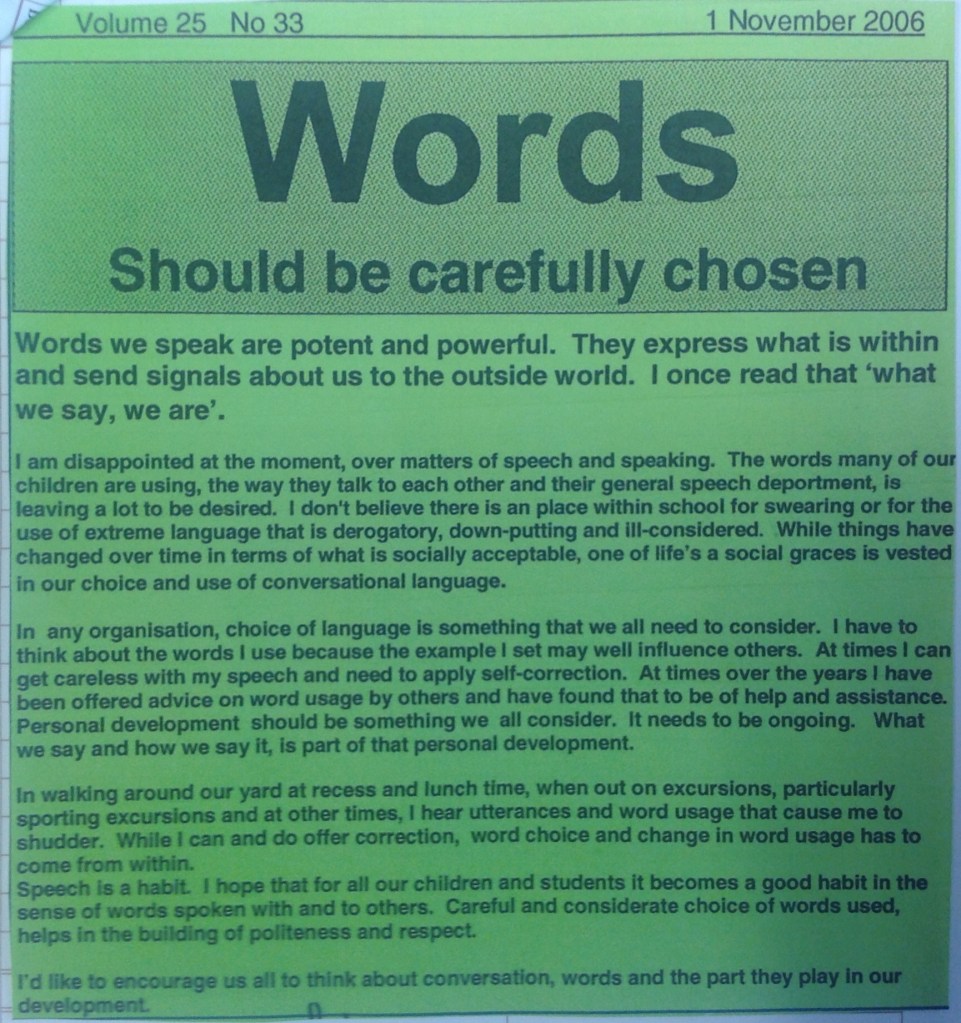
AWARENESS IS MY COMPANION

What is the most important thing to carry with you all the time?

AWARENESS

The one thing I have and try to carry with me everywhere is the quality of ‘awareness’. Put more bluntly, ‘having my wits about me’ at all times is the one quality that I hope never leaves me. Awareness is vital, and without it, important signals about what is going on can be missed. Without awareness, the world could go by and I would miss out.

Being alert and aware are constant and vital companions.

TEACHERS SHOULD BE MODELS

VIGNETTE. 15. MODELLING

I don’t believe that we can over estimate the importance of teachers modelling for students. This goes for primary and secondary students.

In some contexts teaching is regarded as being a profession in which one group (teachers) tells the other group (students) what to do and how it should be done. This of course is rather simplistic definition of teaching and learning processes. It hardly examples the interaction and togetherness that ideally embraces teachers and pupils in teaching/learning contexts.

One of the very important aspects of the leadership offered by teachers is the modelling they do through their own personal example and conduct. Students being young look to and emulate teachers and others. An example of this is the children often tell the parents that particular viewpoint is right because it is what the teacher thinks, therefor it must be right.

Without being prescriptive in anyway, I believe that modelling extends to include the following:

Dress standards

Speech patterns and modelling – setting a bright example free speech and vocalisation.

Punctuality

Showing respect.

Handwriting, including in students books and on whiteboards.

Correct spelling and accuracy in word usage.

He This list could go on, but I’m sure you get the drift. Teachers deal with the development of people. It’s as we do and how we are that is so important to those we teach and shape toward being the adults of tomorrow.

BLOGGING TO SHARE A LIFE FORCE

What change, big or small, would you like your blog to make in the world?

In my early years as an educator, I was assisted by many people who were senior and experienced in Education who helped me with advice and supported me with suggestions. Certainly, at that time there were people at Inspector level and above who were quite tyrannical and offered very cutting comments to neophytes and beginning educators.

Back then, before the emergence of new-age technology, communication was by phone, letter or face-to-face conversation.

As a person now retired from education, but with a wealth of experience, I aim to give to others who are starting on one of the most important of occupations.

I set my blog up to support others by sharing information and ideas. I call it “Education a Life Force” and I am happy to share with others through its outreach.

If it can be of help and support to others, then it is serving its purpose.

SCHOOL ATMOSPHERE IS PRECIOUS BUT FRAGILE

Schools are perhaps the most scrutinised of all institutions. Teachers and staff are always under a magnifying glass held by parents, members of the community, employers, social welfare groups and government departments. Examination of schools and teachers by registration boards and performance management units is constant. Processes by which schools and staff administer education are being constantly updated and applied. Curriculum priorities are forever being altered. ‘Compliance’ and ‘accountability’ seem to be the most important key words within school action and teacher performance plans.

Government demands are poured upon educators. Expectations, many of them constantly changing, cascade upon schools like torrential rain. These pressures can become quite destabilising.

This is especially the case in situations where principals and leadership teams feel that everything demanded of schools by the system (and of the system in turn by Government), has to be instantly grasped and wedged into practice. Knee jerk reactions cause inner disquiet for staff who are often reluctant to change practices without justification, but are pressured to make and justify those changes anyway.

Before change is put into place, school staff, council and community members should have the chance to fully understand new policy and direction. ‘Making haste slowly’ is wise but difficult when government gives little time for response.

Constant change in educational direction does little to positively enhance the way those working within schools feel about what they are doing. Staff become ‘focussed by worry’. Is what they are doing, good enough? Teachers may maintain brave faces but beneath the surface suffer from self doubt. This in turn leads to discontent and unhappiness.

Positive Atmosphere A Must

It is essential that school principals and leadership teams offer reassurance and build confidence within their teaching and support staff groups. This does not mean lowering standards, but acknowledging and appreciating staff effort. Making that appreciation public can help through sharing the efforts of teachers with the wider community.

Well-being cannot be bought as a material resource. Neither can it be lassoed, harnessed or tied down. The ‘feel’ of a school is an intangible quality that generates from within. It is a product of the professional relationships developed by those within the organisation. School atmosphere, which grows from the tone and harmony within is precious. That feeling can also be lost if positive recognition and appreciation of staff is discounted or not considered important.

It is up to Principals and leadership teams to ensure that positive atmosphere, precious yet fragile, is built and maintained. It is easy to lose the feeling of positivism, so necessary if an organisation is to grow and thrive on the basis of its human spirit.

I recommend the wisdom of building spirit within our schools. It will add to feelings of staff satisfaction and well-being. Stability and happiness within school workplaces, embracing staff, students and community, will be the end result.

LOOKING IN ON EARTH

Describe your life in an alternate universe.

If I lived in an alternative universe then a pre-requisite would be looking at Earth and considering what aspects of Earthling example might be applied to life on my alternative universe.

On close observation, I saw the violent crime, theft, white collar crime, greed, avarice, and environmental disruptions resulting from the greed of mankind.

I saw world leaders talking of peace but preparing for war. I saw conflict in every part of the world, people fighting civil, regional and wider world conflicts.

There were small pockets of happiness but Earth was generally shrouded in a black cloud of despair.

From my alternative universe, I determined that I would like it to be an environment that was based on ANYTHING other than the example offered by Earth.

TAKE TIME TO DEVELOP DEXTERITY

I have written elsewhere about the importance of handwriting skills and their development for children.

There are the rudiments of learning that I have an estimate the value in developing coordination capacity and find motor skills for children. These things all take time and unfortunately are often discounted for the sake of expediency.

If it’s required the traits of paper be pasted into scrapbooks, in terms of time it can be easier and quicker for teachers and assistance to complete that activity. Having children do their own growing takes longer time and creates mess! However unless children practice glueing the skill is going to escape them and ultimately they will be the poorer for not being able to do this independently on their own.

The same goes for cutting, colouring, and other skills requiring physical manipulation and metal dexterity on the part of children.

When children are in the very lower grades of the school, I believe they should have the opportunity under teacher guidance to develop the ability to work independently with materials which include cutting, colouring, glueing and similar. It will take time but in the end pays dividends.

Once children have a mastery of these basic skills and, their ability to apply them in terms of general overall school work will pay dividends in terms of the time it takes to complete particular activities. Rather than shuddering and having aversion to children working with these materials, I believe the teachers should embrace the opportunity to develop with them their skills in these fields.

It may seem easier for teachers assistance to undertake direct these activities on behalf of children in the short-term. However in the long run children without the ability to manipulate materials and use them correctly will be the losers.

MEAL MONEY

What’s the most money you’ve ever spent on a meal? Was it worth it?

MEAL MONEY

For the whole of my life, I have never gone into spending a huge amount of money on meals at restaurants or on the purchase of exotic provisions to cook meals at home. Don’t get me wrong; I’m far from skin G regarding meals and purchasing ingredients if we cook at home.

When travelling overseas, we often provided for ourselves by buying food from supermarkets or shops and then preparing that food ourselves. The same happened when we were travelling around Australia. The only exception I can think of was when we had Christmas dinner in Georgetown on Penang Island in Malaysia one Christmas.

We went to the Tunku Abdul Razzak Centre for our Christmas lunch. We decided somewhat extraordinarily to purchase a decent bottle of wine for our meal. From memory, I think it was about AU$45, the most I have ever paid for a bottle of wine.

Very few people, it seems, ever had wine with their meals at the restaurant. We had two or three drink waiters hovering around usFrom the bottle being opened until it was consumed.

I remember the wine but not what comprised the rest of the mail.

(Actually, it was on the same day that the five of us had the wildest and most hair-raising race ride in two trishaws from our hotel to our lunchtime meal. It was downhill all the way, and if the topic of a ride ever comes up on this site, I will write more fulsomely about going to dinner.)

When it comes to eating, I’m somewhat of a traditionalist and like plain and wholesome meals without too much garnish. I also love a good steak. We have had three meals in Australia going back over the years, which I remember not so much because of cost but the excellent way the steaks for our dinner are prepared and served.

The third most favourite steak I’ve eaten in this context was at the RSL Club in Gunnedah, New South Wales, back in the late 1970s.

The second-best steak I’ve ever eaten was served to us in the BP Cafe attached to the service station in Ravensthorpe in Western Australia.

A gold plate for the best steak I have eaten goes to the then chef, an apprentice of the Margo Myles Restaurant in the Tennant Creek Hotel in the Northern Territory. The steak was out of this world. It was probably around 1984 or 1985 when that particular meal was served, and I still remember it to this day.

I am 77 years old. Based on three meals a day for the years I’ve been alive, I’d estimate eating 84,300 meals in various situations. That is a lot of eating and a lot of meals. I’d hate to have to pay for them all at once.

HORSE RECALL

Scour the news for an entirely uninteresting story. Consider how it connects to your life. Write about that.

THE STORY IN THE PAPER

Wild horses facing cull

Wild horses in Kosciuszko National Park could soon be targeted by aerial shooting.

NSW Environment Minister Penny Sharpe announced the new control measure as part of an amendment to the management plan for the horses, stating that the animals had thrown the park’s “balance” out of whack.

“Over recent years the numbers of horses in the park at Kosciuszko have become unsustainable,” she said on Monday.

“We need to remember that the head of the Murray River starts through those mountains.

“The impact on soil and the impact, particularly on other threatened species within the park, is now coming to the point where the horses could drive them to extinction.”

MY RESPONSE

At first glance this seemed to me to be an innocuous and entirely irrelevant story. It was talking about wild horses in an area known for its ruggedness and isolation at least three or 4000 km away from me. Of what interest could a story like this hold for me as it is right off my radar.

I re-read the story and somehow in the light of history the innocuousness seems to fade from my mind. Fleetingly, I thought about these horses or at least that their predecessors and the place they filled during World War one on overseas missions. I thought about the part that horses played with primary production and agriculture before the advent of tractors.

And then I thought about wild horses and the challenges they face in life and living; no better personified or articulated than in the words of the song Brumby Jack.

Suddenly, the memory of this song and what it meant came flooding back to me. This song was enjoyed by many children in my schools over the years. I taught it to them, we talked about what it all meant, and there was meaning and relevance to the consideration of the issue of wild horses.

Decades later, I occasionally have students who write online (or who remember if I see them) of my teaching them about wild horses through the song “Brumby Jack“.

I have re-produced the words of this song. Unfortunately (or fortunately is the case might be) I can’t sing it to you but it does have a catchy tune and children really loved it.

BRUMBY JACK

See the dust cloud on the plain,

Hear the sound like falling rain,

Flashing hooves and heads held high,

As the wild bush brumbies gallop by.

Chorus*

*Here comes Brumby Jack,

Bringing the horses down the track,

Hear his come as he wheels them around,

He keeps them together safe and sound.

There’s Stumpy, Billy. Silver Dan,

Pickles, Jim and Pelican,

He has a name for everyone,

And when he calls they come at a run.

Chorus

He loves his wild bush friends so well,

Many a farming man can tell,

He’ll never eat or go to bed,

Until he’s sure they’ve all been fed.

Chorus

Froim the mountain side to the distant plain,

Here, there and back again,

They roam the country wild and free,

‘Cause that’s the way they want to be.

Chorus

30 HAPPINESS PILLS

List 30 things that make you happy.

Our marriage of 54 years.

The successes of our children.

The decency and progress on the pathway of growing up by our grandchildren.

The closeness we share as a family.

The development of my mission statement in 1984.

My distrust of debt.

The saving of money so that when we buy, what we have is ours.

Having our house as a home.

Growing pawpaws to give away.

Writing my blog.

Connecting through LinkedIn.

Meeting up with past students.

Touching base with past parents of students.

Learning about the successes in life of past students.

Being a people person.

Responding to daily assignments (prompts) from Jetpack.

Editing.

Writing letters on key issues.

Keeping my diary.

Talking on the phone to our children and grandchildren.

Sending and receiving emails and texts from our children and grandchildren.

Learning about artificial intelligence.

Following local politics.

Tending to the garden.

Taking photographs.

Providing food and water for birds.

Watching old movies.

Bursting into song any time and anywhere.

Writing poetry.

Sharing resource materials with others.

Keeping active.

This must be it for about thirty spots of happiness.

IS SPELLING NECESSARY OR SUPERFLOUS

Some say that attention the spelling is old hat and the discipline of being able to spell accurately and correctly is not necessary anymore.

In an age of computer technology, they argue that the computer, iPads and similar gadgets provide students with correct spelling options through “spellcheck” and other text-refining devices. Therefore it is not necessary to know how to spell words by heart.

Others argue that in terms of priority, spelling is a basic that no longer needs to be taught. There are other teaching and learning priorities.

Maybe “experts” believe that spelling skills will be acquired by osmosis. Some people genuinely believe that spelling accuracy isn’t essential because corrections for spelling and grammar can be provided by checks inbuilt into attachments for Word documents and others. My personal belief is that that is the lazy way out.

I once had a teacher say to me, “I don’t teach spelling because I don’t like it.” Teaching basics is apparently dull and quite stifling for some people. This overlooks the fact that teaching essential basic understandings is repetitious. Not all learning is tinsel and glitter. However, there is a way of engaging children with spelling that makes it quite exciting and looked forward to. There are numerous spelling games available that can be adapted for classroom use. These can be developed to support and reinforce graduated learning.

Spelling and word appreciation games up also available. This is one area where computer and iPad use can be reinforcing. My contention, however, is that spelling is an area that requires primary teaching. It can’t all be left to children working on devices and acquiring the understanding they need without teaching going into the program.

An example of one game I used with spelling was to ask children to within their minds to configure words broken into syllables attached to a piece of elastic. There is the word. As your stretch the elastic in your mind’s eye, the word breaks into syllables. Syllable awareness enabled children to follow the pattern of the word. When the word had been examined by the stretch method, the elastic was relaxed; the word came back together and was spelt orally with everything all in place. I found this method worked remarkably well, especially if it was built into a game including competition between children for accuracy and recall.

I believe we neglect to spell at our peril and to the eternal loss of students.

__________________________________________

RECALLING A HABIT

Describe one habit that brings you joy.

There are some habits that as they grow upon people transition from being “habits“ to “vices”. Smoking, drug taking, alcohol drinking, gambling, and other habits can become addictions that cost plenty and don’t return very much value because of their characteristics. In terms of money, health, family and community building, they offer very little benefit but I’m saw a great deal of time and cause people to miss placed their priorities.

In reflecting upon this question, the habit that I most cherish is the habit of “recall“. I think back over times that have been I remember my efforts as an educator, parent, husband, and contributor.

The habit of recall has assisted me in my writings on social, and educational issues particularly. I’ve also been able to recall and write some aspects of history associated with our time in education which commenced in 1970. I have been helped by the diaries that I’ve kept over the years but also have a good remembrance of situations and incidents and ride on issues that are focused and also anecdotal.

I am careful when writing about anecdotal stuff because that’s very personal.

Being able to recall and having that as a habit is useful in terms of keeping my mind active and going back over time connecting the dots to follow developments in all sorts of areas of a political, educational, social, and developmental nature. It also helps me to be aware and to be wary of policy development where that is simply revisiting something that has been tried in the past and then discarded.

I think ‘recalling’ is a good habit to have.

Story telling as a part of the teacher’s repertoire should not be allowed to die. If it is fading, consider the need for its resurrection.

Story telling has become a lost skill for many teachers. The emphasis on its importance has diminished because these days the use of technology is substituted for old fashioned story telling by voice. It is now more fashionable to sit children in front of computer screens or smart boards, with DVD’s doing the story telling.

I’d encourage teachers not to allow story telling to become a lost art. Children of all ages love story telling.

There is the ordinary and more usual form of ‘once upon a time’ story telling. This narration approach is embellished if the narrator adopts a characterisation role, with different vocal impressions representing characters within the story.

There are other variations.

Rather than being a narrator, the storyteller can get inside the story by assuming character ownership. Telling a story for instance “Goldilocks and the Three Bears” from the viewpoint of being one of the characters and embellishing the story from that particular character’s viewpoint, adds a quite exciting variation.

The “character” chosen need not be animate! Using the same story, the storyteller might choose to be the plate of porridge, the broken chair, the disappointed “too hard” bed, or any of the other artefacts in the story.

These variations can appeal to the imagination of children and to get them really fired up. Storytelling lends itself to extension in drama, art, and elements of science, maths and written expression.

I believe it quite possible to link storytelling and extensions to elements of the curriculum. But it takes engagement and getting outside the purist form of written documentation (The way in which curriculum documents often dictate resources and approaches) in order to achieve these ends.

MACABRE CURIOSITY

What are you curious about?

MACABRE CURIOSITY

it’s difficult to quantify curiosity, particularly for someone like me who tends to be curious about many things. Some of that curiosity extends to happenings and the forecast of outcomes (in my mind) locally, regionally, state and territory, Australia-wide, within the four hemispheres of Earth and indeed worldwide with everything in together.

I’ve always believed imagination which is closely aligned with curiosity to be an important ingredient of thinking. When involved with Education, are used to put to students that they have three eyes, A left eye, a right eye and an inner or imaginative eye.

This third eye was the mind’s eye. I used to tell children that the imagination within the minds was a wonderful characteristic and let them know that too often as people age, the mind’s eye grows dim and the imagination fades. I used to counsel them that as they grew up and matured, they ought to try their hardest to keep their mines Ilana alive, vibrant and functioning.

A student, aged 11 at the time, once said to me as I was teaching, “Mr Gray, you have the body of a man and the mind of a child.“ I took that as a compliment and a confirmation of the fact that my imagination and curiosity were still very alive and well. I hope they have not died or gone to sleep during the years of my retirement from full-time education.

That is a long aside but it leads to the thing in this life about which I am most curious – and sadly it is not a happy thought for my imagination to dwell upon.

The world is full of conflict. There is conflict within regions and countries. There is open disputation between countries which is leading to war. The Russian/Ukraine war (Which Vladimir Putin said would last for three days) has now been going on for 530 days or more. If China is battling against Taiwan and Taiwan is declaring readiness for war against China. America and Australia and others are looking to support Taiwan on (which incidentally they don’t even recognise Country) if there is a conflict. New paradefence is the number one priority on the agenda of a growing number of countries. It seems to me the talk about peace is pyrrhic and it’s only a matter of time before civil unrest and our pride war take over the world. I sincerely believe that Armageddon is just around the corner.

Such is my curiosity and my worry for family our country all countries and people of the world. My curiosity may be macabre but it reflects upon are you a real problem.

REJOICE FOR OTHERS

Teaching is a significant profession, in my opinion, the most important of all. From time to time colleagues and those with whom we work May be recognised and celebrated by the conferral of awards.

It can be easy for professional jealousy to creep into the thinking of those who feel they should be publicly recognised but have missed out.

A test of true collegiality is rejoicing in the success of others, appreciating what they are doing for the system. Thanking and congratulating them on their successes and what they’re achieving in education can often mean as much to them as the award itself.

Unfortunately, we live in an age where Balkanisation and selfishness are somewhat to the four. It’s in this context of jealousy and envy for the success of others can be quite an doing of one’s attitude. “Why not me?” becomes the salient question. People who dwell on perceived injustice associated with nonrecognition can become quite cynical and spoiling of their characters and outlook. Feeling good for others and genuinely rejoicing in their successes can help build personal self-esteem and build positive attitude.

From time to time throughout my career, I’ve confronted this particular issue and been enriched by having appreciated the efforts and recognition bestowed upon others.

Education is a collective profession, one that is most effective when we are all pulling in the same direction.

BE KIND – ALWAYS

Write about a random act of kindness you’ve done for someone.

BEING KIND

I could tell you as readers about many acts of kindness that have been offered to me by people over time I’ve appreciated each and everyone intern, and I have always tried to be kind, sincere and kind to other people.

Over many years I have helped many people and have in turn been helped by many.

It’s hard to get them to single out anyone singly and particularly in recent times. However, allow me to tell you that the School At which I was Principal for 20 years recently had its 40th-anniversary celebration. I was not able to attend on August 2, so instead tended my apologies and spent $150 on a lovely Boquet with an appropriate card thanking everyone for their great contribution to the school over a long time and wishing everyone in the present looking towards the future all the very very best.

I don’t think this was a kindness so much as a recognition and appreciation, for apart from the first two years of my principalship at that school, the remaining 18 years were the best.

We should always be kind to and recognise the goodness in others. And we should do for people what we would like them to do for us.

See Thanking with Flowers.

APOLOGY IS IMPORTANT

One of the sticking points about life and relationships both personal and professional, is to insist that ‘your’ viewpoint is the right viewpoint. To offer an incorrect statement or recommend an action that proves to be wrong is reluctantly followed by an apology.

Within school contexts, this can have atmosphere-destroying and suspicion-arousing outcomes.

For teachers, it can be all too easy to make mistakes. It may be the incorrect spelling of a word, the misunderstanding of roles played by children in some dispute, or getting it wrong when it comes to a particular fact being correct or incorrect. In these instances and others, apologising to students for a mistake or misunderstanding is important. It models a correct social attitude to children and also earns respect from children. The following examples illustrate my point.

1. Incorrect Instructions

On occasions, incorrect instructions might be given to students who are asked to complete an assignment or other piece of work. When the mistake is realised, or when it is pointed out by students or parents, an apology and correction earn respect. To discount the error is quite the reverse. If students complete work tasks based on instructional error, acceptance of the assignment rather than requiring resubmission is the better course of action.

2. Forgetting an event

The lives of teachers, classes and schools are both crowded and busy. In that context, upcoming events which require preparation, parental permission, the wearing of special clothing (i.e. swimming, costumes for an item being presented) or the need for extra food because the class is going on an excursion can be forgotten. Sometimes it is too late to correct the matter so children miss out on the event or the excursion. Apologise for your mistake; don’t try to brush it over.

3. Failing to keep appointments

Appointments are made to be kept. Perchance you are not able to keep an appointment, for instance with a parent or student, make contact and apologise. Set up an alternative date and time.

4. Misjudgement

If misjudging a matter, apologise for the mistake. It can be easy to misjudge a situation involving student discipline, work completion and so on. If this happens and the mistake is yours. say so and apologise.

Teachers are models. This includes behaviour and attitude. If something you do is wrong, say so, apologise and move on. That will be good modelling and leading by example. Apologising as necessary is part of role modelling.

VISUALISE HENRY

How would you describe yourself to someone who can’t see you?

VISUALISE HENRY

In life, I have often imagined people with whom I’ve communicated but have not seen to be substantially different from how they appear when vision takes over.

I have imagined people to be short, but they are tall. I have supposed people to be fat, but they are thin. I had imagined men to be follicularly enhanced with full heads of hair but discovered them to be follicular challenged with a bit of hair when my eyes happened upon them. And so it goes with imagined and actual outcomes being a confirmation or possibly a disappointment of how one seems to be and how they are when seen in the person.

If describing oneself to another is the only option, the person giving the self-description might be tempted to indulge in a little fantasy. That would not be wise for in the end descriptive truth may be found to be a lie.

So here goes:

I used to be thin but now am unfortunately rather fat.

I like to wear casual clothes and you will find me in shorts, a T-shirt, and wearing socks and sneakers. I use toggles rather than laces in my sneakers.

I have a full head of hair although it is thinning a little but that is the dimension of the strands rather than the loss of the crop.

My beard has been part of my facial countenance since 1975.

My legs and arms are pockmarked with indentations created by the removal of various cancers over time.

Whenever I go into the sun, sunglasses are part of my dress. Without them, I squint and wince my eyes.

I have a benign cyst on the right-hand side of my nose, a cyst with which I was born. Every so often I have to cut or at least shave the two or three long hairs that grow enthusiastically from its surface.

I have a fairly deep voice and if you can’t see me you may hear me at times because I’m a habitual singer, singing in shops, when driving, when walking, when gardening, when doing dishes, when undertaking washing and any other housework, and even when I’m in the toilet.

HOLIDAYING DURING SCHOOL TERM TIME? Then keep a travel journal

Trip Diaries

While children and their families are not encouraged to take annual leave during school term time, this can be unavoidable. We are not able to dictate the parents when they take the children from school for holidays because the circumstances are beyond our control.

Parents will sometimes come and approach schools and teachers for work to be done while children are on holidays either interstate or overseas. It really works! The work state is that best sporadically completed. Young people also feel it to be an imposition and don’t approach tasks with a positive mindset.

I was often confronted by families taking leave during school time. Home work as described above was never said. Rather, I’d sit down with children, talk with them about trip diaries and encourage them to compile a journal that covered the holiday period.

Children who accepted this task were rewarded when they returned to school. This happened in a number of ways:

Children had their diaries read, were able to share them with classes, and received certificates commemorating the work that they had put into their journals.

Students shared their journals with their classes, educational units, and often at unit or house school assemblies. One of my methods was to interview children during assembly using an “question-and-answer” technique.

On occasion, local media was contacted meaning of the children were featured in the local newspaper with the work they had done being acknowledged.

Encouraging children to complete diaries commemorating their travels gives them and indelible and everlasting reminder of the undertaking. It has the added benefit of encouraging them to keep records, the strategy that will stand them in good stead throughout life.

Consider this as a strategy that may be useful during your teaching career. And a valuable research and observational opportunity for students

GOODBYE TO PARENTAL TRADITIONS

What traditions have you not kept that your parents had?

Some people will have let go of more parental traditions and requirements held of children than others. In thinking about this question in a broader context, it seems that background, country of living, race and religion, and whether adulthood and letting go of parental positions and requirements has been in recent times or, as in my case, back in the mid to late 1960s. This is a fascinating question to ponder and responses, I’m sure, will be very wide-ranging.

In my situation, I was born in 1946 to parents who were very “prim and proper“, as I see things today. That was particularly the case with Mum, who was entirely Victorian in her outlook – and a replica of what I have heard of her parents.

My Father was more liberated and less bound to traditional ways of living, but after marrying, Mum seemed, from what I have heard, to have changed and taken on her ways of looking at life.

My parents were upright Christians. They brought me up the same way. My parents did not drink alcohol, and neither did they smoke – although my father dead until a couple of years after marrying Mum.

Mum particularly adhered to the principles of healthy eating, and we became a meat-minimal family.

As a child, I was not allowed to drink tea or coffee because I will not good for my health. I was not allowed to go into my parent’s bedroom, nor into a little storage room on the side of the house where everything was kept, mainly Mum’s, going back to her childhood.

I was never told my parent’s ages, and ask as I might. They remained a secret until I discovered by surreptitious inquiry into various papers and documents when I was 18 or 19.

I always felt (be it natural or imagined) that my sister, some years younger than me, was my favourite child.

I believe my parents thought they could have a say in what occupation I followed and what my ultimate marital relationships might be. It also seemed that they did not want me to go too far away geographically in my years of grown-up independence.

I could go on but rather would not because the circumstances that linked me to my parents in their final years were based on significant geographic distance and on some representations made or felt about me on what had been my home front, Making me feel somewhat apprehensive about visiting or having contact other than by letter or phone.

Please forgive these reflections, but they lead to the things that have passed from parental-encouraged traditions.

I was a father to my children at a young age, with us deciding not to have children after we turned 30. I was the older of two siblings, they were four years between us, and my father was 42 when I was born. The change in my circumstances regarding fatherhood meant that I was much closer to my children and age and much more aligned with them as a consequence.

There are only 2 1/2 years between our three children, and they click and support each other in their closeness. That was something I never had.

I did drink alcohol and, for three years of my life, smoke cigarettes. The latter I gave up at the age of 29, and I haven’t drunk alcohol for nearly 13 years. (I can promise you that that dramatically improves my financial situation.)

While focused on values in life and trying to live by those values, I do not formally adhere to any faith and do not attend any church.

Our children were always welcome to anything in our house because it was ‘our’ house. Nothing was off limits and neither is it for our grandchildren.

I knew nothing about my parent’s finances or wills. Our wills are open to our children and have been developed in consultation with them.

There is no secret kept about our ages. Any information our family wants is freely available.

Religions or spiritual affiliations are not something forced on our children. We have shared our thoughts but never tried to undue influence.

My parents did what they thought was right for me and I have done the same with my wife for our children.

SCHOOLS SHOULD OWN THEIR APPRAISAL PROCESS

Educators are quite constantly involved with processes relating to testing, measurement and evaluation. This is done in different ways by people directly and indirectly connected with schools. While most factors of measurement relate to academics, there are other things to be considered when evaluating schools.

Over time priorities and processes have changed. These days within the NT a detailed visit by senior colleagues including a group of the principal’s peers and senior management staff is the way appraisals are undertaken. The process lasts several days. Examination includes conversations with some school staff members.

The Northern Territory Education Department has been concerned about the performance of its schools since taking over responsibility for education in 1978. Various models have been followed.

One of the very best was called the “Internal/external School Appraisal Model”. This involved members of the school staff and members of community working in groups to analyse the various aspects of school function. Teaching performance, staff relationships, student welfare, school appearance, communications and all other factors were examined. Each panel included staff and community members. A facilitator was appointed for each group.

Groups had the ability to glean information from a number of options. Included what questionnaires, interviews, and of course the self-awareness of that particular aspect of school function built within the group. Toward the end of the process each group presented in turn to the whole school staff and also members of community who cared to attend those sessions. From the report grew recommendations for future consideration. Each group also indicated things that were being done well and should be continued.

After presenting, each group report and recommendations to the forum of staff and community. Some revisions were then made and a priority put on the recommendations.

When all groups had presented and the final report from the “internal process” developed, this then went to an external panel which considered the report. This panel had the opportunity to order the recommendations as a whole.

This was a very elongated process. However he enabled all staff and those with a keen steak and interest in the school to have input. Importantly the report was owned by school staff and community members.

I applied this model at Nhulunbuy Primary School when first becoming principal. I gained, it was used it Karama Primary School in 1987. Of all the methodologies used over time to help centre school action in the right directions this approach was by far and away the most effective.

When people within an organisation own what they do including developing the context of futures direction the whole process is validated by ownership.

Although it may never happen I would certainly recommend a return to the past when it comes to appraising a school and its place within the community.

HANDWRITING SHOULD BE TAUGHT

There is a lot of debate these days about whether or not handwriting should be taught at school. In some countries, including Finland and the United States, handwriting has gone by the by. Rather than being taught how to use a pen, all students are allowed to learn keyboard skills including touch typing.

While trying to understand why this change has occurred I would be the very last person to advocate that handwriting should become a skill of the past. Rather I believe that it should endure forever.

I am certainly not down on keyboards and computers. But for children to have both handwriting and keyboards is optimal. To become mono-skilled with handwriting going out the door would be altogether wrong. There are many many occasions in life when handwriting is important and indeed the only written communication method available.

When teaching handwriting, the “3 P’s” rudiments immediately come to mind. That has to do with the methodology of writing. It is about;

* pencil or pen hold

* paper position

* posture – the way we sit to write most effectively and comfortably.

Stressing these things over and over again until they become habitual is important.

Part of handwriting is teaching children how to hold a pen or pencil so that it is comfortable and their fingers and wrists don’t ache. Watching people write these days can be quite a torturous experience because of how writing tools are held. It’s obvious from observation that many people have never been taught how to write. That is an absolute pity.

The size (diameter) of pencils and the transition from pencil to pen is a part of writing graduation. Initially, pencils are thick and as children grow older with more dexterous finger administration the diameter of the pencil becomes smaller. When a reasonable degree of writing skill has evolved, then is time to move on to pans. That is usually around year four to year five. Children love graduation to pens and having pen licenses issued to them by teachers.

Lined size is a part of learning to write. The younger child the bigger the line. 1-inch lines (30mm) are generally the starting point going down to around 12 mm by the time children get to the end of middle and the commencement of the upper primary years. Handbooks and exercise books can be purchased where lines are divided into thirds. This helps children when it comes to tall letters (t, f,) and letters having tales (g, y q,). The dimensions associated with writing can be trained with children developing that discernment over time. Over time, the one-third divisions can be left and children go to straight lines for their writing activities.

These days specific handwriting lessons are often not offered in class. Or it may be that there is a handwriting text where children simply open and copy what’s written for them. I believe that those texts are enhanced by the use of a transcription book and also with teachers demonstrating letter formation, joins, words and so on the whiteboard. The idea of children learning by copying helps when it comes to handwriting development.

The way paper or writing books are positioned helps when it comes to the slope of letters. Writing from left to right is part of this and can be difficult, particularly for left-handed children. Left-handers tend to “drag” their arms across pages as they write from left to right meaning that dog ears and crumpled pages become the norm. Train children as they finish a line of writing to lift their arm going back to the start of the

And then working across the page from left to right overcomes the shuffling of arms on paper that can occur if this is neglected.

Steadying the paper or page onto which writing is being done helps. For this purpose, the spare hand can be used. So often it is seen propping up children’s heads as they write where that writing is the task of one hand alone. Rather than the spare hand being a head prop, metaphorically describe it as an anchor which holds the boat (paper or book) steady against the wall so that it doesn’t rock back off forth, or similar. This will involve a lot of reminding and correction easily seen as requiring remediation when teachers are walking around classrooms.

Support children with lessons as a transition from printing to writing script style. Linked script is part of this and it does take time to teach. Little and often is important and I would suggest a handwriting lesson every day.

Remember to comment on handwriting and praise the effort that students put into the script. Be they printing or writing this praise will help.

Handwriting is so important. It needs to be revived not neglected.

WHAT IS ‘TYPICAL’

Was today typical?

For the whole 45 years of my educational career, I learn very quickly that no day is typical that no day is like any other and that no day is like the one that went before. I learned to expect the unexpected: that one always had to be on guard and at least aware that what was planned may not come to pass. I don’t believe during my professional career that I ever thought of any day as being 100% predictable.

Beyond my years at work and now well into retirement, I would not describe today or any other day as ‘typical’. Today the irrigation system at our place was on the blink and we had to get our plumber in to carry out rectification work. Something comes up on most days that wipes our the ‘typical’ component.

The days they come and the days they go. Each is a 24-hour period in its own right, Bur ‘typical’ does not seem to fit today or for that matter, any other day.

HAPPY BIRTHDAY TO ALL HORSES

Happy birthday to all horses.

Today is August 1, and it’s the universal and worldwide birthday celebration of all horses born into this world; each horse moves on one year in age today.

The best situation is the one existing for all horses born on August 2 last year. They have had a full year before turning one.

If my father had been a horse, then he would be one year old, one day after birth. My father was born on July 31, in the year of his birth.

I suppose this is hardly fair on horses, but there has to be a cut off somewhere and that’s what this day has become.

So happy birthday to all horses from the Shetland ponies of the Shetland Isles to the plodding old draft horses still used in some parts of the world, to the racing horses, racing on tracks all over and around the world. To all foals, all fillies, all stallions and horses of all colour.

I think especially today of the brumbies in the highlands. Those in the high country of Victoria and New South Wales may feel a little under the pump because they’re not always highly regarded.

The song “Brumby Jack” comes to mind. This was one of my favourite songs, one that I used to teach children when a teacher. I’ve seen children and spoken to them 35 years on, where as adults they still remember the song.

That I suppose is a slight digression, but I do like horses, and I do want to wish all those four-legged creatures belonging to the equine kingdom a very, very happy birthday for today.