
Prolific passionfruit
Reply

After retiring as a full-time Educator in January 2012, I had the chance to sit back, reflect and learn. There was also within my heart a desire to share with others – especially those who are in preservice training or at the very beginning of their teaching careers – some thoughts and ideas that they might find helpful.
At the beginning of my teaching career – and that was back when education was a lot simpler than it is now in terms of expectations and demands placed on teachers – I was helped in my learning by several educators who were far more experienced than me.
That help came to me in face-to-face conversation, through the telephone, and by letter or correspondence. To say that I was appreciative would be an understatement for in those days of inspection and careful study of newbies by inspectors and superintendents, it was easy to fall foul of expectations.
As I came to the other end of my professional life, the end rather than the beginning, an ambition was born within me and the determination that I hax been helped by senior colleagues and those who had gone before.
It was for this reason that I established my blog with WordPress in 2013, calling it “Education A Life Force“.
In the years since, I have used my blog primarily for educative purposes and through my LinkedIn account have both shared posts on my blog and invited others to my blog by sharing its address. The feedback I get suggests that what I am doing has been appreciated.
I also have a blog for more general purposes not related specifically to education.
There are other things I have done to spread messages, but my blog has been a prime source of helping me to help those in the same way as I was supported by others.
And by the way, I really appreciate WordPress and its management
Last weekend, the Country Liberal Party was resoundingly elected to the Northern Territory Assembly for the next four years.
With some authority, The CLP which had eight years ago been voted out of office leaving only two seats, turned out all around and came back to secure 17 seats in the new assembly. Labour has been reduced to probably for St Se.
Along with many other Northern Territorians, I am looking forward to some of the issues we have confronted, being overcome.
When opening the Australian newspaper on Friday, August 30, I saw the advertisement below.
This advertisement creates significant concern for me, because bringing a plethora of people into the Northern Territory from elsewhere to do all we get devising, guiding, and everything else, Will without doubt, defeat the purposes of this new government.
What we do not need coming into the territory to fill key roles are experts with wonderful CVs, great university credentials and limited experience – if any – in the Northern Territory and its unique politics and specific lifestyle.
We have had the past governments of the Northern Territory undone by the practice of bringing in outsiders who do little other than establish the depth and breadth of their own experience before taking off to greener pastures.
Far too often in the past governments and various of its departments, have been short-sheeted and left floundering in embarrassment by this practice.
We do not need more of the same! We do not need a government with the potential to be undone and reduced to mediocrity because of the infusion of those who, in practical terms, know very little about our territory.
But alas! I can already hear the flow of expressions of interest coming upon us like an avalanche.

The Royal Australian Navy (RAN) fleet is made up of 31 commissioned warships and 16 non-commissioned as of April 2024. The main strength is the seven frigates and three destroyers of the surface combatant force: seven Anzac class frigates and three Hobart class destroyers.
Where does Australia’s navy rank in the world?
Ranked 19th among the 140 most powerful armies in the world, Australia placed 47th in terms of naval power.
BAE System’s Global Combat Ship – Australia will be one of the most advanced anti-submarine warships in the world. The Hunter Class FFGs will be built in Australia by ASC Shipbuilding
The Hunter Class will begin entering service in the early 2030s replacing the 8 Anzac Class frigates, which have been in service since 1996.
The service currently forms the Navy’s Submarine Force Element Group (FEG) and consists of six Collins class submarines. The Royal Australian Navy Submarine Service has been established four times, with the initial three attempts being foiled by combat losses and Australia’s economic problems.
I am convinced that the Western World is living in some degree of ‘independence’ on borrowed time.
Western leadership, actual and potential is like a limp lettuce leaf compared to those leading the communist bloc.
We are going under, and I feel as secure about our future as a drowning man.


With each passing year, the world is becoming ever more complex. Getting from start to finish on issues becomes ever more difficult because of blocks and obstacles inserted by everything from process to the specific – and often selfish – demands of narrowly focused interest groups.
Oh, for a return to the definitive times of the past – times that were more definitive and people had the confidence to back themselves in on issues and decisions of consequence.
People everywhere are talking about peace and creating peace in places where war is presently being played out.
While talking about peace in our world, leaders of most countries preparing, to a greater or lesser extent, for war.
Well, maybe not in Australia where things defencewise just seem to meander slowly, slowly along.
The year 2030 is the one that the Australian Government has proudly earmarked as our country becoming of age in terms of responsibility for minimising the use of fossil fuels and becoming ever more dependent upon renewables.
My thinking about 2030 is that the same vision will be far from the mind of the Australian government. By then if we are not on the brink of a regional war, The war will already be upon us.
Do you think I am dreaming? I wish I was!
In essence, I think we are on the brink of a worldwide Holocaust and totality of destruction.
I can feel it in my bones.
We live close to the T junction of two major roads. When we moved here in 1987, both streets were quiet and relatively free from the likelihood of anything happening.
Fast forward to 2024, thirty-seven years later. Traffic volume has increased at least one thousandfold, and the escalation shows no signs of plateauing any time soon.
Vehicles start moving earlier and end later. The streets are no longer quiet.
I can put up with most things except increased traffic is an outcome of progress. However, there are two exceptions to my tolerance.
The first relates to people on motorbikes who like to rev and rev and rev as much as they can, particularly late at night and in the early hours.
The second increasingly distasteful experiences extend to people in vehicles who insist on tyres screeching and on Herning and on making as much engine noise as possible entering and leaving the T-junction of our roads.
I would desperately love to have a set of tyre spikes and be able to use them To help curb over-enthusiastic bike and vehicle drivers who care not a whit about the noise they make and the offence they create.
Is it wrong for me to think this way?

Tenzing Norgay and Sir Edmund Hillary reached the summit of Mount Everest in May of 1953, the British had been trying to climb it for 31 years. However, the summit was reached for the irst time by a Nepalese and New Zealand citizen, with both working together to reach the top of the world.
For poor old Mount Everest, it has been all downhill since then. With the passing of years, more and more people have taken to climbing the mountain. Tens of thousands have had a go, with some not being able to go past one of the interim camps on the way up the mountain.
They have left many ‘gifts’ – indeed hundreds of tonnes of them – on the mountain. Material waste. and human excrement of all kinds. Mount Everest has been turned from the centrepiece of a beautiful, pristine wilderness into one of the most notorious of the world’s rubbish dumps.
A sad and permanent pessimism is all pervasive and sits within my soul.
It is always there and is created by a number of circumstances relating to environment, social and economic circumstances and the increasingly tenuous state of the country – Australia – and the world in which we live.
THERE IS NEVER ANY BLUE SKY
Blue sky,
Has fled from my life.
Replaced,
By ever thickening,
Ever darkening,
Clouds of despair.
From bright light,
To dimming.
Then penumbric reflection,
Of dusk.
Deepening,
Into the black night,
Of depression.
Like an Arctic winter,
The sun,
No longer rises.
My life,
Is without shadow,
Without illumination.
I am
Lost in tundra darkness,
24/7/365.
More and more,
I realise,
Extinguishment,
Is the only escape.

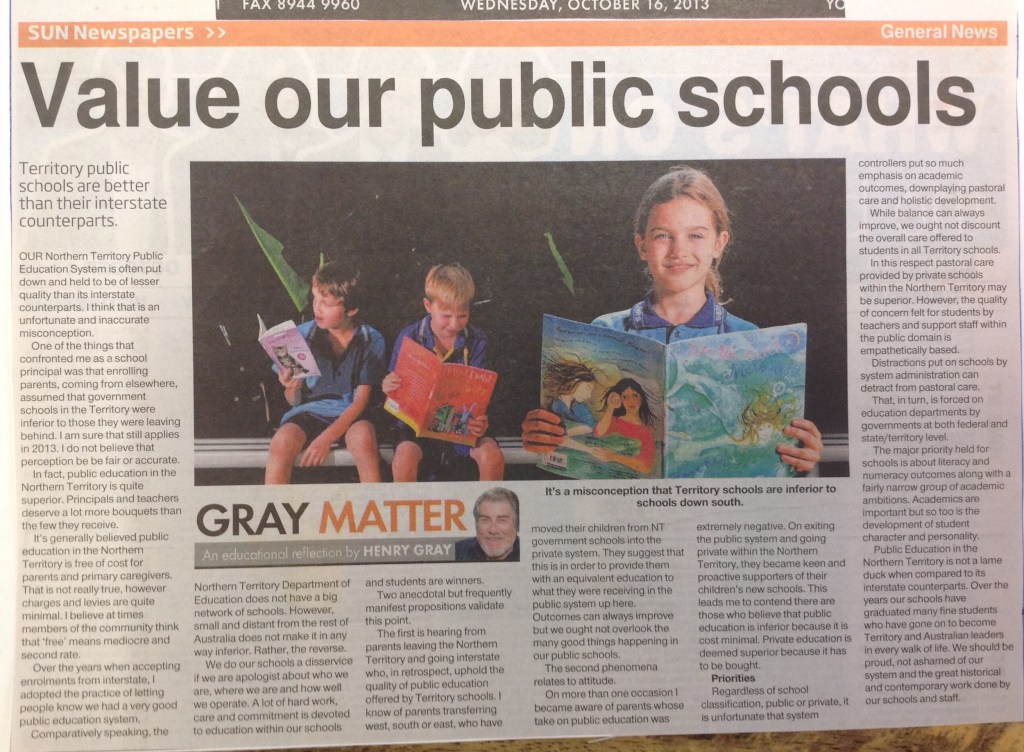
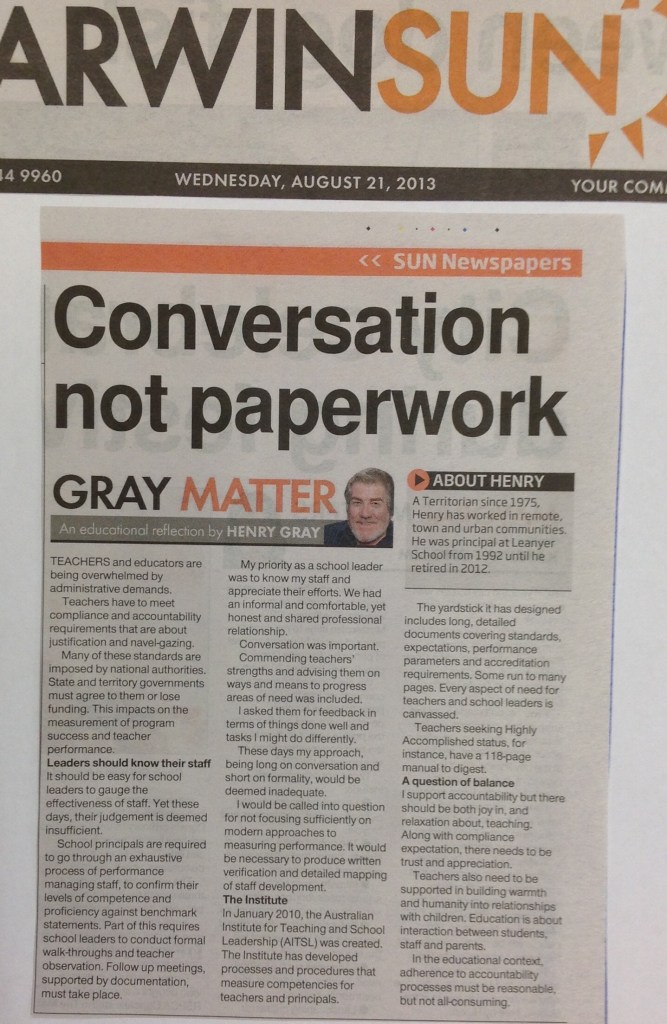
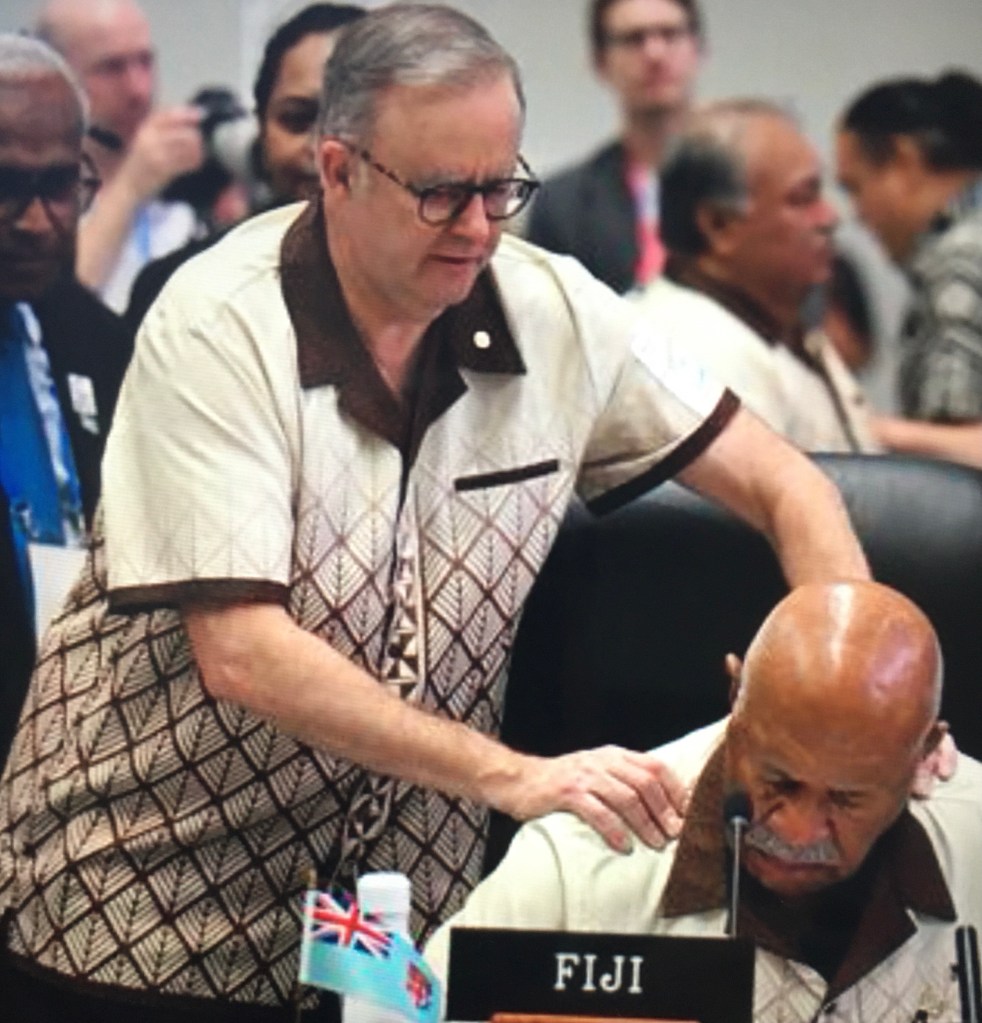
I suffer greatly from a post election syndrome. It might be called “depleted recognition syndrome“.
For me, a wonderful thing in the weeks and sometimes months leading up to an election is the number of pamphlets from aspiring candidates extolling personal and party virtues. Some even contain handwritten messages inviting me to contact them to discuss matters should I so wish.
My letterbox flourishes and I feel valued.
Now the election is over and decisions have been made about who is going to represent constituents in parliament, the mailbox has gone from being overloaded pretty well to nothing at all. No more pamphlets and no more paraphernalia – until the next election.
How on earth will I cope?
I am trying in my thinking to square what is happening in Alice Springs with its everlasting feast of youth crime – and non- fix with the issue being totally out of control – with what is happening with stood-down Yipirinya School principal Gavin Morris, who is on the mat over matters of trying to kerb aberrant behaviour, which has had an impact on the school.
How do I deal with the disparity?
Note: This is from two decades ago.
Teacher development consumed a hell of a lot of my time, and that of my senior leadership group, goes into developing people so that they can do their job better in terms of building kids and achieving, hopefully, the outcomes that we want.
We are riddled with teachers in our system up here who oughtn’t to be teaching.
We also have a hell of a lot of teachers in our system who are got to be’s, not want to be’s.
They don’t want to teach, but they have to teach, and often it’s because they weren’t sufficiently qualified to pick up any other occupation from a training viewpoint.
Have things changed?
. I don’t think that it’s something that we should just sort of lay down and accept.
I mean, I was never a principal who’s a doormat. And all my time – touch wood I suppose – I’ve never been physically set upon by any parent, and woe betide any parent that tried it on because I’d bring the full force of the law to weigh on them, and I’d do that for my staff as well.
But, you know, at the end of the day I think you’ve got to take a position, you’ve got to be seen, you’ve got to have a profile, you’ve got to have visibility, you’ve got to share that with your staff, you’ve got to have them supporting it.
SCREECH, YELL, HOLLOW, SCREAM
Canberra May 29, 2024
I have been listening to the federal parliamentary question time in the House of Representatives.
I am sitting in my car listening to it right now.
Talk about a circus of shouting, hollowing, screaming, and elected members on both sides of at the house. The whole thing is just a total and utter shambles and schnozzle.
I just hope that students and other impressionable people are not listening to the hubbub going on in the Federal Parliament this afternoon. What a terrible, terrible example our politicians are setting to the listening public.
One sensible question and one sensible answer fell into the midst of the session, but that was almost anachronistic.
I was principal at Leanyer School for 20 years before retiring 12 years ago.
Had the Labour government been returned at the election on the weekend, there was a promise that if the Wanguri Seat passed to Shlok Sharma, the school would be upgraded in terms of facilities and staff to the tune of $4 million.
With the CLP winning government, that has gone, with the promise being blown away in the wind of political change.
This issue has caused me to reflect upon the school and its community.

So many electorate offices in Darwin’s northern suburbs at the moment, and in the wash-up to Saturday’s election, are closed and being cleaned by politicians and their staff after so many incumbencies – in Saturday’s election – were terminated by voters. There is some shock and horror at how territory electors removed many politicians from office.
Change is major.
I drove around in Darwin and its suburbs this afternoon as is the case on most afternoons. It’s nice to go for a drive. But I could not help feel emptiness and disappointment today.
Today is the day after the Northern Territory election. Those wonderful posters and core flutes have all disappeared – all 50,000 or 60,000 of them. How empty the streets looked.
There were no faces coming back at me through our windscreen and side windows; no happy smiles sparkling eyes or glistening white teeth. No more political aspirants.
I hope I can cope with what we have now lost.
If people apply for jobs in writing and do not make it onto a short list for interview, make sure they are contacted and advised their applications were unsuccessful. Non-communication is rude.
If people are unsuitable for advertised positions, consider offering them feedback as to why their applications were unsuccessful. Encourage them to up-skill to achieve placement in the future.
GOVERNMENT has talked of cutting red tape and reducing the time and effort business owners have to devote to administrative process. I hope this happens so owners can refocus on prime needs.
It is a sad state of affairs that throws up the realisation that many young people are disinterested in work. Let us remember and appreciate young people who have a positive and caring work ethic.
My hope is that businesses committing to the employment of young people are not disappointed. Some honour their employers. Others are definitely ‘short term’ jumping ship, going at a moment’s notice.
As business or service providers, consider thanking clients or users for patronising your organisation. Appreciation expressed in this way will travel via grapevine to others. Value your customers.
Make sure that ONLINE DETAILS are kept up to date, particularly opening hours. If sites get out of date, they can be a source of frustration rather than a font of information for potential customers.
Consider PROMOTIONS through pages of papers, sometimes produced periodicals and via online writing onto interest groups and conference sites. Consider pamphlet drops and get to be known.
A problem for enterprise in the NT (and elsewhere) is the STICKABILITY of employees, particularly many of the younger set. Workers need to commit to their work, respecting ‘the boss and the business’.
It is important to INVITE CUSTOMER FEEDBACK and their genuine response to service rendered. Seek both compliment and suggestions that might lead to improvement of service delivery.
BRIEF DAILY SUMMARIES can be useful. Summary might include: *Activity/project; * How did I feel (+’s and -‘s); *What did I learn; * Implications for study/ work (tasks), people (relations) and self.
The excitement of the buildup to the NT election has gone. It is all flat the day after.
I feel flat and exhausted. Maybe this sort of excitement is not good for an old man.
The Northern Territory election, predicted by some to be a cliffhanger, was anything but that!
Rather than it being a cliffhanger, Labor fell off the cliff.
Election Day,
The time has come,
Who will have lost,
Who will have won,
We know not yet,
But time will tell,
Will it be red (Labor) or blue (CLP),
Come the winner’s bell?
One mob will cheer,
The other sign,
As time ebbs out,
On Election day,
The hype’s been huge,
What can I say,
What will come to the NT,
Post Election Day.
WORD OF MOUTH support from satisfied customers and happy clients is the best of all advertising for Northern Territory companies. Shoddy service on the other hand will turn on you in this place.
There are business enterprises that do a great job. We need to remember to appreciate them. Small Business Awards programs are one avenue and nomination for recognition is worth contemplation.
Some businesses fall on hard times, with situations beyond their control. When confronted, proprietors need to look at alternative opportunities. The first reaction should not be defeatist. Chin up!
Businesses shoot themselves in the foot when profit at all costs becomes paramount. It is then that the customer and client becomes disaffected. They feel regarded as being pawns in a profit game.
It seems that many businesses are not particularly interested in business enhancement and public relations. Quotes sought for work needed are not offered or reluctantly provided.
APATHY IS SAD!
There are businesses and proprietors who care. For some, there is the challenge of having staff engaged and interested. For others there are staff shortage issues. Employees turnover can be a problem. Skewed motivation is an issue when it is discovered employees are more interested in their salary than their work.
However, the apparent ‘don’t care and not interested’ is certainly inherent within the management of some businesses, particularly trades areas where work is plentiful. Further, there are some business which take the line of ‘the customer owes’ when it comes to arranging work to be done. In fifty year’s in the NT, both in remote areas and Darwin, I have seen and experienced plenty of both caring and disinterested businesses.
THANKS and APPRECIATION need to be built into all organisations. We focus too much on compliance and accountability and insufficiently on genuinely valuing what employees do for businesses.
We should aim to support NT BUSINESSES by preferring them for supply of product and in the letting of contracts for capital works construction. To by-pass local business and go elsewhere is not right.
SELF-CERTIFICATION is a dangerous thing. I believe all work undertaken should be checked by an external certifier, in order to validate the work to both the builder and the client. It avoids pitfalls.
When dealing with matters, aim to play the ball (issues dealing) and not the man (messenger). Too often we sidetrack and in having goes at people overlook the need to concentrate on the agenda.
Coaching, mentoring and genuine patronage need to be part of strong organisations. Confidence and strength needs to be built within. Sharing of ideas needs to be organisational health at heart.
The fabric of organisations is strong if ‘warp’ and ‘weft’ communications are open and honest. Subordinate to superordinate links and peer to peer contexts need to be supportive and appreciative.
The 4 R’s of housing
Reports
Remediation
Renovation
Responsibility
The oldest issue
The longest issue
The most cost focussed issue
The most neglected issue
The most often recycled issue
An issue without end.
English used to be, very definitely, the prime language and the major way of communication in Australia. We learned English when we went to school, including speech, listening, grammar, punctuation, and all the rules that went with the use of our language in oral or written form.
Students going for year 12 had to take English as a compulsory unit – at least one sometimes more than one unit.
When I trained as a teacher, the English Method and its teaching was a number one unit. We had to be able to speak correctly, read correctly, listen carefully, and have no speech imperfections in our make-up.
No longer! The purity of English has turned it into a hybrid form of communication and distorted its expression.
With the inroads of IT end the corrupted language which is part of these platforms, we are drifting in terms of English language competence, from bad to worse.
This acceptance of language mediocrity blows my mind.
My last excitement was 22 August 2020. That was the day we had our last Northern Territory election. I get very, very excited about elections.
My next day of great excitement will be tomorrow August 24, 2024. Four tomorrow is exactly 4 years after our last election.
Elections really, really turn me on.
.Worth a read and reflection.
STUDENTS SCHOOLED IN SMUT
Herald Sun Monday July 1 2024
EXCLUSIVE – Susie O’Brien – Suzan Delibasic
A growing sexual culture in Victorian schools means students are calling teachers pedophiles and sluts, and making pornographic memes and comments about them.
Both male and female teachers are reporting a rise in “casual statements about serious sexual issues” including boys being suspended for catcalls such as “clap them cheeks”.
Slurs also included girls who “call any male teacher who tries to maintain the class rules a pedophile at the drop of the hat”, according to one teacher on an online forum.
The teacher also said they had seen “disturbingly graphic public declarations of sexual acts directed toward female staff and students”.
“We recently suspended a boy who had a Word document with a list of various girls and women at the school and his preferred sex acts for each one,” the teacher wrote.
Another teacher reported one student who said “f–k you bitch” when he was disciplined.
A collection of teachers at one private boys’ school said boys were drawing penises on their school books, threatened to “piss in the corner” if not allowed to go to the bathroom and referred to a group of female teachers as a “coven”.
The Herald Sun has found a litany of social media posts, both from students in state and private schools, where teachers are accused of being pedophiles and having relationships with students.
“(Teacher’s name) after he preys on innocent little Indian boys,” one TikTok post said, while another post accuses a teacher of having a “relationship” with a student.
There are also several degrading posts in which teachers are matched up as couples while being mocked.
Samantha Schulz, a senior lecturer at the University of Adelaide, called for a national collection of instances of anti-social behaviour, abuse and harassment in schools.
Dr Schulz said the offensive attitudes “cut across the sectors” and were found in many different types of schools.
“Little change will be made until the problem is measured and acknowledged, and a unified system of reporting is put in place,” she said.
Dr Schulz surveyed teachers’ comments on social media, reporting “heightened use of misogynistic language and behaviours by male students, some as young as five”.
One teacher said: “Boys are increasingly using misogynistic language towards female students and teachers, telling them to ‘make me a sandwich’.”
Other teachers noted the use of terms like “slut” and “rape-able” used about female teachers. They said boys would make animal noises and grab their genitals and make rude gestures towards women and girls at the school.
Monash University researcher George Variyan said social media extended the reach of such attitudes, operating as a kind of “echo chamber” for Andrew Tate and other influencers.
“We need to do more, and it’s not just about having a one-hour consent education incursion,” he said. “This kind of profane behaviour has always been there but now technology is amplifying this.
“There’s not a single parent or teacher out there who is not concerned about this issue,” Dr Variyan said.
A Department of Education spokeswoman said: “Any harassment of staff by students is completely unacceptable, and schools will take appropriate disciplinary action against any students who engage in this kind of conduct.”
Come Sunday, the Northern Territory election will be all over, bar the shouting. No more will a drive around our streets and suburbs be the same. The 50,000 -maybe more – core flutes have been reflecting the faces of electoral hopefuls for many weeks. It will all be gone a day after the electon.
I will miss the happy, smiling, anticipatory faces.
I am 78 years of age and sh.t scared of becoming a victim of the Australian-aged care system. Metaphorically, I think of aged care as being a shark tank into which people who are old and frail can be too easily tossed.
Non-compliance with standards is far too common. There seems to be a falsification tendency within the system.
Aged care costs plenty but care in far too many places seems to be minimal.
Too many people going into nursing homes become shrouded in blankets of sadness that smother them and their families.
OLD FASHIONED READING IS THE BEST
In these modern times, it is easy to replace traditional reading approaches with device supported alternatives. The proof of this change is confirmed by the number of bookshops that have been relocated away from the Northern Territory, changed business focus or closed. Among these are the ABC Bookshop, Dymocks and Angus & Robertson. While newsagents carry text material, dedicated bookshops are in decline.
Tablets and electronic books are becoming ever more popular, replacing what was a preference for books and traditional texts. Newspapers and some magazines have skyrocketing numbers of online readers, but subscriptions to hardcopy and paper formats are declining.
Electronic reading is an individualised alternative. The interaction is between the reader and the device. Text sharing and discussion does not take place because this reading method is not a group activity. Reading from devices does little to promote text sharing and companionship between readers.
Jackie Sinnerton made this point in a recent column about what should be an important sharing between parents and children. She suggests that “… parents should stick with old fashioned storybooks when reading to their children and ditch the electronic devices … reading from a device or e-book fails to engage children in the same way as a storybook. Parents and children verbalise and interact more when story and pictures are in print.” (Reading more special when it’s in print, NT News, 27 March 2019)
Traditional reading offers interactive opportunities for parents and children. Quoting from a prominent paediatrician Dr Tiffany Munzer, Sinnerton explains that the tradition of parents and children reading together offers “ … interactions, including warmth, closeness and enthusiasm during reading (which) create positive associations with reading (that) will likely stick with children as they get older.” (Op cit).
Although not stated, this benefit will in all likelihood be carried forward and become a habit that today’s children will practice as tomorrow’s parents.
Traditional reading promotes family togetherness. It also supports children in their acquiring of reading, conversational and comprehension skills.
The NT News and other papers belonging to the Murdock stable recognise the importance of shared readings in the family context. From time to time, sets of books which can be purchased by families reading newspapers, are offered for sale at most reasonable prices. This is a positive and practical initiative.
Access to traditional books and sharing quality time focussing on written text, adds value to family life. Children from homes where shared reading and discussion is a family habit, stand to gain a head start in reading, discussion and social sharing which are elements of formal schooling.
MEDIA INFLUENCES YOUTH
From time to time the issue of media influence on shaping the values of young people comes up for discussion.
It is often asserted that what young people see, hear and experience has no influence on the shaping of their attitudes and values. People are scoffed at if they suggest otherwise. Researchers and others connected with empirical study assert that young people know that games are for amusement. Therefore, playing these games will have no impact upon their lives.
I believe that to be totally wrong. Many young people immerse themselves for hours on end, day after day, week after week in playing these games. Common sense suggests this has to impact on their thinking and attitudes.
Young people may become so totally absorbed in this “escape from reality“ that it becomes their reality.
While some of these amusements are quite benign, many of the more popular ones are about murder, massacre, slaughter, and macabre behaviours. It stands to reason that young people (and those who are not so young) who become totally immersed in these activities will be influenced by their addiction.
The fact that so many young people these days are “I“ and “me” people who do not think about others, may well be a result of exposure to online gaming. Lack of manners, slack, disrespectful speech, the inability to focus on real life tasks in school and elsewhere, disinclination toward real life activities all point toward cyberspace influence. The key characters in online games generally behave in a way that promotes heroism through bullying, harassment and other negative behaviour. Can we wonder at this bravado and these attitudes rubbing off on the impressionable minds of youthful gamers?
Common sense suggests that the antisocial behaviour of many young people has its genesis in their indulgent online activities. When cyberspace completely absorbs the minds and the attention of users, something has to give!
One of the most recent games is “fortnite”, which focuses on extremely negative social behaviour. Game changes and modifications always seem to focus on negatives, rather than social decency.
I believe it imperative for parents to be aware of the online games their children are playing. They would be wise to monitor the classification of these activities and the length of time spent in online indulgence.
Without doubt, the games children play impacts on their thinking, attitudes and behaviour. That can have negative consequences. It may result in them making poor decisions that impact upon their lives and their futures.
ALLERGY AWARENESS ON SCHOOL AGENDAS
Schools have to be increasingly aware of food allergy issues. Nut allergies are of particular concern. It seems more and more children are becoming nut sensitive. Recess and lunch box contents can be an issue.
“With severe allergies on the rise, no childcare centre, pre-school or school can afford to be uninformed about the risks to children in their care. They need to arm themselves with information on food allergy and anaphylaxis and create environments that are safer for all.” (Allergy and Anaphylaxis Aust. Website)
Until about 20 years ago, very few schools had policies that considered the risk of food allergies. This has changed. Most schools, particularly preschools in primary’s have policies relating to allergic sensitivities that can confront children.
The most common of these allergies is that relating to the susceptibility of some children to fall violently ill, if they come into contact with nuts. Many schools advertise that they are “nut free zones”. Parents are frequently asked to take into account the fact that foods including nuts and sandwich spreads containing nuts should not be included in children’s recesses and lunches.
While this is restrictive parents for the most part accept that nut contamination could have far reaching consequences for susceptible children.
Two way awareness
It is important for care and caution to be a two way process. Children who are nut allergic should understand their condition. It’s important that they take care to steer clear of any food danger. I believe the children from very young ages, including those in preschool, should be aware of the need for self-preservation.
From time to time there is a worry that children suffering from allergies might be teased or even threatened with contamination. This is usually an unnecessary fear. One of the qualities demonstrated by children is a genuine empathy and care for those whose circumstances are confronted in this way. It’s wise for teachers and children in all classes to be aware of children who may suffer from allergic reaction to nuts.
Schools in which all staff and therefore students are aware of an allergy situation can offer support. A further safeguard is for teachers and school support staff to have epipen training so this can be administered in the case of an emergency.
Nut consciousness and allergy awareness is the part and parcel of modern education. It’s just another duty of care responsibility existing for schools and staff. That duty is helped when parents and students cooperate to help make school environments safe, secure places for all students.
IN THE BLACK – NEVER IN THE RED
I hate debt.
Interest payments on borrowings are dead money.
I always work on the principle of having money to buy and having money to save.
Savings are important. They are enhanced by budgetting to meet expenses.
In budgeting, I ensure that splurging is avoided. Money is not treated in a miserly or penny-pinching manner. It is spent sensibly and saved prudently.
Budgeting is important and accountability critical. I would not have it any other way.
I ABHOR ‘I’
“I“!!
It is a selfish word. It is the most misplaced word. It is a suffocating word, smothering the notion of “we“ and “us“. It is a proud word, forever upholding individuals over the collective.
I was born a baby boomer. Then came the X and Y generations, the Millennials and the Z generation.
Going back over time the focus always used to be on “we“ in terms of the way we put others before ourselves and valued the community above ourselves.
Now that’s all gone! People think only of themselves, and what they want, and to hell with the rest!
Too many politicians are in politics for themselves and not other people. Too many CEOs of retailing and manufacturing companies are in their positions for their good, and what they want comes first. Too many people in government departments are more concerned about themselves and what they can get out of their jobs than they are about the jobs they do and the people they serve.
Service for others used to be heart service. These days it is lip service. It is not genuine but rather pretends. People who put others before themselves are a distinct minority.
Yes, the word “I” is the word I would most like to banish into extinction.
In my whole life, I have only once been on a motorbike as a pillion passenger – and have never actually driven a bike.
On this particular occasion, I was invited to be a pillion passenger on the motorbike owned by my future brother-in-law.
I got onto the bike, we travelled about a metre, and the bike spilled onto the ground and us with it.
What happened then was that the motorbike chain ripped the gusset out of my trousers.
I had to make a quick trip uptown on foot in as modest a way as possible to buy a new pair of pants. The only ones I could get were a size or three too big but that was the way it had to be.
No more motorbike riding for me ever again.
We are just five days away from the official Northern Territory Legislative Assembly election on August 24.
I have been counting the days down in my diary for the past several months, and now it’s down to single digits for days remaining.
Tonight on Sky News there was an hour-long debate between Government Chief Minister Eva Lawler and Country Liberal Party Opposition Leader Lia Finnochario.
I recorded the debate and will watch it tomorrow. In overall terms, I am very, VERY excited about the culmination of our once in every four years election.
Early voting started on August 12 and within the first seven days of pre-polling, 58,000 have already voted. With only around 6,000 voters in each of our 25 seats, seats could change and the election outcome is far from predictable.
I am very excited.


Very rarely do I have a dreamless sleep. Most nights it seems, I dream and dream and sometimes those dreams seem endless.
They are also repetitious, sometimes night after night, the same old, same old. Like trying to end an endless stream of laundry that has to be washed in an old fashioned way and then hung on outside lines to dry.
And in this dream it is always raining and drying washing is almost impossible.
My dreams go on and on. I have done so much to rehabilitate our educational system in the NT. All in my dreams.
Should dreaming be as intense and the memories of dreams as permanent as they become?
I do not know!
It is 2024. By 2019, this man was already the longest-serving PM in Israel’s history.
Turbulence and trouble always seem to dog his heels. He faces stiff scrutiny in Israel for some of his leadership actions. Is this conflict a tool by which he can help stave off this examination?

I am sh.t scared of becoming a victim of the Australian-aged care system. I think of aged care as being a shark tank into which people who are old and frail can be tossed.
Non-compliance with standards is far too common. There seems to be a falsification tendency that exists within the system.
Aged care costs plenty but care in far too many places seems to be minimal.
Too many people going into nursing homes become shrouded in blankets of sadness that smother them and their families.
Do politicans, ahead of elections, make promises they know will never be realised?
Why do voters swallow political promises – like fish taking a baited hook – knowing that they will be binned the day after the election?
Why do educators tacitly allow students to set the behaviour agenda in classrooms and act so powerlessly when it comes to behavioural expectations?
Attacking Mr Dutton for his cautionary and common sense approach to an intake of Gazian refugees who have, at best, been cursorily vetted is ridiculous.
It confirms that far too many politicians are all about popularism rather than a rational and logical approach to issues like this.
Australian politicians calling Dutton out for racism need only look at many countries in Europe to see how mass migration condoned by political leaders – without security checks – has brought so many to the brink of disaster.
Dear Mr Sharma,
We are into the last week, indeed the last few days, before voting will culminate in what happens on August 24. All our candidates in all the seats will be getting quite excited with anticipation. I have been counting down the days in my diary and we are nearly there.
Although I would never in a million years dream of standing for an election, as a very, very old man who has been voting in NT elections since 1975, I get very, very excited about elections.
I am often disappointed that the many, many promises are either not kept or are diluted to the point of making little discernible change to the issues they identified.
But so what! Elections tend to be full of what becomes empty rhetoric – and there is always next time!
All the very best for the last days of the campaign.
Regards
Poor Old Henry
August 19 2024
Today is a special remembrance day for Australian defence Force personnel who were conscripted into d3efence service and then sent to Vietnam. Australia committed to supporting America during the Vietnam War.
For so many who went to Vietnam, death awaited. Many others from both Australia and America, lost limbs and in other ways were hideously injured by the atrocities of war.
For Australian returned servicepeople, one of the awful underpinnings ws theway in which they were spurned and reviled by the general poploation. The war was horrible, accomplished little, and hurt many with terrible physical and mental scars.
PTSD was a major affliction while others succumbed to cancer. Many – indeed scores of returnees – lost mariages, families and their lives through suicide.
I am 78 and consider myself ever so lucky that the birthday ballot, by which those conscripted to training and war, did not include my date of birth.
So much sacrifice, so many deaths, and so much loss of access to an everyday and decent life – and for what?

In the Sunday Territorian today, August 18 2024
An Australian past Prime Minister Kevin Rudd, now Australia’s ambassodor to America, is doing a great job in representing our country, He is articulate, astute, a scholar, a person with deep understanding of China and South East Asia and a person who is careful to represent our country to the best of his ablity.
Importantly, and despite some criticism, he is more than willing to establish a reputation as being supportive of everyone he contacts. He represents Australia in a way that may incur expenditures but that is necessary for the interests of the critical representative role he fills.
This has attracted some response (as per the Sunday Telegraph), but expenditure is understandable in the interests of the critical representative role he fills.


Do non-indigenous Australians, individually and organisationally, have to apologise time and time and time again for the perceived historical treatment of Indigenous Australians?
Is compensation for perceived wrongs toward Indigenous Australians being rolled out time and time and time again?
Is there seemingly no end to the huge amounts of money paid in recompense terms to those who were here before us?
Is money often paid as royalties wasted by splurge spending, meaning benefits it might bring, are quickly dissipated?
(but beware rose-coloured glasses)
So much hoo-ha and confusion now exists in this world. It is so very complicated and unstraightforward.
I grew up in a simpler era and find myself increasingly confused as we walk through these modern times.
The clarity of life has become quite kaleidoscopic.
I was once nimble, a fleet of foot, and because of our farm’s terrain with steep and rocky hills, very, very good at climbing.
Alas, now a hack, all that is in the past.
I remind myself of a draft horse these days, for that is what I am like. I’m slow but dependable and will get there in the end.
I won’t be put off by distractions, like a draft horse that goes from one place to another and the completer and finisher of tasks. It may take a little while to complete, but those tasks will get done.
I’ve often thought draft horses are reflective, accepting of people and focused on endpoints rather than distractions.
I hope that is me.
Protecting public service from abuse
Attacks on public servants are not new, but sadly, they seem to increase exponentially in these modern times.
Front-line providers – teachers, school principals, police, paramedics, nurses, hospital orderlies and support staff in government departments – are increasingly on the receiving end of vile and abusive behaviours.
The matter needs to be addressed, but will the government elected on August 24 meaningfully address the issue, or will it succumb to the noisy minority interest group brigade and let it go through to the keeper?
Unfortunately, present rhetoric is unlikely to translate into action outcomes.
Abuse of public servants and those delivering front line services is going from bad to worse.
Politicians, promises and delivery
Throughout my adult life, I have tried to live with the offerings of politics in a way that focuses on issues rather than personalities, on the quality of messages rather than the messengers.
So much of our political system, not only in the NT but Australia-wide, is strong on distorting what opposition politicians say by denouncing and criticising them as people – thus muddying their messages.
Sadly, all political parties, whether in government or opposition, are intense on messaging but very short when delivering outcomes.
Our political system is strewn with broken promises.
Taxi drivers upside
I have been a periodic user of Darwin Taxis for the past 30 years.
There are some outstanding drivers with whom one can enjoy conversation while travelling.
Taxi drivers do it tough, working long shifts, often in dangerous conditions at night – and increasingly during the day – and earn relatively meagre wages.
I am always happy to tip drivers who are positive in outlook and dispositionally friendly.
They never ask – and I have never been ripped off.
Five times the Australian average
The sad and growing scourge of violence against women will only ever get worse.
Justice systems allow offenders to bail while waiting for their court cases for violent offences.
On top of that, penalties are often trivial. Appended protection and trespass orders are ineffective and a waste of paper upon which they are printed.
Electronic bracelets should be required for EVERYONE who is charged with violence – and not only against women.
These matters are being treated far too trivially and leniently by the justice system.
In these times of increasing violence, God help women, children and us all.
Dr Peter Forrest Historian Extraordinaire
Few things make my blood boil more the the crass and indifferent manner in which our universities hand out honorary doctorates to notary publics.
These doctorates are not earned through any academic effort but conferred because recipients are deemed to be important people.
The awarding of an Honorary Doctorate to Peter Forrest is an exception, for this man and his partner have spent decades researching and writing about NT History.
The amount of research Dr Forrest has done would, in terms of time devoted to study and pages written, be the equivalent of several PhDs.
I am glad he has been honoured.
Care Homes scare me
As a 78-year-old Territorian who has been here since 1975, I fear contemplating a final years stint in a retirement home.
The various surveys, including the Royal Commission into Aged Care, have filled me with dread.
A primary focus of care is to make money from those in homes, especially where questions of equity about residential rights are considered.
Neither do I want to become a burden on others because of declining physicality or mental health.
I would much prefer to have access to the option of Voluntary Assisted Dying rather than ending up in institutionalised care.
We do not have access to VAD at the moment, so suicide has to be contemplated.
POLICE ARE LUMBERED
Without stating the obvious, it seems to me that our police force in the Northern Territory is increasingly lumbered with responsibilities to counter crime, which makes their load almost an impossible one.
They are increasingly responsible for domestic violence issues (which seem to be growing at an exponential rate), countering public violence, and managing what appears to be an increase in traffic violations. They must be aware of potential injury to people and wanton damage to property being levied against our community.
I have personally witnessed on many occasions how police do their jobs and do them well. I’m also well aware of how they are treated by members of the public, with insult, attempted assault, taunting, racial vilification of them in their work, and so on.
One of the difficulties for police is that they must be so cautious in carrying out their duties, lest they even minimally overstep the mark. It seems that perpetrators of wrongdoing have so many rights that even the slightest policing misstep violates their entitlements.
Requiring police to be doing evermore in policing and demanding they be ever more vigilant in terms of the way they react to wrongdoing must be frustrating to the extreme. It is no wonder that many police leave the force.
I wonder, too, whether it is wise for new police who have just finished their training to be given first-up appointments to crime hot spots and remote areas around the territory.
I have a massive respect for our police force, and that stretches ck over decades in the Northern Territory. However, for them to be disrespected and treated like baggage and have to minutely monitor every action they undertake lest they cause offence or impose upon the entitlements of perpetrators of wrongdoing is just not right.
I have an ancient vehicle that still goes well. Registration requires an annual check for serviceability and roadworthiness, which is fine.
I want to stay with this vehicle because car theft in the NT (Including Hiluxes, SUVs and flashy, expensive and new cars} is rife.
Over a short time, hundreds of vehicles worth millions of dollars have been stolen.
If they are crashed, sympathy is heaped upon the thieves, especially if they are killed or maimed. Scarcely a thought is offered to vehicle owners, many of whom are still paying these vehicles off.
The fact they are up against it, with insurance premiums hiked for claims and payments still due on damaged, trashed or burnt vehicles, matters not.
My ancient vehicle will do quite nicely
Homegrown territorians needed to boost the NT – CM says
I think our Chief Minister is right to be concerned about the lack of Territory talent aimed at being more significant contributors to our economy and developing socio-economic direction.
But whether or not the territory becomes more focussed upon by those born and raised here is a vexed question.
So many, young and old, move away because they believe their chances of succeeding are better elsewhere.
Part of this may have to do with the many middle and upper occupational levels, filled by those from overseas and interstate rather than from within the NT.
Many outsiders also come to boost their CVs and broaden their experience before moving elsewhere.
Remote area teacher needs
This is a new and continuing chapter in a story of need that is decades old.
It takes me back in time to the memory of a working party st up in the late 1970’s, with the task of “developing a program of incentives that woud attact teachers to remote area service “, then “retaining them for extended periods of time.”
Many of the needs and incentives being identified and suggested in 2024, were made by that group of educators.
The working group included members appointed by the education department and the teachers’ union.
I was a union member of the group.
Our extensive recommendations were minimally met, and what we identified back then are still concerns of this present time.
Defence in a hopeless situation
Beneath the announcements and the veneer about our defence forces, infrastructural development and assets – to be used in war – acquisition, there seems to be little real consolidation;
I feel that Australia is far from being prepared for any conflict, either in supporting allies or in defending our shores.
We are short on navy personnel, with, I believe, only three vessels in service at the moment.
The ADF is vigorously trying to step up recruiting to make up personnel shortfalls, while equipment upgrades and supply are many years away. We have been caught short on defence.
Will war come to Darwin
With Darwin being where Darwin is, and with the ever-upgrading of defence training and facilities, I stand in the yard, look at our home, look at the surrounding neighbourhood, and wonder when (not ‘if’) it will be reduced to smouldering rubble by a missile or barrages of rockets directed at our city.
Darwin, Palmerston, Nhulunbuy (where fuel storage is anticipated), Alice Springs (with Pine Gap being front and centre of Chinese interest) and other towns and communities will need bomb shelters and missile refuges.
Our state of readiness for protection from environmental desecration and shattered infrastructure occasioned by war is zero out of ten.
The war that will envelop our region is imminent, and we are far from ready.
Crime will not stop
We came to the NT in 1975.
No matter where we lived, safety and security were not an issue – until we came to Darwin in 1987.
It was then I became aware that all was not well; this was reinforced when our home was broken into in 1989.
Since then, I have watched with increasing concern as criminal behaviours, mainly youth crime, have grown to exponential proportions.
The government and opposition promise the issue will be addressed every four years during election campaigns.
After each election, promises are found to have been hollow, and the only thing happening is increased crime.
Will things be different after the August 24 2024 election?
Sadly, I think not.
Age can be a burden
As a person now aged 78, I cringe at the thought of physical or mental incapacity requiring me to go into aged care in a residential facility.
I have read too many chilling accounts of what can and often does go wrong.
The Australian Royal Commission into Aged Care was a real eye-opener for me.
Should I decline to become dependent on others, particularly in an institutionalised situation, and having lived what I hope has been a complete and fruitful life, I want to be able to opt-out.
That is why entitlement to Voluntary Assisted Dying is so essential. The alternatives are not at all palatable.
Is the King coming?
The King IS coming and so is his Queen
How wonderful it will be when our King comes visiting his most loyal country in October.
I live in hope the trip goes ahead, as I would love the opportunity to see our King and Queen Camilla.
I remember well as a seven-year-old joining the throng to wave to our then Queen Elizabeth 11 and Prince Phillip on the road past Kings Park in Perth.
That was in 1953. I would love for that childhood experience to be reduplicated in my old age.
Expenditure priorities in times of scarcity
When facing cost of living pressures, people would be wise to assess expenditure priorities.
With accommodation costs at astronomic levels and food costs rising, cutting back on costs associated with social and recreational pursuits seems a common sense choice.
Given Australia’s economic circumstances, I am amazed that expenditures on alcohol, sports venue attendance, gambling, and food delivery to homes by Uber (adding hugely to costs) have not been trimmed.
CDU prioritising International students
While this may be an excellent initiative, consider our own (domestic) students who often have a hard time gaining part-time employment to help offset their HECS costs. Initiatives in both education/training and employment opportunities that promote international students over locals are shortsighted and disappointing.
Analysing the Royals
How wonderful it is to have hundreds of experts studying the body language, poise, facial expressions, gaits when walking, and the revealing traits of royal personages when they wave to crowds. The Royals must feel chuffed about all this attention.
Good morning world, from Leanyer in Darwin, the capital of the Northern Territory in Australia. It is 9.30 am on Friday August 16 2024.
I hope wherever you are in the world, you and yours have a great day.
Henry
Thoughts for August 15 in email to him
Dear Mr Sharma
I look out my window every morning, to see your smiling countenance coming at me from across the road in Leanyer Drive.
It is somehow reassuring to know that you’re out there, with others, looking to represent our electorate beyond August 24.
I am going to miss your happy face every morning once the core flutes have gone.
All the best with your campaign as we reach the business end of the upcoming election.
Poor old Henry
15th of August 2024
Posted on March 11, 2013 on my blog
PREPARING THOSE WHO WOULD TEACH
A lot is being talked about in the community and reported in the media on the subject of teacher quality. The soul searching and almost daily comment around Australia and in the Northern Territory is futuristic and forward looking. I believe in looking forward, those responsible for teacher preparation need to reflect on past teacher training practices, revisiting and including some of the key elements in our 21st century teacher preparation courses.
Historical Priorities
My teacher training dates back to 1968 and 1969 at Graylands Teachers College, a post second-world-war collection of Nissan Huts with a few added on buildings, in Perth WA.
At that time, two year training programs were being phased out, being replaced by three years of training. As a mature age student I was required to be one of the last two year trainees.
Fast forward nearly sixty years, and no-one gets to graduate as a teacher without a four year degree or a Graduate Diploma in Teaching built onto a pre-existing degree. The difference between training then and now, involves more than course length.
You would think that the extra training would lead to better teaching on graduation. Not so. In those past years, trainees were taught to teach and were properly readied for the classroom. These days, its often a case of degree qualified teachers being readied to take up classroom positions without the methodological awareness training they need to confidently enter the profession. High level academic qualifications do not necessarily translate into excellent teaching skills.
While the world is a more complicated place than it was fifty years ago, the essence of what is required to be a good teacher stays the same. Subject knowledge, a sound understanding of teaching methods and the ability to ‘model’ as a teacher dealing with children were essentials when I trained – and should be the same in this day and age.
The needs remain but I worry that critical teaching and preparation methodologies are insufficiently stressed. Rather than prospective teachers receiving that understanding while in training, they graduate with degrees and as neophytes are expected to begin acquiring practical teaching skills and dispositions upon full-time entry into classroom teaching positions.
Teacher Training in the Sixties
In the 1960’s, trainees at Graylands undertook the following studies:
* Educational Theory and Practice, a detailed unit that occupied two years.
* Teaching Methods for key subjects which also conducted over two years. Key subjects included English, Mathematics, Psychology, Social Science (including history and geography). Teaching method included consideration of Junior, Middle and Senior Primary students.
* One year courses taken during the two year program included Social Institutions, Science, Art, Craft, Music, Oral English, Physical Education, Health Education, and Drama.
* Students had to undertake one major and three minor electives relating to teaching and involving research and formal recording and documentation. Nature Study, further investigation of Education Theory and Methodology, Creative Writing and Historical research are examples of optional studies.
* A compulsory one year course in Arithmetic set at Grade Seven level had to be satisfied. This included an exam which had to be passed before graduation. Those failing had to re-study, re-sit and pass the exam before satisfying training requirements.
* A compulsory one year Spelling course had to be passed. Trainees sat a test during which 100 words were administered. A pass required 99% (ie one mistake only allowed). A cross out and re-write of a word so it was correct, was deemed a ‘mistake’. Students failing this and Arithmetic had to re-sit the exams at a later date.
There were other requirements .
* During the two year course, students had to attend lessons being taught at Demonstration Schools. They had to observe then discuss lessons with demonstration teachers. They then had to write these lessons in a Demonstration Book in reflective manner that indicated their developing awareness of teaching pros and cons.
* At the beginning of their two year program, all potential teachers were given a reading and oracy task. Those who were assessed as being other than fully competent readers and speakers, were required to attend speech and diction classes aimed at developing these skills. This was seen as necessary because classroom teachers were models for their students.
Practice Teaching
* Students undertook a practice teaching round (teaching practicum) each term. Duration increased from the first practice of one week to the final practice of one month. Each student went out on practice teaching six times during their two year program, in different school types and at varying grade levels.
Trainee teachers were rigorously assessed by the practice school and the training college. At the end of formal observations both oral and written feedback was offered the practice teacher. This focussed on lesson content, teaching method, and vital supplementaries of classroom control (management) and student assessment.
At the end of the practice, a Teaching Mark was awarded to each student. She or he took this to the next practice, with the challenge that competencies be consolidated in order to ‘grow’ the person as a preservice teacher. Evidence of growth sustained or added to the teaching mark, but backward movement reduced that evaluation.
Graduation
In order to graduate, students had to pass all subjects. They also had to attain a C level Teaching Mark or better. Those failing in these requirement might be Awarded a Conditional Teaching Certificate, with a requirement that the deficit be made good and the certificate confirmed within the first teaching year. If this did not happen, employment of the teacher was discontinued.
Of the various courses I have undertaken over time, the attaining of my Teacher’s Certificate was by far and away the hardest of these studies.
Along with other students (there were some 230 from memory in my course, including quite a healthy percentage of men) I often wondered at the need for the course to be so rigorous and often so fatiguing.
Over the years, I have come to bless the training I received for its focus on both rigour and emphasis. Teacher training was character building. Not everyone stayed the course. However the attrition rate was not huge, because prior to entry all aspirants were psychologically tested and evaluated for suitability to undertake the training program.
Without doubt, the focus and the quality of our training helped, for we were solidly prepared for entry into schools and classrooms.
Our preparation for this vital profession was based on a solid foundation.
I don’t disrespect modern day teacher preparations by Universities and Colleges of Advanced Education. However, there is room for the solid foundation received by those who trained yesterday to be revisited in these modern times.
Henry Gray
March 11 2013
And where are we in 2024? Further than ever behind the eight ball when it comes to preparing teachers to teach.
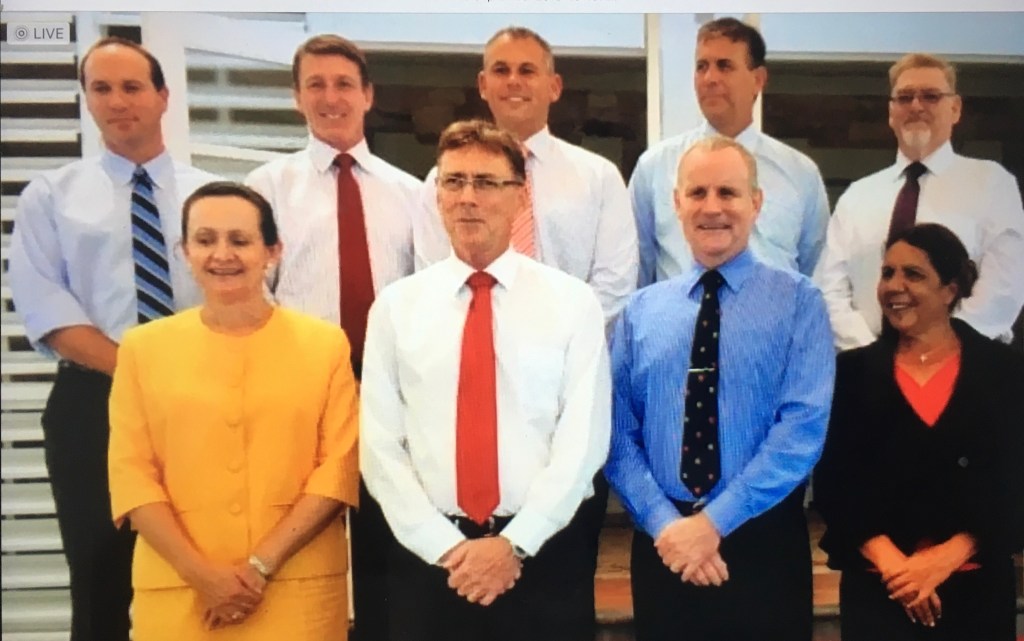
This was the CLP Cabinet with Terry Mills as the first CLP Chief Minister, following the CLP losing the ejection to Clare Martin’s ALP Government in 2001.
There is a possibility but not a strong probability that the asking of ‘Dorothy Fix’ questions during question time, will become a thing of the past.
There is a possibility but not a strong probability that America will wrest back the Number One Economic Position in the world from China.
There is a possibility but little probability that the drain of police exiting the Northern Territory will be halted.
You know you have lost bulk when warning signs like this, no longer worry you for fear of collapsing under your weight.

NAPLAN results for students tested in Literacy and Numeracy around Australia in 2024 reveal alarming trends. There are declines in overall literacy and numeracy outcomes for students in many areas. Testing involves all Australian students in Years 2, 5, 7 and 9.
Testing commenced in 2008 and has been part of the education calendar in every year since – excepting for 2021 when cancelled because of the Covid pandemic.
The lead article in today’s Australian newspaper. It is worth a read and some reflection.
Australia has sacrificed the teaching and understanding of basics, loading the curriculum with nonsense subjects, woke attitudes, and general crap.
Schools are failing. Educational fads prevail with commitment to critical teaching out the window. (See Peta Credlin’s commentary on Sky on 14 August 2024)
You know birds have brains when they can find and open a packet of birdseed and go for the ‘self-service’ option when it comes to feeding.

You know that election day is drawing nigh, when the milk you are using, expires on election day.

It is late in the day but better late than never. Yesterday was the first day of pre-polling for our election in the Northern Territory and my wife and I cast our votes.
Meanwhile, both the Labour government and CLP opposition are advertising and advertising. Sadly, – and I speak as a person who has been voting in the Northern Territory since 1975 – at least 80% of those promises, particularly about the control of crime, will never be realised.
Governments are frightened to take charge of the situation because they run into antagonism from rowdy interest groups who wouldn’t have a clue about what’s going on, just wanting to protect and “understand” the perpetrators of grievous sin.
As for the rest of it, we will wait and see what happens in the wash-up from the election. But I am not holding my breath.
Why is there such apathy about voting and the political system in Australia? Some 480,000 students in our schools do not know what civics and civic education is about.
Voting in Australiauscompulsory, but 600,000 people failed to vote at the last Federal election.
Of those who voted, 800,000 cast donkey -informal and invalid – votes.
Australians are fed political disinformation and misinformation.
Australians are in danger of becoming a politically illiterate society.
In the right space, NO
Can sweep away obstacles
Can be a definitive response
Can offer clarity out of confusion
Can make the utterer stronger
Can earn respect for the user
Is often hard to utter the first time
Can earn respect based response from peers
Is often sparingly enunciated because it is easier to go with the flow
Is, sadly, often discounted
Is a word that should be central rather than peripheral to vocabulary
Why (17)
Do politicans act in such an unholy and rabble rousing manner during question time in parliament?
Are trite and meaningless questions asked by many posing questions for cabinet ministers to answer?
Are 25 billion dollars splurged on online gambling in Australia every year? (Are the intense advertising campaigns conducted by gambling houses leading people into gambling addiction?)
What gives me peace? A short, simple question. but one shrouded in complexity. It is a question I find hard to answer because peace of mind does not come easily.
I think a lot but most of my thoughts focus on things and issues I find worrisome. Rather than focusing on peaceful things, my thoughts lead to worries about problems at the local, territory and Australian levels.
It seems at times there are so many issues of a social, emotional, economic and political nature that there is little room in my head for thoughts that generate peace and serenity.
At night I try to switch off, but nine times out of ten, finish up dreaming. and so intensely that I wake up in the morning remembering quite vividly the details of my dreams. They are hardly peaceful but focus on issues requiring solutions.
I guess what gives me peace, or as close as it comes, is when I am sitting in front of the television, chilling out and dozing off.
That’s the way it is for me
It’s here?
It’s here!
Pre-polling in the NT begins today. Mobile polling booths will be starting the countless thousands of kilometres they will cover around the Northern Territory from today right through until Friday August 23.
Wow! What a program!!


Tomorrow, August 12 2024, is the day pre-polling for the Northern Territory election opens. Many will vote before the official voting day on Saturday, August 24.
The isolation of many communities in the NT means mobile polling booths are visited around the territory. Electoral officials set up in each community for several hours, with people encouraged to vote before the temporary facilities are pulled down and moved on. Travel from one community to the next is by vehicle or plane.
So, starting tomorrow, we are on the business end of choosing the next government. It’s on for young and old.
.With the imposition of an increasing number of barriers to free speech, fewer and fewer people have the confidence to comment freely on issues. Cartoonists have been an exception to this rule. They defy the odds by region, state, country and the world for plying their trade and calling those out who act wrongfully or make shortsighted and crass decisions.
Good cartoonists honestly and unswervingly highlight the pros and cons of issues. While they may invoke people and personalities into cartoons, they do this to magnify matters about which we should be concerned.
All cartoonists have specific drawing styles, which adds to their stamp of communication by caricature. A key ingredient of cartooning is conveying a message so the reader is not left wondering what the cartoon is really about. His style and relevance make the cartoonist’s messages meaningful. They take on contentious matters and stimulate debate on issues.
Any law or its interpretation that would stifle the free expression of cartoonists would be a retrograde step. Freedom for cartoonists to express what are often deep-seated community opinions must be preserved. That right should be as sacrosanct as parliamentary privilege.
But if laws of restriction were to be introduced, I am sure cartoonists would defy them and continue their trade of offering us all deep-seated awareness and understanding
GOTTA BE GOOD AT SOMETHING
I WASN’T GOOD AT
On the Farm as a Child
Extracting double-gee plants and seeds from growing wheat crops.
Removing eggs from. Underneath clucky hens inmm laying nests.
Hand milking cows.
Crutching and doctoring flyblown sheep.
Eating vegetables prescribed by my Mother.
Wearing a hat for sun protection – and I have suffered!
Resisting spoonfulls of sugar from the sugar bowl.
Denying myself scoops of fat from the dripping tin in the Coolgardie safe.
Dedicating time to feeding and watering the fowls.
Cutting heads off roosters being prepared for sale in our home town.
Sitting still in church.
Focussing on the study of mathematics, physics and chemistry.
As an Adult and Educator I wasn’t good at:
Accomodating Type B personality people.
Pretending agreement with policies with which I actively disagreed.
Having to take on staff members who were ‘gottabees’.
Having to acquiesce to ‘ascribed authority focussed’ superordinates.
Sloppily dressed members of staff.
Accepting system perogfatives to ‘water down’ expectations for some students.
Appreciating system and Australia-wide testing regimes.
Not sharing my school’s successes with media.
Being told in 1974 that I was over-educating indigenous children.
Lots more examples could be furnished; in fact many more hundreds of things at which I am not good could be listed.
A GOOD THING
One thing I believe myself to be good at doing is saying “sorry” when I’m wrong, learning from my mistakes, appreciating those who point out my weaknesses and improvements, and always striving to do my best.
Oops – that is four good things
Never in all my life have I ever wanted to open a shop. It is not my scene. That said, my daughter and son-in-law have a bakery and cafe in one of the Northern Territory’s regional towns. It is known as “The Peninsular Bakery and Cafe”, a business they started from scratch twelve years ago. Now the business is thriving and enjoys an outstanding reputation. (They have a website and Facebook page if anyone wants to explore online.)
Their enthusiasm, dedication and commitment to serving people through the service provided is well and truly understood and apprecated.
Considering this question, the only shop I could think of as being one for me would be a florist shop. I love flowers, and during my years as a school principal, I spent hundreds of dollars on flowers to help celebrate birthdays, school anniversaries and so on. I loved the joy that the giving of flowers brought to people for whom they were purchased.
The joy I felt in giving flowers and the delight I Invariably saw or heard about from recipients made everything worthwhile.
Yes, it would be a florist shop for me
Why is K3 salt being touted as a guaranteed weight-loss agent?
Why do people succumb to scammers’ ‘invitations’ to be ripped off, when they know before responding that ‘offers’ are too good to be true, and they will be fleeced?
Do so many of Australia’s international teams suddenly choke and snatch defeat from the jaws of victory when leading games by big margins?
Why do so many sportspeople become proud, lose all vestiges of humility, and believe they are entitled to special treatment wherever they go and with whatever they do?
Both the Labor government and the CLP opposition in the NT are set to launch their campaigns this weekend. With pre-polling for the August 24 election opening on Monday August 12, voters will be faced with significant choices.
Matt Cunningham writing in our local paper today, has written as follows and I share his thoughts.
THE SEATS CLP NEED TO WIN TO CLAIM NT ELECTION
Matt Cunningham, NT News, 10 August 2024
The 2024 Territory election could be one of the closest in recent memory. The Country Liberal Party needs to gain six seats to win a majority. Here are seven electorates it will be targeting as early polling begins on Monday.
l
PORT DARWIN
Labor’s incumbent Paul Kirby is retiring at the election after he was dumped from the cabinet late last year.
Labor was probably lucky to hold this seat in 2020.
The conservative vote was split between the CLP and Territory Alliance.
At the 11th hour TA candidate Gary Strachan (now running for the CLP in Johnston) reversed his preferences and put Labor ahead of the CLP after a dispute with CLP candidate Toby George.
The CLP’s candidate in 2024 is health professional Robyn Cahill.
Labor’s candidate is Brian Manning, an assistant school principal.
If the CLP can’t win this seat in 2024, they’re done.
FONG LIM
Like Port Darwin, this is an inner-city seat the CLP needs to win to have any hope of victory. The incumbent is Education Minister Mark Monaghan.
The CLP’s candidate Tanzil Ranman is an Oxford scholar and economic geographer from the Department of Chief Minister.
He was a member of the Labor Party until a few months ago but switched sides after missing out on ALP preselection.
GOYDER
This conservative seat in Darwin’s rural area is held by former CLP deputy leader Kezia Purick, who is retiring.
Purick defected and became an independent during the CLP’s last term in government and has comfortably held the seat since.
The CLP would be confident of winning the seat back but will face a stiff contest from Independent Belinda Kolstad, who is being backed by Purick.
Although even if Kolstad won, she would be almost certain to support a CLP minority government.
BLAIN
This seat is in Palmerston, where a swing to the CLP is likely to be most pronounced, given the law-and-order and cost-of-living issues that are being felt more acutely by voters here. Blain is the former seat of CLP Chief Minister Terry Mills.
Incumbent Mark Turner became the first Labor candidate to win the seat in 2020, when the conservative vote was split between Mills, standing for his new Territory Alliance Party, and the CLP.
Turner was kicked out of the Labor caucus in 2021 and later expelled from the party when he crossed the floor to support a CLP motion for an inquiry into police morale.
The former police officer has been an outspoken supporter of former constable Zachary Rolfe. Labor and CLP insiders believe Turner is a genuine chance to hold the seat as an independent. Labor’s candidate is Palmerston councillor Dani Eveleigh, while Matthew Kerle, who lost to Turner by just 13 votes in 2020 (2PP after Terry Mills was eliminated), is standing again for the CLP.
DRYSDALE
Also in Palmerston, Drysdale is held by Chief Minister Eva Lawler. While Lawler appears to have turned Labor’s electoral fortunes around there are some in the ALP who fear she could lose her own seat if there are strong swings in Palmerston.
It’s unlikely, but not beyond the realms of possibility that Labor could win enough seats to form a minority government but lose its leader along the way.
The CLP’s candidate is former soldier Clinton Howe who has been working hard on the doors.
WANGURI
Darwin’s northern suburbs – home to many of the almost 24,000 public servants in the NT – have been a Labor stronghold since Clare Martin’s historic election victory in 2001.
The CLP’s best chance of pegging back one of these seats (Labor holds them all) could be in Wanguri.
This might seem unlikely given Labor’s massive margin.
However, incumbent and former deputy Chief Minister Nicole Manison is retiring and much of the vote in Wanguri would be her personal vote.
Wanguri includes many family-oriented, traditionally conservative voters who would have been attracted to Manison – the daughter of a police officer and perhaps the most centrist member of the Labor caucus – but might be reluctant to vote for a new Labor candidate, particularly given the crime issues the government has faced.
Labor’s candidate is former shoppies’ union organiser Shlok Sharma who is getting strong support from Manison.
The CLP’s candidate is Oly Carlson, a long-time Darwin resident who from all reports has been working hard on the doors ahead of election day.
Popular former lord mayor Graeme Sawyer’s entry as an independent adds an extra twist.
KARAMA
This is another northern suburbs seat that could fall to the CLP.
Residents in this seat have been impacted more than others by the dramatic rise in crime and anti-social behaviour.
Held by Minister for Territory Families Ngaree Ah Kit.
The CLP’s candidate is former Chamber of Commerce deputy chief executive Brian O’Gallagher.
These are the same two candidates who contested in 2020.
Continual travelling companions
Never be without
Your common sense
Your powers of observation
Your listening ears.
Leave them home at your peril.

Never ever underestimate the value of keeping a diary. You never know when you will be thankful you did!
In a previous entry I wrote of the value of record keeping. Many professionals keep brief records because of the time it takes to compile these documents. Over the years I have put hundreds and hundreds of hours into diary keeping and extended records including case notes. My diaries are personal documents. Copies of all other records were always kept. When I retired, these records came with me.
Records can help if one becomes involved with writing. As a regular contributor to newspaper columns and in writing for online and print publications my records have been an invaluable assist.
In recent years, it has become commonplace for past students to begin litigation against former teachers and principals. These actions can be about any number of issues, ranging from teaching ineptitude resulting in fail grades through to allegations of physical, emotional and sexual abuse. Without the advantage of records, recall is at best vague and hazy. With the assistance of records, searches can be made to assist in refuting false and malicious allegations.
I strongly urge educators to establish the diary habit and practice record keeping. You never know when this habit will reward you for the effort.
I am astounded and very disappointed for the Principal of Yipinya School in Alice Springs, Dr Gavin Morris. He has been charged with allegedly physically assaulting some students in 2023.
It is not for me to speculate on the pros and cons of what is happening at the moment, other than to reaffirm that people in charge of institutions – in this case a major school organisation – are, these days, walking on eggshells.
People in positions of authority have to be especially careful of the way they go about fulfilling their leadership briefs.
I feel for Dr Morris at this time.
One of the sticking points about life and relationships both personal and professional, is to insist that ‘your’ viewpoint is the right viewpoint.
To offer and incorrect statement or recommend an action that proves to be wrong is reluctantly followed by an apology.
Within school contexts, this can have atmosphere destroying and suspicion arousing outcomes.
For teachers, it can be all too easy to make mistakes. It may be the incorrect spelling of a word, the misunderstanding of roles played by children in some dispute, or getting it wrong when it comes to a particular fact being correct or incorrect.
In these instances and others, to apologise to students for a mistake or misunderstanding is important. It models a correct social attitude to children and also earns respect from children and students.
WRITING FOR THE SUNS
A little over four years ago, I was invited to write a weekly education column for the Suns, a community newspaper published each Tuesday as an insert in the Northern Territory News.
The Suns has gone through a number of changes over time, and I am outlining distribution as it happens in 2017. The Suns is also published as a stand alone paper which people can pick up for free.
Along with other NT News products it is also available online.
This week was my 200th column for the Suns, my first being published on July 2, 2013. I have enjoyed developing the column and can confirm that educational topics are never-ending.
My columns are necessarily edited for inclusion in the paper. Unedited versions are published on my blog at
https://lnkd.in/gse2g-g
I have enjoyed giving back and giving to the community through my column. Many people comment to me and generally in terms of appreciation. It is a nice and personally rewarding way of engaging with the community in a volunteer context.
And I wanted to share my 200th celebration on my blog.
Regards.
Henry Gray
Australia’s preoccupation with the Olympic games has taken its collective mind off the real world and its here-and-now issues.
I hope on the NT election day of August 24, there are no ambulance movements, no vehicle thefts, no home invasions or business break-ins. I hope there are no incidents of domestic violence, or alcohol-induced incidents at shopping centres, in car parks, at bus exchanges or in taverns or nightclubs.
I hope there will be no distractions to Territorians celebrating election day and rejoicing with whoever is chosen to form the new four-year – we have fixed terms – government.
Do non-indigenous Australians, individually and organisationally, have to apologise time and time and time again for the perceived historical treatment of Indigenous Australians?
Is compensation for perceived wrongs toward Indigenous Australians being rolled out time and time and time again?
Is there seemingly no end to the huge amounts of money paid in recompense terms to those who were here before us?
Is money often paid as royalties wasted by splurge spending, meaning benefits it might bring, are quickly dissipated?
There is a lot of frailty about human life. One can be up and going, vibrant and happy one day and suddenly reduced by accident or illness the next.
Life can look like going on for endless years – only to be truncated by environmental catastrophe or man-made disaster.
Add these days, the prominence of scammers and the deep deceptions with which so many genuine persons are confronted, and the issue of threats and ruination are compounded.
One never knows in retiring for the night, how the next day will emerge.
Life is tenuous and fraught.
For the whole of my life, I have never gone into spending a huge amount of money on meals at restaurants or on the purchase of exotic provisions to cook meals at home. Don’t get me wrong; I’m far from skin G regarding meals and purchasing ingredients if we cook at home.
When travelling overseas, we often provided for ourselves by buying food from supermarkets or shops and then preparing that food ourselves. The same happened when we were travelling around Australia. The only exception I can think of was when we had Christmas dinner in Georgetown on Penang Island in Malaysia one Christmas.
We went to the Tunku Abdul Razzak Centre for our Christmas lunch. We decided somewhat extraordinarily to purchase a decent bottle of wine for our meal. From memory, I think it was about AU$45, the most I have ever paid for a bottle of wine.
Very few people, it seems, ever had wine with their meals at the restaurant. We had two or three drink waiters hovering around usFrom the bottle being opened until it was consumed.
I remember the wine but not what comprised the rest of the mail.
(Actually, it was on the same day that the five of us had the wildest and most hair-raising race ride in two trishaws from our hotel to our lunchtime meal. It was downhill all the way, and if the topic of a ride ever comes up on this site, I will write more fulsomely about going to dinner.)
When it comes to eating, I’m somewhat of a traditionalist and like plain and wholesome meals without too much garnish. I also love a good steak. We have had three meals in Australia going back over the years, which I remember not so much because of cost but the excellent way the steaks for our dinner are prepared and served.
The third most favourite steak I’ve eaten in this context was at the RSL Club in Gunnedah, New South Wales, back in the late 1970s.
The second-best steak I’ve ever eaten was served to us in the BP Cafe attached to the service station in Ravensthorpe in Western Australia.
A gold plate for the best steak I have eaten goes to the then chef, an apprentice of the Margo Myles Restaurant in the Tennant Creek Hotel in the Northern Territory. The steak was out of this world. It was probably around 1984 or 1985 when that particular meal was served, and I still remember it to this day.
I am 78 years old. Based on three meals a day for the years I’ve been alive, I’d estimate eating 84,660 meals in various situations. That is a lot of eating and a lot of meals. I’d hate to have to pay for them all at once.
Listening was an important attribute instilled as an attribute enhancing comprehension and understanding.
Handwriting was taught and legibility encouraged.
Children learned about words through phonetic study.
Oral reading to the teacher and within groups lead to fluency when sharing text. Discussion within groups and shared conversation built understanding about meaning of the written word.
Children learned tables and mathematical formulae. They developed the ability to carry out mental computation and were dexterous without the need for calculator assistance.
Grammar was studied. Rules relating to the English language and usage were studied and understood.
Spelling was an essential subject. Words and their usage was an important part of study.
My oh my, how things have changed.
I woke this morning to the realisation that the Australian Stock market had fallen 3% yesterday, losing $100 billion, reinforced to me the fragility and artificiality of the global financial world.
The chess-like pieces on the Stockmarket boss’s game are not kings, queens, bishops and pawns: They are bulls and bears, hellbent on eliminating each other.
Health issues continue to plague a significant proportion of people in the Northern Territory. So many of those afflicted could avoid impacts if habits and lifestyle were more significantly appreciated.
Hurry on August 24 – Election Day in the NT.
The share market has decreased leveraging huge losses over the past 24 hours, up one day and down the next. How many bankrupcies will grow from the stock market plunges today and in the days ahead?
Looking around the world on the news, it is hard to find anywhere where there is anything other than bitter struggles and unrest, with riotous behaviour ripping the world asunder.
The Darwin Turf Club carnival wound up today, with the Darwin Cup being one of the closest in recent years.
Now, it is only 19 days before the next NT Government election. Pre-polling opens in a week.
There is both a possibility and strong probability that the Australian stocks and shares market will decline by close to 6% for the day, August 5 2024,
And close to 18% by COB August 9 2024.
There is a possibility but only the remotest of probabilities, that promotions to positions of responsibility will return to being filled on the principles of merit, rather than by virtue signalling.
There is a possibility but not a very strong probability that governments will cease procurement practices favouring, prioritising and ‘weighting’ some applicants based on race and ethnicity.
There is a possibility but an almost zero probability that crime, including domestic violence incidents, will ever be curbed in the Northern Territory.
There is a possibility but not a strong probability that the stock market will be guided by rational and logical commonsense, rather than by the motivations of greed and raw emotion.
There is a possibility but not a strong probability that reunification between Princes William and Harry will take place.
There is a possibility but not a strong probability that an era and aura of happiness and tranquillity will settle like a blanket on Australia.

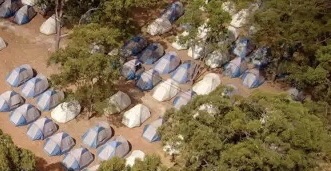
Sleeping modules at Garma.
Our marriage of 55 years.
The successes of our children.
The decency and progress on the pathway of growing up by our grandchildren.
The closeness we share as a family.
The development of my mission statement in 1984.
My distrust of debt.
The saving of money so that when we buy, what we have is ours.
Having our house as a home.
Growing pawpaws to give away.
Writing my blog.
Connecting through LinkedIn.
Meeting up with past students.
Touching base with past parents of students.
Learning about the successes in life of past students.
Being a people person.
Responding to daily assignments (prompts) from Jetpack.
Editing.
Writing letters on key issues.
Keeping my diary.
Talking on the phone to our children and grandchildren.
Sending and receiving emails and texts from our children and grandchildren.
Learning about artificial intelligence.
Following local politics.
Tending to the garden.
Taking photographs.
Providing food and water for birds.
Watching old movies.
Bursting into song any time and anywhere.
Writing poetry.
Sharing resource materials with others.
Keeping active.
This must be it for about thirty spots of happiness.
Leadership paragon
Thank you, Anthony Albanese, for being the excellent paragon of leadership and innate goodness you have become. You are Australia’s answer to Moses of old, who led his people for so long and guided them through so many dark places. You are Australia’s shining light.
Leadership Lighthouse
I am so glad that our PM is a man whose word and position on issues are steadfast and unwavering. We have every reason to be buoyed and stimulated with adulation for his qualities of leadership which richly benefit us all.
Australia’s Shining Light
How blessed we are to have an astute and deeply empathetic Prime Minister in Anthony Albanese who cares for and is there for us all. Our problems are his problems and he is with us and of us as a caring Australian. I feel that he embeds every one of us in his soul. I thank him for his warmth and humanity.
Steadfastly Truthful
One of the outstanding things about our prime minister Anthony Albanese is that he never contradicts himself. He holds steadfast and true to the positions that he takes on issues and is very clear and letting us all know about the courses of action and believes to be the best we should follow.
He has so many positive qualities that make him an outstanding leader, a person leading us onward, forward and evermore into an era of prosperity.
A deep thinker and quiet reflector
There is, without doubt, a place for non-verbalisation and silence, and the good thing is that our prime minister knows when it is wise to let Conversational debate rage around without actually joining in.
Recently, he has been invited to comment on and take ownership and responsibility for the ministerial comments of others.
With great dignity and maturity, he has declined ownership of the statements of these others, attributing them to those making the statements. He does not take ownership of things that other ministers say, for they are responsible for their portfolios. He fully trusts them.
Great awareness of outcomes deriving from action
“Cause-and-effect“ is a concept understood perfectly and indeed expertly by our Prime Minister Anthony Albanese. He was well aware of the fact that actions he takes will result in consequences. That makes him a person who is very very careful in terms of policy, process and direction. He is careful not to lead Australia in any direction that is likely to have negative consequences. He is careful, consultative, and thanks very carefully about the pros and cons of all issues before making decisions.
It is this capacity that makes him a stand-out leader.
Maker of Meaningful Decisions
What a timely topic, and how deeply reflective it is of the strategies so ably demonstrated by our Prime Minister. No decision is ever rash or shortsighted but instead made after deep consideration of all elements of issues and with the long-term needs of our country and all therein, taken into careful account.
The Old Testament had King Solomon, his profound wisdom and careful decision-making.
We have Anthony Albanese; how blessed are we!
GARMA 2024
The significance of Garma every year cannot be overlooked or underestimated. But given the cost of attendance, I have to wonder how many official and semi-official attendees pay their way – or is it a case of taxpayer subsidisation of the attendance price? Locals who might want to attend also have to pay $270 for a day pass (four days) and $140 for those between the ages of 6 and 14. Garma must bring significant income to the organising group.
 Site ready for tonight’s outdoor performance.
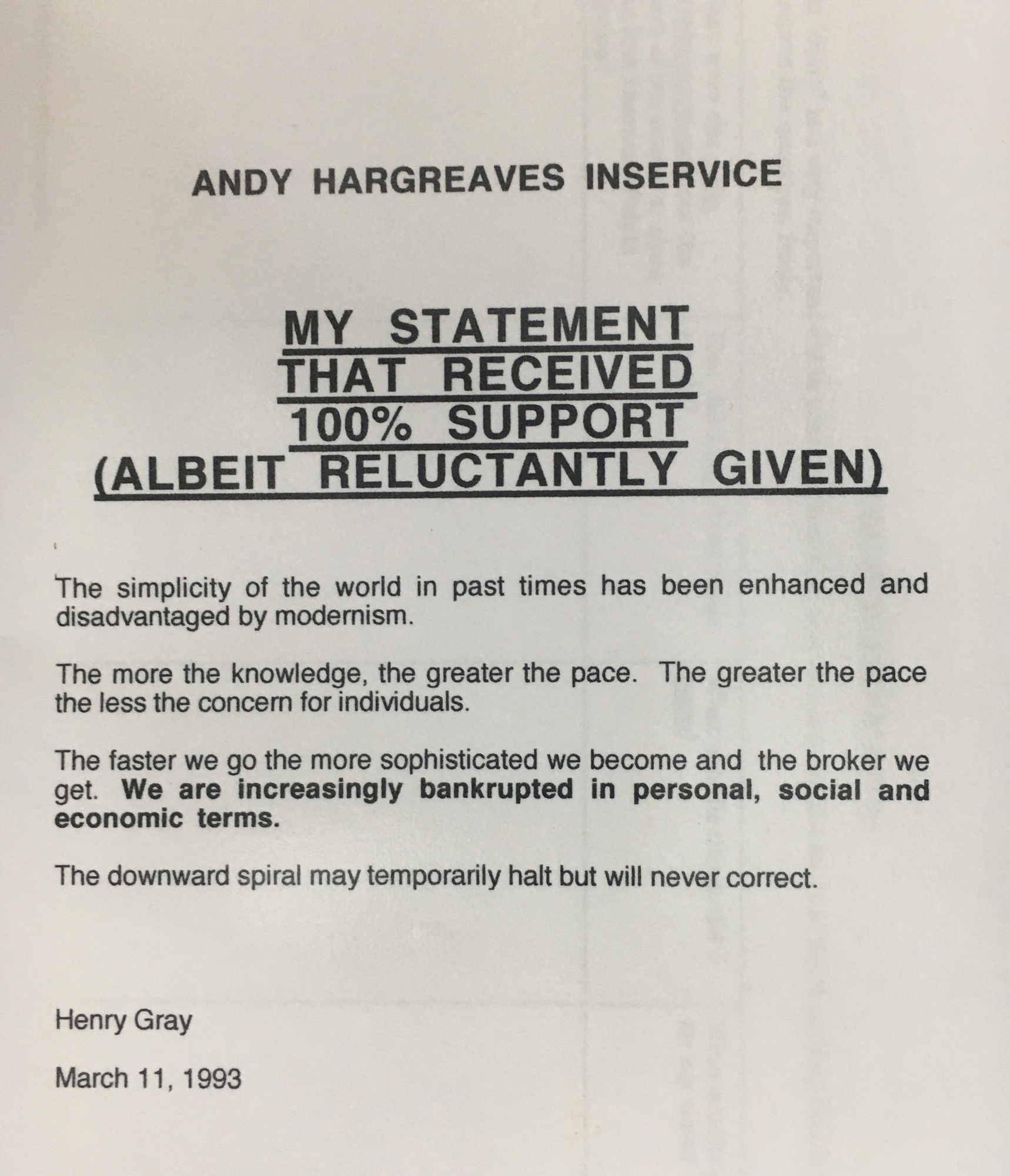
A prediction from long ago that is sadly coming to pass.
On November 28 2014, one of the best ever conferences on Indigenous Education was held at the Darwin Convention Centre. It had to do with Indigenous Leadership in schools and the contribution being made to education by Indigenous and Non-Indigenous Staff.
Over 200 people, the majority being Indigenous Australians attended the conference. Fifty organisations, mostly school representatives from government and private schools were involved. While those attending were from all over Australia, there was a strong focus on Northern Territory schools and NT educational outcomes.
The conference was organised by the Centre for School Leadership at Charles Darwin University and the Australian Centre for Indigenous Knowledge and Education. Conference highlights included demonstrations of indigenous cultural learning by students from Wagaman Primary and Sanderson Middle Schools. The conference put to bed some myths that have been part of societal thinking for a long time.
The commonly held belief is that nothing happens and no progress is being made in rural and remote schools. Indigenous education is equated with truancy issues and programs constantly thwarted by chronic teacher turnover.
There are over 100 remote schools in the NT and by no means do they all deserve the ‘too hard’ tag. For instance, Elliot School 750 kilometres south of Darwin has close to 90% school attendance. The principal has been at the school for 4 years and all classroom teachers from this year will be staying on in 2015. The conference confirmed that other remote schools are improving in these areas.
Several presenters attested that Indigenous educational success and progress in our remote and urban schools depends on relationships between Aboriginal and Non-Aboriginal staff. If they work ‘together as one’ students respond positively to learning opportunities. Of course care and empathy needs to be inclusive of students. Successful schools also engage with community.
Those successful and progressive schools identified during the conference have high standards and expectations. They engage with and support students toward positive personal attainment. Importantly, there is no disconnection between staff and students.
More than NAP
Our educational system tends to accept that the National Assessment Program (NAP) is the only yardstick by which educational success can be measured. That is because the Federal Government says so. Friday’s conference confirmed that there is much more to building student confidence and competence than NAP alone. Care and commitment go far deeper than preparing students for formal testing. Had senior departmental people and politicans attended the conference, they would have found this to be the case.
In the NT, 44% of our students are indigenous. More and more of them attend urban schools and they are the backbone of rural and remote schools. The conference confirmed Indigenous education is working and delivering outcomes, largely because of relationships building between Indigenous and Non-Indigenous staff. Relations between staff, students and community are also helping to build positive educational results. The conference was one of substance and uplift.
Time has moved on but key issues remain. We ought to watch with interest for further growth, development and educational fulfilment in this area.
Education these days overly focuses on accountability and discounts the importance of teaching and learning Box ticking and accreditation are largely about foolish accountability requirements.
The focus on structure and not function (the teaching and development of the child/children) is distorting education.
The principle of schools being for children has largely been forgotten
Everyone has a “Johore Window“.
For many people, their Johore window is quite wide and open, meaning that for an observer the person whose window is so open, “what you see is what you get“ is the way things are.
For everyone, some aspects of personality and characteristics are unseen or hidden. These elements of a person that he or she knows about are not revealed to others. They are the hidden signs of personality. They only come out to the awareness of others if the person to whom they are secret, tells all and tells others about these things.
I have a couple of secret things and they are well and truly hidden from site.
The first is that my favourite word is “Peeeeeete“. I sometimes use it as a callsign but only very rarely and I am to read both when feeling joyful and sad. It is both a positive and a negative expression.
The second is that I am regarded as being a very confident, aware, and forthright person. So often I suffer from self-doubt and uncertainty and feel that I’m not up to the task I’m undertaking. The self-doubt has been confirmed by various tests and I try very very hard to make sure that it is not visible.
Others don’t see it but it’s certainly something that I feel.
So I’ve shared these things as characteristics and habits that people knew nothing about but now they do.
I would teach singing to anyone from 7 to 70 and would do it for free.
I love singing and burst into song in the streets, the shops, in buses and cars and at any time of the day and nights.
Singing is a joyful activity and lightens the spirit.
It ia a good habit one I would like to share with others each and every day.
it’s difficult to quantify curiosity, particularly for someone like me who tends to be curious about many things. Some of that curiosity extends to happenings and the forecast of outcomes (in my mind) locally, regionally, state and territory, Australia-wide, within the four hemispheres of Earth and indeed worldwide with everything in together.
I’ve always believed imagination which is closely aligned with curiosity to be an important ingredient of thinking. When involved with Education, are used to put to students that they have three eyes, A left eye, a right eye and an inner or imaginative eye.
This third eye was the mind’s eye. I used to tell children that the imagination within the minds was a wonderful characteristic and let them know that too often as people age, the mind’s eye grows dim and the imagination fades. I used to counsel them that as they grew up and matured, they ought to try their hardest to keep their mines Ilana alive, vibrant and functioning.
A student, aged 11 at the time, once said to me as I was teaching, “Mr Gray, you have the body of a man and the mind of a child.“ I took that as a compliment and a confirmation of the fact that my imagination and curiosity were still very alive and well. I hope they have not died or gone to sleep during the years of my retirement from full-time education.
That is a long aside but it leads to the thing in this life about which I am most curious – and sadly it is not a happy thought for my imagination to dwell upon.
The world is full of conflict. There is conflict within regions and countries. There is open disputation between countries which is leading to war. The Russian/Ukraine war (Which Vladimir Putin said would last for three days) has now been going on for 530 days or more. If China is battling against Taiwan and Taiwan is declaring readiness for war against China. America and Australia and others are looking to support Taiwan on (which incidentally they don’t even recognise Country) if there is a conflict. New paradefence is the number one priority on the agenda of a growing number of countries. It seems to me the talk about peace is pyrrhic and it’s only a matter of time before civil unrest and our pride war take over the world. I sincerely believe that Armageddon is just around the corner.
Such is my curiosity and my worry for family our country all countries and people of the world. My curiosity may be macabre but it reflects upon are you a real problem.
My oversight from yesterday, for which I apologise. August 1 every year is the universal birthday of all horses in the world. Imagine, a foal born on July 31, turns one the next day!
It is amazing how many houses built within housing estates, begin to deteriorate and look old, almost as soon as construction is completed. And they all look the same, with scant space to the front, sides or back. Crammed into space.
This editorial in The Daily Telegraph (August 2, 2024) has applicability to each and every one of us, regardless of age, occupational status, background and everything else.
MATILDAS’ FAILURE A LESSON IN HUMILITY
When a great Roman general or Emperor was granted a triumphal march through the city, it was a tradition that one of his aides would stand behind him whispering in his ear: “Remember you are mortal, remember you are mortal…”
The idea was that despite the thousands of adoring citizens screaming plaudits at the great man he would remain grounded and not mistake himself for a god.
Sadly it rarely worked in Ancient Rome and it doesn’t seem to be working too well 2000 years later in Australia if the Matildas’ Olympics campaign is anything to go by.
Australians will well remember the Matildas’ awe-inspiring performance at the World Cup last year. It electrified a generation and they were indeed feted as gods — all the more so because it was the first time many had turned their attention to the women’s team.
Now they are accused of such hubris that their special treatment at Paris, combined with clashing egos in the locker room, was responsible for what has been dubbed “an unmitigated disaster”.
Perhaps they too need reminding that the path to true greatness isn’t hubris but humility.
Teacher turnover and short term teaching appointments are regularly raised as issues in the Northern Territory. Northern Territory education is seen as being far more fluid and mobile than elsewhere in Australia.
While dissatisfaction plays a part in teacher resignation everywhere, there are local factors that come into contention. Chief among these is the considerable number of teachers who have been recruited to the Northern Territory on short-term contracts. This was seen as necessary to fill vacancies in remote and “difficult the staff” schools.
Just a few years ago, advertisements placed in the newspapers invited teachers to come to the Northern Territory to “try the place out”. Generous relocation expenses were offered, with paid southern return guaranteed after a relatively short period of time. Such offers created the impression that teachers are doing our system a favour by being here. The idea that minimal teaching effort would be good enough, became an issue.
Fortunately, this recruitment methodology appears to have been curtailed. However, there is heavy reliance on interstate and overseas teachers taking up vacancies in “out of town” areas. Part of this has to do with the lack of remote area appeal for those who undertake teacher training at the Charles Darwin University. Many preservice teachers are mature age persons with family commitments precluding them from working outside urban areas. Others are distance education trainees, preparing to teach in their home states. Unless and until we are able to reach a point of training a higher percentage of Territory grown teachers, turnover will continue to be an issue.
Training opportunities for Indigenous teachers are provided through the Batchelor Institute attached to the CDU. There have been many initiatives over the years aimed at graduating fully qualified Indigenous teachers. However self-sufficiency in teaching terms is still a work in progress.
A factor contributing to short term teaching careers is that of disappointment with what graduation offers. Many graduates are put off by system priorities . The requirement that they teach in a way that is so focussed on formal testing and assessment outcomes is off-putting. Their wish to teach holistically, seems to be at odds with prescribed system realities. The need to spend significant amounts of time on matters ranging from discipline to paperwork accountability are also disincentives. Both graduate and experienced teachers become disenchanted. That can and does lead them to resignation and the seeking of alternative careers.
Knowing about short term teaching issues is one thing. Fixing them, is another
Recent commentary has discussed shortfalls in the accomplishments of Australian students. Our students compared poorly with their Asian peers and other overseas counterparts. More money and material resources are directed towards Australian education than in many of the countries to whom we are compared, yet our results continue to be inferior.
An issue that impacts on outcomes is that of student attitude. Googling ‘student discipline’ online brings up countless reports confirming this to be the case. The latest PISA (Program for International Student Assessment) survey found that “…Australia ranked 63rd out of 68 OECD countries for classroom discipline.” (Classroom behaviour the key to future pay, Weekend Australian 19 – 20 May 2018). Dr Sue Thompson from the Australian Council for Educational Research (ACER) confirmed that “… the environment is challenging for teachers.” (ABC Australian Kids behaving badly in classrooms, 16.3.17)
The ABC Report by Alice Martin goes into the level and degree of student offending. “ Things you would find in a classroom: an entire class deciding to ignore the teacher in silent protest, chairs thrown, threats and overturned desks.
(Australian) Teachers came forward to tell the ABC about the biggest classroom disruptions they experienced. It did not stop there. One teacher had three Year 9 boys skip her class and smear their poo all over the school gymnasium walls, while others had been cursed with the full spectrum of profanities. The list went on…and on.”
While the level and degree of ill-disciplined behaviour varies, the issue is one that has a deleterious impact upon learning opportunities and academic outcomes.
Classroom behaviour (or misbehaviour) has a negative impact on what can be achieved. Although not talked about openly, the behaviour of many students at both primary and secondary levels, leaves a lot to be desired. Teachers spend as much, if not more time, on classroom management and discipline as they do on teaching. This is not fair on those who are keen to learn.
Classrooms and students in many of our Territory schools are not quarantined from this sad reality.
The issue is one that has its genesis in the bringing up of children. Parents as primary caregivers are responsible for the initial shaping of the values and attitudes of their offspring. Proverbs 22.6 suggests “Teach your children right from wrong and when they are grown they will still do right.” (Bible, Contemporary English Version)
If Australian students are to attain the levels achieved by their overseas counterparts, this issue needs to be recognised and corrected.
I could tell you as readers about many acts of kindness that have been offered to me by people over time I’ve appreciated each and everyone intern, and I have always tried to be kind, sincere and kind to other people.
Over many years I have helped many people and have in turn been helped by many.
It’s hard to get them to single out anyone singly and particularly in recent times. However, allow me to tell you that the School At which I was Principal for 20 years recently had its 40th-anniversary celebration. I was not able to attend on August 2, so instead tended my apologies and spent $150 on a lovely Boquet with an appropriate card thanking everyone for their great contribution to the school over a long time and wishing everyone in the present looking towards the future all the very very best.
I don’t think this was a kindness so much as a recognition and appreciation, for apart from the first two years of my principalship at that school, the remaining 18 years were the best.
We should always be kind to and recognise the goodness in others. And we should do for people what we would like them to do for us.
See Thanking with Flowers
I feel that $20,000,000 of tattoos are walking around Darwin on any one day.
During the Pitch Black defence exercise during the past few weeks, I imagine that planes have flown at least 200,000 kilometres during their sorties.
Immigration into Australia is totally beyond comprehension and out of control. We are being inundated with people, many who have no heart and soul in our country. Multiculturalism can be quite disruptive to Australia’s social and cultural fabric.
 EDUCATION, A LIFE FORCE