AI is asked

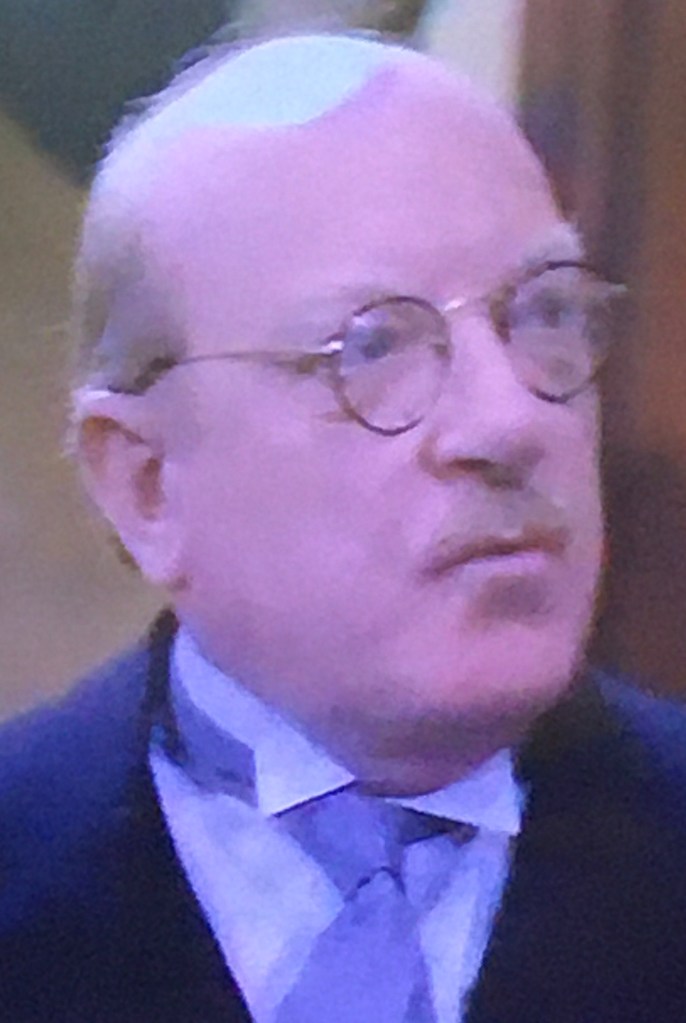
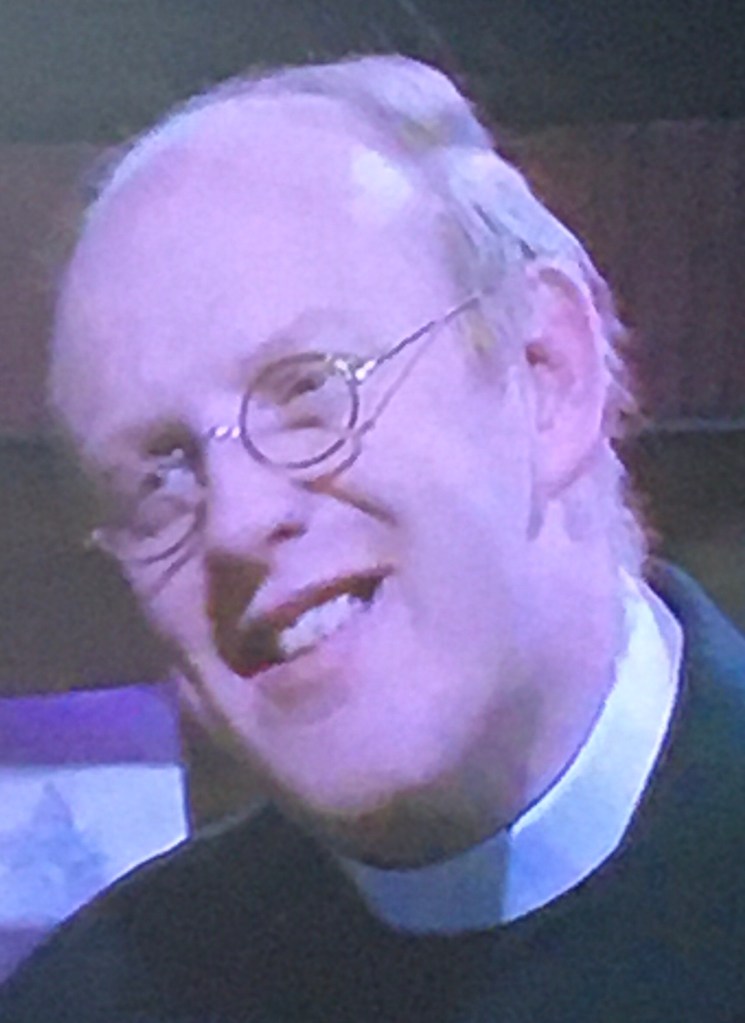
What can cause sudden fear or foreboding to come over a person, impacting on their physical portrayal and mood?

Response:

Sudden feelings of fear or foreboding can be triggered by various factors, affecting both a person’s physical portrayal and mood. Here are some common causes:

1. Anxiety Disorders

  • Individuals with anxiety disorders may experience sudden panic attacks, leading to intense fear, heart palpitations, sweating, and trembling.

2. Stressful Situations

  • High-pressure scenarios, such as public speaking, job interviews, or personal crises, can provoke immediate fear or anxiety.

3. Traumatic Experiences

  • Past traumas, whether recent or long-standing, can resurface unexpectedly, inducing feelings of panic or dread.

4. Phobias

  • Specific phobias can cause overwhelming fear in response to certain stimuli, such as heights, spiders, or confined spaces.

5. Substance Use

  • Alcohol withdrawal, caffeine, or recreational drugs can induce anxiety and sudden feelings of fear.

6. Health Issues

  • Certain medical conditions, such as hyperthyroidism or heart problems, can manifest as anxiety and sudden fear.

7. Environmental Triggers

  • Situational factors, such as dark places, crowded areas, or certain noises, can trigger fear responses.

8. Sleep Disturbances

  • Lack of sleep or sleep disorders like insomnia can significantly affect mood and contribute to feelings of fear or anxiety.

9. Fear of the Unknown

  • Uncertainty about the future or unknown outcomes can evoke feelings of foreboding, causing anxiety.

Physical Effects

  • Body Language Changes: Stiffness, closing off body posture, or fidgeting.
  • Facial Expressions: Widened eyes, frowning, or showing signs of distress.
  • Physiological Reactions: Increased heart rate, sweating, and shallow breathing.

Conclusion

Understanding these triggers can help individuals manage their responses better and seek appropriate support or interventions when needed.

It is so complex

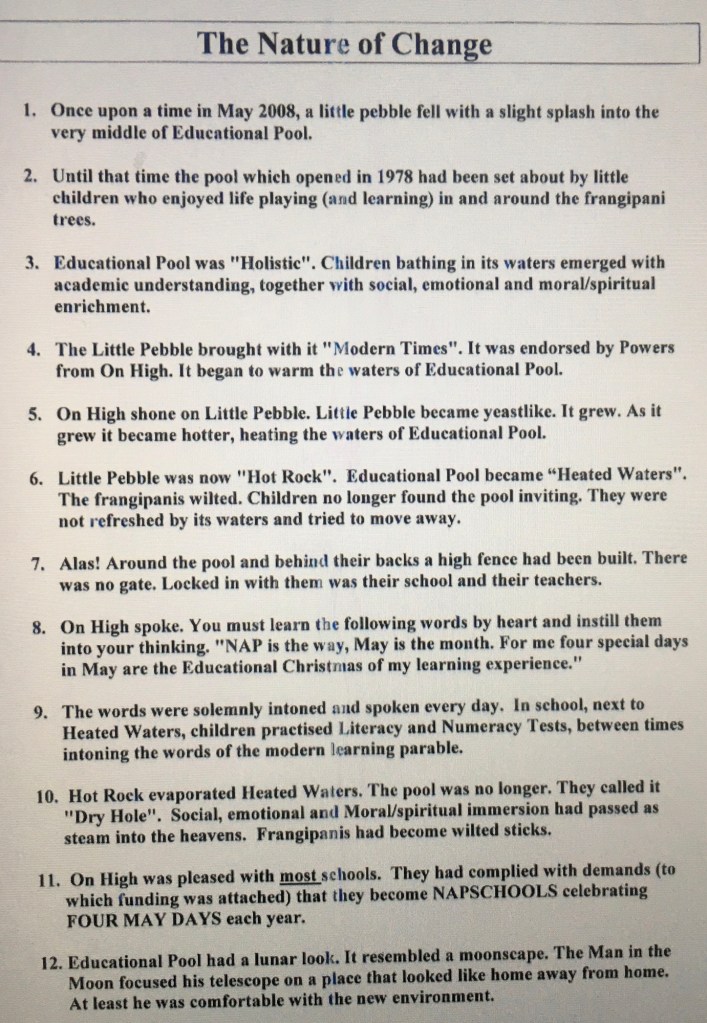
What I wrote and had published about NAPLAN some years ago

NAPLAN PERSPECTIVE NEEDED

With the release of the 2016 NAPLAN results, education again enters a lengthy period of self-examination and study of outcomes. When results are released a prolonged annual period of data analysis commences. This continues for several months. Data as it applies at Australian, State and Territory level data is dissected. Regional analysis and minute examination of individual results at school level follows. Everything else about education seems to stand still, allowing this exercise to be pursued without interruption.

States and Territories are offered plaudits or brickbats depending on outcomes. School results are minutely analysed with the publication of results online at the “My Schools” website.

By the beginning of 2017 data analysis will be exhausted. Then it will be time to prepare for the May tests. Students in the testing years (three, five, seven and nine) will be subjected to trial testing programs aimed at getting them ready for the tests in May.

Of course schools are advised not to go overboard when it comes to testing readiness. However, with so much attaching to NAPLAN outcomes, this advice is rarely heeded. In actual fact, systems want their schools to do well so they compare favourably with their intra-territory and interstate counterparts. Systems also seek and value kudos based on test results.

The costs of saturating Australia’s educational system with NAPLAN must be mind-boggling. It’s probably not an overstatement to suggest that since 2008, when universal testing was introduced, hundred of millions of dollars have been poured into the program.

A major flaw is the interpretation of NAPLAN’s importance. The tests measure narrowly defined academic competencies of four student groups, at the same time each year. The rest of the year and the successes of all students seem to count for little. This testing with its academic focus seems to imply that holistic education is of little consequence. Teacher quality is spoken of in terms of teachers having the ability to prepare children for these tests. There should be more to quality education than fixation on testing regimes.

What of the students

I don’t know if anybody has thought to ask students what they think about this program. If they were to be asked, there might be some interesting, enlightening and eye-opening responses. I believe there would be little appreciation of the weeks and months of pre-test preparation many of them have to endure. A student forum on this program is well worth considering. Whether notice would be taken of their viewpoint altogether another matter.

The tests are now earlier in the year, but the outcomes are pretty much the same as they have been for years on end.

Poor Old Henry laments Coreflute Carnage

Coreflute Carnage

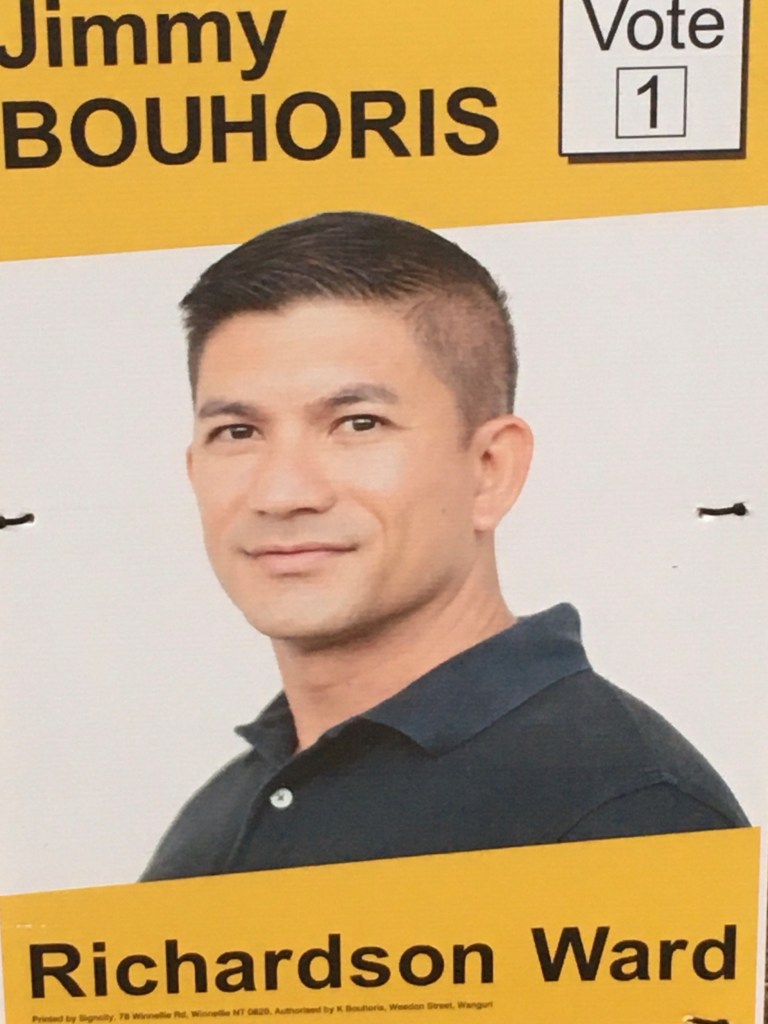
During every Federal, Territory or local government election campaign, our cities and towns take on a unique characterisation of coreflutes everywhere, urging us to vote for those seeking election.

Regardless of what people think about hundreds of coreflutes presenting countenances of those seeking voter support, they disappear quickly after the election.

Coreflutes are a traditional way used by people seeking election.

They are not cheap to manufacture, and volunteers spend much time erecting them around our cities and towns. It’s a pity that some people think it’s fair game to steal, deface, or vandalise these with graffiti. 

Many people pay quite a lot of money to have these advertising boards created. Their efforts and interest in being elected to serve the community should not be disrespected by damaging or destroying their advertising materials.

The Impending Nuptials – POH asks AI

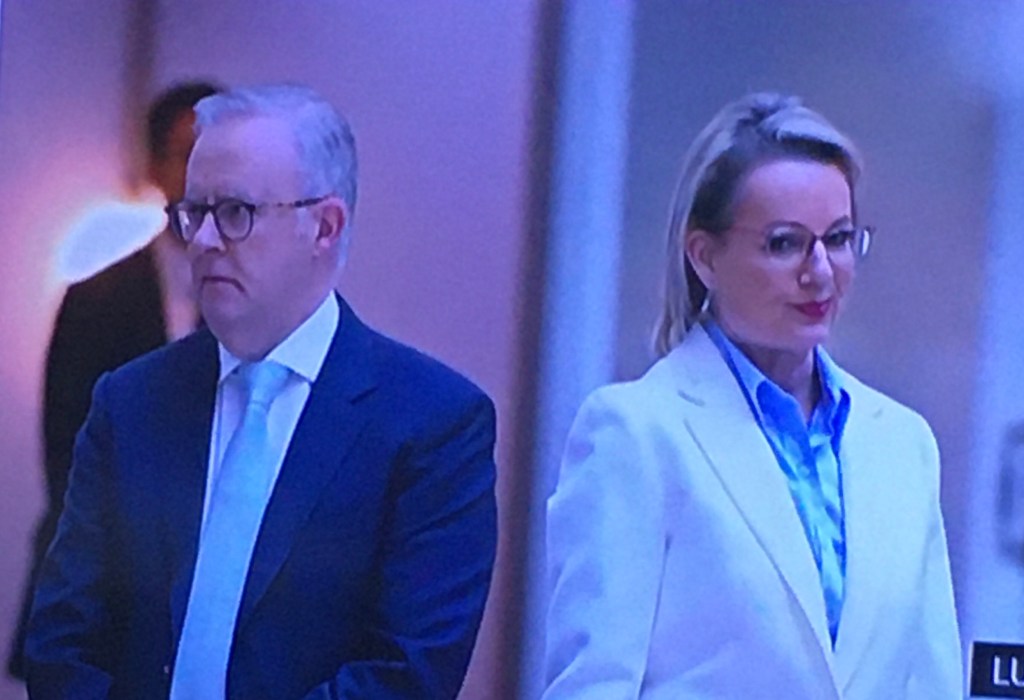
Who is likely to be best man for Anthony Albanese when he marries?

Response:

As of now, there is no official announcement regarding who will be the best man for Prime Minister Anthony Albanese when he marries his fiancée, Jodie Haydon. However, it is expected to be a small and intimate ceremony primarily attended by close family and friends.

For more details, you can check the following articles:

Stay tuned for updates as the wedding date approaches!

A few blank spaces still to be filled in!

POH compares two curriculum documents.

The one on the right is the Singapore Curriculum for the whole of schooling.

The one on the left is part of the Australian curriculum which is full of irrelevance and garbage.

Singapore students do well at school and they are getting better in an accomplishment terms with the passing of time.

For Australian students the results evermore worse with the passing of time.

The focus of education – what it should be

EDUCATION NEEDS TO BE SIMPLE, FOCUSED AND ENGAGING

In this day and age, increasing educational complexity overlooks two vital criteria: ‘simplicity’ and ‘focus’. We need to keep education simple in terms of clarity of message and focus on upholding young people’s key learning and developmental needs. Simplicity and focus need to be absolute priorities. Unfortunately, governments and educational systems have discounted these critical teaching and learning principles.

Nor should the use of technology supplant the prime teaching role of teachers.

Too often, we can’t see the wood for the trees. Embedded within Curriculum Frameworks are key learning principles to which teacher attention is drawn. Those requirements should underpin planning, preparation, and teaching, followed by testing, measurement, and data analysis, leading towards follow-up. However, key learning strategies and straightforward focus principles are set to one side, with teachers being ‘invited’ to unceasingly explore the veritable Cybernet forest of educational resources and alternative methods for their usage.

The depth and density of resources and support materials are mind-boggling. There is also a considerable amount of reduplication or, at best, only minor changes from one precept to the next. Trawling through an infinite resource selection is inordinately time-consuming. The journey often reveals little more than teachers already have in their resource collections.

I’d suggest to teachers surfing the web looking for resources, that they record time started and time finished. They will often find that many, many hours have been spent searching for resources, time committed going well beyond the teaching value of what they download.

Imprinted into the minds of teachers is the imperative that they give of their absolute best, to bring children out the other end of the teaching / learning journey having been enriched. For some reason, possibly a lack of self confidence or by not questioning the suggestion of leaders, the search for resource materials and teaching advice occupies a significant amount of teachers time.

What seems to count

I believe that teachers are often frightened that what they do in terms of teaching, will be insufficient. It seems they feel the weight of accountability, believing people are regularly scrutinising, ready to pounce, criticise and condemn if things are not good enough. They appear to rejoice little and worry a lot about whether their contribution is or isn’t appreciated. This means that they become super self-critical and very rarely take time to rejoice and celebrate their teaching successes.

In Australia the Melbourne Declaration of Education was agreed by Ministers of Education and Education Department CEO’a in 2008. In the very first part of the declaration is a statement exhorting teachers to be holistic in their approach to teaching and learning processes. While academics are highly stressed, so, too, are the social, emotional and moral / spiritual aspects of development. This declaration follows on earlier COAG statements of principle and intent, but in practice this is often set aside.

It seems that teachers are urged to turn their attention away from this position and toward the point of recognising far more limited aspects of development as having greater priority.

In particular, the focus seems to be narrowly focussed on testable aspects of literacy and numeracy, with little else counting as being of educational relevance. In Australia we have what might be termed ‘Four May Days each year’, coinciding with the nation-wide NAPLAN testing for children in years three, five, seven and nine. Tests are taken over three days with a catch up day being allowed for students who have missed out on sitting tests on the designated days. Comparative data comes back to schools, comparing them on the outcomes of these tests against all other schools. That information goes on to the ACARA managed ‘My Schools’ website, which records information relating to outcomes for children in all Australian Schools for public digestion.

From there, media picks up on schools that are well below average, to well above average across the spectrum of tests and years. They then produce colourful tables showing schools from very deep pink (well below average) to very deep green (well above average). Some newspapers delight or have delighted in talking about “Seas of Red”, allowing readers to draw a personal metaphor about what often seems to be the more occasional “Oasis of Green”.

The focus most certainly remains firmly fixed on the importance of teaching, strategies and data collection leading toward the annual NAPLAN program. Data is upheld as the number one Australian educational priority.

The emphasis and the ownership of this testing regime is vested in the Australian Government which insists the program is an absolute universal system priority. It has cost hundreds of millions of educational dollars since its inception in 2008.

This paper is not a forum piece in which further discussion of NAP testing should take place. Rather, I am seeking to show that macro determined programs coming from the Australian Government can and do have the effect of taking us away from a focus that aligns with holistic development and the preparation of children for the whole of life. ‘If literacy and numeracy challenges are satisfied, then the educational job is done’, seems to be an underpinning paradigm.

It is a pity that in this day and age ‘learning in the hands of students is often dismissive of this type and level of engagement. I wondered how appreciative those in high Australian Government places might be of a program like this – or whether indeed they would see it as being relevant!

Classroom Priorities and Teacher Focus

‘Learning in the hands of students’ is just that! It’s about putting into the hands of children technologically developed gizmos that enable them to communicate ‘by finger’, engaging in everything from games and internet study to the transmission and receipt of messages . . . and so on. The onus and emphasis is more and more on technology and less and less on skills that used to be considered important.

What doesn’t happen in modern learning contexts, is taking into account of the need for children and students to be listeners, speakers, readers, and writers. Primary communication skills are often muted.

.

The sending of texts, e-mails and, more recently, Facebook engagement, Twitter entry and other device-supported communication has now taken the place of old-fashioned listening and speaking.

Increasingly, reading and writing are also being committed to the technological domain. We have entered the world of the e-book, tablet reading and keyboard or Siri writing. In some American states and European countries handwriting texts are no longer prescribed, with tablets being the new way forward.

I am personally saddened by the fact that education for children seems to be distancing itself from primary communication skills. The ability of people (young and old) to look each other in the eye, speak up with confidence and to listen without interruption is nearing extinction. If young people are to develop skills and confidence in communication, we will need a return to the era in which these communication skills were considered paramount. There needs to be a rebirth of primary skills in these areas.

I am not suggesting that there is no place for technology in the classroom. What has to be avoided is the situation where technological takeover depersonalises both communication and teaching-learning contexts. These days huge amounts of learning originate online, generated through the computer via the Smart board then outreaching to students. Teachers meantime busy themselves in rubric recording of data that offers comment on the perceptions of what children are learning. This is hardly about teaching and learning in a primary context of engagement. It takes from, rather than from adding to enriching the education of children. It is about secondary engagement (through technological tools and measurement), diminishing prime focus on direct teacher and pupil teaching and learning contexts.

Concluding thought

In our age of modern education, it is of concern that tools which can support teaching and learning are taking over. Resources in cyberspace surely should be no more than just that – resources – to be drawn on carefully and possibly scarcely. We can overdo it on the research and downloads, particularly when so much of what’s out there is essentially reduplicative of what has gone before. The tools we use for data access and to facilitate teaching can be enriching but again should not be replacing that idiom of relationship contact which develops between children and teachers during prime learning time.

Self study should not focus on downloading material to be incorporated into texts and assignments through cutting and pasting. Research can be diminished and understanding lost if this becomes the major way of constructing essays and papers.

Surely education should be reminiscent of and carefully reflective about development and preparation of young people for the whole of life. Part of this is a need for them to be in command of support devices, with teachers ensuring the ‘human side’ of education does not sell out to technological trappings.

‘Keeping it simple’ and ‘keeping it focused’ has served us well in the past; these precepts should not be discarded by Governments and education systems in the 21st century.

Henry Gray

_____________________________________________________________________________

Poor Old Henry shares ‘voice’

VOICE AND ITS USE

The What and How of Oral Expression

The most significant asset belonging to a teacher is their voice. In these modern times, there are those who say that computers and online technologies are replacing teachers. That will never happen because technological devices are tools. Technology is used under teacher guidance, much of that being by oral instruction. Oral expression counts.

Elements of voice, with focus on speech and speaking, should be taken into account by teachers when working with children. The way in which teachers talk with children is an important consideration. Talking ‘with’ children rather than talking ‘at’ them is ever so important. This helps students understand you as being ‘one with them’, not someone looming from above. It is easy to talk down to children and when that happens the respect they have for teachers becomes somewhat dampened.

Their tone of voice needs to confirm teachers as being conversational. Educators in their staff rooms and when talking with each other, are conversational, speaking on the same level as their peers.

When those same teachers go to their classes, their voices may take on a ‘tone of command’ that can become irritating. In metaphoric terms, their voice, which has been ‘quiet and like a car on a smooth bitumen road’ takes on the grind of a 4WD engaged in travel over difficult terrain. That grinding, shrill, loud, commanding voice is not something I would recommend as being a help to teachers wanting to engage with children.

Voice can embrace children or it can be off-putting, distancing children and making the student group difficult to reach.

A conversational voice is engaging. What teachers say and how they say it, comes into the communications equation. While correct language use is important, so too is the way educators use their voices. It is in my opinion, important that staff are conversational with and when dealing with children in their classrooms. The way we talk as well as what we say is very important.

Language as it is spoken and used situationally is a number one issue. Understanding and appreciating the nuances and peculiarities of our language is another.

Language use in teaching contexts

An intriguing element about language is the disconnect between its theory and practice. The theory of language can be reasonably understood. In terms of practical usage and day-to-day application it can be a lot more tricky.

In Australian contexts, there are idiomatic factors of expression, the way words are emphasised, nuances, hidden messages, the use of colloquialisms (expressions) and so on. As well there is pitch, rhythm, tone, intonation and volume. The way in which voice is used plays a very big part of language expression. Teachers need to be aware of these things from the viewpoint of personal language usage when working with children. They also need to have a level of comprehension and understanding commensurate with teaching students about vocal correctness in general speech and speaking terms.

Part of language is the way we use our facial muscles, eyes and the way we use our arms in gesture. All this is part of language in practice.

Of particular importance when communicating is to look at people with whom we are talking. Eye contact is an indicator of confidence. To speak with eyes averted and not to look at people reflects a lack of assurance. Similarly, if talking with a group, it is important to include everyone within the ‘eye contact’ circle.

Facial muscles are important because to use them can ‘make your face live’, providing animation and life through talk. An expressionless face can be taken by those listening as meaning the speaker is not really interested in what he or she is saying. Speech is helped by a ‘living face’ and pleasant expression.

Being aware of language nuances can be challenging due to the constancy of speech and speaking as part of our communication. Speech, speaking and listening strategies underpin daily classroom practice.

Speaking with confidence is a challenge that confronts all those who deal with people. For teachers that has a dual implication. It embraces the way they speak. It also includes awareness about the correctness of student response.

The most important teaching tool possessed by those communicating orally is voice. The words spoken, the way they are uttered and the impact of speech in general terms should be taken into account. There are several key points to consider when speaking to a class or group of a students.

* Speaking at a speed conducive to listening. Speech should not be delivered at a rate of knots or in a painfully slow manner. Extremes mean that contact with the listening group can be lost.

* Using pause to allow your audience time to digest and reflect on what you have said.

* Vocal projection and outreach, avoiding ear burst and fade-out, which imposes ear strain.

* Using words to paint pictures, stimulating the listener’s imagination.

Factors to consider when speaking

There are other factors that need to be taken into account when speaking in a formal or semi-formal context. These are influenced by that fact that relationships between teachers and students in classrooms is professional, rather than being totally informal or social. These elements of awareness include the following.

* Vocal flow, including vocal pitch, voice rhythm and speed of speech.

* ‘Ah’s’, ‘um’s’, ‘er’s’, ‘aw’s’, and other speech fillers. These disjoint speech and suggest the speaker may be imprecise, lacking in confidence or understanding of the subject.

* Other elements of speech delivery to avoid include the following.

* ‘okay’ at start or end of sentences.

* ‘guys’ as a word of address to a mixed audience.

* ‘gonna’ rather than ‘going to’.

* Don’t overdo ‘so’, particularly as a never ending joining word.

* ‘could, could’ (double clutching)

* ‘I was, I was’ (double clutching)

* ‘Wh, when’ and similar double vocal movements.

* ‘and, um’; ‘um and so’; ‘you know’ ad infinitum.

* ‘um and or” ‘um it’s it’s …’.

* ‘aaaand’; ‘o n e’ (word stretching).

* Recognising and applying punctuation when speaking. Commas, full stops and pauses need to be included as a part of speech patterning.

* Pronunciation and word usage are important elements of correct speech.

Gesture Supports Oral Expression

Gesture is the use of physical emphasis when speaking and has a part to play in the development of Oral Expression.

* Gesture can magnify speech.

* Gesture is a tool that can help emphasise and reinforce points.

* Overdoing gesture can undermine conversation because recipients are studying aspects of body language rather than listening to what is being said.

Avoid accidental gesture which is off-putting. These might include the following:

* Wagging a microphone or voice enhancer while speaking.

* Rocking from one foot to the other or swaying from the waist.

* Neck movement which is out of sync with general movement

* Eye contact which has you speaking in one direction, looking in another.

* Randomly putting on and taking off spectacles.

* Holding and wagging or twirling glasses while speaking.

* Doing similar with a pen, lazar pointer or some other prop.

* Pulling at collar, sleeves or any other aspect of apparel.

Eyes – the Ultimate tools supporting Oral Communication

Our eyes are the most important parts of the gesture repertoire. Several points of remembrance can help with the giving and receiving of eye contact

* Look at children. Don’t look over them, under them or around them.

* Engage students individually and collectively through eye contact. Rest on individuals and cover the audience.

* Make your eyes friendly, encouraging and inviting.

* Avoid flat or hostile eyes

* Work on developing qualities of eye contact offered by students to others when they are talking.

Wrap Around Points

I wanted to offer some overall thoughts that may be useful as speech and speaking remembrance or reminder statements. It does us good to reflect on the rudiments of speaking and listening.

* Always speak with conviction and sincerity. The audience can sense passion and speaker belief in his or her message by studying the presenter’s body language. Introduce, develop and conclude carefully

* We need to work on building the speech and speaking skills of young people. Sadly, there is an atrocious lack of speech confidence and accuracy shown by our next generation of adults.

*Speakers and presenters should aim to embrace the audience, drawing listeners in through the power of sincerely uttered words. This will bring them ‘together as one’ in a sharing context.

*Listen carefully to student presenters. Offer praise when it is due and advise them on things they might do differently and better when orally presenting.

*Confident speakers in an informal situations can go to pieces in formal situations. They pull down a blind in their minds which says ‘ uptight time’. Encourage children to keep the blind up.

Conclusion

The development of speech and speaking programs should be part of the curriculum available to children and students of all ages. It is a concern that the ability to speak and listen is not given the credence it deserves.

The qualities of speaking and listening are about more than the mere utterance of words. Oral Expression needs to be part of the enrichment and development of students as confident and competent communicators.

Henry Gray

SA AFL Derby

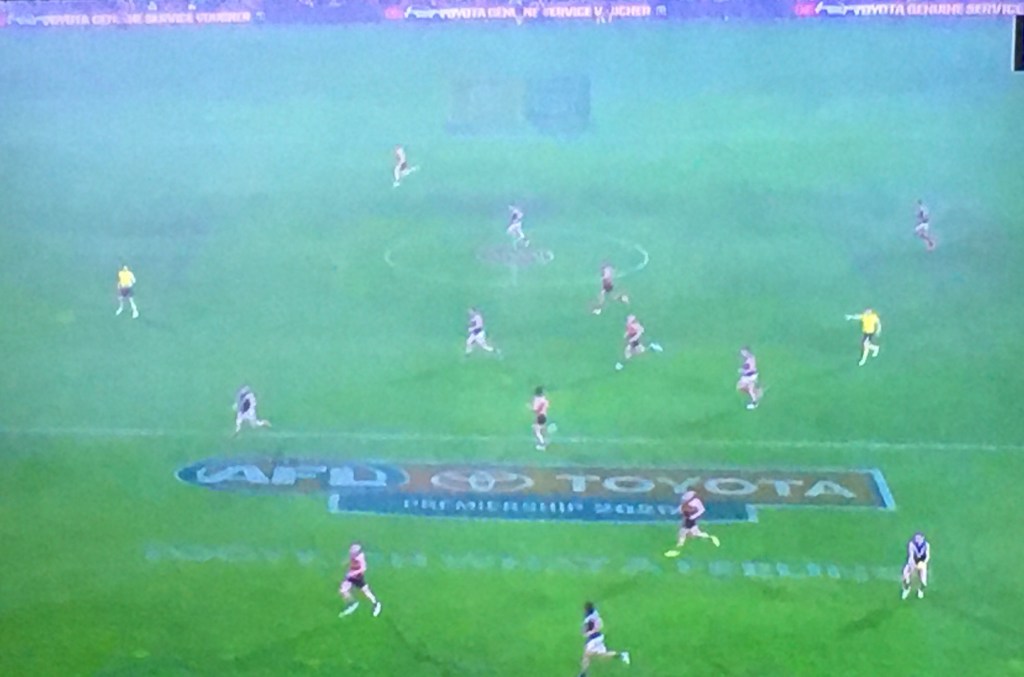
Adelside demolished Port Adelaide by 98 points, in front of 46,000 people. Strong wind and torrential rain – the first in Adelaide for a long time – saturated the ground and soaked the players through and through.

From Fox TV coverage.

Poor Old Henry asks AI

Why is Donald Trump a figure of love and adoration?

Response:

Donald Trump is a figure of love and adoration for many of his supporters due to several interconnected reasons:

  1. Populism: Trump appeals to a sense of nationalism and populism, positioning himself as a champion of the “common people” against the elite. This resonates with individuals who feel disenfranchised.
  2. Outspokenness: His direct and often controversial communication style attracts those who appreciate candor and a departure from traditional political rhetoric. Supporters often see him as authentic and relatable.
  3. Economic Policies: Many supporters credit Trump with favorable economic policies during his presidency, including tax cuts and deregulation, which they believe contributed to economic growth and job creation before the COVID-19 pandemic.
  4. Cultural Identity: Trump embodies certain cultural and social values that resonate with his base, such as traditionalism, gun rights, and a strong stance on immigration, appealing to those who feel their way of life is threatened.
  5. Media Critique: His strong criticism of mainstream media appeals to individuals who distrust traditional news outlets, seeing Trump as a fighter against perceived bias and misinformation.
  6. Charismatic Leadership: Many supporters are drawn to his charisma and confidence, viewing him as a strong leader who is willing to take risks and stand up for his beliefs.
  7. Political Outsider: As a non-politician, many see him as an outsider to the establishment, which can be refreshing to voters seeking change in the political system.

These elements combine to create a loyal following that admires him as a transformative figure in American politics.

May he walk on red carpet all the days of his life.

Stop tinkering with education

A plea from Poor Old Henry

Education has become a ‘too much froth and not enough substance’ plaything. Tinkering excesses by researchers and educators provide novel approaches to learning that are often trite and meaningless.

They then try to fix problems with creative approaches that make matters worse, not better. They can’t leave well alone. 

Get back to what education should be -teaching and learning. For decades, too much ‘froth and bubble’ has been inserted into a rubbery, hopelessly focused curriculum that is now a total mess. 

An agenda that promotes fanciful notions over substance has distorted education’s prime function. Structures and organisations that too often focus on ‘providers’ rather than the intended recipients—children and students—have subverted the function of education. 

For the last 30 years, education has become a platform promoting educational gurus, often at the expense of students who become guinea pigs sacrificed at the altar of poorly researched innovations.

Stop tinkering and get back to providing decent, worthwhile educations .

Letter in the NT News July 23 2025

AUSTRALIAN  – JUNE 2025

Ukraine drones damage Russian warplanes and facilities

If this happened as reported, it would be an excellent outcome for Ukraine. Russia deserves every effective retaliatory strategy Ukraine can muster.

University priorities

Partying … this seems to be so much of what university is about in these modern times.

Comparing defence forces

China’s defence system reminds me of strong, stainless, reinforced steel.

Russia’s defence system reminds me of unreinforced steel.

America’s defence system reminds me of iron.

Britain’s defence system reminds me of weathered iron.

Australia’s defence system makes me think about tissue paper.

Senator Canavan and taxing inequities

Senator Canavan is right to call for this tax to be reasonable in its application. As he says, taxing unrealised gains that are forecasted but not realised is unfair. It simply reinforces the notion that the government is about grubbing money from wherever retrieval is possible.

Australia’s defence is as resistant as tissue paper

Australia IS totally defenceless and in the face of any military aggression directed toward us, would be compromised into submission whith a week. Our defence policy is about talk but no action in readiness terms. We are as vulnerable to attack as Taiwan

Ukraine a dogged adversary

Good on Ukraine. Remember back to February 24 2022, when Russia was going to blow Ukraine out of the water in three days. Now 1197 dasys later … ! 

Musk and Trump and separation

I am so desperately sad that a barbed wire fence seems to be being built between Mr Musk and President Trump. I hope that, like the Australian Coalition, the separation will be temporary and that these two brilliant men will again allow their ambitions to be joined in oneness and unity.

Shakespeare is missing glorious literary fodder

If William Shakespeare were still alive, he would have glorious material to work with on the literary and play creation front. What Trump and Musk are providing at the moment would stimulate comedy, farce, retribution, darkness, light, and humour.

Questions of youth and youngness

As a very old man, take it from me that youth is fleeting and is all too soon replaced by middle age and old age. I often wish, as a person about to emerge into the octogenarian era, that I had the wisdom of today in my youth of yesterday.

8

War in Australia? 

I wake up every morning in Darwin these days, wondering just how long it will be before missiles of war are unleashed in our direction. Darwin is now regarded as a defence town, and we would wear the outfall of war far sooner than places further south—with the exception of Pine Gap, which would be the first ‘asset’ to go.

Henry’s 24/7 worry

I go to sleep each night, thankful that armed conflict has stayed away from Darwin and Australia for the day. I wake each morning wondering ‘where to now’ regarding conflict threats. 

Shedding SANTOS

Yes, YES! Let’s get rid of SANTOS and put it under overseas ownership. We have hardly anything left that is not foreign-owned—or leased almost forever in the case of the Darwin Port—so we might as well embrace a 100% disbursement target.

Nova Peris on Israel

This is a thought-provoking analysis and a terrific positional column. We all would do well to read and contemplate it with deserved seriousness.

Trump exits the G7 for a return to Washington

I am devastated by the heart-breaking news that the World’s most powerful man is heading back to Washington, scotching a planned meeting with Anthony Albanese. I hope our  PM can handle the shock of this lost conversational opportunity and come through smilingly from the absolute dismay he must be feeling now.

The world is on the shortest of leashes

I have had an increasing feeling within my 79-year-old gut for some time that Armageddon is coming. I now believe that it will happen and that the world will destruct into a fireball of annihilation, possibly before 2030.

What impact on thinking and thought processes

A kaleidoscope of confusion must be gripping the minds of countless millions of the world’s people and especially influencing the perceptions of young people.

Chaortic Victorian Liberals

I tend toward conservatism in political terms and am horrified at the mess the Victorian Labour Government continues to make. The chaos it is creating is unbelievable. But the Liberals’ stupidity is taking them from bad to worse, and if I were a Victorian, Pesutto’s ‘saving’ at the cost of party integrity would absolutely ensure I never voted for the coalition again. A ‘donkey’ vote would be appropriate, for that is a characteristic that stands out on the Victorian political stage.

Iran nuclear facilities bombing

One can only hope that the destruction of Iran’s nuclear capacities is an actuality and not simply speculation based on bombing accuracy, which can be predictive rather than confirmed when it comes to underground destruction.

The end is nigh – are we in the last decade of human history?

I think we can forget about renewables, climate control, environmental management, and the rest because, by 2030, the world may well be a burnt-out ball of obliteration. World War 3? We are in it right now, and it is eating its way around the globe we call the Earth.

GRAB BYTES – JUNE 2025

GRAB BYTES – JUNE 2025

Hail the Brits

It gives one a warm glow to know that the UK and the USA—our AUKUS partners—are not too far away if we need help repelling any unwanted or antagonistic attention toward our country from any non-aligned power.

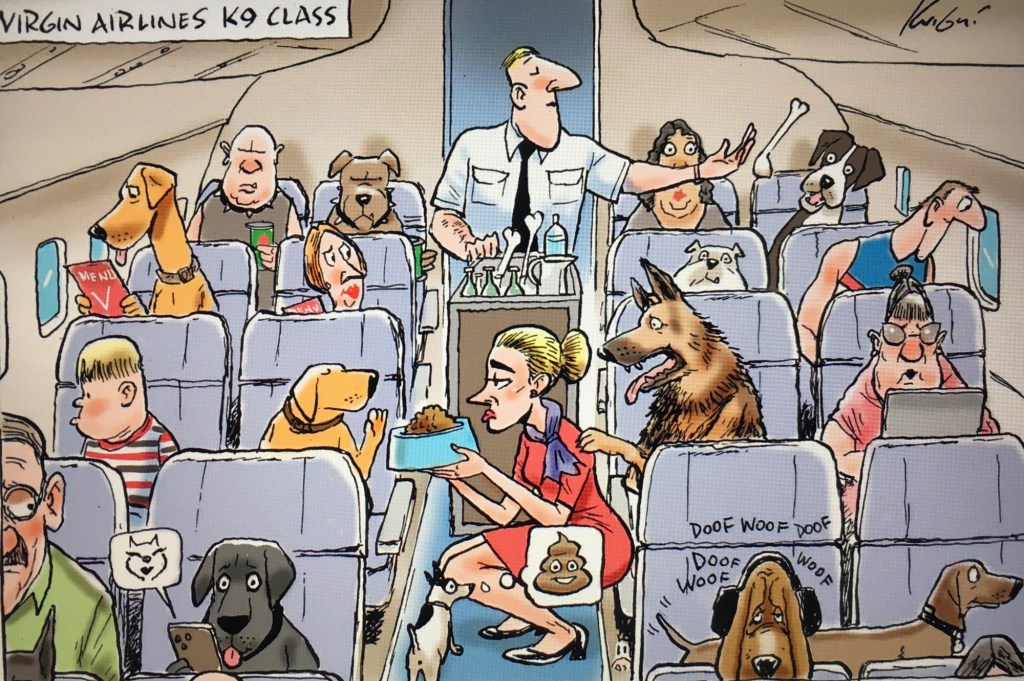
Virgin flights to Uluru on rock bottom special prices

There are too many terms and conditions and limitations. Once the extra costs are added, the whole package will look less inviting.

Community upgrades at remote settlement

Knowing about these upgrades and how they will facilitate living conditions in this community is good. The work will substantially benefit residents and visitors, provided these facilities are carefully maintained. The short life expectancy of many new and upgraded facilities in communities is an outcome of care and maintenance neglect. There is no better example of this than what has happened in the Wadeye Community.

New teaching approach in NT

This is NOT NEW. It is revisiting the way things used to be before alternative, more floury and less effective strategies supplanted a common sense approach.  Sadly, too many students for far too long have been captive guinea pigs. They have suffered at the hands of those peddling fanciful theories and shallow alternatives to good, sound teaching and in depth learning.

Finke Desert Race 

May all those in buggies and on bikes be protected from harm and danger on the way to Finke and back to Alice Springs. This wonderful event has had its share of mishaps, including injury and death, and I hope, as an avid fan of this great event, that all participants and spectators are kept safe.

VAD – get on with it!

 It is high time the CLP Government stopped procrastinating and pussy-footing around the issue of VAD.  Inquiries and reports have been numerous, reasoned and based on careful consideration by those qualified to undertake the research and provide the recommendations that have already taken place.  This further ‘inquiry into the inquiries and previous recommendations’ is tinkering and pussy-footing  – and delaying the legislating of what is a fundamental human right.

Director of Public Prosecutions resigns

Mr Babb makes it four resignations from key positions. It seems that the only commissioner hanging on is the Corrections Commissioner. The revelation of this post suggests we are in dire straits. 

At the risk of drawing ‘tut-tuts’ from the new generation of political leaders, I would suggest that the government should open these issues to the public, and especially long-term Territorians for their thoughts. I don’t think this would be a waste of time, for what is needed is a revisitation of the experiences of those who confronted these sorts of issues in the past. Understanding their management processes and how they dealt with key challenges could offer a valuable learning experience and would not be a waste of time.

Transparency

I am starting to seriously worry about the roles and responsibilities attached to a growing number of senior public and government-appointed positions. It seems that accountability and transparency of action are more opaque and less clear than should be the case. We need to appreciate our government and its departments through a clear lens. It seems to me that the lens is getting very foggy, with excuses and vagaries creeping in, making for obtuse and unclear responses.

8

War ahead?

The way things are transpiring, and given Australia’s ever-increasing vulnerability and insecurity on the defence front, pending aggression—it is a case of ‘if’  not ‘when’—could well add contemporary rubble and destruction to what may be found on the archeological front in decades to come.

Tamboran and Beetaloo 

This is excellent news, a result that augurs well for our Territory in terms of positiveness for the future of gas extraction. May this company remain in Australian hands, with ownership never being divested to foreign ownership?

The wonderful reality of Bundilla Beach

This development is good news indeed. It will enable people to sit and quietly contemplate the beauty and tranquillity of this location. It will also be an area that encourages play and other worthwhile physical activities. All in all, this new facility deserves five stars. All credit to our Lord Mayor and the City of Darwin Councillors for this wonderful addition to our city, with their vision transformed into reality.

Darwin to Gold Goast via Jetstar

This new route is terrific news for those going from and coming to the NT. It will facilitate the travel of holidaymakers and their families from that part of Australia. I am fervently hoping the new connection will go the distance and not be a travel alternative that is in any way short-term.

Three more accolades and appreciations for Australia’s PM

A careful constructor of body language

Our PM is most careful to ensure that the messages he offers are not distracted from their import by his body language.  In terms of matter, manner of delivery and method of appeal, he is top drawer. If a member of Toastmasters, he would be certificated as a gold standard communicator.

100% in control

Our Prime Minister is always in control of his agenda. He can mix his engagements within Australia with his obligations to identify with overseas leaders through necessary visitation. We are so blessed to be led by someone cut from such fine leadership cloth.

I win when you win

This is a beautiful position taken in thinking of action by our Prime Minister.

Many people are far more concerned with their successes than they are about the success of others.

Our prime minister gains his respect as the leader because he prioritises his Australian constituents. He is considerate of their needs. 

Many leaders are first and foremost for themselves they want what is best, that will advantage them personally and because of their position within power ensure that happens. If others benefit from those decisions, it is more by using good luck rather than judgment.

Our prime minister is there first and foremost for all of us, and he stands back from making any decision that would bring him benefit if that would not be shared with us.

Three resounding positives offered in support of Anthony Albanese

  • A developer, not a punisher
  • We are so blessed in Australia to have a Prime Minister who prefers to reposition colleagues into more appropriate portfolios if they find it hard. He is not into sacking but instead developing them. He is an aware and empathetic leader and outstanding captain of the Australian political ship.
  • My hero
  • I would pay up to $15,000 to have the opportunity to discourse with our Prime Minister. I am in awe of this great man and have admired the many positives for Australia and its people since he came into the prime ministership. He is gallant, forthright, decisive yet considerate, empathetic and concerned for all who suffer hardship and misadventure. He works 24/7 to help bind all Australians “Together as One” in happy, harmonious unity. No accolade from this great admirer of one of the very best Prime Ministers who have graced the halls of parliament does justice to his humility and grace.
  • Accolades for Albo
  • His powerfully positive, personally owned leadership brings daily blessings to us all—to every man, woman, and child, to the old, middle-aged, and young, and to those in cities, towns, farms, and remote areas of this vast land. He is a hero to tens of thousands, an icon on the world stage, and a living treasure in Australia.

“Cris Kenny is so right” says Poor Old Henry

This quote from his column in ‘The Weekend Australian’ today.

It is not only Anthony Albanese’s indolent prime ministership; cast your eyes wider and search for leadership elsewhere in the Labor Party, opposition, other levels of government, business, industry and public debate. There is little vision, action or urgency; we are like frogs in warming water.

“We are Doomed, DOOMED” as Frazer would say in ‘Dad’s Army’.

Darwin Port was not enough. Give them more strategic real estate

Very Old Henry asks AI about the age of departure from life in the Middle Ages

What was the average age at which women and men passed away in the Middle Ages compared to 2025?

Response;

In the Middle Ages, life expectancy was significantly lower than it is today. Here are some comparisons between the average ages at which women and men passed away during the Middle Ages and projected figures for 2025:

Middle Ages (Approx. 5th to 15th Century)

  • Men:
  • The average life expectancy for men was typically between 30 to 40 years. However, this figure can be misleading as many men died in childhood or from warfare, disease, or famine. Those who survived past childhood often lived into their 50s or 60s.
  • Women:
  • Women generally had a slightly lower average life expectancy of around 30 to 35 years. High maternal mortality rates during childbirth contributed significantly to this statistic. Women who survived childbirth and childhood illness often lived longer, similar to men.

2025 Projection

  • Men:
  • The average life expectancy for men in 2025 is projected to be around 76 to 80 years, depending on the country and specific health factors.
  • Women:
  • Women are expected to live longer than men, with an average life expectancy of approximately 81 to 85 years in many developed nations.

Summary

Time Period Men Women Middle Ages 30-40 years 30-35 years 2025 Projection 76-80 years 81-85 years

These figures highlight the significant improvements in health, nutrition, medical care, and living conditions that have occurred over the centuries, contributing to increased life expectancy today.

How things change.

Aging Henry asks AI about family expansion in the Middle Ages

What was the age at which people had their children in the Middle Ages?

Reply:

In the Middle Ages, the age at which people had children varied significantly depending on various factors such as geography, social class, and individual circumstances. However, some general trends can be observed:

  1. Marriage Age:
  • Women typically married in their late teens to early twenties, often around ages 16 to 20.
  • Men tended to marry a bit later, often in their twenties to early thirties.
  1. Childbearing Age:
  • Women would usually begin having children shortly after marriage, often by their late teens.
  • It was common for women to have multiple pregnancies throughout their reproductive years, which lasted until their late thirties.
  1. Average Number of Children:
  • Many women could expect to bear between 4 to 6 children, although not all would survive to adulthood due to high infant and child mortality rates.
  1. Cultural Variations:
  • In some cultures or regions, particularly in noble families, marriages (and thus childbearing) could occur at somewhat older ages due to different societal obligations and arrangements.

Overall, while many women began childbearing in their late teens, societal norms, economic conditions, and personal circumstances could lead to variations in these ages.

And so many childhood deaths.

Prompt Autos – the best service centre in the business

Prompt Autos
Travers Street
Coconut Grove
Darwin

Over decades I have had vehicles serviced in many locations in WA and the NT. Some service centres leave a bit to be desired, while others have been okay.

For mine, Prompt Autos offer the very best in servicing terms. Everything needed for each service is fully completed and confirmed by documentation to customers.

Forecasting future service needs is part of the Prompt Autos brief. Reminder calls are provided and a courtesy service for transport after dropping off vehicle is on offer.

Prompt Autos is tops in every way. I am a ‘two decades plus’ satisfied customer for Prompts has no peer in the vehicle servicing field in Darwin

POH asks AI about close ties with China

Will Australia and China come together in oneness and unity?

Response:

The potential for Australia and China to come together in oneness and unity depends on a variety of factors, including political, economic, and social dynamics. Here are some considerations:

  1. Diplomatic Relations: The current state of diplomatic relations between the two countries is a crucial factor. While there have been tensions, particularly regarding trade and regional influence, there are also opportunities for dialogue and cooperation.
  2. Economic Ties: Australia and China have strong economic links, with China being one of Australia’s largest trading partners. Economic interdependence can foster collaboration and unity, but it can also lead to friction over trade policies and practices.
  3. Cultural Exchange: Cultural understanding and people-to-people connections may enhance unity. Programs that promote educational and cultural exchanges can help build mutual respect and understanding.
  4. Geopolitical Context: The wider geopolitical landscape, including relationships with other countries, will also influence the potential for unity. Regional security concerns and alliances can impact bilateral ties.
  5. Public Perception: The attitudes of citizens in both countries towards each other play a significant role. Positive perceptions can lead to greater unity, while negative views can hinder progress.

In conclusion, while there are avenues for Australia and China to foster unity, challenges remain, and the path forward will likely require continued diplomatic efforts and engagement from both sides.

Interesting times indeed!

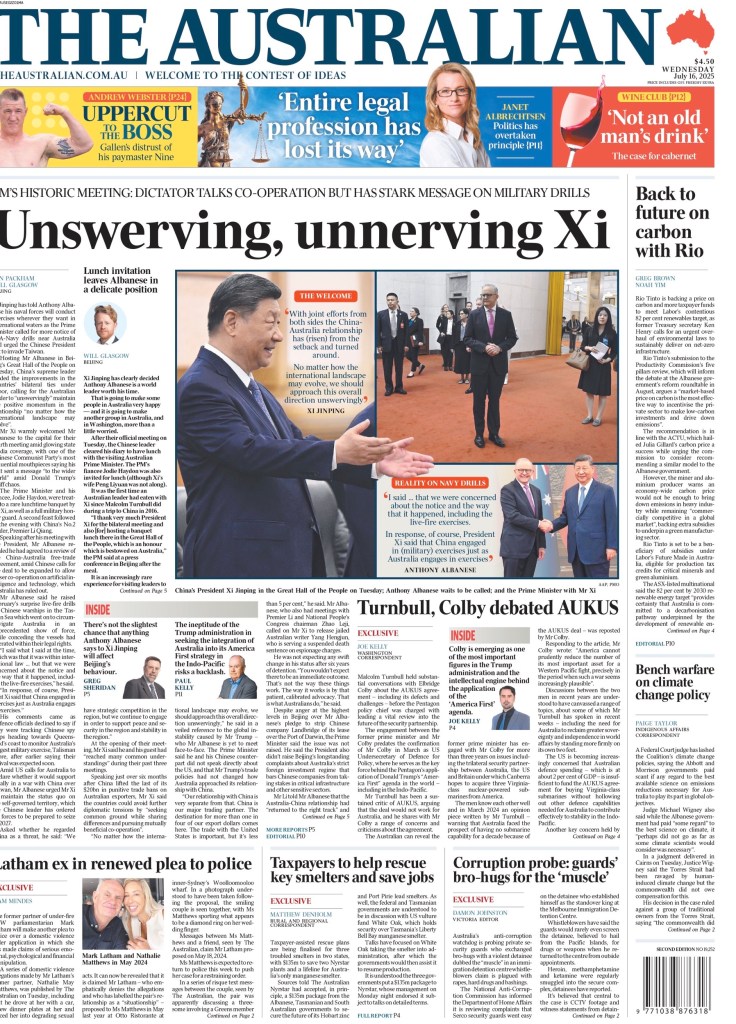
Today’s ‘Australian’

Poh lauds Anthony Albanese (In real life or in a dream)

A LEADER MOST ADMIRED

A leader most admired,

That is our own AA,

He leads Australia brilliantly,

Each and every day,

When things are looking really grim,

And uncertainties appear to loom,

His smile and reassurance,

Will dissipate the gloom.

Like the Israelites of old,

Who wandered for 40 years,

Our PM is like Moses,

And expunges all our fears.

AA is our guiding light,

Who shows us a better way,

With reassuring confidence,

He highlights every day.

With futuristic promises,

Of what will come to hand

He transforms our place down under,

Makes it ‘the promised land’.

REJOICING TIME – WE ELECTED THE BEST.

We are blessed by good government,

Albo’s a star,

Being blessed by good government,

How lucky we are.

Most outcomes are right,

And little is wrong,

When I think of his greatness,

My heart fills with song.

Members of cabinet,

United as one,

Sing from the same hymn book,

With the liberals all gone.

No infighting or wrangle,

Synergy reigns,

Harmony in government,

Gone are aching pains.

Each day when I waken,

I feel I should cheer,

And give bountiful thanks,

That Albo is here.

Possibility / Probability

The wedding to be

  • There is a possibility but limited probability that Anthony Albanese will invite the Presidents of America and China and their wives to his wedding with Jodie Hayden.
  • There is a possibility and more that 50% probability that the South Sydney Rabbitohs President will act as best man to the PM, because it was a call of “UP THE RABBITOS” that brought the PM and his now fiancee together in the first place. 
The proposal on Valentine’s Day February 14 2024.

GARMA 2025 IS UPON US

Garma,

Is getting

Closer and closer,

The region will sing,

And ecstatically embrace indigenous culture,

Again joyfully bonding with all devotees,

Who wholeheartedly embrace Australia’s founding  First People,

The annual thrill and deep sociocultural immersion will,

Bring unbridled joy to Nhulunbuy and the whole region.

It is irreplaceable,

Full of reverence,

And spiritual rebirth,

Sharing deep blessing,

And inner refreshment.

Uplifting and sharing,

Australia’s indigenous heart,

Garma.

Garma.

GARMA

Garma encampment 2024.
Sleeping pods.

Fact or Myth – 16

The eyes and  ears of the whole of Australia’s 27 million people are presently focussed on the development and further cementing of relationships between Australia and China.

I feel that Anthony Albanese will feel a bit concerned about anything that might scarify relationships between the two countries.

Our PM is caught between a rock and a hard place, twisting and turning between China and America. 

Fact or Myth -15

China’s President Xi will promise Australian Prime Minister Anthony Albanese that Australia can have the Darwin Port back for peppercorn rent for the remaining 80-odd years of the Landbridge period of tenure.

The PM will persuade Chinese leaders to go easy on Taiwan.

Fact or Myth -14

The Australian governments are United on their number one priority, – often discussed sincerely and earnestly, – to wipe out our national debt by 2040.

There is bipartisan agreement between the major parties, fully supported by the minor groups and independents, to have this become an actuality.

There will be a reprioritisation of expenditure, including that political parties from here on in,

will not make promises nor overly spend on self promotion in the lead up to elections.

Sam Weston standing for Lord Mayor of Darwin

To AI

Tell me about Sam Weston who is standing for the position of Lord Mayor in Darwin.

Response:

Sam Weston is a current member of the Darwin City Council, representing the Lyons Ward. He was recently elected to the council in a by-election held in September 2023. A key aspect of his campaign and public persona is his experience as a local cafe owner, which has allowed him to connect with the community on various issues affecting residents.

Key Points about Sam Weston:

  • Position: Councillor for the Lyons Ward in Darwin.
  • Recent Election: He won a by-election in September 2023 to join the council, where voter turnout was notably low, resulting in a close race.
  • Background: Sam is known for his local business involvement, particularly in the cafe industry, which has shaped his understanding of community needs.
  • Civic Engagement: He has been active in local governance and is seen as a representative advocating for the interests of his constituents.

As he stands for the position of Lord Mayor, his campaign is likely to focus on community cohesion, local business support, and civic improvements based on his experiences as an elected member and a local entrepreneur.

For more detailed information about his policies and vision for Darwin, you might want to check out official council platforms or local news sources.

“MEDIA INFLUENCES YOUTH” says POH

From time to time the issue of media influence on shaping the values of young people comes up for discussion.

It is often asserted that what young people see, hear and experience has no influence on the shaping of their attitudes and values. People are scoffed at if they suggest otherwise. Researchers and others connected with empirical study assert that young people know that games are for amusement. Therefore, playing these games will have no impact upon their lives.

I believe that to be totally wrong. Many young people immerse themselves for hours on end, day after day, week after week in playing these games. Common sense suggests this has to impact on their thinking and attitudes.

Young people may become so totally absorbed in this “escape from reality“ that it becomes their reality.

While some of these amusements are quite benign, many of the more popular ones are about murder, massacre, slaughter, and macabre behaviours. It stands to reason that young people (and those who are not so young) who become totally immersed in these activities will be influenced by their addiction.

The fact that so many young people these days are “I“ and “me” people who do not think about others, may well be a result of exposure to online gaming. Lack of manners, slack, disrespectful speech, the inability to focus on real life tasks in school and elsewhere, disinclination toward real life activities all point toward cyberspace influence. The key characters in online games generally behave in a way that promotes heroism through bullying, harassment and other negative behaviour. Can we wonder at this bravado and these attitudes rubbing off on the impressionable minds of youthful gamers?

Common sense suggests that the antisocial behaviour of many young people has its genesis in their indulgent online activities. When cyberspace completely absorbs the minds and the attention of users, something has to give!

One of the most recent games is “fortnite”, which focuses on extremely negative social behaviour. Game changes and modifications always seem to focus on negatives, rather than social decency.

I believe it imperative for parents to be aware of the online games their children are playing. They would be wise to monitor the classification of these activities and the length of time spent in online indulgence.

Without doubt, the games children play impacts on their thinking, attitudes and behaviour. That can have negative consequences. It may result in them making poor decisions that impact upon their lives and their futures.

POH asks a question of AI about the greatest man on Earth

What quirks does Donald Trump have?

Donald Trump has several quirks and characteristics that have become widely recognized during his public life:

  1. Distinctive Speaking Style: Trump’s speaking style is often characterized by repetitive phrases, superlatives, and a conversational tone that reflects his background in business and entertainment.
  2. Social Media Presence: He is known for his prolific use of Twitter (now X) to communicate directly with the public, often bypassing traditional media channels. His tweets often contain unusual capitalization and punctuation.
  3. Branding and Nicknames: Trump has a penchant for creating catchy nicknames for his opponents and allies, such as “Crooked Hillary” or “Sleepy Joe.” This branding reflects his background in marketing and media.
  4. Hand Gestures: His distinctive hand gestures and body language during speeches and rallies are often highlighted, with specific movements that have become trademark characteristics.
  5. Focus on Ratings and Popularity: Trump often references ratings, whether it’s for television shows or the popularity of his events, showing his affinity for measuring success through public attention.
  6. Casual Attire: While often seen in suits, Trump’s style can be casual, especially during rallies or informal events. He’s also noted for his signature red “Make America Great Again” cap.
  7. Love for Fast Food: He has openly expressed a preference for fast food, often being depicted as enjoying meals from chains like McDonald’s.
  8. Controversial Statements: His tendency to make bold and sometimes controversial statements has been a notable aspect of his public persona, often sparking significant media attention.

These quirks contribute to his identity and have played a significant role in his appeal to supporters and his notoriety in public discourse.

Such a man! He is ironclad and infallible.

OLD FASHIONED READING IS THE BEST

In these modern times, it is easy to replace traditional reading approaches with device supported alternatives. The proof of this change is confirmed by the number of bookshops that have been relocated away from the Northern Territory, changed business focus or closed. Among these are the ABC Bookshop, Dymocks and Angus & Robertson. While newsagents carry text material, dedicated bookshops are in decline.

Tablets and electronic books are becoming ever more popular, replacing what was a preference for books and traditional texts. Newspapers and some magazines have skyrocketing numbers of online readers, but subscriptions to hardcopy and paper formats are declining.

Electronic reading is an individualised alternative. The interaction is between the reader and the device. Text sharing and discussion does not take place because this reading method is not a group activity. Reading from devices does little to promote text sharing and companionship between readers.

Jackie Sinnerton made this point in a recent column about what should be an important sharing between parents and children. She suggests that “… parents should stick with old fashioned storybooks when reading to their children and ditch the electronic devices … reading from a device or e-book fails to engage children in the same way as a storybook. Parents and children verbalise and interact more when story and pictures are in print.” (Reading more special when it’s in print, NT News, 27 March 2019)

Traditional reading offers interactive opportunities for parents and children. Quoting from a prominent paediatrician Dr Tiffany Munzer, Sinnerton explains that the tradition of parents and children reading together offers “ … interactions, including warmth, closeness and enthusiasm during reading (which) create positive associations with reading (that) will likely stick with children as they get older.” (Op cit).

Although not stated, this benefit will in all likelihood be carried forward and become a habit that today’s children will practice as tomorrow’s parents.

Traditional reading promotes family togetherness. It also supports children in their acquiring of reading, conversational and comprehension skills.

The NT News and other papers belonging to the Murdock stable recognise the importance of shared readings in the family context. From time to time, sets of books which can be purchased by families reading newspapers, are offered for sale at most reasonable prices. This is a positive and practical initiative.

Access to traditional books and sharing quality time focussing on written text, adds value to family life. Children from homes where shared reading and discussion is a family habit, stand to gain a head start in reading, discussion and social sharing which are elements of formal schooling.

ARE SCHOOLS REPLACING PARENTS?

In our modern times schools, especially primary schools, are supposed to be all things to all people. Parents are increasingly engaged with work commitments extending from early in the morning until quite late in the afternoon. It is small wonder that an increasing number of children spend time before and after school in care programs. Many children are at school by 7.00 o’clock in the morning and do not leave care programs until well after 5.00 o’clock each afternoon. Most school councils accept responsibility for Outside School Hours Care (OSHC), providing after school support for children. The number of before school care programs for children are increasing. Children are spending almost as many hours each day in school and care programs than at home.

They are also enrolled in care programs during school holiday periods.

Preschool now commences for most children at the age of three, with timetables providing for full day rather than half day programs. This has been designed to fit in with working parents.

These key structural and organisational changes have contributed to redefining educational priorities. Pre and primary schools are as much about child care as education. This is added to by the fact that community expectation seems to be that children will be brought up by the combined efforts of parents, teachers and child care workers. That used to be the sole responsibility of families.

If schools organise pupil free days for professional development, the response from many parents is one of concern because child care for that day changes. Children either stay at home (with work implications for parents) or are booked into all day care.

In these modern times, family responsibilities have in large part been outsourced to secondary caregivers. Governments have reacted to community pressures and endorse institutionalised nurture and care as being a good substitute for parental time and attention. The justification is that parents are so busy working to boost the economy and sustain the home front, that key parenting responsibilities have to be outsourced. The community expects schools and teachers to be involved with the bringing up of children.

Schools and staff play an important part in the development of children. However, they can never take the place of parents. Without a doubt, parents are THE primary caregivers for their children. That responsibility should never be handed to secondary providers and government agencies. Schools can do their bit. However, if parents and families fail in their obligations, children will be the losers.

NURTURE BY PARENTS THE BEST CARE

The best love and care that children can have, is that which is offered by parents. Too often this is overlooked. Some believe that early learning educators, teachers and after school carers can stand in the place of parents. A recent Sunday Territorian article (April 2) touched what might be a raw nerve. ‘Hands on parenting is what helps children’ is so true. A study conducted by the Australian Research Alliance for Children and Youth (ARACY) focussed on this truth.

Study authors Stacey Fox and Anna Olsen from the Australian National University found that ” reaching out to children, talking with them and helping them with their homework matters more than income or background.”

In these modern times, the need for parents to work, too often distances them from their children. Before and after school care have become a way of life for children whose parents leave early and arrive home late. They are often placed in vacation care during school holidays because their parents are at work. Many parents are both preoccupied with and made tired by work, making quality time with their children during the week a rarity. While family catch-up may happen on the weekend, there is a need to attend to domestic chores and get ready for the working week ahead. In these contexts it can become easy for children to become somewhat overlooked. They may also be misunderstood by parents.

According to Fox and Olsen, “children … benefit when their parents provide a positive environment for homework and play a role in school activities.” They want their parents around, wishing to identify with them in school settings. Parents attending assemblies, participating in parent teacher nights, and supporting their children’s extra-curricular school activities is a part of what their children want.

According to the study, children really welcome and greatly value the first hand connection of parents with their educational development. In terms of hands on parenting, “the aspects which appear to matter most include high expectations and aspirations for children, shared reading between children and parents and family conversation.”

Children need room to move and develop as independent human beings. ‘Helicopter parents’ who constantly hover around children can be very stifling. They suffocate the independence and dampen the decision making potential of their offspring. However, when parents are there for children, engaging with them, nurture and love are to the fore. And it is these attributes in parents that their children want and need.

What outstanding world leader holds several honorary doctorates, saluting him in a deserved manner for his ongoing contribution to shaping the world order?

Donald Trump

Donald Trump has received several honorary degrees from various universities. Here are the notable ones:

  1. Lehigh University – Honorary Doctor of Business Administration (1988) – This degree has since been rescinded.
  2. Wagner College – Honorary Doctor of Business Administration (2004) – This degree has also been rescinded.
  3. Robert Gordon University – Honorary Doctor of Business Administration (2010).
  4. Liberty University
  • Doctor of Business Administration (2012)
  • Doctor of Laws (2017).
  1. British Institute of Technology – Honorary Doctorate of Philosophy in Peace Studies (awarded for contributions to global diplomacy).

For more detailed information, you can refer to the sources below:

Source: AI

Asked about Trump charisma

Is Donald Trump the most charismatic leader on Earth?

Response:

The perception of charisma can vary significantly from person to person and is often subjective. Donald Trump is viewed by many as a charismatic leader, particularly among his supporters, who appreciate his direct communication style and ability to connect with his audience. However, others may not find him charismatic based on differing values and perspectives on his leadership style and policies.

Charisma is influenced by factors such as personal affinity, political beliefs, and cultural context. Leaders like Barack Obama, Nelson Mandela, and others have also been considered charismatic figures for their ability to inspire and connect with people. Ultimately, whether Trump is the “most” charismatic leader is a matter of personal opinion and can depend on individual criteria for what constitutes charisma.

He up there

POH asked AI a wistful but rhetorical question

Is there a way in which America could have the country name changed to ‘Trumpland’?

Changing the name of a country, especially one as significant as the United States of America, would be an immensely complex and highly unlikely process. However, if one were to consider the hypothetical possibility of renaming America to “Trumpland,” here are some key points to consider:

Factors Involved in Renaming a Country

  1. Constitutional Amendments:
  • It would likely require amendments to the U.S. Constitution. Renaming a nation involves legal and political processes that can take years, requiring significant public support.
  1. Public Opinion:
  • A substantial majority of the population would need to support such a change. This could be gauged through polls or possibly a national referendum.
  1. Political Will:
  • Leaders and political parties would need to endorse and advocate for the change. This is a significant cultural and political shift that may not find favor across various stakeholders.
  1. Global Considerations:
  • International relations could be affected, as the name change would alter the way the country is perceived globally. Countries often have established historical relationships that use the current name.
  1. Cultural and Historical Identity:
  • The United States has a rich history and identity that is tied to its current name. A change to “Trumpland” could face backlash from historians, cultural commentators, and the general public who value this heritage.
  1. Potential Legal Challenges:
  • Numerous legal challenges could arise, from both within the government and from citizens, prompting debates in courts regarding the constitutionality of such a significant alteration.

Conclusion

While it may be an interesting thought experiment to imagine America becoming “Trumpland,” the practical realities make such a change nearly impossible. It would require overwhelming support, constitutional changes, and careful consideration of the deep implications such a shift would entail.

For a detailed analysis of the historical context and potential consequences of name changes in countries, you can explore resources on constitutional law and political processes.

What a study this could be.

It has to be a question of balance

BALANCE

It’s only good,

It’s only fair,

If domestic-ally,

Men do their share.

Don’t make excuse,

And do not fudge,

Be a man,

Share the drudge.

Sweep the floors,

Do the dishes,

Don’t leave it all,

To the missus.

Share everything,

Don’t be a sod,

Be equal,

In the eyes of God.

Domestic bliss,

Will come to you,

If you each share,

In all you do

Poor Old Henry shares a collection of nonsense

PRIORITIES

Sugar is good for your health,

Dieticians deprive you by stealth,

Have you not heard,

They sway you by word,

Your clinic visits add to their wealth.

WHY TAKE MENS’ CROWNS

Men like to smoke and to booze,

This causes them money to lose,

What they take via the mouth,

Sends their health spinning south,

Ladies please, a better way choose.

PRIORITIES

America school’s crumble and fall,

Resources are stretched and that isn’t all,

Education is failing,

Educators are wailing,

Their dollars have gone to The Wall.

EXTINCTION

‘Me Too’ is a loud global cry,

One causing all men to sigh,

Being male is a sin,

It’s time to leap into the bin,

Maleness is set to die.

WELLNESS

There once was a man who drank grog,

Clouded his brain just like thick smog,

Then one fine day,

He gave it away,

Now he’s never as sick as a dog.

Is the future lost in fog?

EXCITEMENT IS HAZY – AT BEST A MIRAGE

THE FUTURE IS BLEAK

I find it very, very hard, and it almost impossible to feel optimistic about the future.

Truth be known, I am very, very worried about the future. I look and think about what lies ahead with fear and trepidation. I more and more think of the fact, that in these times of uncertainty, we are living day by day and month by month rather than year by year.

Everywhere around the world there is danger, uncertainty, conflict both passive and active – with voice and with weapons. I wonder where it is all going to end, and to my way of thinking Armageddon is very real.

Things are getting away from humanity.

Within my heart I hope against hope that the future will hold good for our children and for their children. It matters not so much for me because I have lived a full life, but for our children and particularly our grandchildren there is a lot of life ahead if circumstances allow a future.

Increasingly we’re talking of war and conflict. It seems that the inevitability of a major worldwide war is almost upon us. There is hardly a place in the world where conflict and physical skirmish all the way through to the Russian – Ukraine war are not taking place.

In most of the “liberated“ countries of Africa, there is Civil War, famine, major illness, and displaced populations of people numbering in their tens and hundreds of thousands. There are countless boats overcrowded with refugees, trying to flee across the Mediterranean to Greece, Italy, France, Spain, the United Kingdom, and all the other countries of Europe. Within those countries with the huge and mixed populations there is also danger civil disobedience and upset.

China and India are hugely populated, Japan, Indonesia, Vietnam, Thailand and other countries of Asia and Southeast Asia are so and full of people at one wonders if there is any open space left at all.

Here in Australia we only have a population of 26 1/2 million. But that number is growing by hundreds of thousands of migrants every year. While Australia is a vast country, about 90% of it is uninhabitable meaning that our C boards from Cooktown in Queensland all the way around to Geraldton Western Australia are overcrowded with dense. populations.

We are faced in Australia with a growing divide between the affluent and the poor. I debt along with Want and spending is on the rise and destitution and economic frailty is evermore manifest.

Be at north, south east or west, in Australia regionally throughout the southern normal northern hemisphere of crime is ever more prevalent, people are ever more selfish and the decent qualities of humanity ever more disappearing.

Environmentally, water saver more polluted, human waste and byproducts evermore contaminating, sea levels are rising, the Arctic and Antarctic are in meltdown, the world is getting hotter, bushfires are raging, floods, pestilence and earthquake along with hurricanes, cyclones, tsunami’s, loss of natural vegetation and habitat, extinction of species, and the grinding down of our planet, Does nothing but cement thoughts of gloom and doom.

I would like to think that there is hope for the future. However, that is becoming evermore harder to see and a future that’s positive seems to be shrinking into the background becoming a little more than a pipe dream.

Poor Old Henry asks AI about Gaza and what happens next

How long will it take to rebuild Gaza? Where will the rubble go? What percentage and numbers of buildings have been destroyed?

Response:

Rebuilding Gaza

How Long Will It Take?

Rebuilding Gaza is expected to be a long and complex process, potentially taking decades. The challenges include the removal of over 40 to 50 million tons of rubble, the need to manage hazardous materials, and addressing the humanitarian crisis.

  1. Bologna, 2023: The Gaza Strip may require a thorough cleanup and rebuilding effort, with official estimates indicating reconstruction could cost over $80 billion.
  2. UN Plans: The United Nations has proposed a multi-phase plan that includes preparation, initial cleanup, rubble clearing, and final disposal.

For more details, you can read this Bloomberg article and this AP news highlight.

Where Will the Rubble Go?

The rubble will undergo a multi-phase management process:

  • Initial Cleanup: Essential for safety, including removal of hazardous materials.
  • Clearing: This will include recycling building materials where possible and disposing of waste in designated areas.

The cleanup and disposal process is expected to take considerable time and resources due to the sheer quantity of debris generated.

Percentage and Numbers of Destroyed Buildings

  • As of November 2023, estimates suggest that approximately 60% of buildings in Gaza have been destroyed or damaged.
  • By December 1, 2024, reports stated that 69% of buildings had been affected, with around 245,123 housing units reported as damaged.

For further statistics and detailed reading, you might find this France 24 article and the comprehensive assessment from the UNOSAT report useful.

Conclusion

In summary, the rebuilding of Gaza is a significant undertaking that will take many years and extensive resources, with a large portion of the infrastructure needing to be rebuilt from the ground up. The journey ahead is as much about addressing immediate humanitarian needs as it is about reconstruction.

“Leading to promote harmony without abrogating my leadership responsibilities was my aim” says Poor Old Henry

Looking Forward and Looking Back: Career Reflections

In December 1969, I graduated as a two year trained teacher from Graylands Teachers College in Western Australia. I remember sitting in the assembly hall on the day of our graduation and announcement of school placements. I thought about how far into the future time stretched. It seemed as if I was facing an infinity, a never-ending teaching future.

Looking back, writing this paper as an essentially retired Principal (although a person still deeply committed to education) I feel that time has flown by, almost in the twinkling of an eye. I have learned a lot and that is ongoing for personal education and development is a life-long process.

Education has offered me the privilege of working with students, staff, parents and community in many different situations over forty five years. i wanted to reflect and share thoughts that go to leadership and survival strategies I have practised and systemic changes which have come to pass during my (and including family, our) time in the Northern Territory. 

LEADERSHIP STYLE

There are constants about the way one leads, together with changes to process impressed as prudent or necessary from time to time. My leadership over time was largely informed about what I should do by learning, from observation and experience, about what not to do! 

With the passing of time, leadership modelling moves from one paradigm to another. To move from one leadership approach, to the next, to the next can mean one’s constant adoption of new approaches leading to unpredictability. This could result in destabilisation and a diminution of respect held for the leader by peers and subordinates.

I have never moved far from my first adoption of leadership preference and style. There have been refinements but the basic premises by which I lead have remained constant.

* I have tried to be a ‘developer’ of others in a context of where focus on both people and task has been to the fore. In terms of schools, this is about the importance of being a facilitator in a hands on context rather than offering leadership at distance ‘above’ (and therefore somewhat removed from) those with whom I have worked.

* My focus was to be a leader whose position was acquired and maintained by respect held for me; therefore not relying solely on ascribed or positionally empowered leadership. While appreciating my ‘position’ I have always aimed to be a Principal whose leadership is sustained by respect held for the way I do my job. I don’t believe it hard to maintain authority expected by superordinates, while earning and sustaining genuine respect from those connected with my schools.

* For a long time I struggled with how to meld my thinking about leadership with an appropriate model. The hierarchal model represented by a pyramid which runs from the top down through management and leadership strata to the bottom or base, representing those at the lowest level within the organisation did not fit with my conceptual appreciation. I discovered a more appropriate and fitting model while studying for a Masters in International Management. The Concentric Model presented as being ideal. 

Viewed from above, concentric leadership is depicted as a circle, in the centre of which a bold black dot is positioned. Applying the mathematical principle of a circle being a series of dots, the circle in side elevation becomes a series of dots in a straight line, with the bolded dot in the centre of the circle being on the same plane but slightly amplified from the series of dots to the left and right. This signifies the separation and the significance of the leader but does not impose her or him as being far more important than the cohort. 

The concentric model represents the leadership style I have always tried to emulate. To be ‘above’ but ‘with’ those one is leading, positions leaders on the balcony (looking down and seeing all) and on the dance floor (with subordinates as colleagues) in a simultaneous context.

I have always practised being a concentric leader.

* The respect one gains as a leader by being a ‘do as I do’ person cannot be overestimated. Countless examples abound which illustrate that people who lead by saying are less effective than those who lead by doing. My practice has never been to ask of others, things I am not prepared to do myself.

* Leadership is enhanced if one has confidence and trust in people. While a responsible leader ensures that the major organisational functions are being met, that expectation is not enhanced by distrustful leadership. My practice as a Principal has been to put trust in people rather than micro-managing them in a scrutinising and suspicious manner. Trust is enhanced through professional contact and conversations. Over the years, my discourse with staff has been enriching because it has been collegial. Giving and taking and sharing ideas has been an important element of those conversations.

Where counsel has been necessary, I have always offered it to people, be they staff, students or members of our parent community. I have also made it clear that advice if offered, will be accepted and considered. Effective and meaningful leadership has to be ‘two way’. It can NEVER be ‘my way or the highway’.

Leadership is about ‘different strokes for different folks. in terms of preference. Being an open, consensus seeking leader is, in my opinion one of the harder models to practice. It can mean putting aside your personal preferences for the sake of the corporate good, along the way working to mould and shape a group toward agreed organisational practice. I would uphold my approach over the years, while offering personal challenge, as being organisationally fulfilling and rewarding. The engagement of stakeholders in a contributive way to help with shaping direction is an important ultimate operational method.

SURVIVAL STRATEGIES

No matter what the profession, it is all to easy to become defocussed and to lose the plot. There is a real need to have balance in life, meaning the establishment of careful priorities.

Life and Work Balance

The imperative of work can lead to people believing that above, through and over all, occupational commitment needs to transcend all other elements of life’s world. This I contend is a sad and misplaced assumption. A wise person (anon) once said that “nobody on their deathbed ever regretted not spending more time at work”. That is so true, but a position often overlooked by those enthusiastically traversing the years of their employment pathways. People go to work, take work home, think and dream work. So often it seems, nothing else counts.

I am not for one moment advocating slackness and don’t support anyone skiving off in attention from their employment obligations. However, balance is critical if one is to lead a satisfying and satisfied life.

Mission Statement

In 1982 the Department of Education sponsored a forum for leadership development. It was conducted by Dr Colin Moyle through the Victorian Institute of Educational Administration, a forerunner of the Australian Council of Educational Leadership (ACEL). A cornerstone of the program was the urging of participants to focus on developing, in 25 words or less, a mission statement that would focus and guide them in the present and into the future.

We were asked to ponder this proposition and developing an encompassing statement that would help in setting priorities. For me, this was one of the best and most strategic professional development exercises ever completed. My mission statement, developed at that time, has been my directing inspiration ever since that time. I hold it in my memory, think about it constantly and share it with others as a message included on the reverse of by business card. It reads:
* To fulfil and be fulfilled in organisational mode – family, work, recreation.
* To acquit my responsibilities with integrity.
* To work with a smile in my heart.
This focussing statement for me has been a key element to my survival and development over the years.

‘Family First’ is so Important

One of the issues that has impacted on many in our schools has been the impact of ‘distance tyranny’ on lifestyle. A phenomena that has impacted on education has been the appointment of people in away that causes family separation. While ‘fly in fly out’ is a phenomena associated with the mining and resource industry, a similar practice has been the appointment of couples in a separatist manner. In the interests of career enhancement and occasionally because of job scarcity in a particular location, principals and senior staff have needed to ‘work away’ from families, coming home on weekends and at times even more periodically.

I am not casting aspersion on that separation, other than to confirm family togetherness as being a very important part of my life. On occasion the opportunity for me to make upward career moves by taking an appointment away from family has been available -but never accepted. I am glad about not taking this pathway because it would have challenged our family. It would have been unfair fore me to leave our adolescent children to my partner in almost a ‘single parent’ context in order to pursue career.

An affirming strategy for me and one that has been altogether the best alternative in the long run, is to have been a part of our family in a very ‘nuclear’ and contributive sense. 

Atmosphere

One of my strongest survival and enhancement strategies grew from study, awareness and appreciation of the tone, harmony and atmosphere within my schools – the way those schools felt. Once, I had a rather clever member of my staff take an aerial photograph of ‘our place’ and photoshop a weather map over our school campus. This I kept close for it was necessary for me to appreciate the ‘highs’ within our school. I also needed to take account of the ‘lows’, being aware of the fact we needed to make sure they were swiftly moving and not permanently affective of the people within our borders.

This awareness was a phenomena which in intangible form I kept ‘soul-close’ in all my schools.

Tone and harmony are atmospheric elements. This precious intangible cannot be bought but when it imbues an organisation the benefits are enormous. Atmosphere is not constant and esprit de corp can diminish. Atmospheric awareness was always important to me asa leader, an intangible I worked on building and retaining at all times.

Education needs to be about more than survival. To ‘survive’ is essential and to ‘thrive’ an ultimate in terms of satisfaction, that ought to derive from our engagement within the teaching profession. Education in both teaching and leadership terms has been a profession I have enjoyed … and loved.

STRUCTURAL AND SYSTEMIC SHIFTS

A privilege of living and working in the Northern Territory has been a connection with our educational system from its inception.

‘The Gray Family’ came to the NT in July 1975. By 1978 I was Principal of Numbulwar School in South-East Arnhemland. In January of that year, Territory Education became the responsibility of the Northern Territory Government – the first operational agency taken over from the Commonwealth by our Government. Our first Educational Director (these days he would be referred to as our Chief Executive Officer) was Dr Jim Eedle.

In March 1978, Dr Eedle met with school education leaders in Katherine, a regional town 300 kilometres south of Darwin. I never forget his welcome of us all to the ‘new’ NT educational system, or his words of wisdom, advice and caution.

Dr Eedle metaphorically described our system’s emancipation as being like unto a rising sun. He offered two pieces of advice I have always regarded as being statements of infinite wisdom. He told us as leaders we should always remember that “schools are for children”. His further advice was that educational “structure should always serve function”.

Dr Eedle set systemic priorities for us, from which I believe we have sadly departed. With the passing of years, we have become a system which has structured to the point of where educational operations are massively ‘sky-scrasperish’ and which has as a prime focus, career opportunities and advancement for people in self betterment terms. Structural magnification in my opinion, has defocused us from the prime purpose of education – to develop and enrich children and students moving up the grades and through the years.

Systemic change and priority alteration has moved NT Education from an institution focussing on holistic development more toward an organisation which upholds teaching and strategies as important only in leading to data confirmed outcomes. It seems that the needs of children and students no longer underpin education in endpoint terms. The ‘ends’ are data and statistical derivatives, the students a means to that end – or so it would appear!

I worry that part of this change in system and therefore school focus is to narrow education down to a point of where students are ‘performers’ on the stage of test based outcomes rather that persons being developed toward becoming confident, competent people with the know how they need to cope with and contribute to tomorrow’s world.

Contract Employment

One of the most significant changes – and on reflection, one of the most detrimental – that occurred for principals in the Northern Territory, was their movement to contract employment. In the NT, this meant Principals severing their connection as permanent members of the Northern Territory Public Service. In exchange for the benefits of contractual employment, they became temporary Education Department employees on four year contracts, renewable if performance was satisfactory. In time, four year contracts were reduced to two years or ‘two-pluis-two’ before recent reinstatement to four year periods.

A downside of this change, together with accountability and compliance being more and more heavily stressed for principals with each passing year, has been the striping of Principal confidence and an increase in their hesitation to lead in any way that might be out of the box.

The belief principals have, that unless they perform their contracts may not been renewed, hangs over many in a Sword of Damocles manner. Principals have in my opinion become a bilingual group. On the one hand they talk quietly and covertly to each other in a way that reflects genuine sharing of feeling. On the other, when they are in superordinate company, they indicate a ‘sharing’ of system held ambition they don’t really feel. In the interests of employment security, they cannot afford to fall foul of the system.

Interstate Infusion

Any system needs revitalisation that comes from the infusion of new blood: No system should become inbred. However, that new blood can come from within as well as without. ‘Within’ is about growing our leaders through developing them through the years and up the ranks. In this way teacghes can grow to become Principals via a Senior Teacher and Assistant Principal track. It is critically important that a significant percentage of our leaders are home grown, along with our system drawing in some from outside the NT.

With the passing of time it has become patently apparent that those within are often overlooked for promotion, with outsiders being preferred. Indeed, there are those in high positions within the NT who appear to believe those within our system are of lesser calibre than external (to the Northern Territory) recruits. 

It worries me that the trend toward external engagement of people to senior positions seems a continuing trend – ands this to the denial of our home grown personnel. This trend does little to promote goodwill within and confidence toward our system by many who have given good, faithful and envisioned service. I believe vesting – or re-investing – confident in homegrown and long-term Territory educators, entrusting ands respecting them in leadership roles is important, necessary … and overdue. 

Data Focus

With the passing of time, demands made of educational systems by Governments have impacted on schools. Compliance and accountability requirements, the linking of data to performance outcomes and the trying of funding to results, has both narrowed and magnified educAtional perspectives. As a new system and taking into account Eedles’s advice, I thought of our schools as having a panoramic perspective and wide ranging holistically focussed outlook. With the passing of time that focus narrowed to a point of where academic focus seemed to be the ‘b all and end all’ of education: Social, emotional and moral/spiritual perspectives have been tagged as less important than they were historically.

There needs to be strong adherence to holistic development because there is more to preparing people for tomorrow’s world that literacy and numeracy competence. There is a feeling of fallaciousness about measuring our children, Australia’s educational ‘product’, against the way they compare in literate and numerate terms with the rest of the world. Sadly it seems, systemic change has discarded this principle. Rather than schools being for children, they are institutions for data gathering and number crunching. Children and students are no longer the endpoint; they are merely a means to an end. 

Our client group must be re-elevated. Schools are for children. While structure is important, the status of providers one of essential consideration and data an important measurement criterion, we must not lose sight of who we are doing it for – the children and students of today who are tomorrow’s adults and our future leaders.

Concluding thoughts

There is so much that is important about the work undertaken by educators. Developing our children and students toward their future roles in life’s world is possibly the most significant of all professions. Beyond the nuclear (and extended) family unit, we are charged with the most important of all occupations, that of human development. We do it better if we work closely in a collegiate sense and in partnership with parents and children themselves.

For me, education has been challenging and rewarding. I gave up entitlement as an only son to inherit our family farm and opted for life as a teacher. How glad I am that with my family I followed my dream

“Just wondering” Henry asks AI

Is Donald Trump likely to offer Prince Harry a job at the White House?

Response:

There is no indication that Donald Trump is likely to offer Prince Harry a job at the White House. In recent statements, Trump has commented on Prince Harry’s situation regarding his residency in the U.S. but has not mentioned any job opportunities.

  1. Comments on Deportation: Trump has ruled out deporting Prince Harry, saying that he has “enough problems with his wife,” Meghan Markle, and implied that Harry does not need additional stress. This indicates that political or formal job placements are not on his agenda regarding the prince.
  2. Focus on Immigration Issues: Currently, discussions around Prince Harry in the U.S. focus more on immigration status and legal matters rather than any professional roles in government.

For further details, you can check these sources:

In summary, there are no credible reports or indications that Donald Trump would consider offering Prince Harry a position at the White House.

Curtain call.

POH asks AI about Royal example

Is there one Royal couple whose example is one of domestic harmony and bliss?

Response:

One royal couple often cited as an example of domestic harmony and bliss is Prince William and Catherine, Princess of Wales (formerly known as Kate Middleton). Here are several reasons why they are viewed in this light:
1. Strong Partnership

  • Prince William and Kate have been together since their university days and have built a solid partnership based on mutual respect and support.
  • They work together on various charitable initiatives, emphasizing their shared values and commitment to public service.

2. Family Life

  • The couple is known for prioritizing family life. They have three children: Prince George, Princess Charlotte, and Prince Louis. They often emphasize the importance of family unity and spend time together engaging in family activities.

3. Public Appearances

  • When appearing in public, William and Kate often demonstrate affection and camaraderie, showcasing a caring relationship that resonates with the public.
  • Their handling of royal duties balances professionalism with a sense of personal warmth, further enhancing their image as a harmonious couple.

4. Modern Approach

  • They have adopted a modern approach to royal life, openly discussing mental health and the importance of well-being within their family. This candidness has helped bridge the gap between the royal family and the public.

5. Charitable Work

  • The couple is involved in numerous charitable causes and has made mental health, education, and conservation some of their primary focuses, which reflects their shared values and goals.

Conclusion

While every relationship has its challenges, many view Prince William and Catherine as a contemporary royal couple embodying harmony and dedication to family life. If you are interested in a different royal couple or their contributions, feel free to ask!

Our next king and queen in waiting.

Is childcare in Australia in a good place?

POH asks AI

Are children in childcare in Australia in safe environments?

In Australia, the safety of children in childcare facilities is a significant concern, and there are regulations and standards in place to promote and ensure a safe environment. Here are some key points regarding safety in childcare in Australia:

Regulatory Framework

  1. National Quality Framework (NQF): This framework sets the standard for early childhood education and care across Australia. It includes licensing, assessment, and quality ratings for childcare services to ensure they meet specified safety and welfare standards.
  2. Education and Care Services National Law: This law governs the operation of childcare services, ensuring that they comply with safety regulations, staff qualifications, and the wellbeing of children.

Safety Standards and Practices

  1. Safety Checks: Childcare services undergo regular inspections by regulatory bodies to ensure compliance with safety standards. This includes checking facilities for hazards and ensuring staff are trained in child safety practices.
  2. Staff Qualifications: Educators and staff in childcare facilities are required to have appropriate qualifications, including first aid training, child protection training, and an understanding of health and safety standards.
  3. Child-to-Staff Ratios: Regulations specify child-to-staff ratios to ensure that each child receives adequate attention and supervision, which is critical for their safety and wellbeing.
  4. Policies and Procedures: Childcare services implement policies addressing health and safety, including emergency procedures, supervision protocols, and reporting mechanisms for any incidents.

Public Perceptions and Concerns

While many facilities adhere to these guidelines, concerns can still arise regarding:

  • Individual Facility Practices: The quality of childcare can vary between providers, and not all facilities may meet the highest standards.
  • Accidents and Incidents: Instances of accidents or neglect can occur, leading to public concern over the safety of children in childcare settings.
  • Monitoring and Accountability: Advocacy for more stringent oversight and accountability measures continues, especially in light of any reports of incidents that compromise child safety.

Conclusion

Overall, while safety regulations are in place to ensure children in childcare in Australia are in safe environments, the effectiveness can vary based on individual facilities. Families are encouraged to research childcare options thoroughly, visit facilities, and communicate with staff to ensure their children will be in a safe and nurturing environment.

If you are looking for more detailed information on specific childcare services or safety practices, feel free to ask!

Theoretically positive but glaring practical shortfalls.

Poor Old Henry asks a question about a burgeoning issue.

Is the ‘sandwich generation’ a growing phenomenon in Australia?

Response:

Yes, the sandwich generation is indeed a growing phenomenon in Australia. This term refers to individuals who are caring for both their children and their aging parents simultaneously. Several reports indicate that the number of people in this situation is on the rise due to various societal and demographic changes.

Key Points:

  1. Increasing Longevity & Aging Population: As Australians live longer, more people are finding themselves in the position of providing care to older relatives while simultaneously raising their own children.
  2. Delayed Childbearing: Many Australians are also choosing to have children later in life, which compounds the responsibilities of those who are already caring for aging parents.
  3. Financial Impact: Individuals in the sandwich generation often face significant financial strain, as they may need to contribute financially to both their children and elderly parents.
  4. Psychosocial Challenges: Many “sandwich carers” experience stress and burnout due to the dual responsibilities of caregiving, leading to a call for more support services and resources.
  5. Reported Growth: Experts predict that this demographic will continue to grow, with significant implications for both the healthcare system and social services in Australia.

For a more comprehensive understanding of the sandwich generation in Australia, you can refer to articles such as:

These resources provide insights into the current state and challenges faced by the sandwich generation in Australia.

I feel very, very alarmed.

Happy birthdays between leaders – yes or no?

Asked of AI

Do Putin and Trump share birthday greetings?

Response:

Yes, Vladimir Putin has called Donald Trump to wish him a happy birthday. For example, on June 14, 2025, Putin reportedly called Trump to congratulate him as he turned 79. During their conversation, they not only exchanged birthday greetings but also discussed various international issues, including topics related to Iran and Ukraine.

Here are a few articles detailing this event:

This exchange highlights the ongoing communication between the two leaders, despite the complex dynamics of their countries’ relationships.

Way to go.

POH asked AI

Which is the best hospital in the world?

Reply:

According to various rankings, the top hospital in the world for 2024 is the Mayo Clinic. Here are a few sources reporting this information:

  1. Newsweek’s “World’s Best Hospitals 2024” – Mayo Clinic is ranked as the best hospital globally, noted for its quality of care and patient outcomes. You can read more about this here.
  2. U.S. News & World Report – The Mayo Clinic is also recognized in their 2024-2025 Best Hospitals ranking, maintaining a significant lead in multiple specialties. More details can be found on their site here.

These rankings typically consider various factors including patient outcomes, hospital reputation, and medical expertise, supporting Mayo Clinic’s reputation as a leader in healthcare.

The Mayo Clinic has multiple locations, primarily in the United States:

  1. Rochester, Minnesota – This is the flagship location and the largest campus of the Mayo Clinic. It offers an extensive range of services and specialties.
  2. Phoenix, Arizona – The clinic’s campus in Arizona provides similar services and specialties as the Rochester location, focusing on patient-centered care.
  3. Jacksonville, Florida – This location also offers comprehensive medical services and specialties, serving patients in the southeastern U.S.

Each campus is renowned for its advanced medical care, research, and education. If you need more specific information about services or specialties at any of these locations, feel free to ask!

Vacations over time – but now Poor Old Henry at age 79, is a homebody

THE BEST PLACE FOR HOLIDAYS

In the 1970s through until 2010 we often travelled, firstly with our children and as they turned into young adults, by ourselves.

Over the years we visited many places and had learning and insightful holidays. They were challenging and impacted by limited budgets. They were also enjoyable, great for family togetherness, and offered wonderful alternatives and coping opportunities. The holidays were great.

However, these days, with retirement being a full-time occupation, holidays at home are the best alternative available. No more crowded airports, expensive airfares, noisy and smelly destinations.

Just peace and quiet that fits an upper-end septuagenarian.

I love reflecting on our past holiday experiences, but these days I relish holidays at home.

Poor Old Henry asks AI about facial hair

Who has the record for the longest beard ever grown?

Response:

grown is held by Hans Langseth, a Norwegian-American man. His beard measured an incredible 17 feet 6 inches (5.33 meters) long when he passed away in 1927. This record is recognised by the Guinness World Records and remains unbeaten to this day. Hans Langseth’s beard is not only notable for its length but also for the way it has become a part of his legacy.

POH asks a hypothetical about behaviour.

There is a very naughty boy. He goes to a public school. If he transfers to a Christian school, will be get good?

Response:

Transferring to a different school, such as a Christian school, can influence a child’s behavior, but it depends on various factors. Here are some points to consider:

  1. Environment: A new school may provide a more structured environment or a different approach to discipline that could positively affect behavior.
  2. Values and Teachings: Christian schools often emphasize moral values and character education, which might help shape a child’s behavior in a positive way.
  3. Peer Influence: The influence of peers plays a significant role in a child’s behavior. If the new environment fosters positive friendships, it may lead to better choices.
  4. Support and Guidance: Strong support systems, including dedicated teachers and counselors, can help guide a child toward better behavior.
  5. Individual Differences: Ultimately, the child’s willingness to change and adapt is key. Some children may respond positively to a new environment, while others might not.

In summary, while transferring to a Christian school could provide opportunities for positive change, the outcome will depend on many personal and environmental factors.

Thank you.

“How can I get good” POH asked AI

Response:

Improving your skills and getting better at something involves a combination of practice, dedication, and strategy. Here are some steps you can follow:

1. Set Specific Goals

  • Define what “good” means for you in the context of what you want to improve. Specific, measurable goals will help you stay focused.

2. Practice Regularly

  • Consistency is key. Set aside time regularly to practice and work on your skills. The more you practice, the better you will become.

3. Seek Feedback

  • Get input from knowledgeable sources, whether it’s teachers, mentors, or peers. Constructive feedback can guide your improvements and help you identify areas for growth.

4. Learn from Mistakes

  • Don’t be discouraged by failures. Analyze what went wrong, adjust your approach, and use these experiences to grow.

5. Study and Research

  • Read books, watch tutorials, or take courses related to your field of interest. Learning from experts can provide valuable insights and techniques.

6. Stay Open-Minded

  • Be willing to try new techniques or methods. Staying adaptable can help you discover what works best for you.

7. Join a Community

  • Engage with others who have similar interests. Whether online or in-person, communities can provide support, motivation, and additional resources.

8. Teach Others

  • Teaching what you’ve learned to others can reinforce your understanding and identify areas where you need further knowledge.

9. Track Your Progress

  • Keep a journal or portfolio of your work. This will help you see how far you’ve come and motivate you to keep improving.

10. Stay Patient and Persistent

  • Improvement takes time, and progress may not always be linear. Stay dedicated and patient with yourself through ups and downs.

Conclusion

Remember that everyone improves at their own pace. The key is to remain committed, maintain a growth mindset, and enjoy the journey of becoming better at what you love.

I hope I can get good and feel better.

Poor Old Henry asks a key question of AI

In the Northern Territory, does crime pay?

Response:

The question of whether “crime pays” in the Northern Territory, or any region, is complex and multifaceted. Here are some points to consider:

Economic and Social Impacts of Crime

  1. Short-term Gains vs. Long-term Consequences:
  • Individuals may experience short-term financial gains from criminal activities; however, the long-term consequences can include imprisonment, loss of reputation, and weakened community relations.
  1. Cost to Society:
  • Crime imposes significant costs on society, including law enforcement, legal proceedings, and incarceration expenses. These costs often outweigh any financial benefits gained from criminal activities.
  1. Impact on Communities:
  • Crime can lead to community degradation, affecting local businesses, property values, and overall quality of life. This can result in decreased investment in the area and a cycle of poverty and crime.

Crime Statistics in the Northern Territory

  • The Northern Territory has experienced higher crime rates in certain categories compared to other Australian states, including violent crime, domestic violence, and property crime.
  • Government initiatives have aimed at reducing crime and addressing its underlying causes, such as poverty and lack of education.

Legal Framework and Enforcement

  • Law enforcement in the Northern Territory is active, and significant resources are devoted to combating criminal activities. Criminal behavior often leads to arrest, prosecution, and penalties, which can deter potential offenders.

Conclusion

Overall, while criminal activities might yield immediate and illicit profits for some, the broader societal impacts, legal ramifications, and personal consequences indicate that crime does not “pay” in a sustainable or positive way. The focus should be on community support and crime prevention to foster a safer and healthier environment for all residents.

It seems to me that criminals young and old set a social agenda, that requires authorities to be everlastingly reactive.

Poor Old Henry disclaims subject authority


NOT AN AUTHORITY

I have interests across a broad range of fields but do not consider myself to be an authority in any area.

Listening, sharing opinions, making suggestions, dwelling on what others say on particular subjects, and at the end of it all looking at the way people have worked together on the issues has been and continues to be my practice.

Shared contribution is the optimal way of progressing on matters under consideration. In that way, everybody is a part of the process.

To introduce levels and degrees of importance of people dealing with matters is presumptive and somewhat artificial. That can give people airs and graces, self-defeating of groupship.

That is not the way I operate. I make decisions and have done so all my life – but not from any elevated pedestal.

On education being a load of fluff

EDUCATION IN THESE MODERN TIMES

In these modern times,

I muse and suppose,

We have to be happy,

That anything goes.

Uniforms are out,

Other dressing is in,

To express pride in one’s school,

Is now a sin.

Neat, tidy hair,

NO we loudly say,

To be unkempt and untidy,

Is the new, modern way.

School is a chore,

With each passing day,

Students find learning a bore.

Academics are out,

Good times are the go,

And it’s no longer true,

You reap what you sow.

Deep learning has gone,

Fluffy subjects are in,

Too much pretending,

Where study has been.

We keep on with the pretence,

Modern schooling is good,

Replace fine traditions,

‘Fashion’ says that we should.

But fret not or worry,

All will pass for sure,

Because the word ‘fail’,

Is an issue no more.

The Donald Trump era must never fade away.

AI was asked about this by POH.

How might Donald Trump best be honoured at the end of his second presidential term?

Response:

Honoring a president at the end of their terms can take various forms, reflecting their contributions and legacy. Here are several ideas for how Donald Trump could be honored at the end of a second presidential term:

  1. Presidential Library: Establish a presidential library dedicated to his presidency, housing documents, artifacts, and exhibits about his policies, achievements, and significant events during his tenure.
  2. Commemorative Statues: Erect statues or monuments in significant locations, such as Washington, D.C., or in his home state, to celebrate his contributions and influence on American politics.
  3. Legacy Award: Create an annual award in his name recognizing individuals who embody the values and priorities he championed during his presidency.
  4. National Holiday: Consider establishing a holiday that reflects his presidency’s themes, such as economic growth, national pride, or development of specific policies he advocated.
  5. Documentary or Film: Produce a documentary or feature film detailing his presidency, focusing on major events, policies, and personal anecdotes from those who worked closely with him.
  6. Public Speaking Tour: Organize a speaking tour where he can share his experiences, insights, and vision for the future with supporters and interested citizens.
  7. Tribute Event: Host a large-scale tribute event featuring political allies, supporters, and notable figures who can speak to his impact on the country.
  8. Scholarships or Grants: Establish scholarships or grants for students or programs that align with his values, focusing on areas like business, finance, or public service.
  9. Books and Publications: Encourage the publication of books about his presidency, including collections of his speeches, writings, and notable interviews.
  10. Community Initiatives: Launch initiatives in his name aimed at improving local communities, reflecting the policies he championed during his presidency.

These ideas can be adapted and modified to reflect the public’s sentiments and the broader historical context of his presidency.

Maybe a world committee might be appointed to harness these ideas and recommend honouring outcomes.

SINCERITY MUST UNDERPIN GRATITUDE


SINCERITY

Sincerity must underpin all expressions of gratitude and thanks. Gratitude to be genuine, must be from the heart. It must be offered sincerely, unrequitedly and should also come from the person offering the things rather than it being suggested to that person by a third party.

Expressions of “second-hand gratitude“ mean that the person offering the thanks is doing it on behalf of somebody else and therefore it is rather indirect.

As a school principal and throughout the whole of my life, working and otherwise, I have believed in and practised showing gratitude and thanks to others.

Being grateful and thanking people is important in a world where we are increasingly prepared to criticise and condemn and ever slower to appreciate and say thank you for things that have been well done. In other words, there seems to be no trouble in pummelling people with brickbats, but bouquets are given far more infrequently.

Offering a thank you and showing gratitude is something I have believed in and practised.

Over the years my thank you‘s and expressions of gratitude have been oral, in writing, recorded through media stories, posted as Appreciations on LinkedIn and my blog, offered at school assemblies and other forms like Toastmasters and so on.

Expressing gratitude and saying thank you it’s a quality I cherish to this day. Being retired it may be more often in the form of oral affirmation of effort or through myBlog.

Appreciation and gratitude to all people with her mother satiated from a very young age to that of a very old man has been a very important part of my life because it uplifts others and makes me feel good

Bow wows confused by fireworks.

Poor Old Henry to AI after cracker night in the Northern Territory.

Why do dogs get spooked by fireworks?

Response:

Dogs can become spooked by fireworks due to several factors:

  1. Loud Noises: Fireworks create sudden, loud sounds that can be alarming to dogs, much like thunder during a storm. Their sensitive hearing makes these sounds especially intense for them.
  2. Unpredictability: The unpredictability of the noise and lights can confuse and stress dogs, as they might not understand the source of the disturbance.
  3. Neophobia: Some dogs are naturally more anxious or timid, and unfamiliar sounds can trigger fear responses. Fireworks may represent a new and frightening stimulus for them.
  4. Associative Learning: If a dog has previously had a negative experience associated with loud noises, they may become conditioned to fear similar sounds in the future.
  5. Social Behavior: Dogs are social animals, and the anxiety of their owners during fireworks can also heighten their stress. They can pick up on their owner’s emotions and react accordingly.
  6. Lack of Exposure: Dogs that are not regularly exposed to loud noises may be more sensitive to them. Socialization during their early months can help reduce their fear of loud sounds.

It’s important for dog owners to take steps to comfort their pets during fireworks, such as providing a safe space, using calming products, or creating white noise to drown out the sounds.