AI comments on POH’s habit of singing in the toilet or when abluting

Singing in the toilet is generally considered a lighthearted and harmless activity. Many people enjoy singing in the shower or bathroom because the acoustics can be good, and it can be a private space where they feel comfortable expressing themselves. However, whether it’s “wrong” can depend on the context:
1. **Privacy**: If you’re in a public restroom, singing might disturb others or be seen as inappropriate. In a private bathroom, it’s usually fine.

2. **Volume**: If you’re singing loudly, it might be disruptive to others nearby. Being mindful of your volume is important.

3. **Cultural Norms**: In some cultures or settings, singing in certain places might be frowned upon, so it’s good to be aware of the norms around you.

Overall, if you’re enjoying yourself and not bothering anyone else, there’s nothing wrong with singing in the toilet!

Good to know.

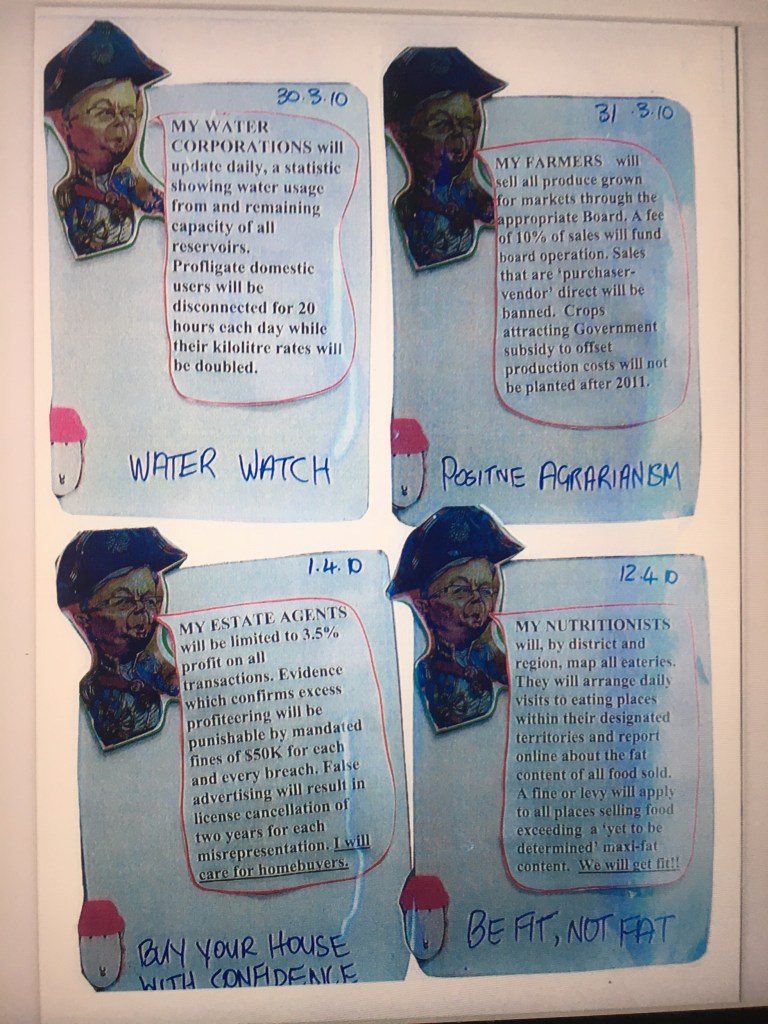
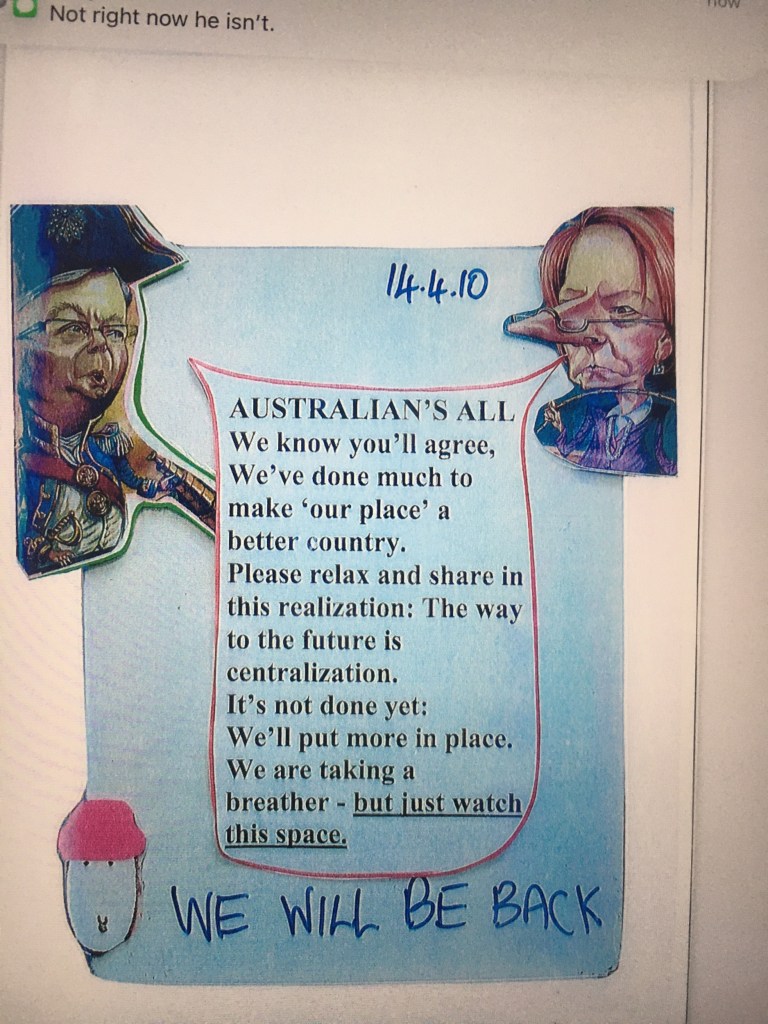
POH asks AI if one of his idiosyncracies – always wearing a pink hat – was okay

The decision for male school principals to wear pink, wide-brimmed hats while supervising students should be based on the context of the school environment, the message it conveys, and the comfort level of the principal.

Here are some considerations:

1. **School Culture**: If the school promotes a culture of inclusivity and self-expression, wearing a pink hat may be perfectly acceptable. It could even be seen as a way to challenge gender norms.

2. **Professionalism**: Principals are often seen as role models. If the hat is perceived as unprofessional by the school community, it might be advisable to choose more neutral attire.

3. **Student Engagement**: A unique hat could serve as a conversation starter and make the principal more approachable to students, fostering a positive environment.

4. **Personal Preference**: Ultimately, the principal should feel comfortable and confident in their attire. If wearing the hat aligns with their personality and leadership style, it could be a positive choice.

5. **Community Reaction**: Consider how parents, staff, and students might react. If there is a risk of negative feedback or misunderstanding, it may be wise to reconsider.

In conclusion, there is no definitive answer, and the decision should be made based on the specific context and values of the school community.

I think it was okay for me to wear a pink hat.

AI calls out vile character traits for Poor Old Henry

One of the most despised traits that people often cite is **hypocrisy**.

Hypocrisy involves claiming to have moral standards or beliefs to which one’s own behavior does not conform. It can lead to a loss of trust and respect, as people generally value authenticity and integrity.

Other traits that are commonly viewed negatively include dishonesty, arrogance, and selfishness, but hypocrisy tends to resonate deeply because it undermines the very principles of honesty and integrity that people expect from others.

Poor Old Henry is staying home

I do not like going out.

I have been to one formal occasion in the past three years – to be awarded a medal at Government House.

I ordered a suit to be tailored. It was fitted and adjusted three times. It was NEVER right but in the end I ran out of time for try-ons and had to take the garments.

The suit cost A$590. Then there were accessories.

On the night:

The coat was too big.

The pants were too loose and the belt was faulty. My pants kept threatening to fall to my ankles and I had to keep hitching them up.

The shirt was way too big and its sleeves far too long.

I felt like a dork and the next day, gave the suit and shirt to the Red Cross.

Now I hate going out at night and with very few exceptions, stay home.

I’ll-fitting and awful suit.

AI upholds the need for empathy

What is the most important human trait or value?

AI’s response:

Determining the most important human trait or value can be subjective, as it often depends on individual beliefs, cultural backgrounds, and personal experiences. However, many would argue that empathy is one of the most crucial human traits.

Empathy allows individuals to understand and share the feelings of others, fostering compassion, connection, and cooperation. It plays a vital role in building relationships, resolving conflicts, and promoting social harmony. By being empathetic, people can support one another, create inclusive communities, and work towards the common good.

Other important traits and values often mentioned include integrity, kindness, respect, and resilience. Each of these contributes to personal development and the well-being of society as a whole. Ultimately, the significance of any trait or value may vary based on context and individual perspectives.

Poor Old Henry is spinning out

There is so much tinsel and glitter about life in Australia.

There is so little meaningful substance.

So much trite nonsense is consuming educational curriculums.

So little literacy and numeracy substance remains a core teaching priority.

I think that the decency of what has been an Australian way of life has been cast into the vast wilderness of this country – somewhere between Lake Disappointment and Mount Hopeless.

Henry is still wondering “how can THIS be”?

INJURED TEACHERS COMPO BLOWOUT

Herald Sun Tuesday September 3 2024 Bolding mine

exclusive – Suzan Delibasic – Susie O’Brien

More than $50m has been paid out to Victorian teachers and tertiary staff who were injured on the job in the past two years, with experts blaming the ­“explosion” of compensation claims on aggressive students and staff bullies.

WorkSafe data obtained by the Herald Sun under Freedom of Information laws shows teachers from state and private schools, as well as tertiary and TAFE educators, made 1199 of claims in 2022 and 1468 claims in 2023. The claims included teachers suffering psychological stress, concussions, fractures and even cases of deafness.

Some of the biggest payouts include more than $141,500 for psychological harm, $120,253 for head injuries and $103,000 for wrist injuries. There was just over $25m in payouts in 2023, compared to $26.2m in 2022.

Carbone Lawyers partner and head of personal injury law John Karantzis said there had been an “explosion” of WorkSafe claims at schools.

“Teachers and support staff are under fire from aggressive schoolchildren and gangs,” Mr Karantzis said.

“Just recently, we had a case where a student pulled a knife on him and held it to his throat.

“Teachers are also experiencing psychological harm, including bullying from students and staff.”

Mr Karantzis said the Education Department and independent schools needed to provide better support and training.

“Unfortunately we’re seeing time and time again that staff are not being trained to manage these types of violent and aggressive situations, and as a result they are suffering serious long-term injuries.”

Michael*, 65, who worked at a state school in Melbourne’s north, sustained serious psychological and leg injuries in mid-2020 after breaking up two fights between females in the schoolyard.

“Two girls got into a massive punch-on and I tried to break up the fight. I put my arm out and one of the girls ran into me and took the full force of her weight,” he said.

“I didn’t fall but I felt something crack in my right knee.”

Michael said he notified the school about the fight, but “nothing was done”.

“They failed in their duty of care,” he said.

Michael said he was then injured on the same day after being forced to intervene in another altercation between two female students. He said he felt unsafe due to youth gangs that would frequently enter the schoolyard.

“They would have knives, knuckle dusters and their biggest defence was that they would ring up their friends who would show up to the school in a car.

“One of the worst things I saw was a year 9 boy having his head stomped by a group of students.

“This has had a traumatising impact on me … It’s not going to go away and I’ve had to do a lot of work with a psychologist to rebalance my life.”

Michael, who has had two surgeries and full knee replacements, is now awaiting a payout of more than $320,000 in compensation after seeking help from Carbone Lawyers.

Meanwhile, another law firm, Arnold Thomas & Becker, has received almost 100 inquiries in the past year relating to teacher injuries while working.

One of their clients, regional primary school teacher Julie*, who injured her vertebrae after tripping due to the school providing an unsafe environment, said her whole life had been “turned upside down”.

“It’s affected everything from my physical to mental wellbeing, my life will never be the same,” she said.

An Education Department spokesman said: “Victoria leads the nation in supporting health and wellbeing for principals and school staff and we have invested more than $200m since 2018 to support health, safety and wellbeing risks in schools.

* Names have been changed

CHECK OUT THE SEARCHABLE GRAPHIC AT HERALDSUN.COM.AU

Poor Old Henry – as a retired principal – wonders “how can this be”?

TEACHERS WALK OUT OF ‘TOXIC’ PRIMARY

Suzan Delibasic

Sunday Herald Sun September 8 2024.   Bolding mine

Five teachers have resigned from a Victorian primary school making allegations about a “toxic” culture, and saying the stress had taken a toll on their mental health.

The Sunday Herald Sun can reveal the staff, who have asked to remain anonymous, claim to have endured months of “bullying”, “intimidation” and “extreme stress” from the leadership team at Jindivick Primary School.

Some said they had experienced panic attacks on their way to work.

They said their concerns had been passed on to the Department of Education and the Victorian Ombudsman.

A teacher who quit her job claimed the school leadership team had failed to provide a safe and ­inclusive environment.

“It got to a point where you couldn’t even say anything to children that were misbehaving including swearing at teachers and other serious behavioural issues,” she said. “Their (children’s) accounts of incidents were believed over ours.

“I also witnessed the bullying and toxic culture created by the principal and it left me ­extremely stressed.

“It’s not somewhere that I would encourage anyone to work in. I feel extremely sorry for what my colleagues have gone through.”

Several former teachers also claimed that principal Lara-Jayne Wilson, who was ­appointed late last year, had failed to support them.

Another woman, who has been teaching for almost 15 years, said she was forced to ­resign in July, claiming she was offered no support by the Department of Education or the school’s regional director.

She said her problems began when a parent made an ­“unsubstantiated” complaint about the way she had spoken to her child.

“The principal did not advise me of the complaint or communicate with me as to why the student was removed from my class,” she said. “I felt like I was kept in the dark.”

The teacher claimed it took weeks to secure a meeting with the principal and when they eventually met she was “given the impression that everything had been sorted”. She continued to feel “distressed” for months and felt Ms Wilson continued to “target” her.

“She would gaslight me and lie that staff were making complaints about me, but I would ask staff members about it and they wouldn’t know what I was talking about,” she said.

“It was seriously intimidating, and I felt so much anxiety driving to school every day. It’s taken a serious toll on my mental health and I even had an employment limitation, which prevents me from working in any public system, and that is still being investigated.

“I’ve provided eight referees who have provided eight written character references supporting me, but I’m still awaiting an answer from the department.”

A Department of Education spokesman said: “We’re helping schools tackle challenging student behaviour so that teachers can teach and students can learn in a positive and supported environment.”

?

Poor Old Henry is appalled …

 To date this year, there have been 49 deaths on Northern Territory roads. Included are vehicle drivers and passengers, motorbike and quad bike riders, cyclists, pedestrians and people sleeping on roadways. 

This is horrendous and shameful for a territory with a population of 250,000. With four months to go until the end of 2024, who knows how many will have died when the bell tolls to end the year.

POH rues the diminution of educational focus – in the NT and everywhere

SCHOOLS SHOULD BE FOR CHILDREN

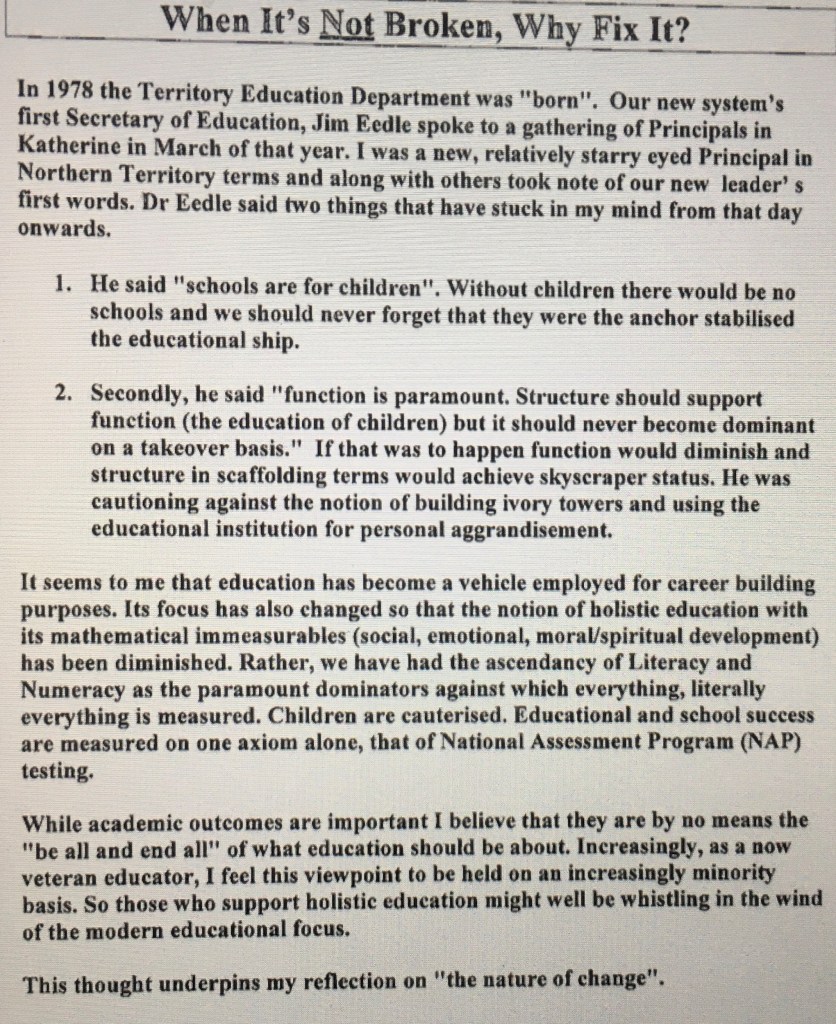
All school pedagogy should put children first. When the Northern Territory took on responsibility for education in 1979, our first director was Dr Jim Eedle. 

In March of that year he gathered all Principals of Northern Territory schools to a conference in Katherine. He said to us in his inimitable way of speaking, that we should always remember that “schools are for children”.

This he said was the prime function of schools. He went on to say that structure and organisation should always be about supporting function, the looking after of education for children. He suggested that if structure became the all important thing, that the quality of function would diminish.

Fast forward 45 years, and I think that the function of education is now well and truly in the shadow of structure. How I would love to have a revisitation to the words and sentiments of our first Director.

Possibility/Probability

There is a possibility but not a strong probability that Jim Chalmers will replace Anthony Albanese as government leader before the next federal government election.

There is a possibility but not a strong probability that Australia will wise up to the wisdom of going steadily when it comes to replacing reliance on fossil fuels.

Poor Old Henry asks AI to comment on the downsides of blogging

While blogging has many advantages, there are also several disadvantages and challenges that bloggers may face. Here are some common drawbacks:

  1. Time-Consuming: Creating high-quality blog content can be time-intensive. Researching, writing, editing, and promoting posts require significant effort and dedication.
  2. Consistency Required: To build and maintain an audience, bloggers need to post regularly. This can be challenging, especially for those with other commitments, leading to burnout or inconsistency.
  3. Technical Challenges: Setting up and maintaining a blog can involve technical skills, such as web design, SEO, and troubleshooting. Not everyone is comfortable with these aspects, which can be a barrier to entry.
  4. Competition: The blogging space is highly competitive, with millions of blogs available on various topics. Standing out and attracting an audience can be difficult.
  5. Monetization Challenges: While there are opportunities to monetize a blog, it often takes time to generate significant income. Many bloggers struggle to find effective monetization strategies.
  6. Negative Feedback: Bloggers may receive criticism or negative comments from readers. Handling criticism can be challenging and may affect a blogger’s confidence and motivation.
  7. Privacy Concerns: Sharing personal experiences or opinions can lead to privacy issues. Bloggers may face unwanted attention or scrutiny, especially if they discuss sensitive topics.
  8. Platform Dependence: If using a third-party platform (like Medium or Blogger), bloggers may be subject to the platform’s rules and policies. Changes in algorithms or platform features can impact visibility and traffic.
  9. SEO Knowledge Required: To attract organic traffic, bloggers need to understand search engine optimization (SEO). This can be complex and requires ongoing learning and adaptation.
  10. Content Theft: Bloggers may face issues with content theft, where others copy and use their work without permission. This can be frustrating and may require legal action.
  11. Emotional Investment: Blogging can be an emotional journey, especially if a blogger invests a lot of time and effort into their content. Low engagement or lack of recognition can be disheartening.
  12. Distraction from Main Goals: For some, blogging can become a distraction from other important tasks or goals, particularly if it takes up too much time or energy.
  13. Evolving Trends: The blogging landscape is constantly changing, with new trends, technologies, and audience preferences. Keeping up with these changes can be demanding.
  14. Limited Audience: Initially, it can be challenging to attract readers, especially if the blog is new or the niche is not well-defined. Building an audience takes time and effort.

Despite these challenges, many bloggers find the experience rewarding and fulfilling. By being aware of these disadvantages, aspiring bloggers can better prepare themselves and develop strategies to overcome potential obstacles.

Poor Old Henry asks AI to comment on the advantages of blogging

Blogging offers numerous advantages, both for individuals and businesses. Here are some key benefits:

  1. Creative Expression: Blogging provides a platform for individuals to express their thoughts, ideas, and creativity. It allows writers to share their passions and interests with a wider audience.
  2. Building Authority: Regularly publishing informative and insightful content can establish a blogger as an authority in their niche. This can lead to increased credibility and trust among readers.
  3. Improved Writing Skills: Consistent blogging helps improve writing and communication skills. Over time, bloggers learn to articulate their thoughts more clearly and effectively.
  4. Networking Opportunities: Blogging can connect individuals with like-minded people, including other bloggers, industry experts, and readers. This can lead to collaborations, partnerships, and friendships.
  5. SEO Benefits: Well-optimized blogs can improve search engine rankings, driving organic traffic to a website. Quality content can attract backlinks and enhance online visibility.
  6. Monetization Potential: Bloggers can monetize their content through various means, such as affiliate marketing, sponsored posts, advertising, and selling products or services.
  7. Audience Engagement: Blogs allow for direct interaction with readers through comments and social media. This engagement can foster a community around the blog and encourage reader loyalty.
  8. Personal Branding: Blogging helps individuals build their personal brand. It showcases expertise, personality, and values, which can be beneficial for career advancement or business growth.
  9. Knowledge Sharing: Blogging allows individuals to share their knowledge and insights, contributing to the collective understanding of a topic. This can be particularly valuable in educational or professional contexts.
  10. Flexibility and Control: Bloggers have full control over their content, design, and publishing schedule. This flexibility allows them to adapt their blog to their personal or business goals.
  11. Long-Term Value: Quality blog posts can continue to attract traffic and generate interest long after they are published, providing ongoing value over time.
  12. Therapeutic Benefits: For some, blogging can be a form of therapy, allowing them to process thoughts and emotions, share personal experiences, and connect with others who may be going through similar situations.

Overall, blogging can be a powerful tool for personal growth, professional development, and community building.

Poor Old Henry appeals to tourists

Come tourists, come

To all potential tourists

Come tourists, come

To all potential tourists; 

Come see the NT, 

The best views by far, 

Share time in the NT, 

See how lucky we are, 

To live in a place, 

So worthwhile to share, 

Come and enjoy,

Is my entreaty and prayer.

Come see the NT, 

The best views by far, 

Share time in the NT, 

See how lucky we are, 

To live in a place, 

So worthwhile to share, 

Come and enjoy,

Is my entreaty and prayer.

POH prognosticates about the new CLP government of the NT

The new government going forward

I believe that our new Chief Minister and her government are well-positioned to make a positive difference in how our territory is developing.

The government will need to be resolute, firm on its key commitments, and not become the fall guy sucked in by the desire to appease narrowly focused ‘one issue’ interest groups.

Poor Old Henry’s suspicion confirmed by AI

POH’s question

What is the most frequently uttered swearword in the world?

AI’s response

The most frequently uttered swearword in the world is often considered to be the F-word, “fuck.” It is widely used in various languages and cultures, often due to its versatility as an expletive, intensifier, or in various expressions. However, the frequency of its use can vary significantly depending on cultural context, language, and social norms. Other common swearwords may include variations of “shit” and “damn,” but “fuck” tends to be the most prominent in many English-speaking contexts.

Poor Old Henry asks AI about language

The baby’s first word

It’s not uncommon for children to pick up on expletives or swear words, especially if they hear them frequently in their environment. However, the first words that babies typically learn to speak are usually simple, everyday words related to their immediate experiences, such as “mama,” “dada,” “ball,” or “no.” 

While some children may indeed learn a swear word early on if they hear it often, it’s more likely that their first words will be those that are used in positive or neutral contexts. The context in which language is used plays a significant role in language acquisition, and children tend to mimic words that are used in loving or playful interactions. 

That said, it’s important for parents and caregivers to be mindful of their language around young children, as they are very impressionable and often mimic what they hear.

Poor old Henry asks AI

Why don’t people smile and laugh and be happy any more?

There are many factors that can influence why people may seem less inclined to smile, laugh, or express happiness. Here are a few potential reasons:

1. **Stress and Anxiety**: Many people face significant stress from work, financial pressures, or personal issues, which can lead to feelings of anxiety and make it harder to feel happy or relaxed.

2. **Social Media and Comparison**: The rise of social media can lead to unhealthy comparisons with others, which may affect self-esteem and overall happiness. People often present curated versions of their lives online, leading to feelings of inadequacy.

3. **Isolation**: Modern life can be isolating. Many people experience loneliness, which can diminish feelings of joy and connection with others.

4. **Mental Health Issues**: Conditions such as depression and anxiety can significantly impact a person’s ability to feel happiness or express joy. Mental health awareness has increased, but stigma and lack of access to care can still be barriers.

5. **Cultural Shifts**: Societal norms and values can change over time. In some cultures, there may be less emphasis on open expressions of joy or laughter, especially in serious contexts.

6. **Global Events**: Events such as pandemics, political unrest, or environmental crises can lead to a collective sense of worry and fear, overshadowing moments of joy.

7. **Busy Lifestyles**: Many people lead fast-paced lives filled with responsibilities, leaving little time for leisure and enjoyment, which can contribute to a lack of happiness.

8. **Lack of Connection**: Genuine connections with others are vital for happiness. If people feel disconnected from friends, family, or community, it can lead to feelings of sadness or apathy.

While these factors can contribute to a perceived decline in happiness, it’s important to remember that many people still find joy and laughter in their lives. Encouraging connection, mindfulness, and self-care can help foster a more positive outlook.

POH laments the disappearance of councillors 

Oh, woe is me, for  I feel quite undone.

Yesterday, our rates notice for the City of Darwin Council arrived in the mail. Inclusions apart from the Bill itself, include a statement about all the wonderful things that Council has done.

However, there was one glaring omission! In past years the council has included an insert in rates notices that this year was missing. 

What was missing, was a detail about our Lord Mayor and our councillors in the various awards – which now leaves me wondering who they all are, because you never hear from ward councillors from one election to the next – or so it seems.

I haven’t been contacted by a councillor in our ward for at least the last eight or nine years. Who are they and where are they? Without that inclusion reminding me of who our councillors are, I have completely lost touch with them.

Poor Old Henry is not his Granddaughter

My granddaughter has a function to attend this evening, as he is shortlisted for an award in creative writing.

Coming from a feeling remote corner of the Northern Territory, she must shop for Clothing and accessories to wear to the function this evening.

Now I am her old grandfather and I am with her if she looks at what she wants and makes a selection for this evening.

It is important and I am remembering that what she gets  It’s for her to wear, not me.

I am supportive, and can offer suggestions but in no way must I dictate what she chooses to wear.

Grandparents should be there for their grandchildren, but should not get in their faces.

Poor Old Henry is flummoxed 

Why is it important for up-and-coming leaders and those responsible for organisations, to discount the past and never to learn from the  mistakes and successes of their predecessors.

This propensity to discount and ignore the past puts organisations into a position of where so often the samei I i shortfalls and the same standard progress is repeated over and over and over.

All old people like me can do, is to sit back and think lol“been there, done that“, and watch while they sink  or swim.I

Poor Old Henry sitting at the Darwin Airport and reflecting

 I’m waiting for my granddaughter to collect her luggage when the baggage handlers put it on for Carol so it can be collected.

While I’m sitting, I’m thinking about the fact that when we first travelled on an aeroplane in 1975, passengers were much different to the way they are now, in terms of the way they dress and just their general department and demeanour.

It’s so much more casual now with everybody dressed in anything.

The airports are jampacked with people everywhere even here in Darwin. At Darwin, there’s a lot of confusion at the moment because upgrades are happening within the terminal and also outside. I think they’re anticipating a major uptake in the number of people coming through and using this airport in future years.

To say that passengers – and there are lots  of them  – are anything other than amotley collection would be an overstatement.

These days the crush of people going through airports onto planes to sit in cramped circumstances like battery hens in cages is the way it is in 2024.

Darwin Airport collecting luggage.

Poor Old Henry and Darwin’s ‘corrugated  bitumen’ phenomena

I have a 14 or 15-year-old vehicle that has been well-maintained and is regularly serviced.

We drive quite a bit to keep our eye on how things are progressing in various parts of Darwin. We also visit Palmerston, Darwin‘s nearby city neighbour.

Buildings are going up everywhere and houses are being constructed at a rate of knots.

However, one of the things becoming painterly obvious is the state of our roads, both major and minor in our two cities. Driving along many roads is now like driving on a corrugated gravel track. It may look smooth but reflects the underlying surface of the road breaking down.

Potholes do not help, but they are repaired in time. In many places, the surface bitumen is  breaking down and patching makes the roads look like a web of striations.

However, it is the subsurfaces of our roads that are breaking down giving more and more impact to one feeling as if driving on corrugations. The only way this is going to be fixed is for the road to be taken up and rebuilt at sub-surface levels.

Whether or not that ever happens, I do not know I do know that the fixing would run to many, many millions of dollars.

POH is in a quandary over the Australian Government’s political drivers

I do not feel reassured about the security vetting of those being rushed into Australia willy-nilly at the behest of our Federal Government.

Too many hasty decisions in all sorts of areas are being made by ministers in the Albanese Government because they want to soft soap and persuade voters in their electorates, lest they be turfed at the next election.

This is a prime example of putting yourself ahead of our population’s wants and needs – both economically and in security terms – at large.

I hope this government has only one term of tenure. 

Poor Old Henry fears for the future of the Western World

I looked and listened to the interviews of the Democratic hopefuls on TV. 

It seemed to be a staged production focussed on ‘non-commitment’ as an outcome to be gleaned by viewers. 

Given the calibre of key candidates on both sides of the political equation, I shudder at the likely future confronting America.

God help us all, for we are at a significant political crossroads.

Poor Old Henry is caught in the cross-hairs of the Middle East

I despise and hate the motivations of all terrorists.  What happened in Israel on October 7 was and is reprehensible.

However, I also question the motivations of Israel’s PM Netanyahu, whose actions as a leader seem to paint him as someone hell-bent on deflecting those legal problems he confronts in Israel because of his leadership strategies. 

He is singularly minded to the point of discounting what millions of Israelis are feeling and wanting.

Is the West wise to follow him with what seems like one hundred per cent compliance with his whims?

Poor Old Henry looks forward to VAD in the NT

I am so happy that the VAD Committee has recommended practical and logical ways in which the entitlement to end one’s life if passed through the Assembly, will work.

When the law is passed, it will be a total relief to me, a 78-year-old man. With  euthanasia  not being an option available to me, should I need to access the option, I have been left feeling very insecure and vulnerable.

Poor Old Henry – with the help of Goatchat – appreciates Adam Drake

Appreciation of Adam Drake

Adam Drake is a remarkable individual whose dedication to uplifting others shines brightly across the Northern Territory. His unwavering support manifests in countless ways—whether through the generous sharing of his time, financial contributions, or priceless wisdom, Adam tirelessly engages with those in need. He serves as a beacon of hope, illuminating the path for individuals battling the shadows of self-doubt and uncertainty.

In a world where challenges can often feel overwhelming, Adam’s commitment to doing good is a testament to his character. He doesn’t just offer assistance; he embodies the spirit of compassion and empathy, empowering others to recognize their potential and strive for a brighter future. Through his actions, he fosters a sense of community and belonging, reminding everyone he touches that they are not alone in their struggles.

Adam’s ability to connect on a personal level encourages resilience and inspires individuals to envision and pursue a better way forward. His presence is transformative. As he continues to uplift and support those around him, Adam Drake exemplifies the profound impact one person can have on countless lives, making the world a better place for all. Thank you, Adam, for being such a guiding light.

Poor Old Henry worries about the way Australia is trending

Is it wrong for me to think the Federal Government is absolutely stuffed?
Is it wrong for me to think this government is the worst government we have had since Federation?
Is it wrong for me to doubt the wisdom of the renewables policy?
Is it wrong for me to think that coal and gas are almost ‘enemies’ of and to the Australian lifestyle?
Is it wrong for me to despair about our ability to defend ourselves against future aggression?

Is it wrong for this 78-year-old man to feel total and utter despair about the future of this country?

“THIS IS WORTH A THOUGHT”, Suggests Poor Old Henry

LET’S LICENSE MUMS AND DADS

In The Sunday Mail (Brisbane) September 1 2024

Emily Pidgeon

A retired detective who believes pet owners have stricter responsibility expectations than parents is calling for radical solutions to tackle the youth crime crisis.

Former detective superintendent Mark Ainsworth says there is a certain level of accountability for animal owners, and questioned whether similar guidelines should be put in place for parents and guardians.

“You need licences to look after certain animals,” Mr Ainsworth told Gary Jubelin on the I Catch Killers podcast.

“You’re responsible for the animal’s wellbeing and you’re held accountable (for its behaviour).

“What’s the difference between that and holding a parent or guardian accountable for their child’s behaviour?

“People have to take responsibility for the children they’re raising.

“If someone breaks into a house or damages something, the parents need to be held accountable.

“I’m not saying this relates to all parents and guardians.

]

“I understand some are at their wits’ end trying to control their kids and conform with laws.”

The respected detective, who led the 2012 investigation into Allison Baden-Clay’s murder, said youth crime isn’t a policing issue, it’s a “whole community problem”.

Police have become babysitters, he said, which is “costing the community a hell of a lot of money”.

“Particularly here in Queensland, they are used as a stopgap measure for other duties, which are not necessarily policing duties.”

The retired investigator said he believed the youth crime epidemic was partially caused by the baby bonus scheme introduced by the John Howard government in 2004.

“Women in particular who got the $5000 baby bonus ran out and bought televisions or put drugs up their arms,” he said. “Now society is trying to look after those kids. I’m not saying all, but a lot fall into that age category.”

Mr Ainsworth said youth crime has become a core focus in policing, taking crucial resources away from solving other crimes.

“These offenders are getting put before the court, they get bail or they get sentenced and then they’re meeting with like- minded kids who then come out and reoffend,” he said.

Imposing tougher prison sentences, he said, won’t solve the problem.

“In reality, how often does a juvenile receive the maximum penalty? I’d argue it’s not a deterrent for the kid at the time.

“It’s just an easy way for the government to say we’re tightening things up, but they’re not looking at the core issues going on.”

Mr Ainsworth said he believed the solution was encouraging young children to step away from technology and learn important life skills.

“Set up a diversionary system to divert kids away from the court system,” he said. “It’s nothing new. They can get an education, learn farming skills, learn respect, learn a trade and more importantly, get away from social media.

“So there’s no phones or no computers and they can learn life skills that we learned as kids growing up.”

The former officer, who was with Queensland Police Service for almost 40 years, said a diversion program should be accessible to all children.

Poor Old Henry ponders ‘blogging’


After retiring as a full-time Educator in January 2012, I had the chance to sit back, reflect and learn. There was also within my heart a desire to share with others – especially those who are in preservice training or at the very beginning of their teaching careers – some thoughts and ideas that they might find helpful.

At the beginning of my teaching career – and that was back when education was a lot simpler than it is now in terms of expectations and demands placed on teachers – I was helped in my learning by several educators who were far more experienced than me.

That help came to me in face-to-face conversation, through the telephone, and by letter or correspondence. To say that I was appreciative would be an understatement for in those days of inspection and careful study of newbies by inspectors and superintendents, it was easy to fall foul of expectations.

As I came to the other end of my professional life, the end rather than the beginning, an ambition was born within me and the determination that I hax been helped by senior colleagues and those who had gone before.

It was for this reason that I established my blog with WordPress in 2013, calling it “Education A Life Force“.

In the years since, I have used my blog primarily for educative purposes and through my LinkedIn account have both shared posts on my blog and invited others to my blog by sharing its address. The feedback I get suggests that what I am doing has been appreciated.

I also have a blog for more general purposes not related specifically to education.

There are other things I have done to spread messages, but my blog has been a prime source of helping me to help those in the same way as I was supported by others.

And by the way, I really appreciate WordPress and its management

Alarm bells ring for Poor Old Henry

Last weekend, the Country Liberal Party was resoundingly elected to the Northern Territory Assembly for the next four years.

With some authority, The CLP which had eight years ago been voted out of office leaving only two seats, turned out all around and came back to secure 17 seats in the new assembly. Labour has been reduced to probably for St Se.

Along with many other Northern Territorians, I am looking forward to some of the issues we have confronted, being overcome.

When opening the Australian newspaper on Friday, August 30, I saw the advertisement below.

This advertisement creates significant concern for me, because bringing a plethora of people into the Northern Territory from elsewhere to do all we get devising, guiding, and everything else, Will without doubt, defeat the purposes of this new government.

What we do not need coming into the territory to fill key roles are experts with wonderful CVs, great university credentials and limited experience – if any – in the Northern Territory and its unique politics and specific lifestyle.

We have had the past governments of the Northern Territory undone by the practice of bringing in outsiders who do little other than establish the depth and breadth of their own experience before taking off to greener pastures.

Far too often in the past governments and various of its departments,  have been short-sheeted and left floundering in embarrassment by this practice.

We do not need more of the same! We do not need a government with the potential to be undone and reduced to mediocrity because of the infusion of those who,  in practical terms,  know very little about our territory.

But alas! I can already hear the flow of expressions of interest coming upon us like an avalanche.

Poor Old Henry ponders the ‘fragility’ of Australia’s Navy 

The Royal Australian Navy (RAN) fleet is made up of 31 commissioned warships and 16 non-commissioned as of April 2024. The main strength is the seven frigates and three destroyers of the surface combatant force: seven Anzac class frigates and three Hobart class destroyers.

Where does Australia’s navy rank in the world?

Ranked 19th among the 140 most powerful armies in the world, Australia placed 47th in terms of naval power.

BAE System’s Global Combat Ship – Australia will be one of the most advanced anti-submarine warships in the world. The Hunter Class FFGs will be built in Australia by ASC Shipbuilding  

The Hunter Class will begin entering service in the early 2030s replacing the 8 Anzac Class frigates, which have been in service since 1996.

The service currently forms the Navy’s Submarine Force Element Group (FEG) and consists of six Collins class submarines. The Royal Australian Navy Submarine Service has been established four times, with the initial three attempts being foiled by combat losses and Australia’s economic problems.

Poor Old Henry’s innate fear

I am convinced that the Western World is living in some degree of ‘independence’ on borrowed time.

Western leadership, actual and potential is like a limp lettuce leaf compared to those leading the communist bloc.

We are going under, and I feel as secure about our future as a drowning man.

Poor Old Henry ponders complexity and yearns for the return of simpler times

With each passing year, the world is becoming ever more complex. Getting from start to finish on issues becomes ever more difficult because of blocks and obstacles inserted by everything from process to the specific – and often selfish – demands of narrowly focused interest groups. 

Oh, for a return to the definitive times of the past – times that were more definitive and people had the confidence to back themselves in on issues and decisions of consequence.

Poor Old Henry contemplates the future

People everywhere are talking about peace and creating peace in places where war is presently being played out.  

While talking about peace in our world, leaders of most countries preparing, to a greater or lesser extent, for war.

Well, maybe not in Australia where things defencewise just seem to meander slowly, slowly along.

The year 2030 is the one that the Australian Government has proudly earmarked as our country becoming of age in terms of responsibility for minimising the use of fossil fuels and becoming ever more dependent upon renewables.

My thinking about 2030 is that the same vision will be far from the mind of the Australian government. By then if we are not on the brink of a regional war, The war will already be upon us.

Do you think I am dreaming? I wish I was!

In essence, I think we are on the brink of a worldwide Holocaust and totality of destruction. 

I can feel it in my bones.

Poor Old Henry dreams of tyre spikes

We live close to the T junction of two major roads. When we moved here in 1987, both streets were quiet and relatively free from the likelihood of anything happening.

Fast forward to 2024, thirty-seven years later. Traffic volume has increased at least one thousandfold, and the escalation shows no signs of plateauing any time soon.

Vehicles start moving earlier and end later. The streets are no longer quiet.

I can put up with most things except increased traffic is an outcome of progress. However, there are two exceptions to my tolerance.

The first relates to people on motorbikes who like to rev and rev and rev as much as they can, particularly late at night and in the early hours.

The second increasingly distasteful experiences extend to people in vehicles who insist on tyres screeching and on Herning and on making as much engine noise as possible entering and leaving the T-junction of our roads.

I would desperately love to have a set of tyre spikes and be able to use them To help curb over-enthusiastic bike and vehicle drivers who care not a whit about the noise they make and the offence  they create.

Is it wrong for me to think this way?

Poor Old Henry shudders at what is happening to Mount Everest

Tenzing Norgay and Sir Edmund Hillary reached the summit of Mount Everest in May of 1953, the British had been trying to climb it for 31 years. However, the summit was reached for the irst time by a Nepalese and New Zealand citizen, with both working together to reach the top of the world.

For poor old Mount Everest, it has been all downhill since then. With the passing of years, more and more people have taken to climbing the mountain. Tens of thousands have had a go, with some not being able to go past one of the interim camps on the way up the mountain.

They have left many ‘gifts’ – indeed hundreds  of tonnes of them – on the mountain.  Material waste. and human excrement of all kinds. Mount Everest has been turned from the centrepiece of a beautiful, pristine wilderness into one of the most notorious of the world’s  rubbish dumps.

Poor Old Henry feels everlasting melancholy

A sad and permanent pessimism is all pervasive and sits within my soul.

It is always there and is created by a number of circumstances relating to environment, social and economic circumstances and the increasingly tenuous state of the country – Australia – and the world in which we live.

THERE IS NEVER ANY BLUE SKY

Blue sky,

Has fled from my life.

Replaced,

By ever thickening,

Ever darkening,

Clouds of despair.

From bright light,

To dimming.

Then penumbric reflection,

Of dusk.

Deepening,

Into the black night,

Of depression.

Like an Arctic winter,

The sun,

No longer rises.

My life,

Is without shadow,

Without illumination.

I am

Lost in tundra darkness,

24/7/365.


More and more,

I realise,

Extinguishment,

Is the only escape.

Poor Old Henry laments the paucity of political pamphlets

I suffer greatly from a post election syndrome. It might be called “depleted recognition syndrome“.

For me, a wonderful thing in the weeks and sometimes months leading up to an election is the number of pamphlets from aspiring candidates extolling personal and party virtues. Some even contain handwritten messages inviting me to contact them to discuss matters should I so wish.

My letterbox flourishes and I feel valued.

Now the election is over and decisions have been made about who is going to represent constituents in parliament, the mailbox has gone from being overloaded pretty well to nothing at all. No more pamphlets and no more paraphernalia – until the next election.

How on earth will I cope?

Poor Old Henry laments – “Help – my brain is splitting!”

I am trying in my thinking to square what is happening in Alice Springs with its everlasting feast of youth crime – and non- fix with the issue being totally out of control – with what is happening with stood-down Yipirinya School principal Gavin Morris, who is on the mat over matters of trying to kerb aberrant behaviour, which has had an impact on the school.

How do I deal with the disparity?

Poor Old Henry reflects upon what was the challenge of teacher development

Note: This is from two decades ago.

Teacher development consumed a hell of a lot of my time, and that of my senior leadership group, goes into developing people so that they can do their job better in terms of building kids and achieving, hopefully, the outcomes that we want.

We are riddled with teachers in our system up here who oughtn’t to be teaching.

We also have a hell of a lot of teachers in our system who are got to be’s, not want to be’s.

They don’t want to teach, but they have to teach, and often it’s because they weren’t sufficiently qualified to pick up any other occupation from a training viewpoint.

Have things changed?

Poor Old Henry shudders at the thought of school leaders being doormats to aggressive parents

. I don’t think that it’s something that we should just sort of lay down and accept.

I mean, I was never a principal who’s a doormat. And all my time – touch wood I suppose – I’ve never been physically set upon by any parent, and woe betide any parent that tried it on because I’d bring the full force of the law to weigh on them, and I’d do that for my staff as well.

But, you know, at the end of the day I think you’ve got to take a position, you’ve got to be seen, you’ve got to have a profile, you’ve got to have visibility, you’ve got to share that with your staff, you’ve got to have them supporting it.

Poor Old Henry reflects on the behaviour of Australia’s Federal Politicans during question time

SCREECH, YELL, HOLLOW, SCREAM

Canberra May 29, 2024

I have been listening to the federal parliamentary question time in the House of Representatives.

I am sitting in my car listening to it right now.

Talk about a circus of shouting, hollowing, screaming, and elected members on both sides of at the house. The whole thing is just a total and utter shambles and schnozzle.

I just hope that students and other impressionable people are not listening to the hubbub going on in the Federal Parliament this afternoon. What a terrible, terrible example our politicians are setting to the listening public.

One sensible question and one sensible answer fell into the midst of the session, but that was almost anachronistic.

Poor Old Henry feels for Leanyer School

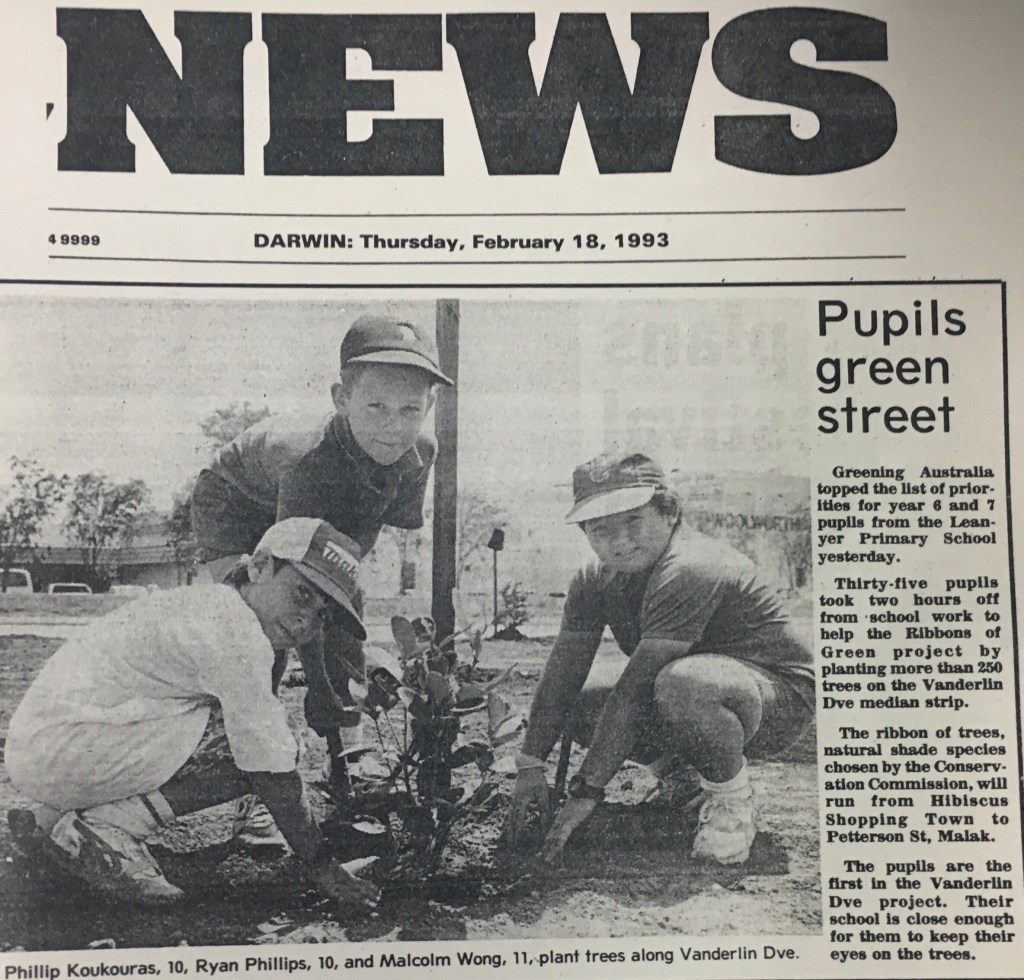
I was principal at Leanyer School for 20 years before retiring 12 years ago.

Had the Labour government been returned at the election on the weekend, there was a promise that if the Wanguri Seat passed to Shlok Sharma, the school would be upgraded in terms of facilities and staff to the tune of $4 million.

With the CLP winning government, that has gone, with the promise being blown away in the wind of political change.

This issue has caused me to reflect upon the school and its community.

Ms Carlsen won the seat for the CLP. It had been safe Labor for decades.

Poor Old Henry beholds outgoing politicans cleaning processes

So many electorate offices in Darwin’s northern suburbs at the moment, and in the wash-up to Saturday’s election, are closed and being cleaned by politicians and their staff after so many incumbencies – in Saturday’s election – were terminated by voters. There is some shock and horror at how territory electors removed many politicians from office. 

Change is major.

Poor Old Henry mourns Darwin’s sad and empty streets

I drove around in Darwin and its suburbs this afternoon as is the case on most afternoons. It’s nice to go for a drive. But I could not help feel emptiness and disappointment today.

Today is the day after the Northern Territory election. Those wonderful posters and core flutes have all disappeared – all 50,000 or 60,000 of them. How empty the streets looked.

There were no faces coming back at me through our windscreen and side windows; no happy smiles sparkling eyes or glistening white teeth. No more political aspirants.

I hope I can cope with what we have now lost.

Advice to Leaders – 8

If people apply for jobs in writing and do not make it onto a short list for interview, make sure they are contacted and advised their applications were unsuccessful. Non-communication is rude.

If people are unsuitable for advertised positions, consider offering them feedback as to why their applications were unsuccessful. Encourage them to up-skill to achieve placement in the future.

Advice to Leaders – 7

 GOVERNMENT has talked of cutting red tape and reducing the time and effort business owners have to devote to administrative process. I hope this happens so owners can refocus on prime needs.

It is a sad state of affairs that throws up the realisation that many young people are disinterested in work. Let us remember and appreciate young people who have a positive and caring work ethic.

My hope is that businesses committing to the employment of young people are not disappointed. Some honour their employers. Others are definitely ‘short term’ jumping ship, going at a moment’s notice.

Advice to Leaders – 6

As business or service providers, consider thanking clients or users for patronising your organisation. Appreciation expressed in this way will travel via grapevine to others. Value your customers.

Make sure that ONLINE DETAILS are kept up to date, particularly opening hours. If sites get out of date, they can be a source of frustration rather than a font of information for potential customers.

Consider PROMOTIONS through pages of papers, sometimes produced periodicals and via online writing onto interest groups and conference sites. Consider pamphlet drops and get to be known.

Advice to Leaders – 5

A problem for enterprise in the NT (and elsewhere) is the STICKABILITY of employees, particularly many of the younger set. Workers need to commit to their work, respecting ‘the boss and the business’.

It is important to INVITE CUSTOMER FEEDBACK and their genuine response to service rendered. Seek both compliment and suggestions that might lead to improvement of service delivery.

BRIEF DAILY SUMMARIES can be useful. Summary might include: *Activity/project; * How did I feel (+’s and -‘s); *What did I learn; * Implications for study/ work (tasks), people (relations) and self.

Advice to leaders 4

WORD OF MOUTH support from satisfied customers and happy clients is the best of all advertising for Northern Territory companies. Shoddy service on the other hand will turn on you in this place.

There are business enterprises that do a great job. We need to remember to appreciate them. Small Business Awards programs are one avenue and nomination for recognition is worth contemplation.

Some businesses fall on hard times, with situations beyond their control. When confronted, proprietors need to look at alternative opportunities. The first reaction should not be defeatist. Chin up!

Advice to leaders 3

Businesses shoot themselves in the foot when profit at all costs becomes paramount. It is then that the customer and client becomes disaffected. They feel regarded as being pawns in a profit game.

It seems that many businesses are not particularly interested in business enhancement and public relations. Quotes sought for work needed are not offered or reluctantly provided. 

APATHY IS SAD!

There are businesses and proprietors who care. For some, there is the challenge of having staff engaged and interested. For others there are staff shortage issues. Employees turnover can be a problem. Skewed motivation is an issue when it is discovered employees are more interested in their salary than their work.

However, the apparent ‘don’t care and not interested’ is certainly inherent within the management of some businesses, particularly trades areas where work is plentiful. Further, there are some business which take the line of ‘the customer owes’ when it comes to arranging work to be done. In fifty year’s in the NT, both in remote areas and Darwin, I have seen and experienced plenty of both caring and disinterested businesses. 

Advice to leaders 2

THANKS and APPRECIATION need to be built into all organisations. We focus too much on compliance and accountability and insufficiently on genuinely valuing what employees do for businesses.

We should aim to support NT BUSINESSES by preferring them for supply of product and in the letting of contracts for capital works construction. To by-pass local business and go elsewhere is not right.

SELF-CERTIFICATION is a dangerous thing. I believe all work undertaken should be checked by an external certifier, in order to validate the work to both the builder and the client. It avoids pitfalls.

Advice to leaders -1

When dealing with matters, aim to play the ball (issues dealing) and not the man (messenger). Too often we sidetrack and in having goes at people overlook the need to concentrate on the agenda.

Coaching, mentoring and genuine patronage need to be part of strong organisations. Confidence and strength needs to be built within. Sharing of ideas needs to be organisational health at heart.

The fabric of organisations is strong if ‘warp’ and ‘weft’ communications are open and honest. Subordinate to superordinate links and peer to peer contexts need to be supportive and appreciative.

Poor Old Henry has language confusion

 English used to be, very definitely, the prime language and the major way of communication in Australia. We learned English when we went to school, including speech, listening, grammar, punctuation, and all the rules that went with the use of our language in oral or written form. 

Students going for year 12 had to take English as a compulsory unit – at least one sometimes more than one unit.

When I trained as a teacher, the English Method and its teaching was a number one unit. We had to be able to speak correctly, read correctly, listen carefully, and have no speech imperfections in our make-up.

No longer! The purity of English has turned it into a hybrid form of communication and distorted its expression.

With the inroads of IT end the corrupted language which is part of these platforms, we are drifting in terms of English language competence, from bad to worse.

This acceptance of language mediocrity blows my mind.

Poor Old Henry shares a disturbing story about Australian education

.Worth a read and reflection.

STUDENTS SCHOOLED IN SMUT

Herald Sun Monday July 1 2024

EXCLUSIVE – Susie O’Brien – Suzan Delibasic

A growing sexual culture in Victorian schools means students are calling teachers pedophiles and sluts, and making pornographic memes and comments about them.

Both male and female teachers are reporting a rise in “casual statements about serious sexual issues” including boys being suspended for catcalls such as “clap them cheeks”.

Slurs also included girls who “call any male teacher who tries to maintain the class rules a pedophile at the drop of the hat”, according to one teacher on an online forum.

The teacher also said they had seen “disturbingly graphic public declarations of sexual acts directed toward female staff and students”.

“We recently suspended a boy who had a Word document with a list of various girls and women at the school and his preferred sex acts for each one,” the teacher wrote.

Another teacher reported one student who said “f–k you bitch” when he was disciplined.

A collection of teachers at one private boys’ school said boys were drawing penises on their school books, threatened to “piss in the corner” if not allowed to go to the bathroom and referred to a group of female teachers as a “coven”.

The Herald Sun has found a litany of social media posts, both from students in state and private schools, where teachers are accused of being pedophiles and having relationships with students.

“(Teacher’s name) after he preys on innocent little Indian boys,” one TikTok post said, while another post accuses a teacher of having a “relationship” with a student.

There are also several degrading posts in which teachers are matched up as couples while being mocked.

Samantha Schulz, a senior lecturer at the University of Adelaide, called for a national collection of instances of anti-social behaviour, abuse and harassment in schools.

Dr Schulz said the offensive attitudes “cut across the sectors” and were found in many different types of schools.

“Little change will be made until the problem is measured and acknowledged, and a unified system of reporting is put in place,” she said.

Dr Schulz surveyed teachers’ comments on social media, reporting “heightened use of misogynistic language and behaviours by male students, some as young as five”.

One teacher said: “Boys are increasingly using misogynistic language towards female students and teachers, telling them to ‘make me a sandwich’.”

Other teachers noted the use of terms like “slut” and “rape-able” used about female teachers. They said boys would make animal noises and grab their genitals and make rude gestures towards women and girls at the school.

Monash University researcher George Variyan said social media extended the reach of such attitudes, operating as a kind of “echo chamber” for Andrew Tate and other influencers.

“We need to do more, and it’s not just about having a one-hour consent education incursion,” he said. “This kind of profane behaviour has always been there but now technology is amplifying this.

“There’s not a single parent or teacher out there who is not concerned about this issue,” Dr Variyan said.

A Department of Education spokeswoman said: “Any harassment of staff by students is completely unacceptable, and schools will take appropriate disciplinary action against any students who engage in this kind of conduct.”

Poor Old Henry laments on August 25

Come Sunday, the Northern Territory election will be all over, bar the shouting. No more will a drive around our streets and suburbs be the same. The 50,000 -maybe more – core flutes have been reflecting the faces of electoral hopefuls for many weeks. It will all be gone a day after the electon.

I will miss the happy, smiling, anticipatory faces.

Poor Old Henry and the Aged Care Worry

I am 78 years of age and sh.t scared of becoming a victim of the Australian-aged care system. Metaphorically, I think of aged care as being a shark tank into which people who are old and frail can be too easily tossed.

Non-compliance with standards is far too common. There seems to be a falsification tendency within the system.

Aged care costs plenty but care in far too many places seems to be minimal.

Too many people going into nursing homes become shrouded in blankets of sadness that smother them and their families.

“Don’t forsake the printed text” extols Poor Old Henry

OLD FASHIONED READING IS THE BEST

In these modern times, it is easy to replace traditional reading approaches with device supported alternatives. The proof of this change is confirmed by the number of bookshops that have been relocated away from the Northern Territory, changed business focus or closed. Among these are the ABC Bookshop, Dymocks and Angus & Robertson. While newsagents carry text material, dedicated bookshops are in decline.

Tablets and electronic books are becoming ever more popular, replacing what was a preference for books and traditional texts. Newspapers and some magazines have skyrocketing numbers of online readers, but subscriptions to hardcopy and paper formats are declining.

Electronic reading is an individualised alternative. The interaction is between the reader and the device. Text sharing and discussion does not take place because this reading method is not a group activity. Reading from devices does little to promote text sharing and companionship between readers.

Jackie Sinnerton made this point in a recent column about what should be an important sharing between parents and children. She suggests that “… parents should stick with old fashioned storybooks when reading to their children and ditch the electronic devices … reading from a device or e-book fails to engage children in the same way as a storybook. Parents and children verbalise and interact more when story and pictures are in print.” (Reading more special when it’s in print, NT News, 27 March 2019)

Traditional reading offers interactive opportunities for parents and children. Quoting from a prominent paediatrician Dr Tiffany Munzer, Sinnerton explains that the tradition of parents and children reading together offers “ … interactions, including warmth, closeness and enthusiasm during reading (which) create positive associations with reading (that) will likely stick with children as they get older.” (Op cit).

Although not stated, this benefit will in all likelihood be carried forward and become a habit that today’s children will practice as tomorrow’s parents.

Traditional reading promotes family togetherness. It also supports children in their acquiring of reading, conversational and comprehension skills.

The NT News and other papers belonging to the Murdock stable recognise the importance of shared readings in the family context. From time to time, sets of books which can be purchased by families reading newspapers, are offered for sale at most reasonable prices. This is a positive and practical initiative.

Access to traditional books and sharing quality time focussing on written text, adds value to family life. Children from homes where shared reading and discussion is a family habit, stand to gain a head start in reading, discussion and social sharing which are elements of formal schooling.

“Parents wake up” says Poor Old Henry

MEDIA INFLUENCES YOUTH

From time to time the issue of media influence on shaping the values of young people comes up for discussion.

It is often asserted that what young people see, hear and experience has no influence on the shaping of their attitudes and values. People are scoffed at if they suggest otherwise. Researchers and others connected with empirical study assert that young people know that games are for amusement. Therefore, playing these games will have no impact upon their lives.

I believe that to be totally wrong. Many young people immerse themselves for hours on end, day after day, week after week in playing these games. Common sense suggests this has to impact on their thinking and attitudes.

Young people may become so totally absorbed in this “escape from reality“ that it becomes their reality.

While some of these amusements are quite benign, many of the more popular ones are about murder, massacre, slaughter, and macabre behaviours. It stands to reason that young people (and those who are not so young) who become totally immersed in these activities will be influenced by their addiction.

The fact that so many young people these days are “I“ and “me” people who do not think about others, may well be a result of exposure to online gaming. Lack of manners, slack, disrespectful speech, the inability to focus on real life tasks in school and elsewhere, disinclination toward real life activities all point toward cyberspace influence. The key characters in online games generally behave in a way that promotes heroism through bullying, harassment and other negative behaviour. Can we wonder at this bravado and these attitudes rubbing off on the impressionable minds of youthful gamers?

Common sense suggests that the antisocial behaviour of many young people has its genesis in their indulgent online activities. When cyberspace completely absorbs the minds and the attention of users, something has to give!

One of the most recent games is “fortnite”, which focuses on extremely negative social behaviour. Game changes and modifications always seem to focus on negatives, rather than social decency.

I believe it imperative for parents to be aware of the online games their children are playing. They would be wise to monitor the classification of these activities and the length of time spent in online indulgence.

Without doubt, the games children play impacts on their thinking, attitudes and behaviour. That can have negative consequences. It may result in them making poor decisions that impact upon their lives and their futures.

Allergies evermore confronting in these modern times

ALLERGY AWARENESS ON SCHOOL AGENDAS

Schools have to be increasingly aware of food allergy issues. Nut allergies are of particular concern. It seems more and more children are becoming nut sensitive. Recess and lunch box contents can be an issue.

“With severe allergies on the rise, no childcare centre, pre-school or school can afford to be uninformed about the risks to children in their care. They need to arm themselves with information on food allergy and anaphylaxis and create environments that are safer for all.” (Allergy and Anaphylaxis Aust. Website)

Until about 20 years ago, very few schools had policies that considered the risk of food allergies. This has changed. Most schools, particularly preschools in primary’s have policies relating to allergic sensitivities that can confront children.

The most common of these allergies is that relating to the susceptibility of some children to fall violently ill, if they come into contact with nuts. Many schools advertise that they are “nut free zones”. Parents are frequently asked to take into account the fact that foods including nuts and sandwich spreads containing nuts should not be included in children’s recesses and lunches.

While this is restrictive parents for the most part accept that nut contamination could have far reaching consequences for susceptible children.

Two way awareness

It is important for care and caution to be a two way process. Children who are nut allergic should understand their condition. It’s important that they take care to steer clear of any food danger. I believe the children from very young ages, including those in preschool, should be aware of the need for self-preservation.

From time to time there is a worry that children suffering from allergies might be teased or even threatened with contamination. This is usually an unnecessary fear. One of the qualities demonstrated by children is a genuine empathy and care for those whose circumstances are confronted in this way. It’s wise for teachers and children in all classes to be aware of children who may suffer from allergic reaction to nuts.

Schools in which all staff and therefore students are aware of an allergy situation can offer support. A further safeguard is for teachers and school support staff to have epipen training so this can be administered in the case of an emergency.

Nut consciousness and allergy awareness is the part and parcel of modern education. It’s just another duty of care responsibility existing for schools and staff. That duty is helped when parents and students cooperate to help make school environments safe, secure places for all students.

“Debt … Away!” from Poor Old Henry

IN THE BLACK – NEVER IN THE RED

I hate debt.

Interest payments on borrowings are dead money.

I always work on the principle of having money to buy and having money to save.

Savings are important. They are enhanced by budgetting to meet expenses.

In budgeting, I ensure that splurging is avoided. Money is not treated in a miserly or penny-pinching manner. It is spent sensibly and saved prudently.

Budgeting is important and accountability critical. I would not have it any other way.

Overfocus on ‘I’ abhored by Poor Old Henry

I ABHOR ‘I’

“I“!!

It is a selfish word. It is the most misplaced word. It is a suffocating word, smothering the notion of “we“ and “us“. It is a proud word, forever upholding individuals over the collective.

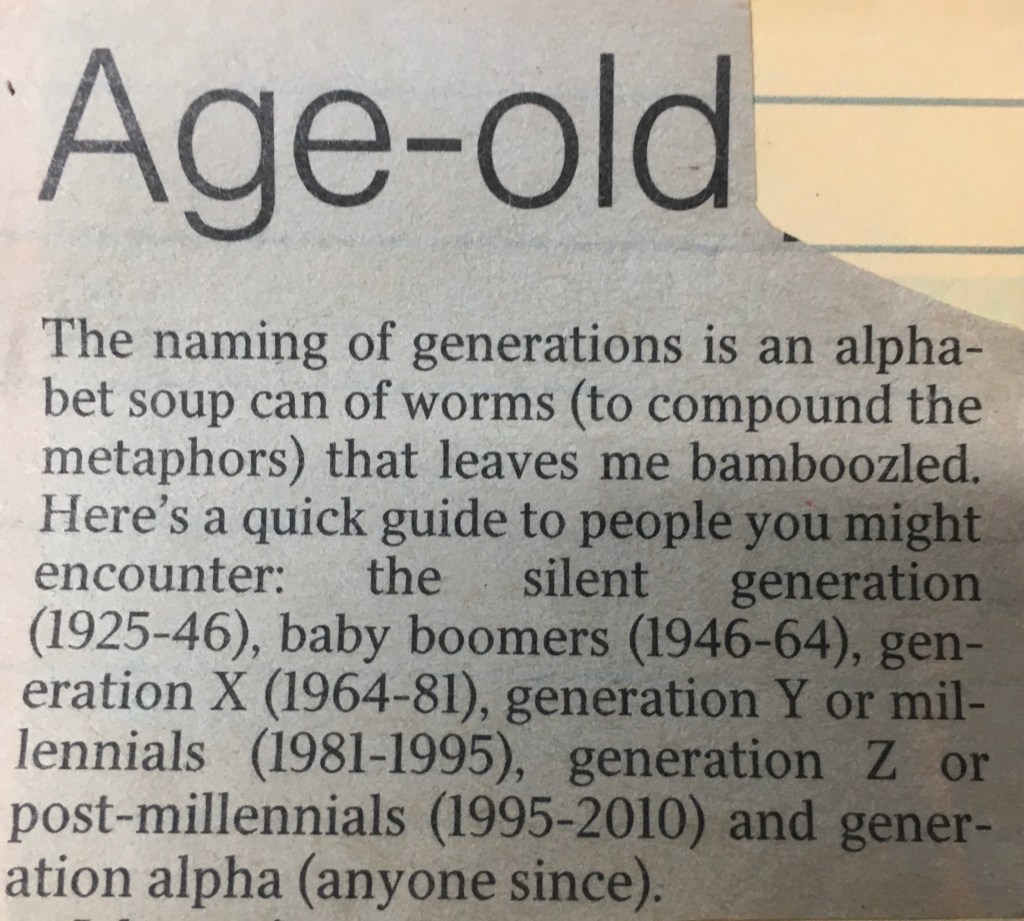
I was born a baby boomer. Then came the X and Y generations, the Millennials and the Z generation.

Going back over time the focus always used to be on “we“ in terms of the way we put others before ourselves and valued the community above ourselves.

Now that’s all gone! People think only of themselves, and what they want, and to hell with the rest!

Too many politicians are in politics for themselves and not other people. Too many CEOs of retailing and manufacturing companies are in their positions for their good, and what they want comes first. Too many people in government departments are more concerned about themselves and what they can get out of their jobs than they are about the jobs they do and the people they serve.

Service for others used to be heart service. These days it is lip service. It is not genuine but rather pretends. People who put others before themselves are a distinct minority.

Yes, the word “I” is the word I would most like to banish into extinction.

Poor Old Henry’s motorbike ride

In my whole life, I have only once been on a motorbike as a pillion passenger – and have never actually driven a bike.

On this particular occasion, I was invited to be a pillion passenger on the motorbike owned by my future brother-in-law.

I got onto the bike, we travelled about a metre, and the bike spilled onto the ground and us with it.

What happened then was that the motorbike chain ripped the gusset out of my trousers.

I had to make a quick trip uptown on foot in as modest a way as possible to buy a new pair of pants. The only ones I could get were a size or three too big but that was the way it had to be.

No more motorbike riding for me ever again.

NT Political Leaders debate – but Poor Old Henry will watch – and listen – later

We are just five days away from the official Northern Territory Legislative Assembly election on August 24. 

I have been counting the days down in my diary for the past several months, and now it’s down to single digits for days remaining.

Tonight on Sky News there was an hour-long debate between Government Chief Minister Eva Lawler and Country Liberal Party Opposition Leader Lia Finnochario. 

I recorded the debate and will watch it tomorrow.  In overall terms, I am very, VERY excited about the culmination of our once in every four years election.

Early voting started on August 12 and within the first seven days of pre-polling, 58,000 have already voted. With only around 6,000 voters in each of our 25 seats, seats could change and the election outcome is far from predictable.

I am very excited.

Poor Old Henry dreams most nights.

Very rarely do I have a dreamless sleep. Most nights it seems, I dream and dream and sometimes those dreams seem endless.

They are also repetitious, sometimes night after night, the same old, same old. Like trying to end an endless stream of laundry that has to be washed in  an old fashioned way and then hung on outside lines to dry.

 And in this dream it is always raining and drying washing is almost impossible.

My dreams go on and on. I have done so much to rehabilitate our educational system in the NT.  All in my dreams. 

Should dreaming be as intense and the memories of dreams as permanent as they become?

I do not know!

Poor Old Henry is devastated by Australia’s aged care system

I am sh.t scared of becoming a victim of the Australian-aged care system. I think of aged care as being a shark tank into which people who are old and frail can be tossed.

Non-compliance with standards is far too common. There seems to be a falsification tendency that exists within the system.

Aged care costs plenty but care in far too many places seems to be minimal. 

Too many people going into nursing homes become shrouded in blankets of sadness that smother them and their families.

WHY (19)

Do politicans, ahead of elections, make promises they know will never be realised?

Why do voters swallow political promises – like fish taking a baited hook – knowing that they will be binned the day after the election?

Why do educators tacitly allow students to set the behaviour agenda in classrooms and act so powerlessly when it comes to behavioural expectations?

Poor Old Henry appreciates the wisdom and common sense approach of Oppostion Leader Dutton to the blind acceptance of refugees.

Attacking Mr Dutton for his cautionary and common sense approach to an intake of Gazian refugees who have, at best, been cursorily vetted is ridiculous.

It confirms that far too many politicians are all about popularism rather than a rational and logical approach to issues like this.

Australian politicians calling Dutton out for racism need only look at many countries in Europe to see how mass migration condoned by political leaders – without security checks – has brought so many to the brink of disaster.

Poor Old Henry ponders the upcoming NT election in an email to Labor Candidate for Wanguri

Dear Mr Sharma,

We are into the last week, indeed the last few days,  before voting will culminate in what happens on August 24. All our candidates in all the seats will be getting quite excited with anticipation.  I have been counting down the days in my diary and we are nearly there.

Although I would never in a million years dream of standing for an election, as a very, very old man who has been voting in NT elections since 1975, I get very, very excited about elections.

I am often disappointed that the many, many promises are either not kept or are diluted to the point of making little discernible change to the issues they identified.

But so what! Elections tend to be full of what becomes empty rhetoric – and there is always next time!

All the very best for the last days of the campaign.

Regards

Poor Old Henry

August 19 2024

Poor Old Henry thinks about Vietnam Veterans Remembrance Day

Today is a special remembrance day for Australian defence Force personnel who were conscripted into d3efence service and then sent to Vietnam. Australia committed to supporting America during the Vietnam War.

For so many who went to Vietnam, death awaited. Many others from both Australia and America, lost limbs and in other ways were hideously injured by the atrocities of war.

For Australian returned servicepeople, one of the awful underpinnings ws theway in which they were spurned and reviled by the general poploation. The war was horrible, accomplished little, and hurt many with terrible physical and mental scars.

PTSD was a major affliction while others succumbed to cancer. Many – indeed scores of returnees – lost mariages, families and their lives through suicide.

I am 78 and consider myself ever so lucky that the birthday ballot, by which those conscripted to training and war, did not include my date of birth.

So much sacrifice, so many deaths, and so much loss of access to an everyday and decent life – and for what?

In the Sunday Territorian today, August 18 2024

Poor Old Henry reflects upon the positive impression being created in America by Ambassasor Rudd

An Australian past Prime Minister Kevin Rudd, now Australia’s ambassodor to America, is doing a great job in representing our country, He is articulate, astute, a scholar, a person with deep understanding of China and South East Asia and a person who is careful to represent our country to the best of his ablity.

Importantly, and despite some criticism, he is more than willing to establish a reputation as being supportive of everyone he contacts. He represents Australia in a way that may incur expenditures but that is necessary for the interests of the critical representative role he fills.

This has attracted some response (as per the Sunday Telegraph), but expenditure is understandable in the interests of the critical representative role he fills.

Copy in the paper, including Warren’s cartoon.

Poor Old Henry ponders Australian Culture and remains confused over some key questions

Do non-indigenous Australians, individually and organisationally, have to apologise time and time and time again for the perceived historical treatment of Indigenous Australians?

Is compensation for perceived wrongs toward Indigenous Australians being rolled out time and time and time again?

Is there seemingly no end to the huge amounts of money paid in recompense terms to those who were here before us?

Is money often paid as royalties wasted by splurge spending, meaning benefits it might bring, are quickly dissipated?

Poor Old Henry transitions from Gazelle to Draft Horse

I was once nimble, a fleet of foot, and because of our farm’s terrain with steep and rocky hills, very, very good at climbing.

Alas, now a hack, all that is in the past.

I remind myself of a draft horse these days, for that is what I am like. I’m slow but dependable and will get there in the end.

I won’t be put off by distractions, like a draft horse that goes from one place to another and the completer and finisher of tasks. It may take a little while to complete, but those tasks will get done.

I’ve often thought draft horses are reflective, accepting of people and focused on endpoints rather than distractions.

I hope that is me.

Poor Old Henry hates the slagging of front line public servants

Protecting public service from abuse

Attacks on public servants are not new, but sadly, they seem to increase exponentially in these modern times.

Front-line providers  – teachers, school principals, police, paramedics, nurses, hospital orderlies and support staff in government departments – are increasingly on the receiving end of vile and abusive behaviours.

The matter needs to be addressed, but will the government elected on August 24 meaningfully address the issue, or will it succumb to the noisy minority interest group brigade and let it go through to the keeper?

Unfortunately, present rhetoric is unlikely to translate into action outcomes.

Abuse of public servants and those delivering front line services is going from bad to worse.

Poor Old Henry lacks faith in politicans

Politicians, promises and delivery

Throughout my adult life, I have tried to live with the offerings of politics in a way that focuses on issues rather than personalities, on the quality of messages rather than the messengers.

So much of our political system, not only in the NT but Australia-wide, is strong on distorting what opposition politicians say by denouncing and criticising them as people – thus muddying their messages.

Sadly, all political parties, whether in government or opposition, are intense on messaging but very short when delivering outcomes.

Our political system is strewn with broken promises.

Poor Old Henry appreciates taxi drivers

Taxi drivers upside

I have been a periodic user of Darwin Taxis for the past 30 years.

There are some outstanding drivers with whom one can enjoy conversation while travelling.

Taxi drivers do it tough, working long shifts, often in dangerous conditions at night – and increasingly during the day – and earn relatively meagre wages.

I am always happy to tip drivers who are positive in outlook and dispositionally friendly.

They never ask – and I have never been ripped off.

Poor Old Henry says Domestic Violence a Northern Territory Scourge

Five times the Australian average

The sad and growing scourge of violence against women will only ever get worse.

Justice systems allow offenders to bail while waiting for their court cases for violent offences.

On top of that, penalties are often trivial. Appended protection and trespass orders are ineffective and a waste of paper upon which they are printed.

Electronic bracelets should be required for EVERYONE who is charged with violence – and not only against women.

These matters are being treated far too trivially and leniently by the justice system.

In these times of increasing violence, God help women, children and us all.

Poor Old Henry back-pedals on an honorary doctorate

Dr Peter Forrest Historian Extraordinaire

Few things make my blood boil more the the crass and indifferent manner in which our universities hand out honorary doctorates to notary publics.

These doctorates are not earned through any academic effort but conferred because recipients are deemed to be important people.

The awarding of an Honorary Doctorate to Peter Forrest is an exception, for this man and his partner have spent decades researching and writing about NT History.

The amount of research Dr Forrest has done would, in terms of time devoted to study and pages written, be the equivalent of several PhDs.

I am glad he has been honoured.

Poor Old Henry is scared to death

Care Homes scare me

As a 78-year-old Territorian who has been here since 1975, I fear contemplating a final years stint in a retirement home.

The various surveys, including the Royal Commission into Aged Care, have filled me with dread.

A primary focus of care is to make money from those in homes, especially where questions of equity about residential rights are considered.  

Neither do I want to become a burden on others because of declining physicality or mental health. 

I would much prefer to have access to the option of  Voluntary Assisted  Dying rather than ending up in institutionalised care.

We do not have access to VAD at the moment, so suicide has to be contemplated.

“NT Police are under the gun” says Poor Old Henry

POLICE ARE LUMBERED

Without stating the obvious, it seems to me that our police force in the Northern Territory is increasingly lumbered with responsibilities to counter crime, which makes their load almost an impossible one.

They are increasingly responsible for domestic violence issues (which seem to be growing at an exponential rate), countering public violence, and managing what appears to be an increase in traffic violations. They must be aware of potential injury to people and wanton damage to property being levied against our community.

I have personally witnessed on many occasions how police do their jobs and do them well. I’m also well aware of how they are treated by members of the public, with insult, attempted assault, taunting, racial vilification of them in their work, and so on.

One of the difficulties for police is that they must be so cautious in carrying out their duties, lest they even minimally overstep the mark. It seems that perpetrators of wrongdoing have so many rights that even the slightest policing misstep violates their entitlements.

Requiring police to be doing evermore in policing and demanding they be ever more vigilant in terms of the way they react to wrongdoing must be frustrating to the extreme. It is no wonder that many police leave the force.

I wonder, too, whether it is wise for new police who have just finished their training to be given first-up appointments to crime hot spots and remote areas around the territory. 

I have a massive respect for our police force, and that stretches ck over decades in the Northern Territory. However, for them to be disrespected and treated like baggage and have to minutely monitor every action they undertake lest they cause offence or impose upon the entitlements of perpetrators of wrongdoing is just not right.

Poor Old Henry says “think of vehicle owners in the Northern Territory”

I have an ancient vehicle that still goes well. Registration requires an annual check for serviceability and roadworthiness, which is fine.

I want to stay with this vehicle because car theft in the NT (Including Hiluxes, SUVs and flashy, expensive and new cars} is rife.

Over a short time, hundreds of vehicles worth millions of dollars have been stolen. 

If they are crashed, sympathy is heaped upon the thieves, especially if they are killed or maimed. Scarcely a thought is offered to vehicle owners, many of whom are still paying these vehicles off.

The fact they are up against it, with insurance premiums hiked for claims and payments still due on damaged, trashed or burnt vehicles, matters not.

My ancient vehicle will do quite nicely

Why are SO many homegrown Territorians non-contributive – a worry for Poor Old Henry

Homegrown territorians needed to boost the NT – CM says

I think our Chief Minister is right to be concerned about the lack of Territory talent aimed at being more significant contributors to our economy and developing socio-economic direction.

But whether or not the territory becomes more focussed upon by those born and raised here is a vexed question.

So many, young and old, move away because they believe their chances of succeeding are better elsewhere.

Part of this may have to do with the many middle and upper occupational levels, filled by those from overseas and interstate rather than from within the NT.

Many outsiders also come to boost their CVs and broaden their experience before moving elsewhere.

Decades old NT teacher shortage worries Poor Old Henry

Remote area teacher needs

This is a new and continuing chapter in a story of need that is decades old.

It takes me back in time to the memory of a working party st up in the late 1970’s, with the task of “developing a program of incentives that woud attact teachers to remote area service “, then “retaining them for extended periods of time.”

Many of the needs and incentives being identified and suggested in 2024, were made by that group of educators.

The working group included members appointed by the education department and the teachers’ union.

I was a union member of the group.

Our extensive recommendations were minimally met, and what we identified back then are still concerns of this present time.

Australian defence forces lost to Poor Old Henry

Defence in a hopeless situation

Beneath the announcements and the veneer about our defence forces, infrastructural development and assets – to be used in war – acquisition, there seems to be little real consolidation;

I feel that Australia is far from being prepared for any conflict, either in supporting allies or in defending our shores.

We are short on navy personnel, with, I believe, only three vessels in service at the moment.

The ADF is vigorously trying to step up recruiting to make up personnel shortfalls, while equipment upgrades and supply are many years away. We have been caught short on defence.

Poor Old Henry has a real worry about the imminence of war

Will war come to Darwin

With Darwin being where Darwin is, and with the ever-upgrading of defence training and facilities, I stand in the yard, look at our home, look at the surrounding neighbourhood, and wonder when (not ‘if’) it will be reduced to smouldering rubble by a missile or barrages of rockets directed at our city. 

Darwin, Palmerston, Nhulunbuy (where fuel storage is anticipated), Alice Springs (with Pine Gap being front and centre of Chinese interest) and other towns and communities will need bomb shelters and missile refuges. 

Our state of readiness for protection from environmental desecration and shattered infrastructure occasioned by war is zero out of ten.

The war that will envelop our region is imminent, and we are far from ready.

Poor Old Henry laments crime increase in Australia’s Northern Territory

Crime will not stop

We came to the NT in 1975.

No matter where we lived, safety and security were not an issue – until we came to Darwin in 1987.

It was then I became aware that all was not well; this was reinforced when our home was broken into in 1989.

Since then, I have watched with increasing concern as criminal behaviours, mainly youth crime, have grown to exponential proportions.

The government and opposition promise the issue will be addressed every four years during election campaigns.

After each election, promises are found to have been hollow, and the only thing happening is increased crime.

Will things be different after the August 24 2024 election?

Sadly, I think not.

Poor Old Henry confronts the frailties of old age

Age can be a burden

As a person now aged 78, I cringe at the thought of physical or mental incapacity requiring me to go into aged care in a residential facility.

I have read too many chilling accounts of what can and often does go wrong.

The Australian Royal Commission into Aged Care was a real eye-opener for me.

Should I decline to become dependent on others, particularly in an institutionalised situation, and having lived what I hope has been a complete and fruitful life, I want to be able to opt-out.

That is why entitlement to Voluntary Assisted Dying is so essential. The alternatives are not at all palatable.

Poor Old Henry is a Monarchist

Is the King coming?

The King IS coming and so is his Queen

How wonderful it will be when our King comes visiting his most loyal country in October.

I live in hope the trip goes ahead, as I would love the opportunity to see our King and Queen Camilla.

I remember well as a seven-year-old joining the throng to wave to our then Queen Elizabeth 11 and Prince Phillip on the road past Kings Park in Perth.

That was in 1953. I would love for that childhood experience to be reduplicated in my old age.

What Poor Old Henry Wonders

Expenditure priorities in times of scarcity

When facing cost of living pressures, people would be wise to assess expenditure priorities.

With accommodation costs at astronomic levels and food costs rising, cutting back on costs associated with social and recreational pursuits seems a common sense choice.

Given Australia’s economic circumstances, I am amazed that expenditures on alcohol, sports venue attendance, gambling, and food delivery to homes by Uber (adding hugely to costs) have not been trimmed.

THOUGHTS FROM THE NT

CDU prioritising International students

While this may be an excellent initiative, consider our own (domestic) students who often have a hard time gaining part-time employment to help offset their HECS costs.  Initiatives in both education/training and employment opportunities that promote international students over locals are shortsighted and disappointing.

Analysing the Royals

How wonderful it is to have hundreds of experts studying the body language, poise, facial expressions, gaits when walking, and the revealing traits of royal personages when they wave to crowds. The Royals must feel chuffed about all this attention.

Shlok Sharma’s Core-flute is across the road

Thoughts for August 15 in email to him


Dear Mr Sharma

I look out my window every morning, to see your smiling countenance coming at me from across the road in Leanyer Drive.

It is somehow reassuring to know that you’re out there, with others, looking to represent our electorate beyond August 24.

I am going to miss your happy face every morning once the core flutes have gone.

All the best with your campaign as we reach the business end of the upcoming election.

Poor old Henry

15th of August 2024

REPARING THOSE WHO WOULD TEACH – A Need to Revisit Yesterday’s Practices

Posted on March 11, 2013 on my blog

PREPARING THOSE WHO WOULD TEACH

A lot is being talked about in the community and reported in the media on the subject of teacher quality. The soul searching and almost daily comment around Australia and in the Northern Territory is futuristic and forward looking. I believe in looking forward, those responsible for teacher preparation need to reflect on past teacher training practices, revisiting and including some of the key elements in our 21st century teacher preparation courses.

Historical Priorities

My teacher training dates back to 1968 and 1969 at Graylands Teachers College, a post second-world-war collection of Nissan Huts with a few added on buildings, in Perth WA.

At that time, two year training programs were being phased out, being replaced by three years of training. As a mature age student I was required to be one of the last two year trainees.

Fast forward nearly sixty years, and no-one gets to graduate as a teacher without a four year degree or a Graduate Diploma in Teaching built onto a pre-existing degree. The difference between training then and now, involves more than course length.

You would think that the extra training would lead to better teaching on graduation. Not so. In those past years, trainees were taught to teach and were properly readied for the classroom. These days, its often a case of degree qualified teachers being readied to take up classroom positions without the methodological awareness training they need to confidently enter the profession. High level academic qualifications do not necessarily translate into excellent teaching skills.

While the world is a more complicated place than it was fifty years ago, the essence of what is required to be a good teacher stays the same. Subject knowledge, a sound understanding of teaching methods and the ability to ‘model’ as a teacher dealing with children were essentials when I trained – and should be the same in this day and age.

The needs remain but I worry that critical teaching and preparation methodologies are insufficiently stressed. Rather than prospective teachers receiving that understanding while in training, they graduate with degrees and as neophytes are expected to begin acquiring practical teaching skills and dispositions upon full-time entry into classroom teaching positions.

Teacher Training in the Sixties

In the 1960’s, trainees at Graylands undertook the following studies:

* Educational Theory and Practice, a detailed unit that occupied two years.

* Teaching Methods for key subjects which also conducted over two years. Key subjects included English, Mathematics, Psychology, Social Science (including history and geography). Teaching method included consideration of Junior, Middle and Senior Primary students.

* One year courses taken during the two year program included Social Institutions, Science, Art, Craft, Music, Oral English, Physical Education, Health Education, and Drama.

* Students had to undertake one major and three minor electives relating to teaching and involving research and formal recording and documentation. Nature Study, further investigation of Education Theory and Methodology, Creative Writing and Historical research are examples of optional studies.

* A compulsory one year course in Arithmetic set at Grade Seven level had to be satisfied. This included an exam which had to be passed before graduation. Those failing had to re-study, re-sit and pass the exam before satisfying training requirements.

* A compulsory one year Spelling course had to be passed. Trainees sat a test during which 100 words were administered. A pass required 99% (ie one mistake only allowed). A cross out and re-write of a word so it was correct, was deemed a ‘mistake’. Students failing this and Arithmetic had to re-sit the exams at a later date.

There were other requirements .

* During the two year course, students had to attend lessons being taught at Demonstration Schools. They had to observe then discuss lessons with demonstration teachers. They then had to write these lessons in a Demonstration Book in reflective manner that indicated their developing awareness of teaching pros and cons.

* At the beginning of their two year program, all potential teachers were given a reading and oracy task. Those who were assessed as being other than fully competent readers and speakers, were required to attend speech and diction classes aimed at developing these skills. This was seen as necessary because classroom teachers were models for their students.

Practice Teaching

* Students undertook a practice teaching round (teaching practicum) each term. Duration increased from the first practice of one week to the final practice of one month. Each student went out on practice teaching six times during their two year program, in different school types and at varying grade levels.

Trainee teachers were rigorously assessed by the practice school and the training college. At the end of formal observations both oral and written feedback was offered the practice teacher. This focussed on lesson content, teaching method, and vital supplementaries of classroom control (management) and student assessment.

At the end of the practice, a Teaching Mark was awarded to each student. She or he took this to the next practice, with the challenge that competencies be consolidated in order to ‘grow’ the person as a preservice teacher. Evidence of growth sustained or added to the teaching mark, but backward movement reduced that evaluation.

Graduation

In order to graduate, students had to pass all subjects. They also had to attain a C level Teaching Mark or better. Those failing in these requirement might be Awarded a Conditional Teaching Certificate, with a requirement that the deficit be made good and the certificate confirmed within the first teaching year. If this did not happen, employment of the teacher was discontinued.

Of the various courses I have undertaken over time, the attaining of my Teacher’s Certificate was by far and away the hardest of these studies. 

Along with other students (there were some 230 from memory in my course, including quite a healthy percentage of men) I often wondered at the need for the course to be so rigorous and often so fatiguing.

Over the years, I have come to bless the training I received for its focus on both rigour and emphasis. Teacher training was character building. Not everyone stayed the course. However the attrition rate was not huge, because prior to entry all aspirants were psychologically tested and evaluated for suitability to undertake the training program.

Without doubt, the focus and the quality of our training helped, for we were solidly prepared for entry into schools and classrooms. 

Our preparation for this vital profession was based on a solid foundation.

I don’t disrespect modern day teacher preparations by Universities and Colleges of Advanced Education. However, there is room for the solid foundation received by those who trained yesterday to be revisited in these modern times.

Henry Gray

March 11 2013

And where are we in 2024? Further than ever behind the eight ball when it comes to preparing teachers to teach.

POSSIBILITY/PROBABILITY

There is a possibility but not a strong probability that the asking of ‘Dorothy Fix’ questions during question time, will become a thing of the past.

There is a possibility but not a strong probability that America will wrest back the Number One Economic Position in the world from China.

There is a possibility but little probability that the drain of police exiting the Northern Territory will be halted.

Thoughts for August 14

NAPLAN results for students tested in Literacy and Numeracy around Australia in 2024 reveal alarming trends.  There are declines in overall literacy and numeracy outcomes for students in many areas. Testing involves all Australian students in Years 2, 5, 7 and 9.

Testing commenced in 2008 and has been part of the education calendar in every year since – excepting for 2021 when cancelled because of the Covid pandemic.

The lead article in today’s Australian newspaper. It is worth a read and some reflection.

Australia has sacrificed the teaching and understanding of basics, loading the curriculum with nonsense subjects, woke attitudes, and general crap.

Schools are failing. Educational fads prevail with commitment to critical teaching out the window.  (See Peta Credlin’s commentary on Sky on 14 August 2024)

YOU KNOW… 2

You know birds have brains when they can find and open a packet of birdseed and go for the ‘self-service’ option when it comes to feeding.

This box was unopened, in a bucket, on a bench and a good 30 metres from where the birds usually are fed.

Thoughts for August 13

It is late in the day but better late than never. Yesterday was the first day of pre-polling for our election in the Northern Territory and my wife and I cast our votes.

Meanwhile, both the Labour government and CLP opposition are advertising and advertising. Sadly, – and I speak as a person who has been voting in the Northern Territory since 1975 – at least 80% of those promises, particularly about the control of crime, will never be realised. 

Governments are frightened to take charge of the situation because they run into antagonism from rowdy interest groups who wouldn’t have a clue about what’s going on, just wanting to protect and “understand” the perpetrators of grievous sin.

As for the rest of it, we will wait and see what happens in the wash-up from the election. But I am not holding my breath.

WHY (18)

Why is there such apathy about voting and the political system in Australia?  Some 480,000 students in our schools do not know what civics and civic education is about.

Voting in Australiauscompulsory, but 600,000 people failed to vote at the last Federal election. 

Of those who voted, 800,000 cast donkey -informal and invalid – votes.

Australians are fed political disinformation and misinformation. 

Australians are in danger of becoming a politically illiterate society.

“NO” can be such a hard word to utter

In the right space, NO

Can sweep away obstacles

Can be a definitive response

Can offer clarity out of confusion

Can make the utterer stronger

Can earn respect for the user

Is often hard to utter the first time

Can earn respect based response from peers

Is often sparingly enunciated because it is easier to go with the flow

Is, sadly, often discounted

Is a word that should be central rather than peripheral to vocabulary

Why (17)

Why (17)

Do politicans act in such an unholy and rabble rousing manner during question time in parliament?

Are trite and meaningless questions asked by many posing questions for cabinet ministers to answer?

Are 25 billion dollars splurged on online gambling in Australia every year? (Are the intense advertising campaigns conducted by gambling houses leading people into gambling addiction?) 

IS PEACE REAL, OR A HOLOGRAPH IN THE ETHER?

What gives me peace? A short, simple question. but one shrouded in complexity. It is a question I find hard to answer because peace of mind does not come easily.

I think a lot but most of my thoughts focus on things and issues I find worrisome. Rather than focusing on peaceful things, my thoughts lead to worries about problems at the local, territory and Australian levels.

It seems at times there are so many issues of a social, emotional, economic and political nature that there is little room in my head for thoughts that generate peace and serenity.

At night I try to switch off, but nine times out of ten, finish up dreaming. and so intensely that I wake up in the morning remembering quite vividly the details of my dreams. They are hardly peaceful but focus on issues requiring solutions.

I guess what gives me peace, or as close as it comes, is when I am sitting in front of the television, chilling out and dozing off.

That’s the way it is for me

Thoughts for August 11

Tomorrow, August 12 2024, is the day pre-polling for the Northern Territory election opens. Many will vote before the official voting day on Saturday, August 24.

The isolation of many communities in the NT means mobile polling booths are visited around the territory. Electoral officials set up in each community for several hours, with people encouraged to vote before the temporary facilities are pulled down and moved on. Travel from one community to the next is by vehicle or plane. 

So, starting tomorrow, we are on the business end of choosing the next government. It’s on for young and old.

CARTOONING – THE TOP AND MOST HONEST PROFESSION

.With the imposition of an increasing number of barriers to free speech, fewer and fewer people have the confidence to comment freely on issues. Cartoonists have been an exception to this rule. They defy the odds by region, state, country and the world for plying their trade and calling those out who act wrongfully or make shortsighted and crass decisions.

Good cartoonists honestly and unswervingly highlight the pros and cons of issues. While they may invoke people and personalities into cartoons, they do this to magnify matters about which we should be concerned.

All cartoonists have specific drawing styles, which adds to their stamp of communication by caricature. A key ingredient of cartooning is conveying a message so the reader is not left wondering what the cartoon is really about. His style and relevance make the cartoonist’s messages meaningful. They take on contentious matters and stimulate debate on issues.

Any law or its interpretation that would stifle the free expression of cartoonists would be a retrograde step. Freedom for cartoonists to express what are often deep-seated community opinions must be preserved. That right should be as sacrosanct as parliamentary privilege.

But if laws of restriction were to be introduced, I am sure cartoonists would defy them and continue their trade of offering us all deep-seated awareness and understanding

POOR OLD HENRY TRYING TO GET GOOD

GOTTA BE GOOD AT SOMETHING

Posted on 

GOTTA BE GOOD AT SOMETHING

I WASN’T GOOD AT

On the Farm as a Child

Extracting double-gee plants and seeds from growing wheat crops.

Removing eggs from. Underneath clucky hens inmm laying nests.

Hand milking cows.

Crutching and doctoring flyblown sheep.

Eating vegetables prescribed by my Mother.

Wearing a hat for sun protection – and I have suffered!

Resisting spoonfulls of sugar from the sugar bowl.

Denying myself scoops of fat from the dripping tin in the Coolgardie safe.

Dedicating time to feeding and watering the fowls.

Cutting heads off roosters being prepared for sale in our home town.

Sitting still in church.

Focussing on the study of mathematics, physics and chemistry.

As an Adult and Educator I wasn’t good at:

Accomodating Type B personality people.

Pretending agreement with policies with which I actively disagreed.

Having to take on staff members who were ‘gottabees’.

Having to acquiesce to ‘ascribed authority focussed’ superordinates.

Sloppily dressed members of staff.

Accepting system perogfatives to ‘water down’ expectations for some students.

Appreciating system and Australia-wide testing regimes.

Not sharing my school’s successes with media.

Being told in 1974 that I was over-educating indigenous children.

Lots more examples could be furnished; in fact many more hundreds of things at which I am not good could be listed.

A GOOD THING

One thing I believe myself to be good at doing is saying “sorry” when I’m wrong, learning from my mistakes, appreciating those who point out my weaknesses and improvements, and always striving to do my best.

Oops – that is four good things

POOR OLD HENRY’S FLORIST SHOP

Never in all my life have I ever wanted to open a shop. It is not my scene. That said, my daughter and son-in-law have a bakery and cafe in one of the Northern Territory’s regional towns. It is known as “The Peninsular Bakery and Cafe”, a business they started from scratch twelve years ago. Now the business is thriving and enjoys an outstanding reputation. (They have a website and Facebook page if anyone wants to explore online.)

Their enthusiasm, dedication and commitment to serving people through the service provided is well and truly understood and apprecated.

Considering this question, the only shop I could think of as being one for me would be a florist shop. I love flowers, and during my years as a school principal, I spent hundreds of dollars on flowers to help celebrate birthdays, school anniversaries and so on. I loved the joy that the giving of flowers brought to people for whom they were purchased.

The joy I felt in giving flowers and the delight I Invariably saw or heard about from recipients made everything worthwhile.

Yes, it would be a florist shop for me

Why (16)

Why is K3 salt being touted as a guaranteed weight-loss agent?

Why do people succumb to scammers’ ‘invitations’ to be ripped off, when they know before responding that ‘offers’ are too good to be true, and they will be fleeced?

Do so many of Australia’s international teams suddenly choke and snatch defeat from the jaws of victory when leading games by big margins?

Why do so many sportspeople become proud, lose all vestiges of humility, and believe they are entitled to special treatment wherever they go and with whatever they do?

Thoughts for August 10

Both the Labor government and the CLP opposition in the NT are set to launch their campaigns this weekend. With pre-polling for the August 24 election opening on Monday August 12, voters will be faced with significant choices. 

Matt Cunningham writing in our local paper today, has written as follows and I share his thoughts.

THE SEATS CLP NEED TO WIN TO CLAIM NT ELECTION

Matt Cunningham, NT News, 10 August 2024

The 2024 Territory election could be one of the closest in recent memory. The Country Liberal Party needs to gain six seats to win a majority. Here are seven electorates it will be targeting as early polling begins on Monday.

l

PORT DARWIN

Labor’s incumbent Paul Kirby is retiring at the election after he was dumped from the cabinet late last year.

Labor was probably lucky to hold this seat in 2020.

The conservative vote was split between the CLP and Territory Alliance.

At the 11th hour TA candidate Gary Strachan (now running for the CLP in Johnston) reversed his preferences and put Labor ahead of the CLP after a dispute with CLP candidate Toby George.

The CLP’s candidate in 2024 is health professional Robyn Cahill.

Labor’s candidate is Brian Manning, an assistant school principal.

If the CLP can’t win this seat in 2024, they’re done.

FONG LIM

Like Port Darwin, this is an inner-city seat the CLP needs to win to have any hope of victory. The incumbent is Education Minister Mark Monaghan.

The CLP’s candidate Tanzil Ranman is an Oxford scholar and economic geographer from the Department of Chief Minister.

He was a member of the Labor Party until a few months ago but switched sides after missing out on ALP preselection.

GOYDER

This conservative seat in Darwin’s rural area is held by former CLP deputy leader Kezia Purick, who is retiring.

Purick defected and became an independent during the CLP’s last term in government and has comfortably held the seat since.

The CLP would be confident of winning the seat back but will face a stiff contest from Independent Belinda Kolstad, who is being backed by Purick.

Although even if Kolstad won, she would be almost certain to support a CLP minority government.

BLAIN

This seat is in Palmerston, where a swing to the CLP is likely to be most pronounced, given the law-and-order and cost-of-living issues that are being felt more acutely by voters here. Blain is the former seat of CLP Chief Minister Terry Mills.

Incumbent Mark Turner became the first Labor candidate to win the seat in 2020, when the conservative vote was split between Mills, standing for his new Territory Alliance Party, and the CLP.

Turner was kicked out of the Labor caucus in 2021 and later expelled from the party when he crossed the floor to support a CLP motion for an inquiry into police morale.

The former police officer has been an outspoken supporter of former constable Zachary Rolfe. Labor and CLP insiders believe Turner is a genuine chance to hold the seat as an independent. Labor’s candidate is Palmerston councillor Dani Eveleigh, while Matthew Kerle, who lost to Turner by just 13 votes in 2020 (2PP after Terry Mills was eliminated), is standing again for the CLP.

DRYSDALE

Also in Palmerston, Drysdale is held by Chief Minister Eva Lawler. While Lawler appears to have turned Labor’s electoral fortunes around there are some in the ALP who fear she could lose her own seat if there are strong swings in Palmerston.

It’s unlikely, but not beyond the realms of possibility that Labor could win enough seats to form a minority government but lose its leader along the way.

The CLP’s candidate is former soldier Clinton Howe who has been working hard on the doors.

WANGURI

Darwin’s northern suburbs – home to many of the almost 24,000 public servants in the NT – have been a Labor stronghold since Clare Martin’s historic election victory in 2001.

The CLP’s best chance of pegging back one of these seats (Labor holds them all) could be in Wanguri.

This might seem unlikely given Labor’s massive margin.

However, incumbent and former deputy Chief Minister Nicole Manison is retiring and much of the vote in Wanguri would be her personal vote.

Wanguri includes many family-oriented, traditionally conservative voters who would have been attracted to Manison – the daughter of a police officer and perhaps the most centrist member of the Labor caucus – but might be reluctant to vote for a new Labor candidate, particularly given the crime issues the government has faced.

Labor’s candidate is former shoppies’ union organiser Shlok Sharma who is getting strong support from Manison.

The CLP’s candidate is Oly Carlson, a long-time Darwin resident who from all reports has been working hard on the doors ahead of election day.

Popular former lord mayor Graeme Sawyer’s entry as an independent adds an extra twist.

KARAMA

This is another northern suburbs seat that could fall to the CLP.

Residents in this seat have been impacted more than others by the dramatic rise in crime and anti-social behaviour.

Held by Minister for Territory Families Ngaree Ah Kit.

The CLP’s candidate is former Chamber of Commerce deputy chief executive Brian O’Gallagher.

These are the same two candidates who contested in 2020.


KEEPING A DIARY WELL WORTH THE EFFORT

Never ever underestimate the value of keeping a diary. You never know when you will be thankful you did!

Never ever underestimate the value of keeping a diary. You never know when you will be thankful you did!

In a previous entry I wrote of the value of record keeping. Many professionals keep brief records because of the time it takes to compile these documents. Over the years I have put hundreds and hundreds of hours into diary keeping and extended records including case notes. My diaries are personal documents. Copies of all other records were always kept. When I retired, these records came with me.

Records can help if one becomes involved with writing. As a regular contributor to newspaper columns and in writing for online and print publications my records have been an invaluable assist.

In recent years, it has become commonplace for past students to begin litigation against former teachers and principals. These actions can be about any number of issues, ranging from teaching ineptitude resulting in fail grades through to allegations of physical, emotional and sexual abuse. Without the advantage of records, recall is at best vague and hazy. With the assistance of records, searches can be made to assist in refuting false and malicious allegations.

I strongly urge educators to establish the diary habit and practice record keeping. You never know when this habit will reward you for the effort.

Thoughts for August 9

I am astounded and very disappointed for the Principal of Yipinya School in Alice Springs, Dr Gavin Morris. He has been charged with allegedly physically assaulting some students in 2023. 

It is not for me to speculate on the pros and cons of what is happening at the moment, other than to reaffirm that people in charge of institutions – in this case a major school organisation – are, these days, walking on eggshells.

People in positions of authority have to be especially careful of the way they go about fulfilling their leadership briefs. 

I feel for Dr Morris at this time.

APOLOGY HAS A ROLE TO PLAY IN THE LIFE OF TEACHERS

One of the sticking points about life and relationships both personal and professional, is to insist that ‘your’ viewpoint is the right viewpoint.

To offer and incorrect statement or recommend an action that proves to be wrong is reluctantly followed by an apology.

Within school contexts, this can have atmosphere destroying and suspicion arousing outcomes.

For teachers, it can be all too easy to make mistakes. It may be the incorrect spelling of a word, the misunderstanding of roles played by children in some dispute, or getting it wrong when it comes to a particular fact being correct or incorrect.

In these instances and others, to apologise to students for a mistake or misunderstanding is important. It models a correct social attitude to children and also earns respect from children and students.

A CELEBRATION FROM 2017 RESHARED

200th ANNIVERSARY!

WRITING FOR THE SUNS

A little over four years ago, I was invited to write a weekly education column for the Suns, a community newspaper published each Tuesday as an insert in the Northern Territory News.

The Suns has gone through a number of changes over time, and I am outlining distribution as it happens in 2017. The Suns is also published as a stand alone paper which people can pick up for free.

Along with other NT News products it is also available online.

This week was my 200th column for the Suns, my first being published on July 2, 2013. I have enjoyed developing the column and can confirm that educational topics are never-ending.

My columns are necessarily edited for inclusion in the paper. Unedited versions are published on my blog at
https://lnkd.in/gse2g-g

I have enjoyed giving back and giving to the community through my column. Many people comment to me and generally in terms of appreciation. It is a nice and personally rewarding way of engaging with the community in a volunteer context.

And I wanted to share my 200th celebration on my blog.

Regards.

Henry Gray

Thoughts for August 8

Australia’s preoccupation with the Olympic games has taken its collective mind off the real world and its here-and-now issues.

I hope on the NT election day of August 24, there are no ambulance movements, no vehicle thefts, no home invasions or business break-ins. I hope there are no incidents of domestic violence, or alcohol-induced incidents at shopping centres, in car parks, at bus exchanges or in taverns or nightclubs.

I hope there will be no distractions to Territorians celebrating election day and rejoicing with whoever is chosen to form the new four-year – we have fixed terms – government.

Why (15)

Do non-indigenous Australians, individually and organisationally,  have to apologise time and time and time again for the perceived historical treatment of Indigenous Australians?

Is compensation for perceived wrongs toward Indigenous Australians being rolled out time and time and time again?

Is there seemingly no end to the huge amounts of money paid in recompense terms to those who were here before us?

Is money often paid as royalties wasted by splurge spending, meaning benefits it might bring, are quickly dissipated?

Thoughts for August 7

There is a lot of frailty about human life. One can be up and going, vibrant and happy one day and suddenly reduced by accident or illness the next.

Life can look like going on for endless years – only to be truncated by environmental catastrophe or man-made disaster.

Add these days, the prominence of scammers and the deep deceptions with which so many genuine persons are confronted, and the issue of threats and ruination are compounded.

One never knows in retiring for the night, how the next day will emerge.

Life is tenuous and fraught.

MEAL MONEY

For the whole of my life, I have never gone into spending a huge amount of money on meals at restaurants or on the purchase of exotic provisions to cook meals at home. Don’t get me wrong; I’m far from skin G regarding meals and purchasing ingredients if we cook at home.

When travelling overseas, we often provided for ourselves by buying food from supermarkets or shops and then preparing that food ourselves. The same happened when we were travelling around Australia. The only exception I can think of was when we had Christmas dinner in Georgetown on Penang Island in Malaysia one Christmas.

We went to the Tunku Abdul Razzak Centre for our Christmas lunch. We decided somewhat extraordinarily to purchase a decent bottle of wine for our meal. From memory, I think it was about AU$45, the most I have ever paid for a bottle of wine.

Very few people, it seems, ever had wine with their meals at the restaurant. We had two or three drink waiters hovering around usFrom the bottle being opened until it was consumed.

I remember the wine but not what comprised the rest of the mail.

(Actually, it was on the same day that the five of us had the wildest and most hair-raising race ride in two trishaws from our hotel to our lunchtime meal. It was downhill all the way, and if the topic of a ride ever comes up on this site, I will write more fulsomely about going to dinner.)

When it comes to eating, I’m somewhat of a traditionalist and like plain and wholesome meals without too much garnish. I also love a good steak. We have had three meals in Australia going back over the years, which I remember not so much because of cost but the excellent way the steaks for our dinner are prepared and served.

The third most favourite steak I’ve eaten in this context was at the RSL Club in Gunnedah, New South Wales, back in the late 1970s.

The second-best steak I’ve ever eaten was served to us in the BP Cafe attached to the service station in Ravensthorpe in Western Australia.

A gold plate for the best steak I have eaten goes to the then chef, an apprentice of the Margo Myles Restaurant in the Tennant Creek Hotel in the Northern Territory. The steak was out of this world. It was probably around 1984 or 1985 when that particular meal was served, and I still remember it to this day.

I am 78 years old. Based on three meals a day for the years I’ve been alive, I’d estimate eating 84,660 meals in various situations. That is a lot of eating and a lot of meals. I’d hate to have to pay for them all at once.

Once Upon a Time in Education

Listening was an important attribute instilled as an attribute enhancing comprehension and understanding.

Handwriting was taught and legibility encouraged.

Children learned about words through phonetic study.

Oral reading to the teacher and within groups lead to fluency when sharing text. Discussion within groups and shared conversation built understanding about meaning of the written word.

Children learned tables and mathematical formulae. They developed the ability to carry out mental computation and were dexterous without the need for calculator assistance.

Grammar was studied. Rules relating to the English language and usage were studied and understood.

Spelling was an essential subject. Words and their usage was an important part of study.

My oh my, how things have changed.

Thoughts for August 6

I woke this morning to the realisation that the Australian Stock market had fallen 3% yesterday, losing $100 billion, reinforced to me the fragility and artificiality of the global financial world.

The chess-like pieces on the Stockmarket boss’s game are not kings, queens, bishops and pawns: They are bulls and bears, hellbent on eliminating each other.

Health issues continue to plague a significant proportion of people in the Northern Territory. So many of those afflicted could avoid impacts if habits and lifestyle were more significantly appreciated.

Hurry on August 24 – Election Day in the NT.

Thoughts on August 5

The share market has decreased leveraging huge losses over the past 24 hours, up one day and down the next. How many bankrupcies will grow from the stock market plunges today and in the days ahead?

Looking around the world on the news, it is hard to find anywhere where there is anything other than bitter struggles and unrest, with riotous behaviour ripping the world asunder.

The Darwin Turf Club carnival wound up today, with the Darwin Cup being one of the closest in recent years.

Now, it is only 19 days before the next NT Government election. Pre-polling opens in a week.

POSSIBILITY/ PROBABILITY

There is a possibility but only the remotest of probabilities, that promotions to positions of responsibility will return to being filled on the principles of merit, rather than by virtue signalling.

There is a possibility but not a very strong probability that governments will cease procurement practices favouring, prioritising and ‘weighting’ some applicants based on race and ethnicity.

There is a possibility but an almost zero probability that crime, including domestic violence incidents, will ever be curbed in the Northern Territory.

POSSIBILITY/PROBABILITY

There is a possibility but not a strong probability that the stock market will be guided by rational and logical commonsense, rather than by the motivations of greed and raw emotion.

There is a possibility but not a strong probability that reunification between Princes William and Harry will take place.

There is a possibility but not a strong probability that an era and aura of happiness and tranquillity will settle like a blanket on Australia.

30 THINGS THAT MAKE POOR OLD HENRY HAPPY

Our marriage of 55 years.

The successes of our children.

The decency and progress on the pathway of growing up by our grandchildren.

The closeness we share as a family.

The development of my mission statement in 1984.

My distrust of debt.

The saving of money so that when we buy, what we have is ours.

Having our house as a home.

Growing pawpaws to give away.

Writing my blog.

Connecting through LinkedIn.

Meeting up with past students.

Touching base with past parents of students.

Learning about the successes in life of past students.

Being a people person.

Responding to daily assignments (prompts) from Jetpack.

Editing.

Writing letters on key issues.

Keeping my diary.

Talking on the phone to our children and grandchildren.

Sending and receiving emails and texts from our children and grandchildren.

Learning about artificial intelligence.

Following local politics.

Tending to the garden.

Taking photographs.

Providing food and water for birds.

Watching old movies.

Bursting into song any time and anywhere.

Writing poetry.

Sharing resource materials with others.

Keeping active.

This must be it for about thirty spots of happiness.

TRIBUTES TO OUR AUSTRALIAN PRIME MINISTER

Leadership paragon

Thank you, Anthony Albanese, for being the excellent paragon of leadership and innate goodness you have become. You are Australia’s answer to Moses of old, who led his people for so long and guided them through so many dark places. You are Australia’s shining light.

Leadership Lighthouse

I am so glad that our PM is a man whose word and position on issues are steadfast and unwavering. We have every reason to be buoyed and stimulated with adulation for his qualities of leadership which richly benefit us all.

Australia’s Shining Light

How blessed we are to have an astute and deeply empathetic Prime Minister in Anthony Albanese who cares for and is there for us all. Our problems are his problems and he is with us and of us as a caring Australian. I feel that he embeds every one of us in his soul. I thank him for his warmth and humanity.

Steadfastly Truthful

 One of the outstanding things about our prime minister Anthony Albanese is that he never contradicts himself. He holds steadfast and true to the positions that he takes on issues and is very clear and letting us all know about the courses of action and believes to be the best we should follow.

He has so many positive qualities that make him an outstanding leader, a person leading us onward, forward and evermore into an era of prosperity.

A deep thinker and quiet reflector

There is, without doubt, a place for non-verbalisation and silence, and the good thing is that our prime minister knows when it is wise to let Conversational debate rage around without actually joining in.

Recently, he has been invited to comment on and take ownership and responsibility for the ministerial comments of others.

With great dignity and maturity, he has declined ownership of the statements of these others, attributing them to those making the statements. He does not take ownership of things that other ministers say, for they are responsible for their portfolios. He fully trusts them.

Great awareness of outcomes deriving from action

“Cause-and-effect“ is a concept understood perfectly and indeed expertly by our Prime Minister Anthony Albanese. He was well aware of the fact that actions he takes will result in consequences. That makes him a person who is very very careful in terms of policy, process and direction. He is careful not to lead Australia in any direction that is likely to have negative consequences. He is careful, consultative, and thanks very carefully about the pros and cons of all issues before making decisions.

It is this capacity that makes him a stand-out leader.

Maker of Meaningful Decisions

What a timely topic, and how deeply reflective it is of the strategies so ably demonstrated by our Prime Minister. No decision is ever rash or shortsighted but instead made after deep consideration of all elements of issues and with the long-term needs of our country and all therein, taken into careful account.

The Old Testament had King Solomon,  his profound wisdom and careful decision-making. 

We have Anthony Albanese; how blessed are we!

THE COSTS OF GARMA

GARMA 2024

The significance of Garma every year cannot be overlooked or underestimated. But given the cost of attendance, I have to wonder how many official and semi-official attendees pay their way – or is it a case of taxpayer subsidisation of the attendance price? Locals who might want to attend also have to pay $270 for a day pass (four days) and $140 for those between the ages of 6 and 14. Garma must bring significant income to the organising group.

IN 2014, INDIGENOUS EDUCATION WAS ON THE UP

(From a decade ago)

On November 28 2014, one of the best ever conferences on Indigenous Education was held at the Darwin Convention Centre. It had to do with Indigenous Leadership in schools and the contribution being made to education by Indigenous and Non-Indigenous Staff.

Over 200 people, the majority being Indigenous Australians attended the conference. Fifty organisations, mostly school representatives from government and private schools were involved. While those attending were from all over Australia, there was a strong focus on Northern Territory schools and NT educational outcomes.

The conference was organised by the Centre for School Leadership at Charles Darwin University and the Australian Centre for Indigenous Knowledge and Education. Conference highlights included demonstrations of indigenous cultural learning by students from Wagaman Primary and Sanderson Middle Schools. The conference put to bed some myths that have been part of societal thinking for a long time.

The commonly held belief is that nothing happens and no progress is being made in rural and remote schools. Indigenous education is equated with truancy issues and programs constantly thwarted by chronic teacher turnover.

There are over 100 remote schools in the NT and by no means do they all deserve the ‘too hard’ tag. For instance, Elliot School 750 kilometres south of Darwin has close to 90% school attendance. The principal has been at the school for 4 years and all classroom teachers from this year will be staying on in 2015. The conference confirmed that other remote schools are improving in these areas.

Several presenters attested that Indigenous educational success and progress in our remote and urban schools depends on relationships between Aboriginal and Non-Aboriginal staff. If they work ‘together as one’ students respond positively to learning opportunities. Of course care and empathy needs to be inclusive of students. Successful schools also engage with community.

Those successful and progressive schools identified during the conference have high standards and expectations. They engage with and support students toward positive personal attainment. Importantly, there is no disconnection between staff and students.

More than NAP

Our educational system tends to accept that the National Assessment Program (NAP) is the only yardstick by which educational success can be measured. That is because the Federal Government says so. Friday’s conference confirmed that there is much more to building student confidence and competence than NAP alone. Care and commitment go far deeper than preparing students for formal testing. Had senior departmental people and politicans attended the conference, they would have found this to be the case.

In the NT, 44% of our students are indigenous. More and more of them attend urban schools and they are the backbone of rural and remote schools. The conference confirmed Indigenous education is working and delivering outcomes, largely because of relationships building between Indigenous and Non-Indigenous staff. Relations between staff, students and community are also helping to build positive educational results. The conference was one of substance and uplift.

Time has moved on but key issues remain. We ought to watch with interest for further growth, development and educational fulfilment in this area.

EDUCATION DESERVES CLARITY

Education these days overly focuses on accountability and discounts the importance of teaching and learning Box ticking and accreditation are largely about foolish accountability requirements.

The focus on structure and not function (the teaching and development of the child/children) is distorting education.

The principle of schools being for children has largely been forgotten

JOHORE WINDOW REVELATIONS


Everyone has a “Johore Window“.

For many people, their Johore window is quite wide and open, meaning that for an observer the person whose window is so open, “what you see is what you get“ is the way things are.

For everyone, some aspects of personality and characteristics are unseen or hidden. These elements of a person that he or she knows about are not revealed to others. They are the hidden signs of personality. They only come out to the awareness of others if the person to whom they are secret, tells all and tells others about these things.

I have a couple of secret things and they are well and truly hidden from site.

The first is that my favourite word is “Peeeeeete“. I sometimes use it as a callsign but only very rarely and I am to read both when feeling joyful and sad. It is both a positive and a negative expression.

The second is that I am regarded as being a very confident, aware, and forthright person. So often I suffer from self-doubt and uncertainty and feel that I’m not up to the task I’m undertaking. The self-doubt has been confirmed by various tests and I try very very hard to make sure that it is not visible.

Others don’t see it but it’s certainly something that I feel.

So I’ve shared these things as characteristics and habits that people knew nothing about but now they do.

A JOYFUL HABIT

I would teach singing to anyone from 7 to 70 and would do it for free.

I love singing and burst into song in the streets, the shops, in buses and cars and at any time of the day and nights.

Singing is a joyful activity and lightens the spirit.

It ia a good habit one I would like to share with others each and every day.

MACABRE CURIOSITY – GOOD OR DANGEROUS?

it’s difficult to quantify curiosity, particularly for someone like me who tends to be curious about many things. Some of that curiosity extends to happenings and the forecast of outcomes (in my mind) locally, regionally, state and territory, Australia-wide, within the four hemispheres of Earth and indeed worldwide with everything in together.

I’ve always believed imagination which is closely aligned with curiosity to be an important ingredient of thinking. When involved with Education, are used to put to students that they have three eyes, A left eye, a right eye and an inner or imaginative eye.

This third eye was the mind’s eye. I used to tell children that the imagination within the minds was a wonderful characteristic and let them know that too often as people age, the mind’s eye grows dim and the imagination fades. I used to counsel them that as they grew up and matured, they ought to try their hardest to keep their mines Ilana alive, vibrant and functioning.

A student, aged 11 at the time, once said to me as I was teaching, “Mr Gray, you have the body of a man and the mind of a child.“ I took that as a compliment and a confirmation of the fact that my imagination and curiosity were still very alive and well. I hope they have not died or gone to sleep during the years of my retirement from full-time education.

That is a long aside but it leads to the thing in this life about which I am most curious – and sadly it is not a happy thought for my imagination to dwell upon.

The world is full of conflict. There is conflict within regions and countries. There is open disputation between countries which is leading to war. The Russian/Ukraine war (Which Vladimir Putin said would last for three days) has now been going on for 530 days or more. If China is battling against Taiwan and Taiwan is declaring readiness for war against China. America and Australia and others are looking to support Taiwan on (which incidentally they don’t even recognise Country) if there is a conflict. New paradefence is the number one priority on the agenda of a growing number of countries. It seems to me the talk about peace is pyrrhic and it’s only a matter of time before civil unrest and our pride war take over the world. I sincerely believe that Armageddon is just around the corner.

Such is my curiosity and my worry for family our country all countries and people of the world. My curiosity may be macabre but it reflects upon are you a real problem.

Thoughts on August 2

My oversight from yesterday, for which I apologise. August 1 every year is the universal birthday of all horses in the world. Imagine, a foal born on July 31, turns one the next day!

It is amazing how many houses built within housing estates, begin to deteriorate and look old, almost as soon as construction is completed. And they all look the same, with scant space to the front, sides or back. Crammed into space.

A LESSON TO BE TAKEN INTO THE LIVES OF EVERYONE

This editorial in The Daily Telegraph (August 2, 2024) has applicability to each and every one of us, regardless of age, occupational status, background and everything else.

MATILDAS’ FAILURE A LESSON IN HUMILITY

When a great Roman general or Emperor was granted a triumphal march through the city, it was a tradition that one of his aides would stand behind him whispering in his ear: “Remember you are mortal, remember you are mortal…”

The idea was that despite the thousands of adoring citizens screaming plaudits at the great man he would remain grounded and not mistake himself for a god.

Sadly it rarely worked in Ancient Rome and it doesn’t seem to be working too well 2000 years later in Australia if the Matildas’ Olympics campaign is anything to go by.

Australians will well remember the Matildas’ awe-inspiring performance at the World Cup last year. It electrified a generation and they were indeed feted as gods — all the more so because it was the first time many had turned their attention to the women’s team.

Now they are accused of such hubris that their special treatment at Paris, combined with clashing egos in the locker room, was responsible for what has been dubbed “an unmitigated disaster”.

Perhaps they too need reminding that the path to true greatness isn’t hubris but humility.

TEACHING CAN BE TOO CHALLENGING – AND MORE SO THAN EVER


Teacher turnover and short term teaching appointments are regularly raised as issues in the Northern Territory. Northern Territory education is seen as being far more fluid and mobile than elsewhere in Australia.

While dissatisfaction plays a part in teacher resignation everywhere, there are local factors that come into contention. Chief among these is the considerable number of teachers who have been recruited to the Northern Territory on short-term contracts. This was seen as necessary to fill vacancies in remote and “difficult the staff” schools.

Just a few years ago, advertisements placed in the newspapers invited teachers to come to the Northern Territory to “try the place out”. Generous relocation expenses were offered, with paid southern return guaranteed after a relatively short period of time. Such offers created the impression that teachers are doing our system a favour by being here. The idea that minimal teaching effort would be good enough, became an issue.

Fortunately, this recruitment methodology appears to have been curtailed. However, there is heavy reliance on interstate and overseas teachers taking up vacancies in “out of town” areas. Part of this has to do with the lack of remote area appeal for those who undertake teacher training at the Charles Darwin University. Many preservice teachers are mature age persons with family commitments precluding them from working outside urban areas. Others are distance education trainees, preparing to teach in their home states. Unless and until we are able to reach a point of training a higher percentage of Territory grown teachers, turnover will continue to be an issue.

Training opportunities for Indigenous teachers are provided through the Batchelor Institute attached to the CDU. There have been many initiatives over the years aimed at graduating fully qualified Indigenous teachers. However self-sufficiency in teaching terms is still a work in progress.

A factor contributing to short term teaching careers is that of disappointment with what graduation offers. Many graduates are put off by system priorities . The requirement that they teach in a way that is so focussed on formal testing and assessment outcomes is off-putting. Their wish to teach holistically, seems to be at odds with prescribed system realities. The need to spend significant amounts of time on matters ranging from discipline to paperwork accountability are also disincentives. Both graduate and experienced teachers become disenchanted. That can and does lead them to resignation and the seeking of alternative careers.

Knowing about short term teaching issues is one thing. Fixing them, is another

POORLY DISCIPLINED STUDENTS RETARD EDUCATION

Recent commentary has discussed shortfalls in the accomplishments of Australian students. Our students compared poorly with their Asian peers and other overseas counterparts. More money and material resources are directed towards Australian education than in many of the countries to whom we are compared, yet our results continue to be inferior.

An issue that impacts on outcomes is that of student attitude. Googling ‘student discipline’ online brings up countless reports confirming this to be the case. The latest PISA (Program for International Student Assessment) survey found that “…Australia ranked 63rd out of 68 OECD countries for classroom discipline.” (Classroom behaviour the key to future pay, Weekend Australian 19 – 20 May 2018). Dr Sue Thompson from the Australian Council for Educational Research (ACER) confirmed that “… the environment is challenging for teachers.” (ABC Australian Kids behaving badly in classrooms, 16.3.17)

The ABC Report by Alice Martin goes into the level and degree of student offending. “ Things you would find in a classroom: an entire class deciding to ignore the teacher in silent protest, chairs thrown, threats and overturned desks.

(Australian) Teachers came forward to tell the ABC about the biggest classroom disruptions they experienced. It did not stop there. One teacher had three Year 9 boys skip her class and smear their poo all over the school gymnasium walls, while others had been cursed with the full spectrum of profanities. The list went on…and on.”

While the level and degree of ill-disciplined behaviour varies, the issue is one that has a deleterious impact upon learning opportunities and academic outcomes.

Classroom behaviour (or misbehaviour) has a negative impact on what can be achieved. Although not talked about openly, the behaviour of many students at both primary and secondary levels, leaves a lot to be desired. Teachers spend as much, if not more time, on classroom management and discipline as they do on teaching. This is not fair on those who are keen to learn.

Classrooms and students in many of our Territory schools are not quarantined from this sad reality.

The issue is one that has its genesis in the bringing up of children. Parents as primary caregivers are responsible for the initial shaping of the values and attitudes of their offspring. Proverbs 22.6 suggests “Teach your children right from wrong and when they are grown they will still do right.” (Bible, Contemporary English Version)

If Australian students are to attain the levels achieved by their overseas counterparts, this issue needs to be recognised and corrected.

BE KIND – ALWAYS

I could tell you as readers about many acts of kindness that have been offered to me by people over time I’ve appreciated each and everyone intern, and I have always tried to be kind, sincere and kind to other people.

Over many years I have helped many people and have in turn been helped by many.

It’s hard to get them to single out anyone singly and particularly in recent times. However, allow me to tell you that the School At which I was Principal for 20 years recently had its 40th-anniversary celebration. I was not able to attend on August 2, so instead tended my apologies and spent $150 on a lovely Boquet with an appropriate card thanking everyone for their great contribution to the school over a long time and wishing everyone in the present looking towards the future all the very very best.

I don’t think this was a kindness so much as a recognition and appreciation, for apart from the first two years of my principalship at that school, the remaining 18 years were the best.

We should always be kind to and recognise the goodness in others. And we should do for people what we would like them to do for us.

See Thanking with Flowers

Thoughts on August 1

I feel that $20,000,000 of tattoos are walking around Darwin on any one day.

During the Pitch Black defence exercise during the past few weeks, I imagine that planes have flown at least 200,000 kilometres during their sorties.

Immigration into Australia is totally beyond comprehension and out of control. We are being inundated with people, many who have no heart and soul in our country. Multiculturalism can be quite disruptive to Australia’s social and cultural fabric.

Defence air exercises – maybe not so reassuring

Exercise Predator and Pitch Black

It would be nice to feel reassured by Exercise Predator and Pitch Black – and the other numerous defence exercises around Darwin and the Top End -that we are a safe and protected community. Unfortunately, unrest and war are engulfing the world at a rate unprecedented in the modern era. With the ADF in all its parts so under-resourced materially and with severe personnel shortages, I worry that we would be easy pickings for a determined aggressor.

Population explosion of political hopefuls.

The Northern Territory has a general election of the Legislative Assembly on August 24. In the territory, we have mandated for you terms of government.

The Northern Territory government goes into Caretaker mode tomorrow 1 August – coinciding with the Universal Horses birthday – with pre-polling opening on 12 August.

There is a festival, a carnival, of extravagant postings and placings of core flutes of people seeking election all around Darwin and Palmerston.

Some electorates are saturated with the likenesses of people seeking election. In the electorate of Wanguri, One hopeful has at least 600 call flute likenesses plastered on fences and walls and roadsides and everywhere else. Many have less signage but it’s still well and truly overdone.

I fantasise that should these posters come to life, Darwin’s population would increase by 50,000 people.

Election Promises on the credit card

Whichever party wins the election in 24 days, one thing is for sure: Fulfilling those election promises – which ARE kept – will be on the Government’s credit card.

Borrowings will take us ever further into debt. With interest payments already a significant drain on the NT treasury, the idea of “short-term gain for long-term financial pain” will come into sharper focus than ever before.

When it comes to debt, how long can the government keep kicking the can down the road before the vast amount we owe turns around to bite the territory hard?

And is that not true of governments everywhere?

ELECTION TIME PENDING IN THE NT (AUSTRALIA)

DV on the increase

Domestic violence and crime belong in the same camp because both are about criminal behaviour. DV and crime are receiving ever more money and are being budgeted to try and curb their manifestation. It is not working – the frequency of both, especially DV, is on the increase. There has to be more than awareness rallies; will the government have the mental steel to invoke anti-DV practices that work?

Crime prevention – the truth of what will change post-election

We are now 26 days from the NT election. Both the Labor Government and CLP Opposition are saturating the Territory with written and verbal promises that significant attention will be given to alleviating Territorians from the scourge of crime post-August 24. Root causes, boot camps, truancy officers to ensure school attendance, holding parents accountable, the continued resurrection of the School-Based Constable program – the promises are dropping thick and fast. Sadly, based on post-election results, there will be little action, and we will all continue living in a crime-riddled Territory.

ME

I am Poor Old Henry.

The youth in me has gone, my skin is wrinkling and stretching with age.

My fear of peaceful tranquility continuing in the NT and Australia is fading fast.

I feel cast out because I am not a First Nations person and that dispossession is increasing with the passing of time.

I am glad to be old for that means my time left on earth is shorter by far, than the time I have already had.

TICKETS WON WILL BE GIFTED

If you won two free plane tickets, where would you go?

In earlier posts, I have outlined the fact that, while travel was a key part of our lives from the 1970s until nearly 2000, the desire to travel as tourists and visitors has all but evaporated.

If I was given two tickets for travel, I would accept them, and then gift them to two of my grandchildren, enabling them to travel and enjoy some aspects of the world. To assist, I would support them with travel expenses to meet accommodation, side trips and entertainment costs.

As we enjoyed travel when younger, I want to offer this opportunity to two of our grandchildren so they can enjoy other places and learn, as we did, about life beyond Australia. They deserve the education, enjoyment and challenges provided by travel.

I am too old and tired to go traipsing around the world.

WHAT’S IN A ‘NICK’NAME

What is the story behind your nickname?

Like many of the questions posed on this site, I’m finding it difficult to get my head around the best way to respond. That probably comes from the time I have spent on this earth, together with the fact that “fortunately”, I continue to be blessed with quite a good memory.

I have been called many things over the years, some complimentary and others rather scarifying. Among these callouts have been a few nicknames.

My thoughts on this? Also confused by the fact that I have used many pseudonyms When writing for various publications over the years. These have generally been in the material sent to imprinted in Newspapers.

I would add that at no time when writing seriously on crucial issues, have I used a pseudonym because one needs to be genuine and attach their name to issues-focused correspondence and papers.

The nickname I use most is one identified on my blog and with several other memberships. It’s probably not a proper nickname because it is only semi-detached from my Christian name.

The identification in “Nick” is “Poor Old Henry”, Often written as showing or as one-word “pooroldhenry”. It is a nickname I use for often answering the telephone as “poor old Henry”. I also use it in other contexts.

The exciting thing about using this nomenclature Is the responses it gets from those hearing it.

“You’re not poor!”,

“You’re not old”,

“poor old Henry” – (with a disbelieving look)

“POOR OLD HENRY!!” –

th expostulation)

“Poor old Henry” – (with some semblance of sympathy).

And so on …

WHY (14)

Do politicians standing for election, plaster the core flutes of their countenances over every conceivable space in the electorates for which they are standing?

Do politicians on high salaries wring every vestige of entitlement from their expenses and entitlements, never spending a red cent of their money?

Do politicians stretch the truth and make pre-election promises they will never keep?

POSSIBILITY/PROBABILITY

There is a possibility but not a strong probability that PM Albanese will oust himself as part of the Australian Government cabinet reshuffle.

There is a possibility and quite a strong probability that Australian athletes earning gold, silver and bronze medals at the Paris Olympics, will be conferred with Orders of Australia and pobbibly Member of order of Australia medals.

There is a possibility and a strong probability that retiring ministers Linda Burney and Brendan O’Conner will be presented with honorary doctorates, possibly from several tertiary institutions.

How can we keep healthy?

A layer of dust circles the world.

A massive layer of disease envelops earth.

There are wars renting and polluting the air we breathe.

Crowding populations evetlastingly spawned are choking space.

It is HARD to keep healthy.

I am glad I am old for that end dates my time on this mortal coil.

THERE IS NEVER ANY BLUE SKY

Blue sky,

Has fled from my life.

Replaced,

By ever thickening,

Ever darkening,

Clouds of despair.

From bright light,

To dimming.

Then penumbric reflection,

Of dusk.

Into the black night,

Deepening,

Of depression.

Like an Arctic winter,

The sun,

No longer rises.

My life,

Is without shadow,

Without illumination.

I am

Lost in tundra darkness,

24/7/365.

More and more,

I realise,

Extinguishment,

Is the only escape.

Poor Old Henry

WHY (13)

Do politicans standing for parliament and councils, find it necessary to place hundreds and hundreds of countenance flutes onto every fence and into every conceivable space, to tell us they are standing for election?

Everywhere? EVERYWHERE!

REGISTRATION DUE IN AUGUST

I have an ancient vehicle that still goes well.

Registration requires an annual check for serviceability and roadworthiness, which is fine. I want to stay with this vehicle because car theft in the NT (Including Hiluxes, SUVs and flashy, expensive and new cars} is rife.

Over a short time, hundreds of vehicles worth millions of dollars have been stolen. If they are crashed, sympathy is heaped upon the thieves, especially if they are killed or maimed. Scarcely a thought is offered to vehicle owners, many of whom are still paying these vehicles off.

The fact they are up against it, with insurance premiums hiked for claims and payments still due on damaged, trashed or burnt vehicles, matters not.

My ancient vehicle will do quite nicely. I will keep my old car.

My 15 year old Toyota Camry

OUCH! TOO MANY KIDS CAN’T HOLD A PENCIL

A letter in ‘The Australian’ on August 29 2019 from Bill Pannell sums up a growing deficiency among students. Pannell writers

“TV report of recent NAPLAN test results suggests a deficiency and continued deterioration in writing skills in Australian high school students.Video footage accompanying these reports makes the reason for this problem obvious: a sort of back-hand claw-like grip of pens and pencils.

Surely some basic instruction in the use of a writing implement would produce improvement in this area?”

Mr Pannell’s letter hits the nail on the head; that the ability to hold a writing tool comfortably and write with wrist and finger authority and control is fast becoming a lost skill. The skill of handwriting used to be taught in school. Handwriting lessons were part of the curriculum.

My urging and heartfelt pleading to graduating teachers is to research and reinstate handwriting lessons as a part of their teaching operation. Handwriting is vitally important and the ability to handle writing tools with authority and comfort should be reinstated. Handwriting lessons should never have been dropped.

HANDWRITING SHOULD BE TAUGHT

There is a lot of debate these days about whether or not handwriting should be taught at school. In some countries, including Finland and the United States, handwriting has gone by the by. Rather than being taught how to use a pen, all students are given the opportunity to learn keyboard skills including touch typing.

While trying to understand why this change has occurred I would be the very last person to advocate that handwriting should become a skill of the past. Rather I believe that it should endure forever.

I am certainly not down on keyboards and computers. But for children to have both handwriting and keyboards is optimal. To become mono skilled with handwriting going out the door would be altogether wrong. There are many many occasions in life when handwriting is important and indeed the only written communications method available.

When teaching handwriting, the “3 P’s” rudiments immediately comes to mind. That has to do with the methodology of writing. It is about;

* pencil or pen hold

* paper position

* posture – the way we sit in order to write most effectively and comfortably.

Stressing these things over and over again until they become habitual is important.

Part of handwriting is teaching children how to hold a pen or pencil so that it is comfortable and their fingers and wrists don’t ache. Watching people write these days can be quite a torturous experience because of the way in which writing tools are held. It’s obvious from observation that many people have never been taught how to write. That is an absolute pity.

The size (diameter) of pencils and then transition from pencil to pen is a part of writing graduation. Initially pencils are thick and as children grow older with more dexterous finger management the diameter of the pencil become smaller. When a reasonable agree of writing skill has evolved, then is the time to move on to pans. That is usually around year four to year five. Children love graduation to pens and having pen licenses issued to them by teachers.

Lined size is a part of learning to write. The younger child the bigger the line. 1 inch lines (30mm) are generally the starting point going down to around 12 mm by the time children get to the end of middle and the commencement of the upper primary years. Handbooks and exercise books can be purchased where lines are divided into thirds. This helps children when it comes to tall letters (t, f,) and letters having tales (g, y q,). The dimensions associated with writing can be trained with children developing that discernment over time. Over time, the one third divisions can be left and children go to straight lines for their writing activities.

These days specific handwriting lessons are often not offered in class. Or it may be that there is a handwriting text where children simply open and copy what’s written for them. I believe that those texts are enhanced by use of a transcription book and also with teachers demonstrating letter formation, joins, words and so on the whiteboard. The idea of children learning by copying really helps when it comes to handwriting development.

The way paper or writing books are positioned helps when it comes to the slope of letters. Writing from left to right is part of this and can be difficult particularly for left-handed children. Left-handers tend to “drag” their arms across pages as they write from left to right meaning that dog ears and crumpled pages become the norm. Train children as they finish a line of writing to lift their arm going back to the start of the

And then working across the page from left to right that overcomes the shuffling of arm on paper that can occur if this is neglected.

Steadying the paper or page onto which writing is being done helps. For this purpose the spare hand can be used. So often it is seen propping up children’s heads as they write where that writing is the task of one hand alone. Rather than the spare hand being a head prop, metaphorically describe it as an anchor which holds the boat (paper or book) steady against the wall so that it doesn’t rock back off fourth, or similar. This will involve a lot of reminding and correction easily seen as being in need of remediation when teachers are walking around classrooms.

Support children with lessons as a transition from printing to writing script style. Linked script is part of this and it does take time to teach. Little and often is important and I would suggest a handwriting lessons every day.

Remember to comment on handwriting and praise the effort that students put in to the script. Be they printing or writing this praise will help.

Handwriting is so important. It needs to be revived not neglected.

THE BEST PLACE FOR HOLIDAYS

In the 1970s through until 2010 we often travelled, firstly with our children and as they turned into young adults, by ourselves.

Over the years we visited many places and had learning and insightful holidays. They were challenging and impacted by limited budgets. They were also enjoyable, great for family togetherness, and offered wonderful alternatives and coping opportunities. The holidays were great.

However, these days, with retirement being a full-time occupation, holidays at home are the best alternative available. No more crowded airports, expensive airfares, noisy and smelly destinations.

Just peace and quiet that fits an upper-end septuagenarian.

I love reflecting on our past holiday experiences, but these days I relish holidays at home.

Toughen laws on crime, particularly youth crime

In Australia and everywhere

Before every election, for as long as I can remember, both the major parties – whether in government or opposition – have made significant promises about controlling and managing crime, particularly youth crime.

The day after the election, the elected government shelves the promises, bowing to pressure from interest groups not to act in any way other than softening existing laws.

Whichever party finds itself in opposition continues to hound and berate the new government to make a change.

If and when elected to government, the vociferousness while in opposition is suddenly muted, with the ‘new’ opposition finding a voice on the issues they are conveniently ignored while in government. Every four years, the cycle is repeated.

And one who has lived with this issue for the past three decades should not be cynical!

TAKE “I” OUT OF OUR THINKING

I ABHOR ‘I’

“I“!!

It is a selfish word. It is the most misplaced word. It is a suffocating word, smothering the notion of “we“ and “us“. It is a proud word, forever upholding individuals over the collective.

I was born a baby boomer. Then came the X and Y generations, the Millennials and the Z generation.

Going back over time the focus always used to be on “we“ in terms of the way we put others before ourselves and valued the community above ourselves.

Now that’s all gone! People think only of themselves, and what they want, and to hell with the rest!

Too many politicians are in politics for themselves and not other people. Too many CEOs of retailing and manufacturing companies are in their positions for their good, and what they want comes first. Too many people in government departments are more concerned about themselves and what they can get out of their jobs than they are about the jobs they do and the people they serve.

Service for others used to be heart service. These days it is lip service. It is not genuine but rather pretends. People who put others before themselves are a distinct minority.

Yes, the word “I” is the word I would most like to banish into extinction.

NOISES WHEN WORKING AT HOME

Barking dogs day and night.

Intermittent arguments among and between people.

Hoons hooning at any time of the day and night, the evidence being in scoured and tyre-streaked roads.

Heavy braking punctuated by car horns.

Traffic going up and down ours and an adjourning main road day and night.

The wailing of police and ambulance sirens.

Regular nighttime parties from residences near and far.

Occasionally, but not often, it is quiet.

THOUGHTS FROM OLD HENRY TO INTERNATIONAL STUDENTS TRAINNG TO BE TEACHERS – 5

Points of advice … continued

16. Resources and materials

These support lessons but do not become ‘the’ lesson. Smart boards support teachers but don’t replace the teaching effort that needs to be applied. It can be easy to think that resource materials occupy a more important place than they should.

Make sure what you use is appropriate to the age level of students. If using a smart board or whiteboard text, make sure it is legible and not written in a small and hard-to-decipher script.

17. Owning lessons and deference to the classroom teacher when you are in charge

Although it can be difficult to understand, please know that you are the teacher in charge, particularly when doing your last practice when you are responsible for the lessons being taught in their entirety. Don’t feel you have to check lessons step-by-step with your mentor while lessons are underway. Ask at the end for feedback but try and carry the lesson without breaking to check how things are going. In part, this will give you increased self-confidence. It will also give children or students greater confidence and belief in your sr ‘Thierry’ teacher.

18. Satisfying competencies

Remember that competencies are cumulative and build on each other. As you satisfy each competency, you need to keep that competency as part of what you are doing, while adding the next to your skills. Don’t make the mistake of thinking that once you demonstrate competency, you can tick it off, forget it and move on to the next skill area. Each competency adds to those that have gone before and they are applied altogether.

19. Conclusion

I wanted to share these thoughts with you. As a person who was once a student teacher, I remember with appreciation the work down with me and helped me develop. It is up to those who are teachers, to make sure we continue help to those who are our upcoming and developing generation of teachers.

Should you wish, feel free to contact me at henry.gray7@icloud.com

THOUGHTS FROM OLD HENRY TO INTERNATIONAL STUDENTS TRAINNG TO BE TEACHERS – 4

Points of advice … continued

11. Lessons and plans submitted well ahead of time

It is critically important to offer your lesson overviews and plans to your Mentor Teacher as far in advance as possible. This will give her or him time to carefully consider your planning, offering you comments and feedback you can

apply going forward. Planning and preparation are key to quality teaching and being well prepared is the essence necessary to quality teaching.

Try to avoid handing initial plans to your mentor in the morning when lessons are to be delivered. This would not give him or him sufficient time to offer you meaningful feedback or suggestions.

12. Being on time

It is also of utmost importance that you are on time at the start of each day and each period. It is good practice to be at work at least 20 minutes before the start of the day so you can set up without being flustered. Similarly, to stay at the end of the day to get as much ready as possible for the next day is wise practice.

As part of this, try and establish with your mentor a time you will meet during or at the end of the day to discuss what has happened. These collegiate (staff together) feedback sessions are essential if you at going to get the most out of your practice teaching period.

If for any reason you need to leave early, make sure you discuss this wi your mentor, then clear it with the school Leadership Team. Often an Assistant Principal is the person responsible for giving the okay on matters of necessary absence.

13. Work commitments while studying

Many students are working during the time of their training and have to fit work commitments around study obligations. Practice teaching requirements mustn’t be compromised by work obligations. If necessary, arrange with employers to change work hours so that you a not put under pressure about practice teaching requirements.

As each Teaching and Learning block is built around the requirement of hours and days, you cannot afford to cut back on required Tim allocations. If you do, it means that practice teaching requirements are not fulfilled.

14. Participating in extra opportunities available for language appreciation

One of the needs that tend to emerge for International Students is naked to avail themselves of the opportunities to practice English Language usage. While some International Students have studied and have TESOL qualifications, there are wide variations in the ways language is studied and practised in ordinary everyday situations. I am not being critical in making this comment: However,

it is true to say that the issue of language is one of the most challenging confronting overseas students. (This would of course work in reverse for a traditional Australian English speaker visiting an over-ease country and participating in teaching programs.)

I strongly urge you to participate in programs that might be available

to help, support and assist you in the area of language usage. As I visit around, there are things about the language I note concerning individual students. I will develop a document that looks at the way language is being applied to circulate it to everyone with whom I am working. It will point out some of the ways language is being used and how it might be better spoken.

15. Classroom observation

Before the course commences – the opportunity to participate in classroom observation for the sake of appreciating the way teachers and students interface and work together would be helpful. This is an expectation that children and students in Australian classrooms may act and respond in the same way as those in overseas countries. The are significant differences. Some of these differences I have spoken to individual students about; relate to attitude, concentration and general behavioural and deportment matters. Being aware of these differences before teaching practices commence could be very helpful.

To be continued

REFLECTIONS ON THE NORTHERN TERRITORY FROM POOR OLD HENRY

NT road deaths

Sadly, 39 people have been killed on our roads during 2024, compared with seven deaths in the same period – January to July – in 2023. However, between July and December 2023, another 24 people parked on territory roads, bringing the total to 31. The worry is the number of people killed in the 12 months of July/August 2023 to this point of time in 2024. Sixty-three people have perished in these twelve months, and that is highly alarming. What has gone wrong?

NT Election looms

Just 34 days to our NT election, I am becoming more excited and more apprehensive by the day. As a very old man, I believe this could be close to the last NT election in which I will have the privilege to vote. I hope the outcomes will bring economic furtherance, social cohesion and enhanced well-being to the Territory.

THOUGHTS FROM OLD HENRY TO INTERNATIONAL STUDENTS TRAINNG TO BE TEACHERS – 3

Points of awareness … continued

6. Aura of friendliness and engagement

Children and students react positively to teachers who manifest an attitude of friendliness and who are willing to share conversationally with them during lessons and activities. In the olden days, teachers in Australia used to be “standoff and starchy”. They did not interact conversationally with those whom they were teaching. These days there is a closer affiliation between teachers and students which has done a lot to add humanity to the profession.

7. Repetition of instructions and children ‘listening for repeats.’

Aim to give instructions as few times as possible. Some children and students get into the habit of deliberately not listening, meaning teachers feel obligated to go over and over and over the giving of instructions. That does not help either in time management or the flow of the lesson. Aim to get to where instructions are given, ideally once only and certainly no more than twice. This will be helpful if instructions are kept simple and brief. Sometimes instructions are too complex or have too many parts. This confuses children, and students go can get lost in directions.

8. Timing of Lessons and Breaks Needed

Make sure you stick to the times set for lessons. This is part of your planning and will be checked through by Mentor Teachers. When lesson times are confirmed, stick to those times rather than running on and going overtime. Make sure as part of this that you transition ( move) from one part of the lesson to the next within the time suggested.

When a lesson finishes and you move to the next task, make sure you follow time so the second or following lesson is not crimped (made short) of time. If you consistently run over time, the periods for recess and lunch may be reduced. Children and students need their break times for eating, playing and relaxing.

You will learn how much to plan for select periods the further you get into your practice. It takes a little while to work out time management matters for a group or class.

9. Your daily recordings of outcomes.

Always write notes at the end of each day that reflect on what you have done well and on things you might do differently and better with or during your following lessons. It is essential to make a note of your successes as well as note the items offering challenges. This ‘reflective journal ‘ is ever so important and can b easily overlooked. I suggest that you write it regarding your plans and notes used during the day, that you write conversationally and that you use it to note things you recall.

10. Self-evaluation

This follows from the above point. ‘Critically think’ about your teaching and the developments within you that are taking place. Consider the way you influence children and students and consider the way they, your Mentor Teacher and other colleagues are impacting you. I strongly suggest that you consider yourself a ‘junior colleague’ and member of the staff of your practice school.

To be continued …

THOUGHTS FROM OLD HENRY TO INTERNATIONAL STUDENTS TRAINNG TO BE TEACHERS – 2

INTERNATIONAL STUDENTS

A Compote of general material prepared for International Students undertaking the Graduate Diploma Program at CDU in 2012 and 2013.

Please note this document is written in a way that reflects my working with a group of students from several Asian Countries. They were training as teachers at Charles Darwin University. This is the first of a series. I am realigning some of my earlier notes and will send these to you as they are updated.

1. Introduction

Thank you to those who were able to come to our conversation on Thursday afternoon. I think it was helpful for us to share time. Students need to have the opportunity to talk and express opinions. Sometimes students have questions they want to ask, and there may not be a forum or the opportunity for this to happen. Another thing discussion helps is for people to realise that others could share their issues. Talking things over and working together in a group situation can be wise.

There were several things you raised which I will take on board. The requested information will also be organised in the next few days.

The issues you raised were, in part, some of those I had listed to discuss. Some other points I had in mind did not come up, so I will discuss them with you in this email.

An important thing for you to consider is that ‘at risk’ where this applies can be taken to mean ‘an extension’ being the opportunity for you to continue to develop and consolidate your teaching development and understanding. This is an essential process because it would be altogether unwise and unfair on you to suggest that everything had even been completed satisfactorily if that was not the case. That would be selling you short and also doing a disservice to the school and the children where you might go and teach on graduating from the course.

One of the things I would urge is that you consider your development to date. Take note of both the theoretical subjects completed and the practical teaching work undertaken.

Think about the things you have done well and celebrate your successes. Think about the ongoing nature of your course and things you might do differently and possibly better if you continue the program. It is always essential to self-evaluate and note your progress in a reflective journal.

2. Matter, manner and method – including VOICE

What you teach, how and why you teach, all come into the equation. Matter or content is prescribed mainly within the curriculum. Children and students need to understand the relevance and ‘why’ things are being taught, why they are necessary and how they are applied. Manner, or ‘how’ you teach, is down to your personality and characteristics. The “3M’s” all connect to help “make” a teacher.

I wanted to place particular emphasis on VOICE. While correct language use is essential, so is how teachers use their voices. It is, in my opinion, important that teachers are conversational with and when dealing with children and students. Many teachers forsake the idea of conversation and use a commanding voice with students most of the time they interact. Their vocal tones can become very unpleasant. The way we talk, as well as what we say, is significant.

3. Facial characteristics

The facial expressions teachers use are essential. It’s important that teachers look happy, relaxed and pleasant. Children and students do not respond well to those who look unhappy, uptight, overly and constantly serious or miserable. The face is an essential part of a teacher’s makeup.

4. Stance and attitude

The way teachers stand, their deportment, their physicality and the way they appear are important considerations. Look and act comfortably, but ensure posture is not overly rigid or overly relaxed and sloppy. There are set a critical example to children and students in how they stand, sit, walk and act. If you are well prepared, this will help your confidence. That will reflect through the matter of how you look and function.

Part of this is to relax with children and students. Don’t be stand-offish and aloof, and always maintain careful standards.

5. Dress standards

Be sure you understand the dress codes that apply to members of staff. If unsure, ask so that you know the dress sense applying to your school. Smart and casual generally fit.

To be continiued

THOUGHTS FROM OLD HENRY TO INTERNATIONAL STUDENTS TRAINING TO BE TEACHERS – 1

International Students

I wanted to offer some thoughts and responses to matters impacting on International Students undertaking the Graduate Diploma program at Charles Darwin University.

Language as it is spoken and used situationally is the number one issue.

Understanding and appreciating the nuances and peculiarities of Australian Culture is another.

A third concern is the seeming inability of some with whom I have been working to manage time allocations. Lessons are planned to take particular amounts of time in total, with time divided sub-sectionally. Students regularly overrun on time taken for parts and the whole of lessons.

Those who have been to China and other overseas destinations to teach, could well be resource people to assist with support and cultural understanding programs. They know what it is like to be expatriate from an Australian viewpoint and could bring a lot of understanding to any program designed to minimize the impact of visa or expatriate living. Icahn immediate come up with three names of educators who have and still fill different roles who might assist.

In dealing with program development about situational living would need to take into account that cultural practices and mores vary widely from one culture to another. Chinese people for instance are often inclined to be impersonal and to remain detached and unengaged if someone in the near vicinity is stressed or if something untoward that needs attention is happening.

From this, the equalities of sympathy, empathy and engagement which impact on the “personality of culture” need to be explored. The context of community is one that varies widely from culture to culture.

At times there are variations to the way in which gender is regarded and treated. Within our multi-cultural and plurals tic society we make every effort (sometimes not successfully) to practice gender equality. Those coming from overseas may have a different take on gender appreciation. Hence there may be occasions when response to a male person who is offering advice may be somewhat different to the quality and level of response offered a female supervisor.

Those coming to our shores as International Students, particularly those who have teaching qualifications from home institutions and who have been practicing as teachers, may not always take kindly to advice. They may feel their basic understandings are in place and they are coming simply to add, at considerable personal expense, an additional qualification. It is critically important that if this the case, our University does not allow itself to agree to a “qualified qualification”. Standards need to be upheld at all times.

My initial point about spoken language and difficulties international students face in its understanding and usage suggest there is a need for a compulsory upfront unit which enables students to come to terms with the way we use language in our classrooms, schools and indeed our community.

This unit might also include for students and awareness of the way our children act and interact in classroom contexts. Overseas students come from backgrounds which generally perceive children and those receiving instruction as being passive creatures who will sit for long periods and soak up the learning offering being provided by the teacher. Dynamic interaction and response by students, in other than a receptive listing mode, does not come into the equation.

To alter the focus of the Graduate Diploma program as it is offered to International Students seems to be an altogether wise and prudent move. As the program in being modified to become a two year qualification with greater focus on pedagogy, would suggest this as the right time to effect necessary change.

There may be an anticipation on the part of some Graduate Diploma (International) students that the course is somewhat of a ‘given’ – a formality if you like. My perception is that their concern in vested in the notion of quickly completing the course so they can presented with the Diploma to frame and hang on the wall. I think they perceive the course as offering a beginning and an end, with the intervening weeks being somewhat of a time formality, to be completed as quickly as possible.

The journey itself and the learning that can and should take place is seen as being a “quick as you can” means to an end. The response of some students is to gloss over their practice periods, talking about “passing”, “failing”, and “ticking boxes” indicating that bit is done and it is time to move on to the next element. Elements are seen somewhat in isolation to each other, rather than being linked and interdependent on each other. Progress needs to

be cumulative, building on what has gone before therefore deepening and broadening the practical teaching experience.

The international student market is growing, and we must get it right for them from a satisfactory viewpoint and ensure that the student development business is working for tertiary institutions. Investment in student satisfaction with outcomes is essential in securing the future of Australian Universities as institutions training overseas candidates

REFLECTIONS ON YOUNG HENRY AS A TEACHER – 3

Why Write About these Things – TO INTERNATIONAL STUDENTS I WAS LECTURING.

Recounting this experience to you, is to demonstrate (show) that all teachers have experiences that impact and help to shape their lives going forward (into the future). At the time as a novice teacher I felt somewhat bewildered and overwhelmed by this experience and the challenges that followed throughout the year. At times during 1970 and in following years, I wondered if teaching had been the right career choice. These days, looking back, I can answer that question affirmatively (with a ‘yes’)

If we as teachers are able to accept and master challenges, this leads to a growth in our strength of character, helping us to become resilient, resourceful educators.

I would like to email you some thoughts relating to elements of teaching, from resources to attitudes, you may find useful. They will be largely reflective and not intended in any way to impugn (criticise).

I have learned a lot on my educational journey and much of that learning has been becauyse of people helping me with development and understanding. These are the intentions (motivations) I have toward you as fellow colleagues.

All the best for your continuing development.

ELECTION IN AUSTRALIA’S NORTHERN TERRITORY -1

ELECTION (1)

The NT goes to the polls to elect a government for the next four years on August 24 – in 35 days.

I have been an NT voter since self-government in the late 1970’s. I am excited and anxious about the possible outcome as we approach the election.

Will the future of our Territory be in the hands of the Lawler Labor Team, or will the CLP under Finacchario’s leadership come from behind – the ‘behind’ being eight years in the political wilderness – and snatch the government benches?

With each day, I am growing ever more apprehensive and nervous about which way the cookie will crumble.

It has been four years in the making, and the planning and anticipation have brought us to the edge of election day.

REFLECTIONS ON YOUNG HENRY AS A TEACHER – 2

My First Teaching Experiences

My first day of teaching was in the beginning of February 1970. We had been appointed to Warburton Ranges in remote inland Western Australia – this after having initial appointments to Merredin a large country town in WA, replaced by Warburton. I will never forget that when we arrived by road after a journey from Perth of 1,600 kilometres, being surrounded by Indigenous Australian’s who were as strange to me as the differences between your home countries and Australia might be to you. We had to find our way in a whole new and different cultural context. English was for members of that community a foreign language and for us, their dialect equally as difficult to understand.

To say we didn’t struggle through the first months as Warburton would be an understatement. Not only was thee language ‘foreign’ to us who were required to teach in English, but the cultural contexts of life were equally as different and difficult to comprehend.

Back to that first day. I was a Master on Probation. Our Principal (THEN called Headmaster) had been appointed after seven years of teaching a top level Grade Seven class in the very best primary school in Perth. It was a research school. He decided that promotion required him to undertake remote service and applied for the leadership role of any primary school in WA. Warburton Ranges was his reward – and he was as much at sea (lost for understanding) as me.

On that first day, he rang the handbell. (There were no electric bells in those days). All the children eventually lined up outside the main school doorand he started introductions. Suddenly the children, sensing some danger, turned and scattered to the four corners of the school yard.

Rushing into the yard from the community came a senior Aboriginal person trailed by his family. He was brandishing (shaking) spears and a woomera (spear thrower). His family members coming behind had an array (collection) of weapons in their hands.

It turned out that he was wanting to spear a senior girl, because she had told his daughter that he (her Father) had snakes in his legs. This was a major affront (insult) to him and he was seeking to punish her for this statement. (The ‘snakes’ were very prominent varicose veins)

The girl who had made the statement was the daughter of another senior man, who was school handyman and gardener. When he because aware of the threat to his daughter, he raced to the garden shed and came out with HIS spears and weapons, setting off in pursuit of the first man and his family.

This all worked out in the end and after a lot of verbalising (language and threats back and forth) the incident quelled (quietened and disappeared).

The children who were students had also disappeared and did not return to their first day until the second day of the school year.

My recall is based in part on memory but there are specific details in my diary – a journal maintained for most of my professional life.

REFLECTIONS ON YOUNG HENRY AS A TEACHER – 1

Some Reflections on the ‘Way it Was’

I remember when first graduating as a teacher, thinking toward the future and feeling just how far it stretched into the distance. Then, it seemed like the future was never-ending and that my teaching career would go on and on and on. In those days, training was for only two years, with three year training for teachers in Western Australia becoming compulsory, from memory, in 1969. Earlier it wads optional (two year or three year trained choice) I commenced training in 1968 and being mature aged was required to undertake the two year training option.

Prior to determining that teaching was for me, I had been a young man working with my Dad on his farm. in those days it was rare indeed for children to have a chance to complete Year Twelve and have the chance for education beyond secondary years. Most boys on farms (in the rural area) left school at 14 or 15 years of age, going to work on farms or at menial (blue collar) jobs. Some but not many did apprenticeships.

Girls left school around the same age and many became domestics (house helps) at home or for others, with the emphasis on cooking, sewing, cleaning and often minding younger siblings (at home) or other people’s children (if employed). For some girls, there were positions in stores or if you were really lucky, a job as secretary in a bank or business.

I was lucky (or blessed) to have Parents who allowed me to complete Year Twelve for without my Leaving Certificate (equivalent to a tertiary entrance qualification) I would never have been able to undertake teacher training. I was (I think) the only boy from my primary school to go on and complete all years of secondary education.

These days I look back and reflect on just how fast it seems the years have flown by. Sometimes I think about the challenges we confronted and the learning I achieved.

A VERY DIFFICULT QUESTION

FAVOURITE GAME

This is somewhat of a difficult question for me to answer.

I have never played cards (the standard pack) in my life. I wouldn’t know where to begin on analysing a pack of cards or beginning to understand any of the games played with them.

Video games are not my thing. I’ve never had a video game application on my phone, iPad, or laptop. To me, video games are a waste of time and miss use of technology. I know that not everybody will agree with me on that particular perception, but we are all different from each other.

Once upon a time I used to played board games – but that was as a child. Included were “Snakes and Letters“, “drafts”, “Chinese Checkers“, “Monopoly“, and “Test Match“.

At one stage when just a little boy, I can meet remember being mesmerised by “Pink Up Sticks”.

As I merged into adolescence and young adulthood, any desire to play board games disappeared and has never returned.

I sometimes wonder whether not playing these sorts of games has somehow or other stunted my character or deprived me of investigative undertaking and lateral thinking opportunities.

But that’s the way it is.

WHY (12)

Do applies that look tempting and nice in supermarkets, so often reveal themselves to be full of bruises when peeled for eating?

Are local authorities so reluctant to spend money on the maintenance of assets, but willing to splurge on extravagant events?

Do so many people elected to councils and into government suddenly become as quiet as mice until the time for the next election is coming around?

HOW I WORKED WITH INTERNATIONAL STUDENTS – FURTHER EXAMPLE

To: XXXX XXXX

From: Henry Gray

Re: Comments and Observations – Written and given after conversation

Time: 11.00 am until 12:00 noon

Lesson: Maths (Measurement)

XXXX

Your preparation for this lesson (paperwork and the readying of aids) was impeccable (spot on). Lessons that are carefully thought through and planned generally succeed because they are built on a very sound planning base. Your documentation confirms that you are developing a sequence of lessons looking at various aspects of measurement. This lesson was one of a series and that was patently clear from your documentation.

It was a pleasure for a person like me, to be able to come in and see ‘at a glance’ what your lesson was about from the documentary evidence. You have a very good way of developing paperwork, including its layout. There was no clutter about your documentation and one did not have to ‘look’ in order to understand the highlights of your planning and approach. The salient (important) points ‘leapt out’ of the planning pages. Your paperwork is of the highest order.

Some thoughts:

1. Good learning continuity including sequencing was apparent from your notes and was/is being practised by you with the children.

2. Measurement was related to real life contexts, meaning the children were having the opportunity to ‘apply’ maths in life’s world contexts. That gave credence and clarity to the learning experience.

3. You were careful to explain (by word and demonstration) what types of situations require measurement by volume, what should relate to measurement by length and so on. This meant that vague and mystical understanding was overcome.

4. You asked good, exploratory questions of the children.

5. You elicited (encouraged) child driven responses to questions rather than coming out and answering questions before children had time to think about them and respond to what you had asked. That is good practice.

6. You kept children on task by gently reminding them about appropriate behaviour – when this was necessary.

7. When working with the group of children on the floor (during written exercise time), you kept a veery good eye across children who were working at their desks. This confirmed to me that you have good group management and class management skills. (It can happen that when teachers focus on groups within a class, they overlook the need to ‘keep across and be aware’ of the class as a whole. That for you was not an issue.)

8. You were careful to ensure that the explanatory and collective aspect of the lesson (prior to worksheet distribution) did not exceed a reasonable time limit. Perhaps if that section could have been a few minutes shorter, children would have had a little more time with written work but that is a minor point.

9. You were ‘posture conscious’ making sure that you worked at a height that was suitable and reassuring for children. You get down to their level when working and this builds confidence by the children in you as their teacher. You are close (without being uncomfortable close and hemming them into a small space) rather than distant – to me that is an important mannerism to have developed. It confirms you feel comfortable with the children and that they feel confident with and in you.

10. The atmosphere (tone and harmony) you generate as a teacher is very affirming (good).

11. It was very apparent that you were the teacher in charge during the lesson and the children for the most part, referred to you in the first instance. That means they understand your role in the classroom and accept you as a co-teacher.

12. Occasionally and unobtrusively (without it being obvious) you touched base with Belinda. You have in my opinion an excellent professional relationship with your Mentor, one based on mutual respect and trust.

13. Your manner as a teacher with children is excellent. You are pleasant, warm and positively affirming of and with the group. Your vocal skills in my opinion are top drawer in terms of voice tone, pitch, rhythm, intonation, speech base, word emphasis, recognition of punctuation as a part of speech delivery and so on. Your voice reminds me of the rhythmic pealing of gentle bells. Vocal tones you use, mean children warm to you as their teacher.

Some suggestions:

1. Make sure children don’t play the obfuscation (time wasting) game by having you explain over and over and over what is being done. Don’t overdo it when asking children if they understand. You did this four or five times at the front end of your lesson and some children responded in a way that caused you to go through it all again. Assume that children have knowledge of process and understanding after you have gone through initially and possibly backed up for the second time over key learning elements.

Then, if there are children who don’t quite understand, pick them up as a small group while the rest with clear understanding proceed to the next part of their exercise.

2. Rejoice in the quality of your diction and keep working on the few areas needing your continuing attention.

a. Your pronunciation and use of ‘sh’ – you tend to go to ‘s’ with words.

b. The need to be aware of the fact that some words (ie ‘sugar’ are said as ‘shugar’ although they are spelled without that sound (sh) being emphasised.

c. Similarly with ‘cl’ ie ‘in the next class’, not ‘in the next cass’.

d. Similarly with ‘th’ ie ‘thirty centimetres’ not ‘tirty centimetres’.

d. Sometimes you miss plurals, ie ‘use your coloured pencils’ not ‘use your coloured pencil’.

These are minor areas, but nevertheless needing your attention.

Conclusion

XXXX, you are on the right track and making very good progress. The litmus for people like me when relating to preservice teachers (and others) is to ask two questions:

i As a Principal, would I welcome this person as a member of my staff?

ii As a parent, would I rejoice in this person teaching my children?

In your case, the answer to both questions is “yes”.

Regards

Henry Gray

7 September 2012

NB Please forgive any spelling mistakes I have made in writing this text

HOW I WORKED WITH INTERNATIONAL STUDENTS

FEEDBACK OFFERED A STUDENT AFTER A DAY’S OBSERVATION OF PRACTICE TEACHING

OBSERVATIONS OF XXXX LESSONS

Leanyer School

Tuesday June 13 2012

Social and Cultural Education, Poetry and Maths

My observations were from 9.00 am until 10.15 am then from 11.45 am until 12.30 pm. This was a quite extensive period of observation.

With the SOCE work, children were working, both in the classroom and also on computer in an adjacent room. They seems to be quite significantly engaged, this being evidence of their interest. When children are working next door in the, computer room, make sure you keep a regular eye on them. Children need this under duty of care arrangements. It is a legal requirement that supervision be constant.

You grouped children on the floor for the introduction and continuation

of poetry development.

Commendations

Good management of children go tended to due focus -at least initially.

Recognition and naming of children who needed to be brought back on task.

Affirming that ‘poetic license’ applies when developing poetry meaning that writers can go outside the boundaries of conventional script writing.

Revision of what had gone before was a good idea – recap is always necessary.

Your suggestion that poetry is a medium through which feelings can be

expressed was good thinking as sometimes children and adults feel restrained when using this medium.

Your speech was generally loud enough to be quite audible to children.

You talked about poem types, in terms of humor, scariness, the invoking of mood and so on. This was done initially and then when children moved on to poetry writing.

You encouraged children to persevere when they were having some difficulty in becoming motivated to write their poems.

Toward the end of the lesson, some of the children shared their efforts. Your invitation to share, their responses and the conversations children had around completed work (of their peers) was a good strategy.

Suggestions

While your voice was loud, your enunciation was not always clear. Aim for precise and deliberate speech.

Revision of your previous lesson tended to go on for too long. It need to be crisp and brief. Don’t overdo revision by going back over countless examples of what has been done, because this loses children who turn off after s period of time.

At one time a child threw a rubber at or toward another child. Be aware and make sure things like that don’t happen.

The children generally went to the writing of poetry without too much fuss.

Make sure when you go from one point of a lesson to the next, that children clearly understand what they need to do.

When using the whiteboard, make sure your writing is clear and legible. That legibility is helped by the use of fresh and ‘visually friendly’ marker pens.

Generally the darker colors – black, blue and purple stand out better than some of the lighter shades.

MATHEMATICS LESSON

The major lesson focus was on the conversion of fractions to decimals.

This concept is one that can be difficult to show and have children understand from the viewpoint of translation. Your lesson focused on whole class work with children sitting on the carpet and working with you on the whiteboard from 11.45 am until 12.10 pm. At that time children returned to thei desks in order to work the subject individually. I took this to be aimed at both consolidation and extension.

Commendations

You thanked children from time to time for the way in which they were cooperating with you. Praising endeavor is important.

You aimed to clarify the difference between mathematical expression using factions and decimals including conversion.

When children commenced written work during the second part of the lesson, you moved around and engaged with them at desk level.

Suggestions

Whiteboard markers were too light for script to be easily read. Children had some difficulty in understanding what you were writing.

Your lesson was ‘two dimensional ‘ in that it was what we call ‘chalk and talk’. It was about teaching from the whiteboard with children responding to script. Your lesson (and this applies to all Maths lessons in my opinion) would have been enhance if children had had concrete materials with which to manipulate and explore fractions and decimals concepts. “Hands on” can involve quite simple materials. If children are allowed to explore and play with concepts using concrete materials, moving to whiteboard and paper (the abstract extension) becomes easier and more meaningful.

I felt that the way in which your lesson unfolded left quite a lot of the children feeling quite unclear about both process and reason for why this knowledge is important.

From the above point, it can be more than useful to ‘set the relevance, of mathematical learning by having conversation with children about how fractions and decimals are applied in real life. This could engage an understanding of area, money, weather and climate, to name just three examples of where an understanding of fractions and decimals is applied.

Always make sure that children clearly understand when they are moving from one part of the lesson to the next. It can help to outline for children the lesson plan, so that as an introduction the lesson sequence is briefly elaborated.

GENERAL

I felt that today you were not sufficiently in control of the children. Their focus and concentration was minimal and frequently lapsed. This meant you had great difficult in keeping children on task. The general noise level was quite elevated. While you don’t want children to be as quiet as mice or so still you can hear a pin drop, neither do you want the level of conversation to be up there in terms of decibel output. Control management and classroom organization are areas that continue to challenge your authority as a teacher. I am not advocating that you bawl children out, but rather that you work on strategies that will help you gain and maintain control.

Set the boundaries and parameters of behaviors that you expect and that at acceptable at the beginning of your practice teaching periods

Make sure to stick to time when it comes to lesson development.

Plan for shorter, sharper and more engaging activities as part of the lesson constructs. Too much of the same approach for too long is a turn off for students.

CONCLUSION

There are some elements of language I will write up and share with all International Students with whom I am working.

All the best for your continuing development.

Regards

Henry Gray

14 June 2012

HOW I WORKED WITH INTERNATIONAL STUDENTS – INTRODUCTORY MESSAGE

INTERNATIONAL STUDENTS

A Compote of general material prepared for International Students undertaking the Graduate Diploma Program at CDU in 2012 and 2013.

Please note this document is written in a way that reflects my working with a group of students from several Asian Countries. They were training as teachers at Charles Darwin University. This is the first of a series. I am realigning some of my earlier notes and will send these to you as they are updated.

1. Introduction

Thank you to those who were able to come to our conversation on Thursday afternoon. I think it was helpful for us to share time. Students need to have the opportunity to talk and express opinions. Sometimes students have questions they want to ask, and there may not be a forum or the opportunity for this to happen. Another thing discussion helps is for people to realise that others could share their issues. Talking things over and working together in a group situation can be wise.

There were several things you raised which I will take on board. The requested information will also be organised in the next few days.

The issues you raised were, in part, some of those I had listed to discuss. Some other points I had in mind did not come up, so I will discuss them with you in this email.

An important thing for you to consider is that ‘at risk’ where this applies can be taken to mean ‘an extension’ being the opportunity for you to continue to develop and consolidate your teaching development and understanding. This is an essential process because it would be altogether unwise and unfair on you to suggest that everything had even been completed satisfactorily if that was not the case. That would be selling you short and also doing a disservice to the school and the children where you might go and teach on graduating from the course.

One of the things I would urge is that you consider your development to date. Take note of both the theoretical subjects completed and the practical teaching work undertaken.

Think about the things you have done well and celebrate your successes. Think about the ongoing nature of your course and things you might do differently and possibly better if you continue the program. It is always essential to self-evaluate and note your progress in a reflective journal.

2. Matter, manner and method – including VOICE

What you teach, how and why you teach, all come into the equation. Matter or content is prescribed mainly within the curriculum. Children and students need to understand the relevance and ‘why’ things are being taught, why they are necessary and how they are applied. Manner, or ‘how’ you teach, is down to your personality and characteristics. The “3M’s” all connect to help “make” a teacher.

I wanted to place particular emphasis on VOICE. While correct language use is essential, so is how teachers use their voices. It is, in my opinion, important that teachers are conversational with and when dealing with children and students. Many teachers forsake the idea of conversation and use a commanding voice with students most of the time they interact. Their vocal tones can become very unpleasant. The way we talk, as well as what we say, is significant.

3. Facial characteristics

The facial expressions teachers use are essential. It’s important that teachers look happy, relaxed and pleasant. Children and students do not respond well to those who look unhappy, uptight, overly and constantly serious or miserable. The face is an essential part of a teacher’s makeup.

4. Stance and attitude

The way teachers stand, their deportment, their physicality and the way they appear are important considerations. Look and act comfortably, but ensure posture is not overly rigid or overly relaxed and sloppy. There are set a critical example to children and students in how they stand, sit, walk and act. If you are well prepared, this will help your confidence. That will reflect through the matter of how you look and function.

Part of this is to relax with children and students. Don’t be stand-offish and aloof, and always maintain careful standards.

5. Dress standards

Be sure you understand the dress codes that apply to members of staff. If unsure, ask so that you know the dress sense applying to your school. Smart and casual generally fit.

6. Aura of friendliness and engagement

Children and students react positively to teachers who manifest an attitude of friendliness and who are willing to share conversationally with them during lessons and activities. In the olden days, teachers in Australia used to be “standoff and starchy”. They did not interact conversationally with those whom they were teaching. These days there is a closer affiliation between teachers and students which has done a lot to add humanity to the profession.

7. Repetition of instructions and children ‘listening for repeats.’

Aim to give instructions as few times as possible. Some children and students get into the habit of deliberately not listening, meaning teachers feel obligated to go over and over and over the giving of instructions. That does not help either in time management or the flow of the lesson. Aim to get to where instructions are given, ideally once only and certainly no more than twice. This will be helpful if instructions are kept simple and brief. Sometimes instructions are too complex or have too many parts. This confuses children, and students go can get lost in directions.

8. Timing of Lessons and Breaks Needed

Make sure you stick to the times set for lessons. This is part of your planning and will be checked through by Mentor Teachers. When lesson times are confirmed, stick to those times rather than running on and going overtime. Make sure as part of this that you transition ( move) from one part of the lesson to the next within the time suggested.

When a lesson finishes and you move to the next task, make sure you follow time so the second or following lesson is not crimped (made short) of time. If you consistently run over time, the periods for recess and lunch may be reduced. Children and students need their break times for eating, playing and relaxing.

You will learn how much to plan for select periods the further you get into your practice. It takes a little while to work out time management matters for a group or class.

9. Your daily recordings of outcomes.

Always write notes at the end of each day that reflect on what you have done well and on things you might do differently and better with or during your following lessons. It is essential to make a note of your successes as well as note the items offering challenges. This ‘reflective journal ‘ is ever so important and can b easily overlooked. I suggest that you write it regarding your plans and notes used during the day, that you write conversationally and that you use it to note things you recall.

10. Self-evaluation

This follows from the above point. ‘Critically think’ about your teaching and the developments within you that are taking place. Consider the way you influence children and students and consider the way they, your Mentor Teacher and other colleagues are impacting you. I strongly suggest that you consider yourself a ‘junior colleague’ and member of the staff of your practice school.

11. Lessons and plans submitted well ahead of time

It is critically important to offer your lesson overviews and plans to your Mentor Teacher as far in advance as possible. This will give her or him time to carefully consider your planning, offering you comments and feedback you can

apply going forward. Planning and preparation are key to quality teaching and being well prepared is the essence necessary to quality teaching.

Try to avoid handing initial plans to your mentor in the morning when lessons are to be delivered. This would not give him or him sufficient time to offer you meaningful feedback or suggestions.

12. Being on time

It is also of utmost importance that you are on time at the start of each day and each period. It is good practice to be at work at least 20 minutes before the start of the day so you can set up without being flustered. Similarly, to stay at the end of the day to get as much ready as possible for the next day is wise practice.

As part of this, try and establish with your mentor a time you will meet during or at the end of the day to discuss what has happened. These collegiate (staff together) feedback sessions are essential if you at going to get the most out of your practice teaching period.

If for any reason you need to leave early, make sure you discuss this wi your mentor, then clear it with the school Leadership Team. Often an Assistant Principal is the person responsible for giving the okay on matters of necessary absence.

13. Work commitments while studying

Many students are working during the time of their training and have to fit work commitments around study obligations. Practice teaching requirements mustn’t be compromised by work obligations. If necessary, arrange with employers to change work hours so that you a not put under pressure about practice teaching requirements.

As each Teaching and Learning block is built around the requirement of hours and days, you cannot afford to cut back on required Tim allocations. If you do, it means that practice teaching requirements are not fulfilled.

14. Participating in extra opportunities available for language appreciation

One of the needs that tend to emerge for International Students is naked to avail themselves of the opportunities to practice English Language usage. While some International Students have studied and have TESOL qualifications, there are wide variations in the ways language is studied and practised in ordinary everyday situations. I am not being critical in making this comment: However,

it is true to say that the issue of language is one of the most challenging confronting overseas students. (This would of course work in reverse for a traditional Australian English speaker visiting an over-ease country and participating in teaching programs.)

I strongly urge you to participate in programs that might be available

to help, support and assist you in the area of language usage. As I visit around, there are things about the language I note concerning individual students. I will develop a document that looks at the way language is being applied to circulate it to everyone with whom I am working. It will point out some of the ways language is being used and how it might be better spoken.

15. Classroom observation

Before the course commences – the opportunity to participate in classroom observation for the sake of appreciating the way teachers and students interface and work together would be helpful. This is an expectation that children and students in Australian classrooms may act and respond in the same way as those in overseas countries. The are significant differences. Some of these differences I have spoken to individual students about; relate to attitude, concentration and general behavioural and deportment matters. Being aware of these differences before teaching practices commence could be very helpful.

16. Resources and materials

These support lessons but do not become ‘the’ lesson. Smart boards support teachers but don’t replace the teaching effort that needs to be applied. It can be easy to think that resource materials occupy a more important place than they should.

Make sure what you use is appropriate to the age level of students. If using a smart board or whiteboard text, make sure it is legible and not written in a small and hard-to-decipher script.

17. Owning lessons and deference to the classroom teacher when you are in charge

Although it can be difficult to understand, please know that you are the teacher in charge, particularly when doing your last practice when you are responsible for the lessons being taught in their entirety. Don’t feel you have to check lessons step-by-step with your mentor while lessons are underway. Ask at the end for feedback but try and carry the lesson without breaking to check how things are going. In part, this will give you increased self-confidence. It will also give children or students greater confidence and belief in your sr ‘Thierry’ teacher.

18. Satisfying competencies

Remember that competencies are cumulative and build on each other. As you satisfy each competency, you need to keep that competency as part of what you are doing, while adding the next to your skills. Don’t make the mistake of thinking that once you demonstrate competency, you can tick it off, forget it and move on to the next skill area. Each competency adds to those that have gone before and they are applied altogether.

19. Conclusion

I wanted to share these thoughts with you. As a person who was once a student teacher, I remember with appreciation the work down with me and helped me develop. It is up to those who are teachers, to make sure we continue help to those who are our upcoming and developing generation of teachers.

Should you wish, feel free to contact me at henry.gray7@icloud.com

Regards

Henry Gray

FELINE FRACAS AND CANINE CACOPHONY

We do not have pet cats or dogs. However, we share with cats on the prowl looking for birdlife or lizards to eat. They come at night, and if they successfully catch prey, then you hear all about it from the commodity of noise that results.

One of the occupations in which we had to indulge when first coming to live in our present house, we had encounters with wild cats – generally domestics that have been let loose into everlasting freedom by their owners – which used to create havoc. It costs us to hire cat traps from the City Council, then catch the cats and take them to the RSPCA. They were generally euthanised, and I felt obliged each time to offer a substantial donation to the RSPCA to look after these unwanted felines.

In a similar context, we’ve had to put up with a nuisance of dogs ever since we moved into this house. We don’t have dogs, but we indeed share the cacophony of noise raised by the canine pets of nearby householders. At times the barking is quite incessant and certainly does not enhance my appreciation for these four-legged friends of man.

Occasionally, we have had stray dogs take refuge at our place until removed by authority. On one occasion, I was required to dispose of a dog to the RSPCA. The reluctance of the group to accept the animal was somewhat tempered by a donation of $400.

Many years ago, when we lived at Angurugu on Groote Eylandt, our daughter did have a pet cat named Tinker, which had been given to her by an aunt. This was just before we set off on the journey from Perth to Darwin, A trip of around 4000 km by car. The cat most certainly made its presence felt during the trip.

It went AWOL in Darwin, and I thought that was it. However, the landlady of the motel where we were staying found the cat and airfreighted it to Great Island, where it was restored to our daughter.

Next door, fellow teachers had a dog – from memory, a pit bull. This was an aggressive dog that, on occasion, gave Tinker a hard time.

However, the cat came out on top. There was a dreadful commotion outside our house in some bushes one morning. We rushed out in time to see that Tinker had dropped from a tree onto the back of Chops, the dog, as it trespassed onto our property. The biting and the scratching that Tinker offered to Chops paid back a good deal of the angst he had caused the cat to that point in time.

Dogs and cats. We don’t have them but we sure share those in the neighbourhood.

HOW I WORKED WITH TERTIARY STUDENTS – 3

Thank you for your indulgence this week in terms of Tuesday. We have significant ‘primary’ involvement with out-of-town grandchildren this week.

Can we aim to gather at our room (Red 6.1.03) at 1.30 pm next Tuesday October 6? I would welcome an RSVP sometime this week (by/on Friday) if that is okay.

If you have points you would like included on our discussion agenda for Tuesday, please note them down. If you were comfortable to do this, I would welcome an emailed copy beforehand as this helps with thinking time.

Points you may like to raise in terms of the ‘theory’ and ‘practical’ linkage of our course would be particularly welcome.

In my opinion it is important that you conduct a period of personal reflection (call it debriefing) following a practice teaching round. That will not happen all at once because reflections keep on manifesting themselves, sometimes at the oddest of moments. That’s when a notebook in pocket or purse can be handy, because a brief notation about the thought as it happens can be recalled at a later and more convenient time.

Your portfolio presentation and the feedback received from that will be also be helpful as you consider the weeks of the practicum.

All the best for a great day

HOW I WORKED WITH TERTIARY STUDENTS – 2

Salutations and my best wishes. I am touching base to see if any of you would like to meet this coming Tuesday 20 October in Red 1.6.03 at 1.00 pm. In terms of my contract with CDU I am yours to employ until early in November so sing out if there is any way I can help or support you.

There are some things I aim on sending you within the next week or two, they relating to educational matters.

Please let me know, if you can, about Tuesday.

H0W I WORKED WITH TERTIARY STUDENTS

With assignments (Assignment One) being almost due I wanted to wish you the best in terms of finalising your material and readying it for presentation.

As a marker I will be looking for an affirmation of your having addressed the topic. Your individual findings are important along with verification of viewpoints from the background of literature and experience.

English as a Different Language is a matter that is more and more an issue for us as teachers. Australia is truly multicultural. Our students bring a rich mix of background in terms of langauge an culture to our schools and classrooms. Fortunately, we have come a long way in terms of recognising all our students and the need to cater for them through positive and engaging educational practices.

Can I suggest you consider discussing your assignment and its preparartion with colleagues? Bouncing off each other in a collegiate sense helps when it comes to clarifying points of view and tweaking things included in writing. Building strong networks helps us all when it comes to individual and collective development.

Thomas Sergiovanni when discussing organisations wrote that ‘people do not work in vacuuns’. That came from the 1960’s or 1970’s and it holds true. We grow professionally through sharing.Consider that assignments are a way of sharing viewpoints of students with markers. Part of that conversation is the feedback markers are able to provide students. Standards are expected and it is important that the assignment requirements are addressed. That said, markers aim to offer positive and constructive feedback.

My approach will be to offer commendation and recognise effort. I will aim to offer suggestions you might find helpful. At the end of my marking program, I will write a document that summarises the assignment from the viewpoint of overall commendations and recommendations.

All the very best with your studies and preparation toward being one of our classroom

SLEEP IS A TIME WARP INFLUENCER FOR POOR OLD HENRY

It’s when I am asleep that I lose track of time. Upon awakening, be at an hour, two, five, ten, or even more hours later – but to me is time which in a conscious sense, has passed me by.

I confess that in all wakeful situations, I tend to be conscious of time and time that is the lapsing time spent on whatever activity be it at work or leisure and time left before it’s time to move on.

But sleep – which I need and like – is certainly time that escapes my consciousness.

DON’T NEGLECT THE TRADES

n recent times, a realisation seems to be growing among  those who are involved with educational decision-making and the setting of priorities for students.  It appears to be dawning upon us all that there is more to education than university degrees and occupations based solely upon pure academics.  That should be reassuring for those who are completing secondary school and are concerned that high-level academic qualifications are a prerequisite to every occupation in life.

So much is made of university qualifications, including bachelor’s and master’s degrees and PhDs, that little else seems to count. That is far from the case.  There is a myriad of excellent occupational opportunities available, requiring practical skill sets outside the scope of degree qualifications.  The pity is that more is not made known about TAFE, VET and trade options when young people are considering career options. The thrust seems toward the need for upcoming tertiary-age students only to consider fully academically focused degree courses.

Tim Pitman and Gavin Moodie, writing for ‘The Conversation’ (Supporting part-time and online learners is the key to reducing university drop-out rates), revealed that the first-year university attrition average for Australia across all universities is under 15%.  For the NT, that attrition rate is just above 26%. This means that one in very four students has cause to re-think tertiary studies.

There are many reasons for study discontinuity, and one might well be a realisation that full-blown degree study is not the best option.  Re-thinking career options are part of this double take. It might also be that study costs and the burden of an upcoming HECS debt weigh on the student’s conscience. Withdrawal from courses by March 31 in the year of enrolment means that HECS debts are avoided.

The need for a re-think can leave students in a state of insecurity about what to do occupationally.

An option that might be considered is promoting to students the array of work opportunities available through trades training and related areas of occupational study. Our territory is desperately short of qualified people. Part of this is a misplaced belief that trades and apprentice-based training leads

to second-class jobs. That is far from the case. Thriving communities need occupational balance, and this is an area of distinct shortfall in the NT

NT ABORIGINAL EDUCATION HAS HAD SUCCESSES

I don’t doubt the truth of sad situational stories about Northern Territory education, published in ‘The Weekend Australian’ and ‘Australian’ weekday editions since September 23. All have been revealing of present situations.

However, I want to correct the perception that nothing good or positive has ever been part of the Aboriginal Education framework in the NT.

Chronic non-attendance has been identified as a critical deficiency.

I was the principal of Numbulwar School from September 1976 until December 1978. I was then principal of Angurugu School for four years, 1979 – 1982. During my years of leadership in those schools, attendance was not an issue: As principal, I made sure that students not only attended regularly but were also as fully supported as possible through programs offered. This was achieved through solid ties maintained with parents and councils in both communities.

Programs included instruction in the vernacular and English languages, achieved through Indigenous Assistants and Non-Indigenous teachers co-teaching primary classes.

Our secondary program prepared students for work through work experience, vocational training and trainee link programs. These programs were undertaken in partnership with the mining company GEMCO, various government instrumentalities and the local community government council.

The present situation, as reported, greatly disappoints me. However, good things happened in past times, and those educational successes deserve to be noted.

NO FRUGALITY ABOUT GOVERNMENT

When Governments are blessed with generosity, they tend to squander, waste and fritter. Saving for a rainy day is anathema.

No matter, when up against lean periods, they borrow heavily and go on squandering, particularly if a Labour Government.

We are a country that has enthusiastically sold its birthright to a point where foreign ownership of Australian assets. Sadly, revenue raised through sales is largely squandered. Are we far away from being that Banana Republidc?

Paid parental leave

The childcare issue is one people should consider before having children. Consider also that the problem was one that parents had to manage until about 30 years ago. These days, it seems that many people give birth to children and then think about the responsibilities associated with their upbringing. These days, parents seem entitled to pass the buck for the upbringing of their children in schools and other institutions. They also hold their hands to be ‘compensated’ for the ‘inconvenience’ of having children. I pity children who grow up in our modern times feeling unwanted and unloved. Institutionalised children and dispassionate, ultimately disinterested parents do nothing for our social future.

Oh that we become pain free.

ACHING WITHIN

Pain is painful

It’s a drain

On our psyche

As we sustain

Outlook on life

And going forward

May we be assured

By the word

Of those who know

And those who care

Sending the Lord

A soulful prayer.

That those who ache

In pain do squirm

Will be blessed with minds

That hold them firm

May their pain reduce

And go away

Rendering them

A blessed day

The upsides and downsides of innovation

RUSH UPON US, DIZZY IDEAS

Innovation, innovation

The new sport that will build our nation

Let all we’ve done up until now

Stand still, as new ideas we sow.

Steady state is droll and dull

Folks waste time who think and mull

Support new ways with shouts and cheers

Let new ways fall on our ears.

Theorists here and gurus there

We need bright sparks everywhere

The world is such a sad, sorry mess

That’s all down to slow progress.

Let us race and rip and tear

Spread new ideas just everywhere

Froth and bubble is what we need

Come, innovate with lightning speed.

If belly up it all goes

With innovation on the nose

We will rush on without a care

Just leave our mess for those back there

ON THE INSIDIOUSNESS OF DEBT

On the subject of credit

YOURS OR THE BANKS

Two men bragged about all they had,

Houses, cars, boats, life was good not bad,

I spoke up when I could,

“Do your banks think that is good?”

Realisations made them both suddenly sad.

__________________

On selling out to the fashion of debt

DEBT IS BAD

Far too often you hear the rave,

“Go into debt, spend, don’t think to save”,

Debt is the mire that drags people down,

Ne’er letting go ’till they all drown,

Going back on your history you are left to crave.

__________________

TEN THINGS I KNOW FOR SURE

1. Businesses will continue crashing.

2. Insurance premiums will continue to rise.

3. Rents will continue to cripple renters.

4. Spending on alcohol, tobacco and social drugs will continue to rise.

5. Childcare will continue to bring up children.

6. Scamming will continue to exponentially increase.

7. People will continue to be evermore selfish and self-centred.

8. Social media will continue to control the lives and enslave the minds of people both young and old.

9. Cognitive awareness will continue to be surrendered to gadgets that do the thinking once done by humans.

10. Wars will continue proliferating and will, possibly sooner than later, lead to World War Three.

WHAT A DAY

Not what was expected.

All over the place.

Spent most of this day at the Emergency department of Royal Darwin Hospital.

Still there.

Waiting.

For outcomes and who knows when results will come through.

And of course, today is the 13th.

DOMESTIC SHARING

BALANCE

It’s only good,

It’s only fair,

If domestic-ally,

Men do their share.

Don’t make excuse,

And do not fudge,

Be a man,

Share the drudge.

Sweep the floors,

Do the dishes,

Don’t leave it all,

To the missus.

Share everything,

Don’t be a sod,

Be equal,

In the eyes of God.

Domestic bliss,

Will come to you,

If you each share,

In all you do.

MEN – KNOW YOUR PLACE

KNOW YOUR PLACE

It won’t be right,

‘Twill be a sin,

‘Till all men,

Are in the bin.

Too long they’ve reigned,

Done so much wrong,

And little right,

Men – begone!

Keep the lid on,

Don’t let them out,

Turn a deaf ear,

Ignore their shout.

‘Tis time for women,

To right the wrong,

Of male domination,

So keep them gone.

The time is right,

Women must rule,

Think otherwise?

You are a fool.

Welcome ladies,

Lead the way,

Control the world,

On this new day.

I salute you all,

And sadly grin,

At my male mistakes,

From inside the bin

DODGING WAR FOR 78 YEARS

What gets better with age are the decades of my life without the force of war being a primary occupation.

What has been handy for me during my lifetime – possibly Mobi good luck than anything else – is the fact that I have not been required to go to war and fight for AUSTRALIA.

The more I think about it, the more I feel that has to do with luck.

On many occasions during my lifetime I have been aware of war as it is waged in many places around the world. Possibly never more so than in 2024!

I was born just after the Second World War. I was lucky enough not to have my name pulled out of the birthday barrel requiring me to fight in the Vietnam War – a conflict that destroyed so many Australians physically and mentally.

I would hope the same for my children and grandchildren, that they would share my luck of living life without having the conflict of war settle itself upon me.

But yet I wonder in my old age whether or not I may yet see conflict that impacts Australia and our region.

The world is bristling and I think without putting a point on it, that a third world war is perilously close.

Much, much closer than we think!

WHY (11)

Do the leaders of nations talk of peace and prepare for war?

Is there such a shortfall in defence personnel numbers in Australia and why are defence assets so antiquated and out of date?

Are Western world leaders, one and all, so frightened of Vladimir Putin and China’s President Xi?

Is Joe Biden continuing to ensure that Donald Trump will be a shoo-in come the November presidential election?

WELCOME TO JULY 11 IN AUSTRALIA’ NORTHERN TERRITORY

Good morning on this dawning day, one full of more yet to be uncovered electoral promises – none of which will be kept, one which will reveal more overnight crime in Alice Springs, one which will reveal more scouring of ovals and scorch marks on roads because of hooning, one that will reveal early morning traffic chaos on our streets, one which will dawn upon those who sleep in the long grass, in shop doorways, on the sides of the roads in their vehicles – which double as their homes.

A morning leading into a day that will offer multiple challenges but few celebrations, a day when criticism and brickbats will be hurled all over the place, with scant appreciation and thanks to those deserving of commendation.

A day which will reveal litter and rubbish in multiple public places, where some businesses will be temporarily closed for lack of staff – or permanently shut because of bankruptcy.

A day that will frustrate many because of restriction on alcohol trading hours, the ability to purchase vapes, and the ever skyrocketing price of cigarettes.

A day like so many others, which may dawn with some hope, but is likely to end in hopeless despair.

A day full of political posturing, finger pointing and denial of responsibility for what is happening in the world.

What then, of tomorrow?

I FEEL DISQUIET

Tonight I feel disquiet about the way the world is heading and feel more insecure and apprehensive about the future than I have for a long time.

I feel that we are on the edge of catastrophe.

Be it at a local level, territory level, Australian level, regional level, or on the global front, it seems to me that more and more is going wrong and less and less is turning out right.

Not only are we afflicted by an increasing number of man-made disasters and tragedies, but it seems that environmental factors are evermore against us.

I confess to feeling a deepening level of apprehensiveness and despondency, that has not overcome me to this extent for a long period.

BEDTIME CAN BE A BIT ALL OVER THE PLACE

In my years of retirement, going to bed and getting up at 10 is a wee bit all over the place. Usually, it’s a case of going to be at around 1030 at night but if something on television is attracting me or there’s some support on it might be later.

Getting up is equally hard to define, sometimes it will be seven in the morning and sometimes as late as 10 o’clock.

Being a retired old man the hours are no longer as important as they used to be.

In my younger years when I was studying as well as having a full-time job as the school principal, I sometimes would go to bed as late as midnight and be up again in the morning by 4 o’clock to study before school and work took over my day.

I remember falling asleep in the location where the power went off at night time by 930 and I was studying. I was studying by candlelight and one night or shall I say early in the morning at about 2 am I knocked over some panels and caught the curtains on fire.

Fortunately, the smoke disturbed my wife who came out and we were able to extinguish the fire before too cold.

That was back then and my sleeping patterns would take probably five or 10,000 words to write about because of the times in which we lived where we were located, what our work was, and what my commitments were otherwise.

These days it is far more simple and far less requiring of stringency

THINKING SHUTDOWN and VEDGING OUT

One of the things giving me be stressing opportunity is to periodically shut down on my thinking sit back in an armchair put my feet up by reclining the chair, shutting my eyes and just vegging out.

Once upon a time, I used to think that this idling with an absolute sin but not any more. As an old man, I need these periods to switch off. During such times sometimes go to sleep, not for long stretches but for restful naps.

And when I come back to the land of reality I feel the better for it.

CARTOONISTS: THE LAST BASTIONS OF HONEST REFLECTION ON KEY ISSUES

.With the imposition of an increasing number of barriers to free speech, fewer and fewer people have the confidence to comment freely on issues. Cartoonists have been an exception to this rule. They defy the odds by region, state, country and the world for plying their trade and calling those out who act wrongfully or make shortsighted and crass decisions.

Good cartoonists honestly and unswervingly highlight the pros and cons of issues. While they may invoke people and personalities into cartoons, they do this to magnify matters about which we should be concerned.

All cartoonists have specific drawing styles, which add to their stamp of communication by caricature. A key ingredient of cartooning is conveying a message so the reader is not left wondering what the cartoon is really about. The cartoonist’s style and relevance make his or her messages meaningful. They take on contentious matters and stimulate debate on issues.

Any law or its interpretation that would stifle the free expression of cartoonists would be a retrograde step. Cartoonists’ freedom to express deep-seated community opinions must be preserved. That right should be as sacrosanct as parliamentary privilege.

But if restriction laws were to be introduced, I am sure cartoonists would defy them and continue their trade of offering us all deep-seated awareness and understanding.

EXCITEMENT IS HAZY – AT BEST A MIRAGE

THE FUTURE IS BLEAK

I find it very, very hard, and it almost impossible to feel optimistic about the future.

Truth be known, I am very, very worried about the future. I look and think about what lies ahead with fear and trepidation. I more and more think of the fact, that in these times of uncertainty, we are living day by day and month by month rather than year by year.

Everywhere around the world there is danger, uncertainty, conflict both passive and active – with voice and with weapons. I wonder where it is all going to end, and to my way of thinking Armageddon is very real.

Things are getting away from humanity.

Within my heart I hope against hope that the future will hold good for our children and for their children. It matters not so much for me because I have lived a full life, but for our children and particularly our grandchildren there is a lot of life ahead if circumstances allow a future.

Increasingly we’re talking of war and conflict. It seems that the inevitability of a major worldwide war is almost upon us. There is hardly a place in the world where conflict and physical skirmish all the way through to the Russian – Ukraine war are not taking place.

In most of the “liberated“ countries of Africa, there is Civil War, famine, major illness, and displaced populations of people numbering in their tens and hundreds of thousands. There are countless boats overcrowded with refugees, trying to flee across the Mediterranean to Greece, Italy, France, Spain, the United Kingdom, and all the other countries of Europe. Within those countries with the huge and mixed populations there is also danger civil disobedience and upset.

China and India are hugely populated, Japan, Indonesia, Vietnam, Thailand and other countries of Asia and Southeast Asia are so and full of people at one wonders if there is any open space left at all.

Here in Australia we only have a population of 26 1/2 million. But that number is growing by hundreds of thousands of migrants every year. While Australia is a vast country, about 90% of it is uninhabitable meaning that our C boards from Cooktown in Queensland all the way around to Geraldton Western Australia are overcrowded with dense. populations.

We are faced in Australia with a growing divide between the affluent and the poor. I debt along with Want and spending is on the rise and destitution and economic frailty is evermore manifest.

Be at north, south east or west, in Australia regionally throughout the southern normal northern hemisphere of crime is ever more prevalent, people are ever more selfish and the decent qualities of humanity ever more disappearing.

Environmentally, water saver more polluted, human waste and byproducts evermore contaminating, sea levels are rising, the Arctic and Antarctic are in meltdown, the world is getting hotter, bushfires are raging, floods, pestilence and earthquake along with hurricanes, cyclones, tsunami’s, loss of natural vegetation and habitat, extinction of species, and the grinding down of our planet, Does nothing but cement thoughts of gloom and doom.

I would like to think that there is hope for the future. However, that is becoming evermore hard to see and a future that’s positive seems to be shrinking into the background becoming a little more than a pipe dream.

AUSTRALIA- AN OBSERVATION AND A PREDICTION

OBSERVATION

SO MUCH of the support in every budget is offered to those who contribute so little to the Australian economy. And so much government largesse goes to organisations like the NDIS, childcare, Aboriginal support organisations and so on, where much of it is consumed by mismanagement and, in some cases, embezzlement, false and inflated claims and fraud. I am always amazed at two significant areas my tax statement advises of my contribution – welfare and interest on Australia’s national debt. Those who are self-sufficient and who abhor/avoid debt cannot be enamoured by these areas of ‘contribution’.

PREDICTION

I predict that in times to come – and before 2050 – Australia will have a Muslim Prime Minister and that there will be suburbs and areas in which Sharia Law is enforced. That will happen because state and territory governments will be increasingly made up of those of the Muslim faith who have been voted into office.

AUSTRALIA – WHAT WE ARE DOING WRONG IN 2024 (3)

15 RUNNING SCARED OF LOSING SEATS

One of the things that impressed me back over time was the fact that political parties seemed – and I don’t think that was my imagination – to be far more focused on principles, values, and direction than is the case in 2024. It seems to me that major political parties in Australia are running scared,

They are frightened of offending people from different ethnic backgrounds and persuasions. Because of this they rather mute their policies, watwering down values and principles that we should be upholding.

Running scared manifested itself in the way governments acquiesce to interest groups and listen to the loudest voices, even when those people are in a distinct minority. Governments waiver about all over the place and become ineffectual and ineffective.

The most recent example of this in Australia is how the government is trying to deal with the issue of the Israel and Palestine conflict. The government is frightened to take a position, with members of the party in government Bending over backwards to avoid offending voters who may turn against them in their own Electrics.

Increasingly, it seems that the government within Australia is operating quickly with a confused focus. That’s not what we need in the times in which we are now living.

MUSIC MAKES LIFE LIVE

Life without music would be deadly dull and frightfully boring. For me, music adds vitality and colour. Country and Western music is my favourite genre, closely followed by folk music. Blues music comes third along with my occasional recourse to Rock and Roll. My favourite group was and still is, The Seekers. I have a couple of their CDs and they are treasured.

The Father of Country and Western Music in Australia was Slim Dusty. He was a wonderful soloist and with his wife Joy McKeen part of a beautiful musical duo. McKeen wrote many of their songs and was a writer for other C And W singers.

I love music and singing, often breaking into song. Some of those are my creation, adapted from poems I have written.

Yes, I like music but the modern-day genres do not turn me on. Musically speaking, I prefer to stay lost in history, rather than chancing my luck in the modern musical era.

WHY (10)

Do people cry poor when they spend so much on cigarettes ( $1.90 Aust for each cigarette smoked), alcohol (around $10 for a pint of beer), drugs and gambling?

Are governments prepared to absolve parents from responsibility for the care, nurture and upbringing of their children?

Has education become so trivialized, with many tertiary courses offering little more than Mickey Mouse qualifications?

Do motorists so deliberately and blindly flout road rules in both urban and country settings?

USA PRESIDENTIAL ELECTION SHROUDED IN UNCERTAINTY

It is both sad and disastrous to realise what is confronting the Democrats in the lead-up to the November presidential election. It is heartbreaking to see President Biden, a physically broken and mentally challenged man, absolutely determined to go around again in search of another four-year term. His insistence will, if he continues, lead to a Democratic wipeout proportionate to what has happened to the Conservatives in the UK.

AUSTRALIA – WHAT WE ARE DOING WRONG IN 2024 (2)

14. TURNING LEFT AND GOING WOKE

Following on from the LGPTIQ acknowledgements and the elevation of this and other groups, it’s important to add that in the last decade this has not been in any way a singular term or change by Australia, in social and institutional terms, this country has taken a significant turn to the left in political extremes and social preferences.

We have also become a country that is almost the “Wokest“ country in the world. We followed on from the American trends in that regard.

While some countries are now retreating slightly from woke extremes, in Australia, they are becoming more ingrained and indelible than ever. Our society is becoming very hard to recognise because of the “splintering“ of social and economic fabric based on group preferences.

These changes are becoming very embedded within the school curriculum and also are being evermore loudly exposed expose by universities.

Where this is all going to end I do not know for the country is on a track that is almost spiralling in a directionless context. Everyone wants to be leading us in all sorts of directions and that is certainly a fragment of pragmatic perspective. It’s true to say that people both young and old are often confused by the lack of clarity that is now a part of our society. And that is leading to an epidemic of mental issues.

MY USE OF SOCIAL MEDIA

TWO WORDS – “I DON’T”

How do I use social media? In two words “I don’t“.

I have never had a social media account and never will. I have seen too many people get into all sorts of situations because of social media – I believe that it does more harm than good.

Thousands and thousands of people of all ages and hurt beyond reason because of the scarifying comments, trolling, putdowns and other shortfalls of social media.

I like blogging and treat that professionally as I do my LinkedIn account. And they will do me just fine.

People can like me, hate me, envy me throw verbal Barrage of negativism at me or anything else. But I know nothing about it because there will never be any revelations to me of anything at all that turns up on my social media accounts.

I am better off without social media and that’s the way it will continue to be.

NEW ZEALAND WAS SO FANTASTIC

My family and I took a fantastic holiday of seven weeks in New Zealand in 1978. 

We campervanned around the North Island, crossed the Cook Strait, and campervanned around most of the South Island. 

Apart from some issues with campervan reliability – which were made good – it was a fantastic trip. 

That was when NZ had a population of just over two million. 

These days, with the population – notwithstanding those leaving – of four million, it may be an altogether different experience. 

That trip was one of the best we ever did, and I could spend hours recounting the beautiful times and experiences of that visit 46 years ago.

AUSTRALIA – WHAT WE ARE DOING WRONG IN 2024 (1)

13. THE LGBTQIA FOCUS

During the past decade, Australia has increasingly supported and applauded the LGBTQIA community. Same-sex marriage is now a part of the equation, and discrimination against people because of their particular identifications has been eased. Recognition of human rights is essential and is being achieved, with the normalisation of special groups becoming a reality.

I think that is all fine, but the pendulum is now swinging too far the other way. There are so many recognitions, so many celebrations, so many parades, and so much hype about the LGBTQIA community that it seems Australia could be regarded as a country where everyday heterosexual living is almost hidden. Recently, I suggested, because of the number of commemorative on special occasions that are being held in an ever-multiplying way to recognise these communities, that we should have a heterosexual parade, One focusing on mothers, fathers and their children.

Balance is important, and we are moving to a point where that is being achieved—or at least was. But now the tip, or rather the tipping point, is much too far the other way.

We had in balance. We achieved equilibrium and their community, and now, with the pendulum swing, the imbalance is being achieved in the opposite direction.

NOT AN AUTHORITY

I have interests across a broad range of fields but do not consider myself to be an authority in any area.

Listening, sharing opinions, making suggestions, dwelling on what others say on particular subjects, and at the end of it all looking at the way people have worked together on the issues has been and continues to be my practice.

Shared contribution is the optimal way of progressing on matters under consideration. In that way, everybody is a part of the process.

To introduce levels and degrees of importance of people dealing with matters is presumptive and somewhat artificial. That can give people airs and graces, self-defeating of groupship.

That is not the way I operate. I make decisions and have done so all my life – but not from any elevated pedestal.

THE SADDEST GOODBYE

By far and away the most difficult in the most challenging phase of my life that I had to call Time upon, was my teaching and educational career. That stretched from 1968 until January 2012.

I was 22 when I went to teachers’ college, and just short of 66 when I retired.

The emotions within me and my love of the job together with appreciation of people with whom I connected made this a hard choice – to retire is so final!

However, sense and sensibility had to prevail. I had to realise and accept that my physical energies were no longer as boundless as they used to be and that my mental acuity and work no longer appreciated my working for 18 hours a day at certain times, on tasks associated with my school.

It was wise for me to retire while I was at the top of my profession. I would have hated to begin declining on the job.

Twelve years on I look back on my career with fond memories and appreciation. Although I did not want to go, I’m glad I did.

DREAMING – APPRECIATED BY OUR COUNCIL

I dreamt that I received the following letter from the City of Darwin Council.

Dear Mr Gray,

On behalf of the Council, I am writing to thank you for the long-time care and dedication you have given to maintaining the verge in front of your house.

When you first moved into 190 Leanyer Drive at the beginning of 1987, the front verge was nothing but grass, None of it ever having been planted and looked after.

The fact that you worked on the verge of getting rid of the dentris, including clay within the subsoil, and then covering it by manually spreading the load of topsoil contributed via the council, was the start of an upgrade that to date, has lasted close to 40 years.

Council knows that you planted the entire area of your verge with buffalo grass and installed an irrigation system to your yard that extended to include watering at your expense, to the verge.

We also note the various stages. The front verge was planted with African desert rose plants and, more recently, frangipanes. The attractiveness of your verge – our property – has drawn many comments of appreciation.

We appreciate that the verge is maintained to a high level by regular watering and fertilising. When your irrigation system, installed some 13 years ago, became obsolete, you upgraded your yard with a new system and again included the verge with that system upgrade.

We appreciate the money you have spent in close to 40 years to transfrom your verge – our property – into a strip permanently maintained and attractive to behold.

Thank you so much for caring. was

Yours faithfully,

Darwin City Council.

October 17 2023.

AUSTRALIA – WHAT WE ARE DOING WRONG (12)

12. TAXING REGIMES

The blessing our country offers palls more than a little because of taxation regimes.

Pay as you earn (PAYE) people contribute, in proportionate terms, a lot more than their due.

Those who make up corporate Australia and the very wealthy know all the tricks for legitimately minimising their tax liabilities.

Their tax accountants serve them well.  

Opportunities for tax deduction are not flagged in a public context.

One has to ‘find out’ about concessions, therefore being disadvantaged

AUSTRALIA – WHAT WE ARE DOING WRONG (11)

11. SELLING  RESOURCES

We counter the blessings Australia could offer by selling our natural resources with an almost wanton abandon.  

Natural gas is an example. Selling virtually all our gas by long-term contract negotiation onto the overseas futures market means we are destitute in terms of our own domestic needs.

While future sales are necessary to secure the capital investment in establishing extraction and refining facilities, we have hardly been smart by going the ‘sell all’ route.

ROMANCE – HOW MANY PHASES

Many years ago I gave a speech that touches on the notion of romance at the Northern Territory A Stepford it was in the prepared speech section and I won the competition that evening.

The subject I chose was “The evolution of relationships“.

I went through four phases calling them courting, camping, nesting, and blanket splitting.

The subject was one that intrigue me because I’d seen those four phases repeated every so often in the lives of people I knew.

I have read about and seen the evidence of very short-term romances. I’m not surprised at the brevity of many relationships. However, in the context of my own life, there has only ever been one romance for me.

Just over 54 years ago I married the lady who I had known for several years and who I love very much. Fortunately, that was reciprocated.

To this day that romance lives on.

My first romance is my last romance, my forever romance

AUSTRALIA – WHAT WE ARE DOING WRONG (10)

10. ADDICTED TO ENTERTAINMENT

Australians often abrogate their responsibilities to real life because of their addiction to entertainment. It is a case of escaping from reality and the responsibilities of life at all costs. In every large city and provincial city, our citizens drink and carouse for all hours of the late night and early morning. How can they possibly come up for work the next day?  

We are a population living from one holiday to the next, in between times, while time idly and spending plenty on the alcohol and social drugs we take into our systems. We are a population sadly sliding downward.

AUSTRALIA – WHAT WE ARE DOING WRONG (9)

9. SELLING THE FARM AND THE ESSENTIALS

This warrants more comment. Not only do we sell our companies to overseas ownership, but our country has also gone from heavyweight to lightweight. We sell millions of tonnes of ‘Australia’ offshore each year –

 then buy back as manufactured products. Never would we put that resource through local manufacturing processes.  We mine gas and commit almost all (WA excepted) to fulfilling overseas contracts. We sell it in the futures market, leaving our domestic situation short and compensating by charging hugely for energy consumption on the home front.   Now Treasurer Hockey wants states and territories to sell government-owned assets, using money to commit to infrastructure – which will depreciate with time. So, we are going toward short-term gain for long-term pain. Our blessed country is in a poor state of health.

BEING APPRECIATIVE – ALWAYS

I am on the record as being a person who made sure that appreciation was conveyed to all those with whom I associated during a long educational career. I was very aware of the fact that so often leaders within organisations are handy with the brickbats but rather sparing when it comes to the bouquets.

Thanking and appreciating the efforts of others, I discovered, does a great deal to build a sense of oneness and unity within organisations. People are involved because they want to, not because they have two.

I also learned that one of the best ways of acquiring positive recognition – as opposed to ascribing power – was to treat everybody equally, have an appreciation for all, and make sure that was conveyed.

Now in my second decade of retirement, I try to appreciate people I meet in and around in casual ways in the life that I lead. That includes appreciating quality service in shops, work done by security guards, the attitude of taxi and bus drivers, How trolley boys in the shop assistant manage their responsibilities and someone I recognised. If somebody is speaking clearly and the role of their filling a very clear I let them know.

That appreciation extends from the family in an outbound way to all those with whom I associate.

AUSTRALIA – WHAT WE ARE DOING WRONG (8)

8.’AGE AND ERA’ CHANGE

The country we live in is hindered by moving from the ‘age of responsibility’ to the ‘age of entitlement’.

Hands are held out for government largesse. Young and old people say, ‘Give me, give me’.

No longer is the country a place where people accept responsibility for their destiny and forge a path to the future based on effort and enterprise.

We expect to be ‘kept’ and care not to contribute through work and effort to the development of this place.

Decreasing numbers of people show initiative, enterprise and resourcefulness.

Increasing numbers are parasitic, living off benefits derived from the public purse.

AUSTRALIA – WHAT WE ARE DOING WRONG (7)

7. THE ‘WE’ GENERATION

When growing up, I was taught by my parents that my life was ‘not for myself alone’.

I should be there to support and help others and be aware of social obligations.

I needed to consider the ‘we’ when it came to interacting with others. Sadly, this wise historical approach has largely gone by the board in our modern times.

Advertising and attitude ingrained into young and old is that life is about ‘I’. ‘I’ am all important, and nothing else matters.

This attitude, if practised, tears at the heart of our social fabric, reducing it to tatters. 

AN ANGLE ON TAXATION

Paying tax is good and I am sad,
So many see it as something bad,
Tax is what makes Australia good,
With pollies spending it wisely as they should,
With our contributions safe to their hand,
Our leaders keep this as a promised land,
I am so glad to part with tax money,
To ensure Australia’s milk and honey,
Spreading hope and care to one and all,
This always is our government’s call.

AUSTRALIA – WHAT WE ARE DOING WRONG (6)

6. TAX AVARICIOUSNESS

The taxation systems under which we labour are no blessing.

I abhor the way in which small and medium income earners are robbed by a system that allows lots of ‘outs’ for those who earn a whole lot more than the small wage earner.

I feel it grossly unfair for the taxation systems to be so convoluted and unstraightforward. Those who want to do things honestly are often left in ignorance of legitimate deductions because the knowledge they need to effect those deductions is shrouded and unclear.  

On the other hand, magnates, huge companies, CEO’s who earn hundred of thousands and millions of dollars are able to find their way around the system through the astuteness of tax accountants.

Tax rules running to thousands of pages impact on those who earn far less – and who through lack of knowledge and understanding pay far more that the rich

WHAT IS WRONG WITH AUSTRALIA (5)

5. THE EXAMPLE OF POLITICANS

The example set by politicans within our parliaments is often little short of disgraceful.

Question times,the abhorrent exhibition of manners and lack of courteousness is justified by a shrug of the shoulders.  Those involved seem to regard this period of parliamentary time as one when ‘anything goes’.  

Sadly, this is the period that draws most people into public gallery’s, including school children.  

It is small wonder that teachers and parents are challenged by the verbal and listening behaviour of children when they see this sad display of manners and courtesy so publicly manifest.

The way politicans behave is a major detractor from the image Australia seeks to portray.

This behaviour puts our country, its states, and territories at risk of being ‘put down’ and ‘sold short’.

WHAT IS WRONG WITH AUSTRALIA (4)

4. WE HAVE BECOME BALKANIZED

The personal touch and familiarity that used to exist between people has largely evaporated.

We have become remote, focused on work, and withdrawn unto ourselves.

Verbal exchange has largely been replaced by emailing and other more impersonal forms of dialogue.

There are distinct threats to personal safety, meaning that guard dogs, fences, security systems, locked gates and blacked out fences have reinforced this balkanisation to the extent of conferring a fortress mentality upon us all.

We care less about others and share less.  The sweetness of the Australian personality has soured.

MR FOLEY HELPED ME SO MUCH


I am 78.

In 1956, I was in the Year Five at Coomberdale primary school in Western Australia.

I was behind, having been being kept back in an earlier grade.

Things picked up for me when I was in Year Five because we had a new headmaster teacher Mr Foley. He took a real interest in me and said that I’d done very well in Year Five and he would help and support me to move from Year Five to Year Seven in 1957.

That’s what happened. All those decades ago he lifted me from feeling miserable and down on myself to somebody who was worthwhile. He was decades before his time for he supported students and was very much a people person.

He was the best teacher I ever had and I remember him to this day with appreciation. Hopefully, I was able to model myself as a teacher in the school principal along the lines of his example.

AUSTRALIA – WHAT WE ARE DOING WRONG (3)

3. THE SILENT MAJORITY ‘WIMP OUT’

Too often our agenda is set by a vigorous and raucous minority who make noise sufficient to convince authorities they speak for far more people than is the case.

The majority are ‘middle of the road’ people but not given to responding – rather they remain silent and apathetic. So it is that interest groups influence agendas in an unfortunate manner, because authorities react to their suggestions in order to pacify their vociferousness.

The fact that we allow these myriad of splinter groups to unduly influence our country, is a factor ripping away at the blessings this country should offer.

AUSTRALIA – WHAT WE ARE DOING WRONG (2)

2. PREOCCUPATION WITH SOCIAL OVERLAY

Many Australians are so into the giddy world of social engagement they have little time for the real world. It often seems we are in a whirlpool of giddy recreational pursuit that hides the real world. We don’t want to know about the serious side of life.

Escapism is the order of the day – every day.

Unless and until we are prepared to confront the real world, denial and an ostrich like stance will continue to afflict us. We need recreation but carrying this to excess is destroying of our country, culture and us an a people within.

AUSTRALIA – WHAT WE ARE DOING WRONG (1)

1. SELLING OUR INHERITANCE – BLESSING DESTROYED

Australia is so wrong, at government and private level, to be in the game of selling off assets and companies into overseas control. We used to be a country that was clearly identifiable as ‘Australia’ in terms of asset ownership and management.

No longer. Increasingly, we have sold segments of our birthright for cash advantage. Sadly, that cash is soon wasted, generally squandered on some ‘quick fix’ and wholly unsustainable project. We keep selling, and we keep wasting.

Increasingly, we Australians are now tenants in a country owned and controlled by overseas principals. We have allowed ourselves to become bankrupted yet continue to sell off whatever bits of the farm are still left

THE MOST DREADFUL OF SURGERIES

I have had several surgeries of a significant nature during my time on Earth.

Some of these operations have been carried out successfully, while others have been less satisfying in overcoming the issues that surgery was supposed to correct.

The most dreadful surgeries that ever happened to me Took place at the Royal Darwin Hospital around a decade ago.

It started with me developing acute pain in my left hand lower side. I went to my GP, and he told me that I had the onset of appendicitis, and I was sent (under my own steam) to the RDH.

In due course, I was triaged, but no beds were available, so I was stuck on a bed in the passageway opposite the emergency Treatment room. There I lay for many hours, in pain, and able to listen to doctors trying their best to revive patients in that emergency room – often because of self-inflicted situations.

What did not help my cause was that some learned doctor came past. He declared I could not have appendicitis because nobody in their 60s ever had appendicitis – so it must be something else.

After being moved into a bed in the emergency ward, I was eventually shifted to an upstairs ward to await my surgery.

By now, the waiting had transitioned from one day to the next, and it was getting on in time, with me still waiting in pain for the surgery to be performed.

Eventually, I was taken into surgery and, following that surgery, was moved to the Darwin Private Hospital.

Being in severe pain, I hadn’t processed fully and properly my options when presenting at the emergency department of RDH and in any case, in Darwin, you cannot be admitted to a private hospital before going through a process of referral organised by a surgeon.

It transpired – at the time and be known to myself or my wife – that the surgeon whose name was on the board above my bed was, in fact, not present during my operation. My understanding is that he wasn’t even in the hospital at the time.

Given the growing urgency of the surgery, The operation was performed by “Fellows” – or doctors in training who is supposed to be supervised in undertaking surgical procedures.

The operation, which generally would have been done laparoscopically, was carried out with my being cut down my sternum and the appendix removed after that procedure.

Going on in time, the upshot of that unusual method of removing an appendix was my bequeathment of a hernia. That Hernia developed because the surgery had weakened my sternum area, Which opened up over time with the Hernia beginning to protrude through my gut.

I should also note that following the operation and before the development of the Hernia, which took place over time, the “Surgeon” who should have been supervising was nowhere to be found.

When I did have my post-operative interview after a few weeks, it was with the surgeon. During our conversation he told me that I had a “small hernia“.

That was somewhat paradoxical because the hernia he was referring to was in the lower part of my body. What transpired however was that the weakening of my sternum due to the operation to remove my appendix, gradually began to come away.

With the passing of some months, it became apparent that I was going to require rectification or surgery to overcome The Hernia that was developing as a result of my appendix removal.

The supplementary surgery allowed for a quarter-size sheet of gauze to be placed across the area where the Hernia had been developing. After this second operation I learned that before the surgeon could insert the gauze he had to do quite a lot of rearranging of my innards because they had been disturbed during the initial appendix removal operation. That created a surgical problem because of these adhesions

This corrective surgery worked for a time, but after some months the hernia started slipping sideways and began to reveal itself because it could not be contained by the mesh that had been inserted

There is more, to this tale, but the story of two surgeries will suffice for this post.

THE SOLITARY MAN

Joe is my hero,  

I’m not on my own,  

In asking that people,  

Leave Joe alone.  

He is in his office,  

Doing great good,  

Overseeing his nation,  

Just as he should.

He’s leading the world,  

That’s plain to see,  

In upholding the virtues, 

Of democracy.  

His age and his wisdom,  

Will mean some pain,  

As he shows how, 

To make things great again.  

Out of the doldrums, 

An onto cloud nine,  

But he cautions that people,  

Must tow the line.  

They must pull together,  

As they all should,  

Uplifting America,  

To make the place good.

I thank you Joe,  

For showing the way,

And being a leader,

Day after day.

RECOGNISING ANTHONY ALBANESE – AUSTRALAN PM

A LEADER MOST ADMIRED

That is our own AA,

He leads Australia brilliantly,

Each and every day,

When things are looking really grim,

And uncertainties seem to loom,

His smile and reassurance,

Will dissipate the gloom.

Like the Israelites of old,

Who wandered for 40 years,

Our PM is like Moses,

And expunges all our fears.

AA is our guiding light,

Who shows us a better way,

With reassuring confidence,

He highlights every day,

With futuristic promises,

Of what will come to hand

When after years of hard knocks,

He transforms our place down under,

Makes it ‘the promised land

ALL HAIL THE LEADER

Putin rules with iron rod,

All Russians grumble,

Putin will prevail,

Resistance will tumble.

There is only one answer,

And it never will be,

In essence all Russians,

To Putin bend knee.

Protests are all show,

Nothing they mean,

Kowtowing they kiss,

The road where he’s been,

They simper and crawl,

To buy life and space,

And fail always to see,

The disdain on his face.

Putin says ‘jump’,

People acquiesce, their heads nod,

In Russia Putin’s not human,

In Russia he’s god.

WHERETO for UKRAINE?


Russia don’t mind,

Russia don’t care,
About war’s destruction,

And people’s despair, 
Wrecking of cities,

Pockmarking the land,
Confirms that Russia,

Has a hard, hurting hand.

Slaughter don’t matter,

Their point to make,
It matters not,

That their claims are fake,
Little by little,

They’ll claw back the past,
‘Till Russia becomes,

‘United’ at last.
The countries that fled,

Their future has gone,
Back to what was,

When Russia has won.

“WE ARE BLESSED” OR “ARE WE BLESSED” TO LIVE IN AUSTRALIA?

The first dozen entries were written over 12 years ago. I think they are still pertinent.

Come 2024, other issues about which I will write have come to pass in more recent years.

WE ARE BLESSED – PREAMBLE 2012

We are told blessed to live in Australia, but I suspect we are somewhat profligate with regard to our birthright. Over the next few entries I thought to outline what we might do differently and better. This does not come from an expert, rather from an aging Australian born and raised citizen, whose next ‘major’ birthday centenary will take me to the threescore and ten – getting closer by the year.

Older people see things differently, possibly more reflectively than the young. We have experienced what is yet to unfold for them, albeit in a different world. The constant is that we all have youth and then grow older. 

I worry about this country  and will share some thoughts.

DAILY HABITS

And some habits are bad, and some are good. Some habits can be selectively applied and therefore not practised from time to time, while others are quite essential and must never be forgotten.

The habit for me that is an essential habit and a habit that has to be practised every day, is that of remembering the medications that have been prescribed for me for blood pressure and cholesterol control. I also take medication to counter depression, with if anything some reassurance from knowing that I am not alone and having to take these three medications.

With blood pressure and cholesterol at all-time highs, particularly in Australia and with depression growing almost exponentially, I’m not talking about anything unique or special.

I would imagine that this essential habit that I have I’ve never overlooked medication is a habit that thousands and thousands and probably millions of Australians also practice.

I’m not averse to talking about this as an essential habit because we always need to be on guard about important factors impacting upon health and well-being.

So this is a habit that I have to practice for my essential good and it’s, for me, a daily experience full-time, and for the rest of my life.

SUSTAINING MY EXISTENCE

Things that help.

Following daily routines.

Singing

Keeping in touch with family.

Writing and blogging

Following linked in

Writing comments for publication in online papers.

Gardening.

Feeding wild birds and looking after our bird bath.

Sleeping at night.

Relaxing in between tasks.

No alcohol – for the past 12 years.

No gambling -ever.

Trying to help others and appreciating all people do for me.

MY SECOND POST – SURVEYING CHILDREN ON THE EVOLUTION OF TECHNOLOGY.

Published on February 17, 2013


TECHNOLOGICALLY SUPPORTED LEARNING – What Some Children Think

The vast majority of educators are very earnest people. They want what is best for children and are committed to quality educational outcomes. Educational technology has evolved hugely, particularly in recent years. We have come a long way in a very short time.

When I commenced my teaching career over 40 years ago, it was blackboard and chalk, supported in a limited way by Fordigraph spirit duplicated sheets. Then came the manually operated ‘Gestetner’, an ink-based machine. You would roneo off increased numbers sheets of paper that gained an impression from a waxed original cut by typewriter or stencil tools and then reproduced for student use. The coarse paper used would often smudge and carry ink runs which blurred the text. The worst part of this ‘technology’ was the potential you had to muck up the stencil while it was being prepared. There was this pink correction fluid that could be brushed on in the stencil so that it could be made over but any mistake always seemed to show through. Things looked up somewhat when the ‘Gestetner’ could be plugged into a power point – that was, if you had power.

I can remember seeing my first computer attached to industry during 1982 in the administrative office of a progressive mining company. It occupied a huge room and had miniscule capacity in today’s terms.

From a school’s viewpoint, shares went up in the mid-80s when we received, at my primary school, a limited number of ‘Boroughs’ units with CBASS software. At the same time, schoolchildren were beginning to have access to Alpha computers, then Commodore 64s. The first Apples arrived a little later.

By that time (1987), I was in a new school, Karama in Darwin’s northern suburbs. Coles introduced an ‘Apples for Computers’ program where, over a number of months, the value of dockets confirming goods purchased could be swapped for Apple computers. Many, many schools enthusiastically entered into the drive for dockets so computers could be purchased. Apple computers were small, heavy and very expensive. Printers and accessory equipment were also costly.

We have certainly come a long way in the last 30 years. Technologies supporting learning have grown and multiplied. Access and availability have increased exponentially, aided by a significant plunge in operational costs from the viewpoint of purchase, maintenance and online access. 

We can say that computer technology ‘is everywhere, everywhere!’ It becomes the case of question, balance and wise use.

At my school, Leanyer School, in Darwin, we have certainly benefited from computer and other technological developments. Rather than writing a paper from the viewpoint of somebody who started with nothing, technologically, who has become a principal well and truly supported by, I wanted to gain an understanding from a group of students in year six (11 years of age and rising to 12 years) about what they thought. So I posed to them a number of questions. They were under the general heading of ‘computers in schools’.

The questions


What do you like about computers in schools, and as a part of education?
What subjects are best supported by computers? Why?
What subjects if any are not helped by computers?
What might our school and our world be like if there were no computers?
What would be the thing you would least like to change about our computer use at Leanyer?
What would be the things you would most like to change about computer use at Leanyer?
What do you like most about the internet?
What do you like least about the internet?
Pretend I (Henry Gray, school principal at Leanyer) have never used a computer and do not know what a computer is or what it can do. Write me a short piece of explanatory text so I can begin to understand this technology.


Frame of reference


This group of students is well immersed when it comes to technology, technological appreciation and understanding. Many have wide ranging access to computer at home. Their learning at school is supported by computer access with enhancing technological immersion through Smart board use and by access to other technological devices.

Methodology


Prior to the exercise, the group and I engaged in a short conversation and I told them that I would like to use their responses to inform a paper I was doing for an online conference. We discussed online conferencing so they fully understood with this paper was going. I also told them when the paper was published, I would give them access to it – and that will happen. I will also share with their parents and caregivers. Naturally, children will be identified by first name only when quoted.

In talking with the children prior to their completing the questionnaire, I explained to them that often adults talk about education for children and that sometimes the notion of educational discussion with children doesn’t happen as fully as it might. (It is easy to leave younger children out of the loop when it comes to inputs they can make and ideas they
have.)

OUTCOMES AND OPINIONS

What do you like about computers in schools and as a part of education?
I like it that computers can help you learn will find places on maps. They are good to use so you can stay in contact with your friends. They are also good fun.’ (Manoli)

‘Computers are good for typing up school projects.’ (Riley)

‘I think that would because there was something we needed to know but could not find it in a book (we would find it). It is a faster way to find information on things.’ (Sahara)

‘What I like is that you can use computer for writing and for doing little assignments (particularly writing questions to help groups in discussion) for an example our Tournament of Minds team.’ (Jenny)

‘I think computer is good in helping us to learn that if we talk to strangers we do not tell them our names.’ (James)
‘For some people it makes things a lot easier to learn.’ (Bailey)
‘I think computers as a part of our school are great for projects and research and if we need information for homework.’ (Chloe)
‘I like a computer for education because it helps me write faster.’ (Hamish)
‘I like computers because they help you search some of your work and school you don’t know.’ (Klein)
‘I like that computers can help in research and learning.’ (Liam)
‘I like computers in schools for our education because they help us do many more things quickly. Computers are good for reports, writing and many other things.’ (Paris)
‘I like that if you need information on the subject can just go onto the Internet and look it up.’ (Nikitas)
‘… I can look unknown information learned more about people, things and (testing) animals of the past.’ (Erin)
‘It is easier takes less time to type; it is quicker and easier to search for things.’ (Jaylee)
‘I like the games on computers that really make you think.’ (Chelsea)
‘I like computers at school because you can do Internet searches.’ (Drew)
‘Computers offer an easier way to research school work. Help us in many different ways to get things completed.’ (Jemma)
‘It is much easier finding out things on the Internet than using books.’ (Karla)
‘Computers are like a shoulder to lean on for schools. They help you find out things you don’t know. Computers teach you things including how to use them.’ (Claudia)
‘Some games on the computer help us strategise our ways.’ (Cayne)
‘Working searching (for information) and typing together with fun activities make computer worthwhile.’ (Evita)
‘I like computers in education because they can help students learn.’ (Yasmin)
What subjects are best supported by computers? Why?
‘Maths has because it can lead to online understanding (through extension). Plus in schools you can play games like ‘Braintastic’ and ‘Targeting Maths’.’ (Manoli)
‘I think writing is the best use for computers because you can go fast.’ (Riley)
‘Library if you need to look for: to read to the class. Maybe science to find out things.’ (Sahara)
‘Literacy including writing and sometimes maths.’ (Jenny)
‘Writing because some people have trouble with handwriting.’ (Bailey)
‘Maybe history because there’s a lot of information about famous people in the past and other countries.’ (Chloe)
‘Maths and history are best supported by computer because of the speed and ease in finding things out.’ (Klein)
‘Writing essays because it would take too long to write by hand.’ (Liam)
‘Typing, power point and essays.’ (Paris)
‘The computer is good for Maths because there are maths games online that help you learn while having fun.’ (Nikitas)
‘Reading. Reading information is the core part of computers. Reading also improves language and people learn new names and words.’ (Erin)
‘Maths and spelling. You can search for words, go to maths games and calculate on the computer.’ (Jaylee)
‘I think all of them because they can be found on the computer or the Internet. You can test your brain without getting embarrassed in front of everyone.’ (Chelsea)
‘Any type of research subject.’ (Jemma)
‘I think ‘Theme’ is the best area for support because you can type information.’ (Drew)
‘Theme study.’ (Claudia)
‘History because the internet can help (ours understand) and also assist with writing reports on the subject.’ (Yazmin)
What subjects, if any, are not helped by computers?

‘Physical education because computers can’t help you to stay healthy.’ (Manoli)
‘(In my opinion) maths.’ (Riley)
Art or physical education because PE is where you do something active. Art is where you draw or paint or something (creative) like that.’ (Sahara)
‘Your ability to know how to read.’ (Jenny)
‘I think internet helps with all subjects.’ (Chloe)
‘Music. Computers can’t help people … about music and notes.’ (Klein)
‘The subjects not helped by computers are physical education, art, maths and DIPL (Doorways into Practical Literacy).’ (Paris)
‘Spelling. I think that the computer doesn’t help with spelling because when people are talking to someone else on the computer they abbreviate … and use slang words.’ (Nikitas)
‘None.’ (Erin)
‘Handwriting, because on the computer you can only type. ‘(Jaylee)
‘DIPL (Doorways into Practical Literacy) is not good to have supported by computer because it has spell-check (meaning that you don’t learn words as you might).’ (Drew)
‘The subject that is not helped at all is art because it is something you do yourself. If you use a computer to do it, you have no right to call it a masterpiece.’ (Claudia)
‘Maths because there are calculators on some computers and it would be better for students to work problems mentally.’ (Yazmin)
What might our school and our world be like if there were no computers?
‘We wouldn’t have medicines to help us get better or be as smart or find pictures or videos to help us with work.’ (Manoli)
‘There would be lots more (use of) pencils and paper with lots of trees getting cut down so they wouldn’t be as many trees left. It would be harder to (do) research.’ (Riley)
‘May be a little hard to find things. Plus we would waste paper because the teacher would have to write a lot down.’ (Sahara)
‘It would be pretty hard because if you had to do a long assignment it would mean more writing and longer time.’ (Jenny)
‘I think our world would still be quite normal because we may have never known what the computer was and what it did.’ (Chloe)
‘All schools and the world would be reading more books, doing more drawing, writing and painting. People would be more active and talking.’ (Klein)
‘We would have to find all the information for projects from books. We would also have to use typewriters instead of Microsoft word.’ (Liam)
‘Well the world be the same. It would just be a little bit harder to store information kits and talk to people in other places around the world.’ (Nikitas)
‘Very slow and we wouldn’t have the ability to learn much about technology and how to use it at schools. We would be able to be smart about researching in books.’ (Erin)
‘It would probably be a boring school and we would waste our time because of searching for things in books and taking a long time to find information in the right book.’ (Jaylee)
‘As children’s/adults wouldn’t be as educated but also the world would be a lot safer because people could not find out information about you on the net.’ (Jemma)
‘We would be living in a cut-back life because mostly everything is controlled by computers. Mankind is putting our lives to the computers and to take it away with the terrible -but we are humans so we would fix it like building a bridge again.’ (Claudia)
‘Things would not be updated and you wouldn’t know if something was to happen straight away. As well, we wouldn’t have as much fun because games we play will not be there.’
‘People like computers would be bored because they would have to do something else. People would not be able to do their work properly. People may not be able to go to other countries because computers and printers have to be used (for booking and travel arrangements).’ (Evita)
‘If the school and our world did not have computers it would be harder for students to learn. For the rest of the people it would be hard to check on email or write stories or a column. It would be really hard (without computer).’ (Yazmin)
What would be the thing you would least like to change about our computer use at Leanyer?
‘Targeting maths because we will be less exact.’ (Manoli)
‘Nothing.’ (Riley)
‘Not being allowed to use the computers at lunchtime.’ (Sahara)
‘For all primary children to have the right to use computers nearly every day.’ (Jenny)
‘Not too sure about that yet.’ (Chloe)
‘The internet and the educational games.’ (Klein)
‘Nothing. I think we’ve got a perfect computer system.’ (Liam)
‘When you least want to change is the internet going away.’ (Paris)
‘The educational games that are on offer to us.’ (Nikitas)
‘Nothing. I like (our) computers how they are.’ (Erin)
‘That they are free for anyone to use at any time during school hours.’ (Jemma)
‘I would least like to change our password control.’ (Claudia)
‘Targeting maths on the computer is both fun and educational. I would like that to stay.’ (Cayne)
‘The thing I would least like to change would be internet access because it helps us finding information.
What would you most like to change about computer use at Leanyer?
‘(I would like) safer internet access.’ (Manoli)
‘I would really like a change to the website blocking (policy).’ (Riley)
‘Being allowed on the internet at lunchtime (not rostered) with no past being required to go onto the internet.’ (Sahara)
‘Access and understanding for little kids so they can learn more.’ (Jenny)
‘The internet is still a little slow at the moment on some computers and some of the computers keep freezing.’ (Chloe)
‘Can we could have a music site?’ (Liam)
‘Nothing. I think these computers how they are.’ (Erin)
‘I would most like to change the speed of things so that files open more quickly.’ (Jaylee)
‘Not all websites should be blocked.’ (Jemma)
‘I think we should get more computers for classes to use maybe four or five more per class.’ (Drew)
‘Basically the type of computers we have. (Brand name) is old and not updated meaning computers are slow most of the time.’ (Cayne)
What do you like most about the internet?
‘I like the Internet because it has games, email, MSN and Facebook.’ (Riley)
‘That it helps you find things out faster than a book (search).’ (Sahara)
‘Games and things we need for homework and assignments.’ (Jenny)
‘It is so easy to learn things from.’ (Bailey)
‘You get to play games search for information you need.’ (Chloe)
‘I like internet because you can search of anything you want including games, fun websites and much more.’ (Klein)
‘The thing I like most about the internet is when we do projects and I can look up the information.’ (Paris)
‘I like that you can have fun while learning, get information and (that you can) talk to people somewhere else.’ (Nikitas)
‘That it doesn’t take half an hour to load a page you want.’ (Erin)
‘I like searching answers to questions and playing games that are on the Internet.’ (Jaylee)
‘It’s an easier way to talk to your close friends and it helps a lot with schoolwork.’ (Jemma)
“I like using the Internet for my work”. (Drew)
‘The best thing …about Internet is its ability to hold all that information including Facebook.’ (Karla)
‘I like to do things on the computers including games like fun brain, typing tournament and others that are educational.’ (Claudia)
‘Exploring it because it is good to find out new things.’ (Yazmin)
What do you like least about the internet?
‘The thing I don’t like about the Internet are all the viruses.’ (Riley)
‘That sometimes if you look something up like ‘monkeys’ it goes do something totally different.’ (Sahara)
‘Improper things and that’s about all.’ (Jenny)
‘Sometimes people post things that can be dangerous.’ (Chloe)
‘The thing I don’t like about internet is that it takes too long to load.’ (Hamish)
‘I don’t like people making websites that are inappropriate for children.’ (Klein)
‘Wikipedia because people lie on that site.’ (Liam)
‘The thing I like least about the internet is when it doesn’t have the right information.’ (Paris)
‘I don’t like that people can get into your personal account and change information on the internet.’ (Nikitas)
‘What I least like about the internet is the Wikipedia. No one gives way some information, most of it isn’t true and people can edit it and write more false things.’ (Erin)
“How it sometimes takes ages to open pages and that it stores pages that have viruses.’ (Jaylee)
‘I like everything about the Internet but not when people bully you online – but I don’t listen to them.’ (Chelsea)
‘It’s not very safe (not as safe) as it should be.’ (Jemma)
‘I don’t like the internet because if you post something everyone sees what you say.’ (Drew)
‘The thing I like least about the internet is how people can put up false facts.’ (Karla)
‘When you look up something and get rubbish information.’ (Claudia)
‘That people can listen to your conversations and barge into them, for example when I and my friend are having a conversation and it is interrupted.’ (Cayne)
Pretend I (Henry Gray, the school principal at Leanyer) have never used a computer and do not know what a computer is what it can do. Write me a short explanatory text so I can begin to understand this technology.
‘First, I will show you how to use the computer and the basics. I would help if (you) didn’t get it right the first time.’ (Riley)
‘A computer is a box face we can look at things faster than in a book. You can download and tighten things including work. You can play games, go on Facebook. You can Google which is a fast way to find something.’ (Sahara)
‘It’s a technology; it helps you understand things and tells you stuff you may not have heard of, it may help you in life and for you to know better. It also provides you with Word documents to type on.’ (Jenny)
‘The computer is like an encyclopedia but has much more information. You can type in what you are trying to find and there would be lots of options you can choose from. Sometimes you have to be careful what you do on the Internet because it can be quite dangerous.’ (Chloe)
‘I would show you how to log on the computer and help you find things. I would help you know how to write on the computer. Then I would show you how to save so that you don’t have to start all over again. Finally, I would show you how to log off.’ (Hamish)
‘A computer has a Central Processing Unit (CPU) and a mouse, keyboard and lastly a monitor. Computers can help you search some of your project and help with homework and other work.’ (Klein)
‘A computer has a hard drive can be used for many things such as looking up information or for doing homework. It has a keyboard ordered to type upon like a typewriter and a mouse for clicking through files.’ (Liam)
‘A computer is a device you can use when you need information, pictures, writing and lots more. Computers are handy because they are there when you need them.’ (Paris)
‘A computer as a technological learning tool that can help you with lots of school requirements. It is … great … that you can play games and chat to friends and family.’ (Nikitas)
‘A computer is a smart, rectangular box. It contains a high source of technology and is built in a complicated way. There is another box which contains the wires and power bits. Attached to the power box is a keyboard. The keyboard is a set of buttons that have the alphabet, numbers (to 9) and other smart functions. Another thing is called a ‘mouse’. A mouse lets you click on buttons on the box screen. That is a computer.’ (Erin)
‘It is an easy technology and you will get a hold of it after a while.’ (Jaylee)
‘Computer can do nearly anything. It is easier to find things on computer. It is one of the best things ever made (refrigerators and electricity are better).’ (Chelsea)
‘You can research all types of different things as well as do some work. You are able to listen to music, talk to friends, discover celebrities, watch movies go on all sorts of websites … and obviously many other things like drawing, taking pictures and so on.’ (Jemma)
‘A computer is a machine that is supposed to make life easier. It is a machine that brings enjoyment and surprises to all.’ (Claudia)
‘The computer is a device that people use for knowledge, fun, talking and humour. It has a square shaped mirror that shows questions and problems you can answer. You can use when you want to talk with friends.’ (Cayne)


Some concluding thoughts


One of the things children spoke and wrote about as being of concern was the fact that inappropriate websites can come up. When Googling, quite by accident, might come the emergence of what one student said were ‘rude websites’. Our school and our Department of Education and Training have very active surveillance programs to ensure inappropriate sites are barred. This is something to work on constantly.

One student commented on concern about the interfering with images that may be up on sites owned by people. She said to change other people’s property is ‘… very rude and I don’t like it’.

Another student suggested that we should be a little bit more thoughtful when considering games we do and don’t block. Some games of educational value are blocked and to have access would ‘… make you think and use your brain’. ‘Not all websites should be blocked’ from another student suggests we need to discuss with children what sites are blocked and why blockages are programmed.

Our policies on sites and access are in the interests of children but we do need to make sure they understand why some sites are off-limits. Additional information carefully communicated will have positive educational benefits and make children aware the responsibilities they have in relation to their online behaviour. Survey responses this point (about blockage) came through on quite a few occasions.

One of the points coming through was that if we had to resort to paper and pencil because there were no computers, the loss of trees because of conversion to paper would increase the level of forest loss.

Most children appreciate the opportunity to talk with friends with many of them having conversations around the globe. I don’t think we realise at times just how much part of communications computer has become.

A theme (probably a wish) expressed by the majority of children was that the internet should be more available for games. Definitely, many children believe that games online add to living opportunities. It becomes a question of balance and education toward that end is something we need to take into account.

While the internet is appreciated, children abhor misuse. That feeling came through from most students. People changing and interfering with things they had no right to touch was anathema.

I want to thank students who shared with me because their perceptions are both informing and enlightening. If anything, this opportunity reinforced the fact that we need to take account of what children have to say and the ideas that they have as we shape things and go forward together. It’s the going forward together that is important. From that grows understanding, awareness shared empathy and organisational synergy.

Above all, and importantly, while technology is enriching and providing extended learning opportunities, I would hope that the notion of holistic education is always there. It’s the academic, social, emotional and moral/spiritual aspects of development that make up the whole person. I hope the technology and its use in our schools supports that but doesn’t diminish nor minimise those characteristics, traits and personality domains that are ever so important to us being both individuals and a collective of people together.

ABOUT THE AUTHOR

I am the past Principal of Leanyer School, in Darwin, Northern Territory, Australia. I was Principal of that school for 20 years from 1992 until 2011. Now retired I am an educator of some 43 years standing, over 40 as a School Education Leader.

MY FIRST EVER BLOG

On issues relating to Principals on contract and my perception of school leadership pros and cons in the Northern Territory.

Published in February 2013

WHAT A LOAD OF OLD ROPE – The Fallacies and Pitfalls of NT

What a Load of Old Rope

Once upon a time in the late 1980s, Principals responded to an invitation that they consider becoming contracted. On offer would be dollars, a car and a context of importance. One could even negotiate a mobile phone.

Salary offers seemed huge in terms of quantum leap. Contracts would recognise the importance of “Principalship” and recompense accordingly. These employment agreements with enhanced remuneration would be four years long – what a stretch into the future!!!

Beware the Hidden Agenda

But, with the carrot came non-negotiable positions. Contract Principals would unhinge from the public service with no fall-back position. “Temporary” employees would face “the end-game”: Contracts would be up for renewal — BUT ….

Principal’s cars were not add-ons but leasebacks with salary contribution paying the lease — with “free” fuel card. It was the card that sold the option.

“Temporary Contract Principal’s employer benefits” were paid by employee contributions. So we as temporary officers pay the employer’s contribution to our superannuation: no longer salary plus super but salary minus super. The plus super came from the employer for those who are permanently employed but the super contribution designated as the employer contribution having to come from the employee was really a take! Mind you, it was said that this came as a salary sacrifice item so therefore it was supposed to be good!!

Holidays away!!! Twelve weeks (six on leave and six on stand down) now reduced to five weeks.

It is required that we contracted ones attend compulsory leadership forums and other programs to which we are called. How independent have we become? Temporary employees with no fallback position on contract end-dates?!?

Maybe, we looked from the viewpoint of it being a “good faith thing” believing that relativities would be maintained and that the benefits allegedly negotiated would always remain unaltered. That has not proven to be the case. The relativities between Principals and Assistant Principals in terms of salary parity have narrowed with the obligations by Principals on contract remaining and being increased. Isn’t that all about doing more for less?

There have been changes by stealth: they are radical and un-negotiated. The major one has been the reduction of four-year contracts to 2 years +2 on extension after a substantial review. The parameters around which the review is based are very extensive indeed.

Reassurances on this vexed question are sometimes offered. Are they genuine or pyrrhic? Principal deperchment (potshoting the officer from the tree branch) and positional challenge are alive and well. What principals (temporary employees) feel is insecurity. Keeping a watch over the shoulder becomes a common practice.

There have been a number of instances in the Territory where Principals have been told that they formally satisfied Performance Management criteria, only to be shot down a short time later over matters touted as being about their incompetence or inability.

In Western Australia (and I would believe elsewhere) those in Principals positions retain permanency and a guaranteed baseline salary with extra performance being recognised by Higher Duty or allowance payments. This recognises the jobs they do but from the viewpoint of assured future positional opportunity. What they have is a fallback position which is about substantive, permanent occupancy. When accepting promotions they don’t have to resign permanent Public Sector positions.

In the Northern Territory, those accepting Contract Principal positions are offered two pieces of paper. The first is one by which they are resigned from permanency with the Northern Territory Public Service. The second is their signature on a temporary contract offer.

I believe in hindsight that Northern Territory Principals were geese to “go contract” under such parlous and non-guaranteed circumstances. Yet those who initially engaged probably felt okay because negative consequences (noncontract renewal) would take a fair while to evolve! That’s my theory and I believe that those who involved in the beginning were happy. Others in smaller schools then wanted contracts. Some got them. We have in the wash-up, negotiated and accepted pyrrhic and one-sided outcomes.

With the passing of time, relativities have changed and contractual benefits have been eroded. “Shrinkage” means that the quantum between salaries paid to contract officers versus others has lessened. Further, permanent Public Service people have an award different to that applying to contract persons. Theirs tends to be superior to our award.

Often the contract award is the lesser award in terms of salary quantum and percentage gain. For example Executive Contract Principals at the lower end of contract opportunity (ECP1A) now get less in real terms than Assistant Principals Level Five (ST5) when one factors in the “employer benefit” obligation and holiday entitlements factors. The former position is responsible for the employer’s superannuation contribution and also has an entitlement to seven weeks less leave per year, with the gross salary quotients between the two positions being only around $20,000.

It is true to say that the extrinsic factors of benefit between contract and permanent positions have lessened. At the same time intrinsic rewards (feelings of job satisfaction) have hardly increased.

The Fear Factor

Maybe, Principals were never “Dare to be Daniels”. Maybe they should have spoken out more about issues over the years. However, I can recall when Principals were far more confident when it came to articulating viewpoints genuinely, openly and honestly than is the case these days. Without the shadow of doubt (coming from the observations of an older principal) my colleagues these days speak two languages more frequently than they ever did before.

There is the language of Principals spoken “above the table”. That is a conversation taking place in public forums and around the ears of superordinates. That is the language Principals feel those who hold power in high places want to hear. It is usually about agreement with propositions and acquiescence toward viewpoints that are developed in a downwards direction onto the system from places on a high. In my opinion and based on observation, that is not necessarily a genuine language because it is not the way people really think. It is simply what they think their bosses want to hear.

There is the language of Principals spoken “below the table”. That is conversation which takes place when Principals are speaking privately to each other and is qualified by the fact that some don’t have confidence in others not to “report back to higher authority”. This impediment aside, it is the language school leaders speak that reflects the genuine concerns they feel.

It is true to say that part of the “fear” Principals feel grows from a perception of bullying coming down from above. Part of the dump is about the fact schools become the repository of every bright idea that anybody connected with education has ever had: Bright ideas go nowhere unless they are piloted or trialed – so enter the school. 

We need new ideas and developing strategies. Schools also need to be steady state places offering students and teachers predictability. Too much change for the sake of change destabilises organisations and creates disequilibrium. That is a dilemma that confronts schools, with Principals and School Leaders often being a reluctant party, not because they want to but because they have to. School Principals receive e-mails that start off with … “congratulations! Your school has been chosen to participate in … “and the message goes on to talk about something of a new, unknown, untried and untested nature.

When one goes into the background about the reason behind such messages, the discovery is made that people on high and people who are higher again, have made the arrangement for this “school opportunity” to take place. Forget about prior consultation with the school and forget about agreements being reached with the school before formalization of the “opportunity”: That rarely happens! Only occasionally, are schools offered a small carrot by way of a payment of two or three hundred dollars for the time, energy, effort and commitment that will be made by staff to the project.

Principals and Educational Leaders all too often sit on the end of this educational process. Small wonder, that many of us in our schools metaphorically type our children as being guinea pigs, vessels used to test this experimentation. We rarely get to understand the benefits of these “ideas” to the creators. Feedback is scarce. However, it would not surprise me at all to learn about Masters Degrees and Doctorates emanating from these practices. Rarely, does the school gain any benefit from what has happened and quite often (in fact more often than not) you don’t hear anything about the outcomes of the study in which you have been “engaged”.

In this context principals and teachers don’t want for nothing to change, because if that were the case stagnation would quickly follow. However, there does need to be dialogue and meaningful engagement around ideas that are being floated when consideration of the way forward is under the microscope.

Bullying

While the above and below table conversations have been part of the Principal Psychology for many years, there now seems to be a magnification around this double conversational practice brought on by a perception of Principals becoming a Bullied Class. School Leaders are more and more being told how it will be, that is the way it will be, that’s why you will do it, these are the outcomes you will cause to happen and so on. There is often not much conversation about any of this — rather, command and demand filtering down from above through e-mail (rather than by conversational) awareness. My belief is that School Leaders find this to be a very de-humanising approach to information dissemination.

Temporary positioning, lack of permanent status and those insecurities outlined above are exacerbated by systemic tendency to command by whip-cracking.

In this context principals feel that trustfulness is departing and formal accountability requirements are magnified. This is hardly a context that will build toward a healthy educational system.

Concluding Thoughts

I know that it is easy to look at the past through “rose coloured glasses”. There is always a danger that as one looks back one will see things in hindsight more positively than issues were viewed at the time they were contemporary. To this end people rely a little on memory and hope that perception (how one feels things were at the time) doesn’t obfuscate fact (how things were at that time).

Nevertheless, it often seems that we go in circles coming back to a starting point going round, and coming back to where we started from in the first place. I have read that if in terms of the journey one traverses in a way that causes him or her to come back to where they started, that they are actually lost. I wonder sometimes if we haven’t become more than a little lost within our system. We revisit many things, models of operation we have been to and over through and around before — before coming back to where we started!

In the Northern Territory, our revisitation to regionalisation as an operational model is on the third occasion of return since the 1970s. The systems within regionalisation that did not work before are not really being looked at as we re-approach the model.
The major issue has always been the willingness of people who are regionalised to live within the region they are serving. Then, there is the issue of travel costs and invariably budgets are quickly exceeded. Then come statements to the effect of support being offered from the distance rather than being provided on the ground.

There may be an advantage in regionalisation this time round from the viewpoint of distance provision because of technological advances and communication online making separated contact more meaningful than in the past. However, this is largely untried and has yet to be assessed.

What hasn’t changed in my opinion is any lessening of the divide between schools and the corporate sector of our Department. In educational terms there continue to be “two worlds”. That separation is in part a result of systemic dysfunction arising from the way which things have evolved over the years. The concerns raised above while perceptual and anecdotal are not singularized to me alone. While good things do happen educationally with fine Territorian’s developing up the grades and through the years, these underpinning antecedents are diminuting and system weakening.

THE BEST EVER EAT – ALWAYS CHERRIES

THE GOLDEN GONG GOES TO …!

In previous posts I have a given mention to Foods that I don’t like and upheld one or two that are quite delicious. However, of all the great foods I have eaten, Nothing tops cherries.

Cherries are without doubt and by far and away my favourite food, always the most delicious whenever they are eaten.

When it comes to determining which are the best cherries I have ever eaten, it’s a case of trying to separate what’s good from what’s good.

In Darwin Northern Territory, cherries are not always plentiful. They come from interstate, are generally sold in cellophane bags Wang a kilo or so, being small, red, usually – but not always – sweet.

On two occasions and probably because of misdirected freight, our local Woolworths supermarket has been supplied with boxed, grade one cherries coming from Tasmania. Fruit of this quality generally finishes up over-flying Darwin en route to Southeast Asia or China. On both occasions I have bought boxes of these cherries (kilogram in each box) for ourselves and family members.

The cost of these cherries at $28 Australian per box was, in my opinion, money well spent. On the home front I have never eaten better or more beautiful cherries than these.

Once when travelling around Australia we happened across some beautiful cherries in New South Wales. We were journeying across the South Australia along the barrier highway through Broken Hill. Unbeknown to me, we couldn’t keep fruit purchased in New South Wales beyond the border and it had to be surrendered. Fortunately we had eaten a good percentage of the cherries we had purchased, and stopped before crossing the border to consume as many more as possible. It broke my heart to surrender those that were left.

The great feed of cherries that I had prior to that border crossing, remained with me for the next two or three days from the viewpoint of digestive awareness.

Without doubt and not withstanding the excellence of some of the Australian grown cherries I have described, the gong for the best ever cherries must go to New Zealand.

During the School holidays at the end of 1978, we went as a family for six weeks of visiting around New Zealand, first the North and then the South Island.

It was in the Lake Taupo District of the South Island that we happened to drive past a number of cherry growing farms, with cherries for sale. We drove into one of the farms and for a most reasonable price bought a container of the largest, sweetest and most lustrous packs of cherries. They were white in texture and skin and were just so beautiful to eat. Before we left the area we bought several more lots of those most luscious fruits.

I love cherries but the ones from the South Island of New Zealand are the best in the world and definitely earned the gold standard award.

Meanwhile, back in Darwin, I look out every day for cherries that may have been bound for China but which figuratively have “fallen from the luggage hold of a freight plane”

TEACHERS – THE IMPOSSIBILITY OF ‘FITTING IT ALL IN’

It’s interesting to contemplate how much schools have to do, cover and undertake these days. A school day is five hours long. How is it to be done in terms of fitting in more and more and more and … ?

We need to get wise. Stop adding and adding AND ADDING to content. We need to drop things off. If we don’t curriculum content becomes back breaking and mind blowing staff. We finish up lost in a maze of priority suggestions and resources. 

The school day is just over five hours long. Schools are not 24/7 operations.

Let’s get wise and learn to say NO to the incessant adding into our responsibility and accountability portfolios. Things need to be manageable for schools, teachers and students

TEACHERS – THE ISSUE OF DISTANCE

It is both sad and worrisome that at times we Balkanise ourselves. That may be unintentional, being an outcome or product of unintentional attitude. Distance grows from being remote or aloof when associating with colleagues and students. 

One’s identity is important, but any siloing of oneself, is distancing from fellow staff and students. That does nothing for effectiveness as a teacher because it is essential that close collegiate links are in place. It is the professional personality in relations that validates efforts, for this builds respect.

I am not for one minute suggesting fraternisation. This of itself can lead to a diminishment of professional character. However, effectiveness as a teacher means that knowing and working with students (and colleagues) in respectful professional (and teaching/learning) togetherness, is a winning strategy.

Know and respect colleagues and students.

TEACHERS – A STEADY STATE IS NEEDED

One of the things wrong with education is the constant chopping and changing of curriculum priorities and methodological preferences. No sooner is something introduced and implemented, often in a piloting manner, than change is on again. Nothing is bedded down before it is added to, subtracted from, replaced or just dumped.

Education is like a frog, hopping from one lilly pad of initiative to the next. There os often little connection between these initiatives. At best, linkage is hazy.

Rather than shallow exploration, education needs to embrace the metaphor of the duck, deep diving into the pool and exploring issues in depth and breadth terms. Educational practices should be more frequently consolidated and less frequently tossed aside in order to grab at some other approach.

We need progress and change. Equally, we need understanding and consolidation

WHY (9)

Do road management authorities ignore seeds that become saplings, electing not to act until the saplings become trees, damaging the road surface with their roots and obstructing road vision for motorists and road users?

And this is very close to a school crossing.

WHY (8)

Do local governments and other institutions require grass maintenance period contractors to ‘dust mow’ during summer and dry seasons when there is not a blade of grass to be cut?

Today in the park opposite our house.

WHY (7)

Do politicians try and bamboozle constituents by the use of obfuscating language?

Did people in high places encourage the use of vapes without restriction for two or three years, before discovering their medical side-effects?

Are black spots on our roads deemed to be dangerous, never fixed until at least four people have died in accidents on those particular stretches?

Do people insist on driving into flooded areas, in spite of warnings, then complaining when they lose their cars and have narrow escape’s after forced rescues?

SCHOOL APPRAISAL – GO INTERNAL REVIEW

Posted in Uncategorized | Leave a reply

SCHOOL APPRAISAL

Posted on ducators are quite constantly involved with processes relating to testing, measurement and evaluation. This is done in different ways by people directly and indirectly connected with schools. While most factors of measurement relate to academics, there are other things to be considered when evaluating schools.

Over time priorities and processes have changed. These days within the NT a detailed visit by senior colleagues including a group of the principal’s peers and senior management staff is the way appraisals are undertaken. The process lasts several days. Examination includes conversations with some school staff members.

The Northern Territory Education Department has been concerned about the performance of its schools since taking over responsibility for education in 1978. Various models have been followed.

One of the very best was called the “Internal/external School Appraisal Model”. This involved members of the school staff and members of community working in groups to analyse the various aspects of school function. Teaching performance, staff relationships, student welfare, school appearance, communications and all other factors were examined. Each panel included staff and community members. A facilitator was appointed for each group.

Groups had the ability to glean information from a number of options. Included what questionnaires, interviews, and of course the self-awareness of that particular aspect of school function built within the group. Toward the end of the process each group presented in turn to the whole school staff and also members of community who cared to attend those sessions. From the report grew recommendations for future consideration. Each group also indicated things that were being done well and should be continued.

After presenting, each group report and recommendations to the forum of staff and community. Some revisions were then made and a priority put on the recommendations.

When all groups had presented and the final report from the “internal process” developed, this then went to an external panel which considered the report. This panel had the opportunity to order the recommendations as a whole.

This was a very elongated process. However he enabled all staff and those with a keen steak and interest in the school to have input. Importantly the report was owned by school staff and community members.

I applied this model at Nhulunbuy Primary School when first becoming principal. I gained, it was used it Karama Primary School in 1987. Of all the methodologies used over time to help centre school action in the right directions this approach was by far and away the most effective.

When people within an organisation own what they do including developing the context of futures direction the whole process is validated by ownership.

Although it may never happen I would certainly recommend a return to the past when it comes to appraising a school and its place within the community.

AUSTRALIAN INDIGENOUS EDUCATION AT THE CROSSROADS

Along with many thousands of Australians, I recently watched the Memorial Service held for Doctor Yunupingu in Arnhem land. Over a three hour period, many tributes and testimonials were offered, confirming his contribution to education and music.

One of the things that stood out most particularly was the way in which “older” Indigenous Australians spoke. What impressed me was evidence of the education obviously offered to them as young people. Their confidence, articulation and capacity to hold an audience through their conversational logic took me down the historical path – back to the “Mission” days of schooling and immediately post that period.

These speakers were at school during a time when education was far less resourced materially but when education for Indigenous Australians was much more effective than now.

Children who are now senior adults used to attend school regularly and learn a way that offered them sequenced, progressive and English based learning. 

Since those days, education has become far more occasional for Indigenous Australians. This is particularly the case with government schools but also affects the private sector. It is a sad fact but true, that irregular school attendance has negatively impacted on education.
A great deal of soul-searching goes on because Indigenous Education these days is not very successful. Certainly there are highlights now and again but all too often the downside of education is revealed. In my opinion it all comes down to one major issue – school attendance.

“Tempting” children and students to school

There are many inducements held out to encourage regular school attendance in community schools. Extended excursions often interstate, are offered to reward long-term school attendance. Sport programs may be on offer. In some places there is a “no school, no pool’ policy. A significant number of communities offer meals provided to children when they attend school. These are but some of the “carrots” offered children in an effort to entice them to attend school
.
While school staff and government agencies do their level best to encourage school attendance, it is up to parents, primary caregivers and children themselves to respond. Far too many communities have school attendances in the 20, 30 and 40 percentile ranges; It is no wonder very little learning progression takes place. Neither should there be surprise that so many of the upcoming generation are functionally illiterate and not able to negotiate in the major language of our country. English is our transactional language and without it citizens are not going to succeed.

Unless there is a significant and uniform upturn in school attendance (and inducements don’t really make change happen – it has to come from the heart) nothing is going to alter except for a continuing diminution of educational outcomes. Attendance and punctuality habits must improve if our younger Indigenous Australians are to go anywhere near emulating the achievements of their elders.

Next week I will show that the issue of school attendance and punctuality has impacts beyond Indigenous education and remote schools, impacting on children and students Territory-wide.

THOUGHTS FOR PRE-SERVICE TEACHERS

A Recap

1.  Always make sure you write notes at the end of each day, that reflect on the things you have done well and on things you might do differently and better with or during your next lessons. It is important to make note of your successes as well as noting the things offering challenge. This ‘reflective journal ‘ is ever so important and can be easily overlooked. My suggestion would be that you write it with reference to your plans and notes used during the day, that you write conversationally and that you use it as a way of noting things you recall.

2.  Teachers are directors, the classroom a stage and students the actors in a play that is pointing them from today toward the present. Each scene offers them ongoing development and confidence building.

3.  If a preservice teacher, never feel undervalued. Know that older colleagues appreciate the qualities you bring to schools. Know you are regarded as staff members while in your practice schools.

4.  SEPARATION of work and home is something we need to consider. There is a time for work, a time for family and a time for recreation. Wo ought avoid polluting time with family by work overlays.

5. The role set of educators is like an ICEBERG. Observers are aware of the one tenth of our duties ‘above’ the water, but unaware of the nine tenths hidden from their immediate view.

6.  Educators are people whose teaching and leadership has a life lasting impact upon students. What we do should come from the heart. Educators make a powerful and hopefully positive impact on students.

7.  Setting SCHOOL PRIORITIES is important. Genuine education is about preparing children and students for the whole of life. This preparation is about far more than academics and test results alone.

8.  Train to be a teacher because you WANT TO be a teacher, not because you HAVE TO be a teacher. Entrance requirements for teacher training should be top of the pile not bottom of the barrel.

9.  Pre-service teachers should listen to and synthesise advice. They should read widely and shared with colleagues. But they should NEVER try and copy others. Each teacher is unique and individual.

10. When counselling, correcting or advising students, be EMPATHETIC. In your mind’s eye, put yourself into their place. Think how it would feel to be on the receiving end of what you are about to say.

11. When in classrooms as preservice teachers, SEEK FEEDBACK from mentors on things you are doing well and on what might be done differently and better. Take initiative and initiate these conversations.

12. With assignments and practice preparation, work steadily toward completion and readiness. USE TIME WISELY. Take breaks, relax your mind, then come back to tasks. RECORD work to do and list tasks done.

13. SOCRATIC DISCUSSION is a method of in conversation with students, where you and they engage in quality discourse. It is superior as a way of developing shared learning and empathetic understanding.

“Great tool to use when intending for the students to take ownership in the learning. Students really carry the load in making meaning, stating and defending ideas, and synthesizing learning. Even better, the students really enjoy the fact that there is not a single right answer, but they must state and defend their ideas. The fact that text is usually utilized in a seminar increases rigor because the students identify and expand upon key ideas, not simply record and regurgitate what the teacher believes to be important.”
By David Zilli

“Of course the teacher must be good at asking relevant questions with well focused objectives. He/She must be able to organize students response logically and probe students answers to make them more specific. Furthermore, if an answer or response is irrelevant the teacher response must be making the responder to think about his/her response. Last but not the least the logical sequence of From easier to difficult, from known to unknown and from concrete to abstract be followed.”
By Mohammad Faiq

14. Regardless of your position, SEEK FEEDBACK from a critical friend or colleague on thing you do well and elements of your performance needing attention and improvement. Be open to advice – it helps.

15. BRIEF DAILY SUMMARIES can be useful. Summary might include: *Activity/project; * How did I feel (+’s and -‘s); *What did I learn; * Implications for study/ work (tasks), people (relations) and self.

ost navigation

← PreviousNext →

THE ENDURING ENDEARMENT OF EVERLASTING CLOTHES

Posted on 

What are your two favorite things to wear?

As an educator, I always had to be careful to set a good standard for dress. Clothes needed to be functional, but they also needed to be presentable.

Throughout my career, regardless of what school situation I was working in, I tried very hard to do the right thing by myself in the example I sent through the clothing I wore. As a school principal, I wanted my staff to be an example in how they presented and, of course, in how they taught. That meant that I had to lead the way by not asking one thing and doing another. That cruels respect and sets a deplorable example.

However, now that I’m retired, I have a penchant for old clothes and like to wear them out. I feel comfortable in old clothes

Recently, a couple of clothing items became so worn that I had to bid farewell. The shirt I farewelled was starting to become very “Holly” indeed. I was in danger of getting sunburnt from the lack of coverage this shirt offered.

I also had an ancient and treasured pair of shorts. Sadly, the expiration date came around the same time the shirt became an object that could not be worn any longer.

I love these old clothes and treasure their memories. In time, replacement garments will take their turn at Wearing out and becoming items beyond economical repair by patching, darning and any other short-term stopgap measure I am doing to extend their longevity.The years and years old shirt 

MY FINANCIAL DILEMMA

MY FINANCIAL DILEMMA

I might be a simple-minded senior who understands the complexities of budget presentation and management.

But when an accumulated and growing debt runs into the hundreds of billions of dollars, HOW CAN WE POSSIBLY HAVE A BUDGET SURPLUS?

That is a bit like saying I saved $10 on the grocery bill this week when I have a house mortgage running into the thousands and growing because of interest rate increases.

So how come Governments have surpluses when they are hundreds of billions of dollars in debt?

THE ESSENCE OF SPIRITUALITY

LIVING ESSENCES COUNT

The question of spirituality within one’s life and how that is manifest has engaged me in different ways from the time I was in my early teenage years.

When young, it was pointed out to me by my parents and reinforced through their example, that church attendance was important and that the manifestations of religion, including compliance with church requirements, were very important. How you were seen living your life was an attribute encouraged in me by my parents and elders. In that context my parents, particularly My Mother, encouraged me to emulate the example displayed by various members of our church and faith.

My departure from the church group came in my early 20s, and was based on disillusionment and wondering About the context in which I found myself. It came to the point of where the life I was leading differed very markedly from the way I felt about the church and display of spirituality through formality and religious ritual.

I came to feel like a hypocrite because the religion I was practising was increasingly distant from my inner feelings.

I worried them about whether leaving the church would come back to bite me hard. That was reinforced by the fact that those within the church who made decisions talked about people who felt like me as “ apostatising” and becoming ungodly. I have never replaced what I left with any other form of religious manifestation and wonder to this day whether this will count against me in any ultimate judgement made upon my life.

Over the years and decades it came to me that “spirituality“ was really about living a good life, being upright, moral, setting a good example in what I did: Defining and living by values espoused as being a part and parcel of decent living.

Those values have become my spirituality. I have tried to live by them, reflecting principles I hold dear through my life and example. As a Father, a school principal and as someone with a degree of community prominence, I have tried to live and to be a worthy example to others.

But I still feel at times that my depaeture from ritualised faith was a let down to my parents and a disappointment to others.

EDUCATIONAL REFLECTONS FROM MY FIRST YEARS – THE 1970’S HAD A DIFFERENT PERSPECTIVE TO 2024.

Please accept. Feel free to print it off. I’d love to know what readers think and would welcome your feedback.

WARBURTON REFLECTIONS

Looking Back through the Rear View Mirror

I was a remote area teacher in WA in 1970, then again in 1974-75. Both periods were at Warburton Ranges in far eastern WA.

Our remote service in the Northern Territory was from July 1975 until December 1986. Included were appointments to Numbulwar, Angurugu on Groote Eylandt and Nhulunbuy.

I will write a little about my experiences and memories during those periods. Variations in living and working in those places during those years sharply contrast with education in 2021.

OUTBACK EDUCATION IN THE ‘NOT TOO DISTANT PAST

Warburton Ranges (WA) in 1970

In the early 1970s (1970, 1974-75), I taught at Warburton Ranges in WA Laverton, our nearest town over 500 kilometres away. We had no regular mail service. A mail truck came in once every six weeks. Outbound mail went to Kalgoorlie with anybody who happened to be travelling in that direction.

Warburton is 552 kilometres from the small town of Laverton (8.5 hours by road in 2021). Kalgoorlie, the nearest service centre, is 892 kilometres (close to 12 hours in 2021) away. In the 1970s, with the road to Laverton from Warburton largely unmaintained and, in essence, a ‘track’, that leg of the trip took far longer.

There were no phones, minimal radio reception, or connection with the outside world besides VJY radio.

VJY radio was controlled by the Mission (1970) and the Department of Health (1974). This mode of communication is not private, not even for telegram transmission. Everything was public.

In 1970, the United Aborigines Mission (UAM), which administered Warburton, had a generally sturdy and reliable truck, an Atkinson, which ran a shuttle supply and mail service between Warburton to Kalgoorlie and return. In clear and still conditions, the dust raised by the Atkinson could be spotted. Children and people would begin to look anxiously west when the trucks were due. A high point on the track was a ‘jump up’ at about 40 kilometres from Warburton.

Children would start to get excited, with that excitement rising to a crescendo when the truck hove into view after crossing Elder Creek four kilometres to the west of the town. It would pull up in the town centre, opposite the store, its yellow paintwork and tarpaulin-covered load covered in outback track redness and dripping with fine dust.

The mailbag, for us all, was a point of excitement. The bag or bags entered the superintendent’s large, sparsely furnished home. He opened the bags and distributed letters and parcels to designated points of the room for staff. Mail for the indigenous community went into a section for later sorting and distribution to recipients through the store-cum-office.

At that time, the emphasis was on letters because the era was pre-facsimile and pre-other forms of electronic transmission. Salaries were dispatched by cheque. Teachers and other government workers would receive three and sometimes four pay cheques at a time. Understandably, we had accounts at the store for the purchase of foodstuffs and other goods.

On the return trip to Kalgoorlie via the Atkinson, outbound mail went via the mailbag. However, trips were not always predictable. The truck was often off the road for lengthy periods because of the need for repairs. The truck was sturdy, but the track to Laverton was one massive stretch of uncertainly, including hundreds of kilometres of punishing corrugations.

This meant piggybacking on the goodwill of travellers and those passing through Warburton to accept and post mail for those looking to communicate with the outside world.

Apart from teaching, I was a student undertaking a correspondence course to upgrade my teaching qualifications. At one point in time, I sent an exam paper to Perth via a pilot who sometimes came to Warburton. He posted the exam paper at the Perth Airport, but it was never received. I was offered two options.

I could either forego a second examination or be given a pass mark because my coursework average for assignments completed was at a distinction level. Or I could resit another examination. I elected a ‘pass’ level for the course.

The mission generated the power supply at Warburton in 1970. They had a diesel-powered generator. The power plant was operational for only a few hours each day. From Monday to Friday, power was supplied between 5.00 pm and 10.00 pm from Monday to Saturday. On Sunday, the power was shut down at 9.00 pm. (These limited hours of supply may have had to do with diesel costs and the fact that funding for the overall operation of Warburton largely depended on donations made to the mission from private sources.)

Although we had a gas stove, each cylinder of gas purchased cost a whole week’s salary, so the use of gas had to be very strictly limited. Washing, cooking and other domestic and work-related functions dependent upon power had to take place during those limited hours. An electric frypan was useful.

From an educational and schooling point of view, activities in 1970 had to be conducted without recourse to electricity. This meant that heating in winter and cooling in summer were not options available to teaching staff. Our school building was of aluminium construction with masonite lining. With its three classrooms linked by an enclosed walkway, the building was suffocatingly and fetidly hot in summer and often desperately cold in winter.

When we returned in 1974, the school had its power generator and no longer had to rely solely on the community. That made things so much better. Some of the locals who had cars also appreciated that engine generating our power. When the sump oil was drained from the engine, it would be claimed and used to top up the oil levels in some of the vehicles.

A vast remoteness about the landscape leading to and from Warburton left those passing through feeling outback majesty.

Characteristics and Climate

The area around Warburton Ranges was semi-desert scrubland and Spinifex. However, every vestige of vegetation had vanished from the country to the north, south, east and west of the settlement, to a distance of at least 4 to 5 km. And the fact that Warburton sat in the middle of a veritable dustbowl meant that every time a breeze would blow up, the settlement would be shrouded in dust.

Sometimes we only had a light dusting (with zephyr-like breezes), but on many occasions, with strong easterly winds, dust filled every nook and crevice of our school and houses. Keeping things clean was a never-ending task.

We didn’t have school cleaners, so our task as a small group of teaching staff was to look after our homes and the school when it came to basic cleaning. The windows in the school and our houses were of the louvred variety; keeping dust out by shutting those windows was impossible. A carpet of red on desk and table tops, chairs, cupboards and other fittings was constant.

On one occasion, we had a visitor who was to be a house guest. On arrival, she immediately set to spruce the house (obviously thinking we had no interest or capability in household cleanliness). The wind came up and blew unceasingly for a period – and she came to understand why the house (also aluminium with masonite wall lining) was as it had presented on her arrival. When the job was done, there was a brief time for any celebration.

Winter winds were dusty, cold and bitter. From April to the end of August, overnight temperatures in the low, single digits were common. Daytime temperatures were often no more than 15 to 18 degrees Celsius, often accompanied by bitter westerly winds. At recess and lunchtime, children would sit along the length of the eastern school wall (the lee wall), soaking up sunshine that was not impacted by wind.

Trying to convince the WA Education Department of the need for fuel-fired heaters for schools and homes was impossible. After all, we only lived 32 kilometres south of the Tropic of Capricorn, so how could we POSSIBLY be cold?

The seasons of the year at Warburton were seasons of contrast. In summer and winter, the sun rose early and set early. Our geographic position meant that the community would have been better served by adherence to central standard time rather than the Western standard time.

Summer temperatures ranged between lows, averaging 22 degrees (C) to 38 degrees (C). In winter, the temperature range was between 6 degrees (C) to 21 degrees (C).

Temperatures during shoulder months ranged between these extremes. Averaging does not tell the whole story because there were times when it was much hotter and much colder than recorded averages.

One of the exciting phenomena of winter months was a vista of “black frost “, which covered large areas in the pre-dawn. Some cattle troughs around Warburton had been used for cattle in earlier times. Those troughs were invariably frozen over, often for some hours each day during the dry and cold mid-winter months.

Warburton’s annual average rainfall was; however, there was a good deal of fluctuation in just how those faults occurred. In 1970 we had only 19 points of rain for the whole year—just a few millimetres. I remember to this day, children running, romping and playing on the strip of green lawn adjacent to the school in sheer delight as those points of moisture fell from the heavens.

When we went back to Warburton in 1974 – 75, there was a real deluge. Elder Creek burst its banks, and the mission was flooded. Water drained away from central Australia, including the Warburton area, and finished cutting channels through to the Great Australian Bight. Warburton, which didn’t have a shred of green anywhere around 1970, became part of the hinterland in which incredible growth and green was everywhere. The vagaries of nature and impossibility of prediction, helped make the community a place of unpredictability.

I kept a diary for the more significant part of my professional life. This is a habit that continued into my retirement years. A few years are missing in the late 1970s and early 1980’s but I have records otherwise. I kept copies of letters duplicated and sent to friends and relatives and have various other documents. (However, from 1982 onward, I kept a diary. Some contain more detail than others, but the value of keeping a journal for all sorts of professional and personal recall needs cannot be overstated. My Father always kept a diary, and it is to him I owe thanks for this becoming, for the most part, an ingrained personal behaviour.)

The First Day of my Teaching Career

My first diary was in 1970. It was a foolscap size diary with a page allocated to each day, and the first day of my full-time teaching experience turned out to be pupil free by accident rather than design. It was a day, now over half a century old, I will never forget.

Warburton Ranges School Headmaster Bruce Goldthorp, an educator with seven or eight years of teaching experience, was on his first day in the role of headmaster. A kerfuffle with beginnings outside the schoolyard quickly entered the school precinct as he lined the students up. One of the older students (1) had told another that her Father had snakes in his legs. Her Father had obvious and prominent varicose veins in his legs. This ‘observation’ was part of an altercation that had occurred sometime prior between the two students.

This comment was relayed to her Father, who took umbrage at the deep insult. She took off into the school and up the classroom connecting passage, being chased by the offended Father and family. With his weapons to hand, he and his family came into the schoolyard, seeking retribution on the utterer of that comment.

The girl’s family, who had commented, became alerted to the dispute and began chasing after the offended family with appropriate weaponry (no firearms were involved).

The result of this situation was a scatter of all students, first as spectators to the event, which rapidly moved from the schoolyard into the community, thence into the distance. There was no school that day: Our first school day of 1970 at Warburton was the second day of the school year.

(1) Names and identities withheld.

Finding the Way – A Process of Discovery

Beyond the school day, life at Warburton in 1970 had a good deal to offer. There was always something going on in the community, and the dynamics between staff could be interesting. There was a strong mission element, with some non-mission staff connected with education and some aspects of welfare. I used to attend some of the religious functions organised by mission staff, for this was the only way of really keeping abreast of trends about what was happening within the community.

The Warburton Store was basic in terms of the goods available for sale. Our diet was strictly limited, with tinned food (including meat, fruit and vegetables) providing a staple diet. PMU Braised Steak and Onions were my absolute favourites. Forest fruit and vegetables were rare. Flour, sugar and tea were staples. The store had a bakehouse connected, with bread being a significant element of the local diet.

The locals would buy bread and put it up on posts or other structures out of the reach of dogs. When it dried to quite bone-hard proportions, they would break it into pieces, dip it in billy tea and eat it in the moistened state.

Tea and sugar were purchased in made-up lots. It was customary to place the whole amount of tea and sugar into a billy can of boiling water and drink it (or use it to soak bread) until the container was close to empty. The billy can then be filled with water and reboiled. This process was repeated until the tea and sugar flavour was depleted.

Fresh meat was a rarity, and management somewhat unusual and possibly bizarre. Periodically, mission management would organise a group that would go into the Warburton hinterland, select a cow from among what was a semi-wild herd, kill it, dress it and bring it back to the store on the tray of a utility.

The beast was then taken into the store and hung in a section that was semi-dark and serviced by a hanging hook attached to a solid beam. Beneath the beasts was a wooden floor, made somewhat slippery by congealed blood dripping onto it over time.

People wanting meat were given a sharp knife and invited to cut off portions they desired. This method of self-service had limited appeal. Although the area was secluded and not as hot as the general surroundings, the meat went off quickly. This butchery method became less practised over time. Locals paid for goods from the proceeds of welfare checks cashed at the store. Staff ran accounts on credit, paying them down when pay cheques arrived.

Fuelling Convoy Cars

In 1970, there was little traffic on the ‘Outback Highway’ from Laverton to Ayers Rock (Now Uluru). Four-wheel drive was almost (but not quite) mandatory for intrepid travellers. High wheelbase 4WD primarily constructed vehicles that could negotiate rugged outback terrain were standard for a tour offering company, “Outback Australia”.

Occasionally, a convoy of vehicles would play “follow the leader “from Perth to Alice Springs. The lead vehicle was generally well equipped, but people coming behind in ordinary conventional cars would have had some difficulty on many track sections.

I’m sure they helped each other when the need arose, although some confronting difficulties were left to rectify their problems there catch up with the rest.

There were often 15 to 20 vehicles in the convoys. They needed to pull in at Warburton for fuel. The store dispensed petrol using an ancient fuel bowser, which allowed the pumping up of five or six gallons of fuel at a time from the concrete underground storage tank. Pumping the fuel up from an underground tank was done by way of a hand-operated lever. When the bowser bowl was full, the fuel was then siphoned by hose from the bowl into the fuel tank of the motor vehicle.

Whenever these infrequent convoys came into town, they would generally arrive in the late afternoon when the school day was over. I would head over and volunteer to pump the fuel and have conversations with persons whose vehicles were being filled.

When fuelled, vehicles would be driven into a second line developed for those ready to continue the eastern journey. On one occasion, a car with a male driver and three female passengers was in the second line. The vehicle, a large tourer (possibly VW), had a large perspex roof. Nearby, some boys were kicking an old and worn football to each other. One of the kickers sent the ball in a high and misdirected fashion into the air. The ball came down, not in the arms of one of the other players, but square onto the Perspex roof of the tourer. The roof smashed with large and small fragments, and the football landed among the three waiting ladies.

It became a case of losing a roof and gaining a football – for the boys bolted before the three women became fully aware of what had happened.

One thing was for sure. The next several hundred kilometres of the trip would have been very dusty indeed!

In those days, the airstrip was a smoothed-out dirt strip periodically maintained just east of the settlement. Fuel for planes was ferried down on a needs basis on the back of a utility or truck and then hand pumped into plane fuel tanks by pumping from 44-gallon (120 litres) drums containing aviation fuel. Fuel was kept under surveillance as much as possible because of substance abuse issues and the cost per drum to freight the fuel (usually on the Atkinson).

The Ballet Company

On one occasion in 1970, a twin-engine plane, from memory, a twin-engine Cessna 412, flew into Warburton. On this occasion, the pilot and passengers, after landing, did not leave the plane and walk up to the community, a distance of several hundred metres. Instead, the election was to taxi the aircraft off the strip, up an incline (not the steepest but quite apparent), coming as close as manoeuvring allowed to the settlement buildings.

It turned out that the passengers were ballet company members on the way from Perth to Alice Springs. They were attired in a way that revealed their individuality as persons connected with the expressive arts profession. The locals were amazed, indeed gobsmacked by the revelations of these personages as they alighted from the plane. Their dress and gait held unique appeal. The local young men could not match these visitors for apparel, but they took them off perfectly for the way in which they deported themselves while out of the plane and on the ground. The mimicking was accurate and entertaining. It lasted for a long time after the plane was returned to the airstrip, fuelled and taken off to continue its journey.

Warburton in 1970 was quite an isolated place. But we could always expect the unexpected, and visitors turning up out of the blue was part of what made the unexpected a part of community life.

A Focus on Vehicles

Vehicles were very much part and parcel of the Warburton Ranges scene. Once purchased and returned to Warburton, most did not last a particularly long time. They were driven and driven until they could be driven no more.

The Outback Road (then much more of a track) was dotted with abandoned vehicles dumped and left adjacent to the road. Some were burnt out, most stripped of parts, but all were left to weather in the heat of summer and the cold of winter months. Some, in fact many, did not make it back to Warburton or, if being driven from Warburton to other destinations, did not complete their journeys.

I remember the Docker River Truck. It was bought with money that had been part of a settlement by Western Mining with a local elder when he sold his promising chrysoprase mine to the company.

The mine was about five kilometres from Warburton, just off the track to the east of the settlement. The Docker Truck, a brand new two-ton vehicle, was so named because it made several trips from Warburton to Docker and back after purchase.

This was before we arrived at Warburton in 1970. By then, the truck, undrivable and beyond economic repair, was outside the southern fence of the school. It had resisted just over 3,000 miles on the odometer. The value of vehicles, once purchased, depreciated immediately. The lives of most were very short.

There was an exception to this rule. Someone bought a yellow Holden FJ sedan. It went and went and went and went! It had an unstoppable motor, notwithstanding that oil used to top up the engine was generally second-hand lubricant that had been drained from elsewhere. The engine mounting wore out from fatigue and from travel over bone-shattering tracks and terrain. So the engine was held in place by green, forked sticks cut from trees that grew at some distance from Warburton.

The vehicle changed hands at regular intervals and, each time, sold for more than the price for which the vendor had purchased it. The Holden defied all odds and just kept on going.

Obviously, it had an endpoint in practical life, but what a vehicle it was. It went far, far further than the distance ever travelled by the Docker Truck. It also offered a quite everlasting memory that shows what can happen when odds and averages are challenged.

The Social Context of Life

In 1970, housing in and around Warburton was somewhat creative but without structure or substance. Indigenous Australians did not live in the township for whom the settlement had been provided. They lived in camps to the north, east, south and west of the community. They were roughly divided on the basis of family and clan boundaries, taking into account compatibilities and incompatibilities. Avoidance requirements were taken into account, but as the settlement was central to all, tensions manifested themselves from time to time.

Sometimes conflicts were minor, confined to an exchange of language. On other occasions, the competition was more intense, involving physical interaction. Traditional weapons were sometimes used, and spearing, usually for payback purposes, was uncommon. Some of these were ritualised. Generally, the health clinic attended and looked after anyone suffering injury medically.

There were no houses, the camps being the construction of wiltjas, made of tin, hessian and other scrap materials. They provided shade but very little else. The structures were blisteringly hot during summer and frigidly cold during winter, when campfires to offer warmth became all-important. Many of these structures had corrugated iron sheets used to build a barrier around the dwelling. These sheets of metal afforded some shelter from the wind.

Blankets were used to help create warmth, and people also slept next to their dogs for added warmth. Locally, cold nights were referred to as ‘two dog nights’, ‘three dog nights’, and so on, indicating just how cruel and shiveringc were those nightly conditions.

There was no housing for Indigenous people other than three units on the west side of the settlement. As people had become deceased either in or nearby, these houses had been effectively abandoned. Some people lived in old cars and vehicles that were no longer running.

Community homes for staff were a mixed collection. One or two places were quite decently constructed, but most buildings for occupational purposes or living were elementary.

Some houses were constructed of local rock, with walls held in place by locally made mud matrix. Education houses were of aluminium with some metal lining.

Warburton Ranges was established as a mission in 1932, Warburton Ranges. At that time, Warburton Mission was under the management of the United Aborigines Mission (UAM), with the mission’s operational headquarters in Melbourne. The UAM represented several earnest Christian religions, including Baptists, Pentecostals and other dedicated Protestant groups.

I am drawing on several online sources to elaborate a little further.

“The United Aborigines Mission ran residential institutions for the care, education and conversion to Christianity of Aboriginal children, mainly on Mission stations and in children’s Homes. The institutional care provided by the UAM was closely tied to Government funding and policy in Indigenous affairs.

The United Aborigines Mission (UAM) (also known as UAM Ministries, United Aborigines’ Mission (Australia), and United Aborigines’ Mission of Australia was one of the largest missions in Australia, having dozens of missionaries and stations, and covering West Australia, New South Wales and South Australia in the 1900s. It was first established in New South Wales in 1895.”

“The UAM ran residential institutions for the care, education and conversion to Christianity of Aboriginal children, mostly on mission stations or in children’s homes. It was mentioned in the Bringing Them Home Report (1997) as an institution that housed Indigenous children forcibly removed from their families”

“The United Aborigines Mission (UAM) was established in Western Australia in 1929 as a successor to the Australian Aborigines’ Mission (AAM). The UAM ran a number of missions and hostels around Western Australia. In October 2019, Sharrock Pitman Legal Pty Ltd, a legal firm based in Melbourne, advised the Find & Connect web resource that the United Aborigines Mission and UAM Ministries were in the process of being wound up. As of February 2020, UAM Ministries remained a registered charity, last reporting to the Australian Charities and Not for Profit Commission in September 2019.” Sources from online Wikipedia

(While completing a Post Graduate Diploma in Intercultural Studies through Mount Lawley College of Advanced Education in 1976, I researched some background on Warburton Ranges and wrote a dissertation titled. “The evolution of cross-cultural relationships that developed in the Warburton Ranges Area in the period 1873 to 1935, taking into account factors that contributed to the comparability or fragmentation of relationships, to determine whether the Aboriginal Cultural Identity was strengthened or weakened because of contact with Europeans in Socio-Economic and Spiritual context.”

I would be happy to share this dissertation with anyone who might be interested. My email address is henry.gray7@icloud.com Feel free to make contact should you so wish.)

Our first period at Warburton coincided with the last years of mission control before the Government took over responsibilities from mission days. During the time we were at Warburton in 1970, the mission was still a mission. That status was designated on signage identifying the settlement to those coming into the town by road from the west.

Spiritual Matters

A building constructed of rock walls with a galvanised roof stood as a church in Warburton. We never witnessed it being fully utilised as a place of worship, but in earlier years, indications are that church attendance was very regular. Indeed, in the early mission days, the story was that unless people attended worship, they might not be given the supplies they needed.

My understanding of worship in 1970 was that spiritual matters were faithfully attended by a small group of dedicated Indigenous people, mostly women. Some within this group worked closely with the two mission linguists working on translating the Bible into Ngaanyatjarra. This was an extensive and detailed task, made more so because of the complexities of translation.

I recall on one occasion that the linguists tried for months to equate the dimensions of Noah’s Ark into some understandable form for the sale of recognition. None of the hills were suitable to allow the accuracy of measurement. There was an open depression in the nearby country named ‘Biel’. The difficulty was one of the conceptual challenges. How could a three-dimensional object (Noah’s Ark) be equated to an elongated hole in the ground (Biel)? In concept terms, slipping the ark into a gap did not work.

At Easter in 1970, a band of Salvation Army musicians came to Warburton to share their music. An evangelist, the Reverend Jack Goodluck came with them. The Reverend set up a HUGE painted screen in the middle of the large cleared area in the settlement centre.

The screen depicted a man with a load of sin on his back. He stood at a crossroads not all that far from the top right corner of the painting. Heaven was right up in that corner at the end of a short ‘road’.

Most of the painting was devoted to the highway south to hell and damnation. The painted scenes of hell, fire, brimstone and oblivion were horrific. Goodluck preached to the large painted screen. Young people, particularly, were terrified by what was going to happen if they did not get good. On the following school day (Tuesday after Easter), many children came to school declaring they were not sinners but rather amongst the saved. They had each been given pledge cards attesting to their determination to make it to Heaven, cards which they had signed as an affirmation of their future direction in life. There are ways and ways of encouraging change in people. This method had a fairly short life when it came to long-lasting influence.

Educational Essence

Some of the children we taught were young people with great potential. Sadly (as will be shown in a later segment), the expectations held for Indigenous children in WA (and elsewhere) were, in the 1970s (and following years), well below par. At that time, awareness of the world outside Warburton was strictly limited because these were the days prior to modern communication technologies available in 2021. Outback transceivers and receivers through VJY two-way radio were the only communication open with the outside world. And in 1970, there was only one such unit at Warburton, controlled by the mission-managed hospital.

In those days, the school year was divided into three terms: two weeks’ holiday at the end of term one (May) and term two (September). There were eight weeks of holiday at the end of each school year.

During the 1970 May school holidays, we drove out from Warburton to Perth, then up to Moora (our home town in WA about 150 kilometres north of Perth) before returning to Warburton via Kalgoorlie, Leonora and Laverton. This was quite a lengthy round trip in our Holden EH Utility. In those days, there were no seat belts or a limit of three people to the bench seat of a utility or any other vehicle.

To offer them an appreciation of the wider world and to broaden their horizons, we took two students out with us for the holiday period. Pamela Brown was a daughter of a senior Pitjantjatjara Elder who had four wives and quite several children. Helen Ward was a keen young student who, like Pamela, always did her best at school. We thought these girls would benefit from an opportunity to experience life beyond Warburton.

These girls were exemplary in terms of their conduct and behaviour (including their ability to acclimatise and adjust to the various situations confronted) during our time away from Warburton during that holiday period. It was tough to judge just how the wider world impacted the two girls, but I would vouchsafe that their learning was significant and that they had much to relay back to their family and those at Warburton on their return. In the years to come, Helen Ward became a respected educator filling a significant role in schools that were set up within the Ngaanyatjarra cohort of schools.

The Scourge of Petrol Sniffing

Negative influences of European/Caucasian culture had a habit of impacting Indigenous communities, and Warburton Mission was not immune to these temptations. One of the most harmful and humanity-weakening habits to creep into remote missions and communities was that of petrol sniffing.

Sadly, the scourge of sniffing is decades old, and the outcomes are still the same as in the 1970s and 1980s. Research undertaken by the Menzies School of Health in Darwin illustrates some aspects of this chronically psychologically addictive habit.

“Petrol sniffing has been a significant source of illness, death and social dysfunction in Indigenous communities over the past few decades. Sniffers start to experience euphoria, relaxation, numbness and weightlessness but often end up with severe and irreversible brain and organ damage.

The part of the brain that controls movement and balance is damaged, and eventually, users cannot walk or talk properly. Many sniffers end up in a wheelchair with severe, long-term brain damage.

Sniffing also leads to behavioural and social problems, and sniffers often get into trouble with the law for vandalism, violence, robbery and sexual assault. They find it difficult to stay at school and hold down jobs.

Poverty, boredom, unemployment, and feelings of hopelessness and despair have contributed to the problem, aided by the low cost and ready availability of petrol.

However, with the introduction of the federal Petrol Sniffing Prevention Program, including the rollout of Opal Fuel, and the NT Volatile Solvent Abuse Prevention Legislation, significant reductions in petrol sniffing in remote communities have been observed.” Source: Menzies School of Health Online Site 2021

While written decades beyond our time at Warburton, the Menzies text explains key elements of this chronic affliction.

In 1970, petrol sniffing was new to Warburton. Its ‘novelty’ impact on the behaviour of children who tried sniffing, causing them to laugh, stagger and act drunk, caused parents and adults to laugh at displayed behaviour. Concerned community members tried to dissuade the core of users from stealing and sniffing petrol fumes from the small tins into which it was siphoned but with limited success.

When we left Warburton at the end of 1970, the problem was not community-wide, with the group being relatively small. But the habit and the number of users were to grow, as we discovered when returning to Warburton in 1974.

The Critical Role Played by Relationships

In my first year as a teacher, 1970 was somewhat of a steep learning experience. I learned much and hopefully gave back as a classroom teacher and community member during the year (which is very fully dealt with in the first diary I ever kept). Most of my years through the 1970s and 1980s were spent in Aboriginal (these days ‘Indigenous’) education. The desire to continue teaching and education in an indigenous context must have been born.

As a ‘newby’ teacher (albeit a mature aged one who had left a family farm to train as a teacher) I learned a great deal during our twelve months at Warburton. In educational terms and for many reasons, I learned a lot about what to do by learning a lot about what not to do. These lessons derived from personal experience helped me separate good teaching practices from ones that were less effective.

The lessons learned were also based on observation of what others did and how they dealt with particular circumstances. I would also add that my training as a teacher (a two-year course in those days) was of great help when it came to translating and applying that training in practical teaching situations.

And treating Aboriginal adults and children as equals in regard and conversation helped. While the Warburton of 1970 was unique and different, the people were people, and we were all on the same plane together. I tried to keep it that way in conversation.

When some people went into communities to live and work, it seemed they tried to ingratiate themselves with the local people to learn about Aboriginal culture and ceremonies. Undue inquisitiveness, I believed to be unwise.

A respectful interest was a far better option, and waiting to earn the confidence of people so they shared was a superior approach to developing cross-cultural relationships.

It was also essential to represent one’s social and cultural mores appropriately. Working in a remote community did not mean abrogating one’s own background in order to embrace that of others. It was quite possible to be symbiotic in terms of both groups living and associating together in the same area. Aboriginal and non-Aboriginal people had – and have – much they could share, including learning and teaching, in a context of proximity and association.

Warburton in 1970 was a different and unique experience, one that helped when it came to preparing me for teaching beyond my first year.

OUTBACK EDUCATION IN THE ‘NOT TOO DISTANT PAST

Warburton Ranges (WA) in 1974-75

When we left Warburton after our year in 1970, I assumed that was the end of our association with the community. I was keen to take on the challenges of a one-teacher school, partly because of their uniqueness and because my training has encompassed preparation for teaching in these situations. Within reason, the WA Department of Education tried to accommodate those teaching for a year at Warburton with a school of their choice.

So it was that the years 1971 to 1973 inclusive were spent at Gillingarra, a one-teacher school some 40 kilometres south of Moora. It was during these years we had our children. I do not intend to write of educational experiences in a way that goes beyond and into our private lives as a family but to confine writing to matters that relate primarily to education and associated living experiences.

Gillingarra, a one-teacher school, had an average of between 19 and 22 students during my three years. I may well write about this school and my experiences in the future.

Reflection and Warburton Return

Toward the end of our three years at Gillingarra, I began to think about my professional future and where it might be appropriate to look beyond our three years (enjoyable teaching years) in this small community. For some reason, the idea of a return to Warburton had some appeal. When it came time to apply for a transfer (with an eye on transferring to a promotional position), I applied for the position of Headmaster at Warburton Ranges. My wife would be a teacher at the school, and we would have our children with us, should I be successful.

I was appointed to the position, and we began thinking about our return with effect from the beginning of the 1974 school year. Toward the end of 1973, I had the opportunity to visit Warburton for a day, travelling on a charter flight that was going up and back on the same day. That would mean a very early start and a very late return on the chosen day.

So it was that on December 18 1973, I returned for a flying visit to Warburton. This was during the last week of the school year at Warburton, and the Department had given me dispensation to make the trip. That was the prelude to our 1974 return and our second appointment to the community.

A New (Second) Beginning

The beginning of the 1974 school year was ‘back in Warburton’ but for me, in a different context to our previous sojourn. We had a staff of four, with the classroom configuration being the same as in 1970. The primary school block contained three classrooms and a demountable adjacent to the main school building. The main house, into which we moved, was attached to the end of the classroom block, with our ‘old’ house standing opposite that dwelling and separated by a strip of lawn.

Opening the school and lining children up to enter their classrooms brought back memories of day one in 1970. Fortunately, on this occasion, there was nothing like the disruption that had happened four years earlier.

During the time between our two appointments to Warburton, a good few teachers had come and gone. We were the first educators and non-missionaries to return.

While there was still a mission influence at Warburton, there had been a good deal of secularisation of staff at the settlement. In 1970, the Welfare Officer had been an ex-missionary. This was no longer the case. The hospital had been taken over more formally by the Health Department, as had the store.

As Prime Minister from 1972 until 1975, Gough Whitlam and his Government oversaw significant changes. A change in the Australian Government, with the arrival of Labour to the governing benches after 23 years in opposition, led to a shift in how remote Aboriginal communities were regarded. Self-management and self-determination were strategies introduced for remote communities by the new look government.

The following extract illustrates change and is added because it offers background to changes at Warburton. It is drawn from an article by Jenny Hocking and published in the Australian Journal of Public Administration on December 7, 2018.

“Gough Whitlam’s Labor government came to office in December 1972 with a vast and transformative reform agenda, at the heart of which was a fundamental policy shift in Aboriginal affairs away from assimilation and toward self-determination, described by Whitlam as; ‘Aboriginal communities deciding the pace and nature of their future development as significant components within a diverse Australia’.

Whitlam’s commitment to self-determination reflected the United Nation’s International Covenant on Civil and Political Rights, which refers to the right of all peoples to ‘freely determine their political status and freely pursue their economic, social and cultural development’. Whitlam made it clear that Aboriginal Affairs would be a priority of his Government by establishing the first separate Ministry for Aboriginal Affairs and introducing a suite of path-breaking policies for Aboriginal people. Pat Dodson, the inaugural chairperson of the Council for Aboriginal Reconciliation, later described the change in policy and intent under Whitlam as ’a transforming sentiment in this country for Aboriginal people’. This article explores the key features of Whitlam’s Indigenous policy and argues that Whitlam’s commitment to self-determination was a unique and radical policy reframing in Indigenous affairs not seen before or since. These advances were1 wound back by the conservative Government of Malcolm Fraser, and the ‘transforming sentiment’ soon reverted to one of ‘self-management’ and unarticulated assimilation.” Excerpt from ‘A transforming sentiment in this country: The Whitlam Government and Indigenous Self-determination.’

This article explores the key features of Whitlam’s Indigenous policy and argues that Whitlam’s commitment to self-determination was a unique and radical policy reframing in Indigenous affairs not seen before or since. The inaugural chairperson of the Council for Aboriginal Reconciliation later described the change in policy and intent under Whitlam as ’a transforming sentiment in this country for Aboriginal people’. These advances were1 wound back by the conservative Government of Malcolm Fraser, and the ‘transforming sentiment’ soon reverted to one of ‘self-management’ and unarticulated assimilation.” Excerpt from ‘A transforming sentiment in this country: The Whitlam Government and Indigenous Self-determination.’

Our return to Warburton was predicated by these changes.

Fast Forwarding Warburton – From 1970 to 1974

There were significant changes to the way Warburton operated in 1974 compared to 1971. An incorporated office had been established to run the administrative business of the community. This included an office and banking facilities which had (1970) been managed through the mission store.

The store was under community control, with Warburton being managed by a large consultancy group, WD Scott and Associates, headquartered in Perth. A community adviser appointed by Scotts was the person on the ground who was technically responsible for the day-to-day management of the community.

Mail connections with the outside world were still irregular. There was no regular mail service, especially for outbound mail, as there was no standard air service from Kalgoorlie to Warburton. VJY (still controlled by Health Department) was still the only way of communicating- by transceiver/receiver, with all communications being public to those tuned in at particular times. Charter planes bringing government personnel into the community were not infrequent, but they had no fixed schedule. For this reason, the preferred method of contact from WD Scott’s head office in Perth with the community adviser was a cassette tape.

The Community Welfare Department was represented by an officer who was not affiliated with the mission. He was responsible for over-sighting Warburton, the Ngaanyatjarra area and a pretty large section of the Pitjantjatjara Lands, reaching northeast to Giles and east toward the Blackstone and Peterman Ranges. The community also had a liaison with Docker River just over the border in the Northern Territory.

From a school viewpoint, we had our own generator, which powered our school and the residences. This was particularly handy on the home front because the gas price was still astronomical, a cylinder of gas costing the better part of a week’s wage. We had no air conditioning and no heating capacity for the dry, cold winter months. The community was also serviced by a bigger generator which ran far more uninterruptedly than had been the case four years earlier. It had been relocated to a point just beyond the immediate community.

Three out of four new and quite elaborate (by outback standards) homes had been built on the southern aspect of the community. These were for some of the staff employed under the application of revamped management. The locals lived as they had in 1970. Nothing had changed in that regard.

The Scourge of Petrol Sniffing

On our return to Warburton, one of the saddest changes confronted was how petrol sniffing had become ingrained among the younger set. Petrol sniffing had become a scourge, one making increasing impacts among boys and young men. Boys had quite ingenious ways of relieving vehicles of petrol, siphoning petrol into cans for sniffing. At that time, unleaded petrol and the revelation of opal fuel was well into the future, with leaded petrol being the most used of fuels for vehicles.

One of our support staff members and a firm supporter of our school, Bernard Newberry, worked unceasingly with young people to help them realise the dangers of sniffing. This included everything from an earnest conversation (in which I also participated) to chasing young people who had cans of petrol to tip the evil liquid onto the ground.

The effects of prolonged addiction to petrol sniffing were apparent when we returned to Warburton in 1974. In 1970, I had a young man in my middle primary class who was, in my opinion, quite intellectually enriched. He was experimenting with petrol sniffing during that year. I had hoped he might desist, but sadly, that was not the case. Instead, he became hopelessly addicted to the extent of reducing himself in the intervening three years to a person who had become an empty, vacuous shell.

Our Welfare Officer, Ron Jarvis, was deeply concerned about sniffing, and we organised an outdoor lesson on the subject that he would conduct. He made a model of the body’s vital internal organs using polystyrene, including the liver, lungs, heart, digestive organs and brain. These he connected with wire and hung them into a frame. He explained to children that petrol had a way of destroying people from the inside. He touched the base of a lung with the equivalent of a teaspoonful of petrol. Immediately, the polystyrene lung began to collapse and ‘melt’ dripping onto the ground.

The impact of the petrol spread, melting ‘organs’ with increasing speed, with the brain the last to disappear. This was a graphic lesson with Mr Jarvis offering appropriate comments as internal organs dissipated. The address had some impact, but for the whole of our remaining time at Warburton, we were confronted with the challenge of petrol sniffing

That challenge was one we never gave up trying to surmount. At that stage, we didn’t know that in years to come, volatile substance abuse would continue, with the addition of hard, addictive drugs and substances with the potential to engulf more and more people.

Focus on Hygiene

While educators, we were very concerned about the general health and welfare of the children at Warburton. To that end, we engaged with the children in several ways to try and enhance general well-being issues. From the beginning of the 1974 school year, we decided to encourage children to shower in the community ablutions blocks as they came from their camps each morning. The showers, a community facility, were rarely used, mainly because the only showering option was cold water. In 1974, the galvanised female and male blocks were separated by partitioning and were entirely private.

The ablutions block had donkey boilers attached, but these had to be serviced.

Donkey boilers were 44-gallon (120-litre) drums hooked up with water inlets and outlets as befitting traditional wood-burning bath heaters. In order to facilitate the showering program, I used to go down each morning and light fires under the boilers. The community supplied wood, and I did the rest.

We supervised the showering programs, supplying detergent for each child. Towels were communal and supplied clean each morning by the Health Department staff. After use, they were collected, washed, dried, and readied for the next day.

This service was provided for most of the 1974 school year from Mondays to Fridays.

We oversaw some other aspects of health care for children. From time to time, we organised haircuts for students to assist with health care. We also arranged for children suffering from weeping ears and scabies to go to the health clinic for treatment. Weeping ears were often accentuated and made worse because the condition attracted flies. Dead flies were often found in children’s ears at the health centre. On one occasion, nine flies were removed from one ear and eleven from the other ear of an afflicted child.

These conditions were worse after weekends and holidays because staff kept a regular and supportive check on students during the school week.

The Education Department supplied vitamin and mineral-enriched biscuits for students. They were a small supplement we added to their diet, distributing them at school. Cartons of canned Carnation milk were sent to be made up and distributed at school.

A midday meal and afternoon tea were supplied to children by the community, this being part of the Government funded support program – as had been the case when we first went to Warburton in 1970.

Afternoon tea was a sandwich and a piece of fruit. On many occasions, this food was passed over by children to others within the community who were not provided for by the program.

Donated Clothing made a BIG Difference

Helping with personal hygiene and cleanliness was not aided by the fact that members of the Warburton Community, adults and children alike, were not overly endowed with clothing. The scarcity of apparel was not helped, for children at least, because if jumpers and outer garments were removed when it was hot, they were generally dropped on the ground and left behind. While others, in time, might pick up and utilise discarded garments, they tended to be left where they fell.

While clothing, in terms of warmth offered, was not an issue in the hot summer months with their generally warm nights, winter offered a different scenario. The cold wind whipped into Warburton from the dry hinterland, adding very cool days and cold nights.

With the issue of need in mind, and considering that little clothing was carried for purchase in the store, I wrote a couple of letters to newspapers, appealing for clothing donations. The situation was carefully explained. We asked that people consider donating clothes for both adults and children. Clothing donations were to be sent to us via the Thomas Nationwide Transport (TNT) depot in Kalgoorlie. TNT’s period contractor who serviced the Warburton run, Dennis Meaker, had generously volunteered to transport clothing to us freight free from Kalgoorlie. Depending on circumstances, Dennis made the Warburton run each week or each fortnight.

We received substantial donations of clothing. As boxes of clothing arrived, we sorted them into four groups for temporary storage. The divisions were women, men, girls and boys.

On Saturday mornings each fortnight or three weeks (depending on supply), we organised clothing into four areas in the three classrooms in the primary school building. Girls’ and women’s clothes went into one room, with boys’ and men’s in the other classrooms. We organised entry and exit at each end of the passage. As people left with their choice of clothing, we asked for a donation of 20 cents for each item. This money was generally forthcoming, but the clothing was freely given if payment was impossible.

Money collected went into school funds and was used to purchase goods for student use. The amount of money allocated by the Education Department for school requisites was paltry (only a few hundred dollars for the school each year), so this money was a helpful supplement.

Additional clothing stocks meant we could upgrade our care program for students. The showering program outlined earlier was limited because children had to put dirty clothes back on after showering. In that context, children were always in clothes needing a wash.

With second-hand clothing now available, we were able to modify the program. Children showered each morning and put their used clothes back on. When they arrived at school, they changed from these clothes to a second set of clean clothes in their desks. This was done with the appropriate circumspection. After changing, the children then washed their dirty clothes with soap or detergent before rinsing them out. Clothes were then placed in proper drying places within the environment of the schoolyard.

Warburton’s moisture-free atmosphere no matter what season, meant that the clothes quickly dried. Children would then collect and fold clothes, leaving them in their desks for changing the following day. In terms of weekends, Friday’s washed clothes were there for Monday morning.

There were some disruptions to this program; circumstances occasioned these, but it was generally maintained. I like to think it made a difference in the well-being of our students. Importantly, it showed them and their families that we cared.

Self Worth and Personal Pride

We supported students in other ways that promoted a sense of self-worth and personal pride. Senior girls were offered personal grooming opportunities through hair care. They would wash their own heads or those of peers, then take pride in combing and other aspects of hair care. The essential equipment we had for these programs meant that students had to make do in rudimentary circumstances. There were far more plusses than minuses for these extension opportunities, particularly for our older children.

While these activities were supplementary to core education, they needed to be met to provide children with the feeling of well-being that is so important if learning is to be meaningful. We were keen to do the best we could, as a school staff, by the students entrusted to us for educational care and development.

School Attendance

Truancy and non-attendance at school was a key issue. This notwithstanding the support programs in place, which included meals in the community children’s dining room. The problem of school attendance was particularly challenging during the cold winter months. Winter winds were often bitterly cold, sweeping across the flats toward the camps and settlement. With overnight temperatures often around the freezing point mark and not getting above the high teens or very low 20s during the day, one could understand the reluctance of children to move from camp areas to the settlement for the start of the school day.

We often experienced the phenomena of black frost, a sheen of dark hue colour, on the land in the early morning. There was no moisture, but the ground was bitterly cold. The mirage lifted off after the sun rose in the sky, but its disappearance was often slow.

Although we had a clothing program that supported the children, footwear was not a part of what was offered. Children and adults at Warburton were, in the majority, always barefooted.

The cold often made children’s and adults’ hardened feet crack open during winter. Medication to heal cracked feet took a long time to work. I admired how people, despite fractured skin, managed to move around quite adroitly and nimbly. That must have taken courage and fortitude.

One of our Aboriginal support staff members Bernard Newbury (who later became a senior called Warburton), worked hard to convince students about the value of school and education.

Occasionally, I would go out in our Mini Moke into some camping areas to talk with students and parents about school attendance. This contact helped, but the truancy issue was always one offering challenge. I could relate several incidents of a somewhat humorous nature that occurred during times spent encouraging students toward school attendance; however, this chapter is not the appropriate forum for recounting these incidents.

We worked hard to make the school relevant to meeting children’s educational and developmental needs. Basic learning needs (literacy and numeracy) were the focus of learning. “Learning by doing” and “hands-on” experiences were developed in order to help make learning live. Some of these strategies are outlined in the following segment.

In the overall context, I felt that we did a very good job in terms of developing the programs we offered our student cohort so they met curriculum requirements and the needs of students.

The Focus of Learning

In order to afford the best opportunities possible to our student cohort, we planned and programmed in a way that developed logical and sequenced learning. Students learning engagement was also a priority, adding a dimension to what might otherwise have been a chalk-and-talk approach.

We followed the WA Education Department curriculum requirements but considered the need to adjust content to recognise children’s learning to date. There were learning shortfalls that resulted from sporadic school attendance, and we worked to make up for gaps in learning by revisiting subject areas where students needed remediation.

To familiarise senior students with community contexts, we developed a wall and ceiling dictionary organised in an A-Z manner. This was an exercise with a daily time commitment. Students drew a picture of the object, person or subject on a large sheet of cartridge paper. The name or title of the picture was then added, with that dictionary/ identity sheet being added to the dictionary. All wall space was eventually covered.

When writing, students who wanted spelling assistance relating to items covered by the dictionary could check the walls and ceiling until they found what they were seeking. This added to both student independence and confidence when they were writing.

Creative and imaginative writing was a focus. I found that older students, both female and male, greatly enjoyed producing written text. On occasion, children were given pictures and photographs to incorporate as illustrations into stories. Correct spelling of words was encouraged.

There was a focus on handwriting, including the ‘three p’s’ of pencil/pen hold, paper position and posture.

Maths, as far as possible, was situational, with examples supporting operations drawn from local experience and the environment of Warburton and its surroundings.

Children were encouraged to read orally and also to develop skills of understanding and comprehension of the written word.

I kept records of student progress in key learning areas (long, long before the concept of KLA’s was formalised), and we understood how well children were doing. While the interest in school by adults was somewhat remote, we offered anecdotal comments and feedback, but in the social context of informal discussion.

Practical and focused learning opportunities were offered. For instance, the use of and understanding of money was aided by the setting up of a pretend shop with goods for sale. Goods (empty cans, packets and so on) were provided, and money was used. An understanding of adding, subtraction and money management ways an outcome of this program.

There was a focus on both art and drama to reinforce other learning areas, particularly literature.

Doing the best we could for the betterment of students was uppermost in our minds. As will be revealed later, this motivation was not one that met with the approval of educational authorities.

Extending Education

We had some exciting and meaningful times at Warburton, which included extension programs aimed at strengthening and enriching student experiences. One of the most memorable was an overnight camp we organised at a location out of Warburton. This involved taking food for several meals and planning with the community for children to spend the night away from their home camps. The interaction between students and their relaxed manner with each other was a highlight of the brief time we spent in that outdoor situation.

Disproving Relationship Myths

Years later, I reflected on the limitations usually adhered to in terms of relationships, which had not manifested themselves in any way during that time. Neither were these relationship elements pronounced in classroom contexts.

There are two other commonly held belief points that I felt, from personal interactions with students, were little more than myths. The first was that individual children did not like praise for work well done because they preferred to be identified as group members rather than in a singular context. Children often worked in groups, and collective appreciation was an element of recognition. However, I never found individual students reluctant to accept praise.

The other enjoinder offered was not to ask children to look you in the eye, because that was shameful for them. They preferred looking down or away when talking, averting facial contact. Sometimes our predispositions to accepting particular and somewhat opposing viewpoints can minimise our effectiveness as educators in working to develop personality traits and characteristics in children. I found that not to be the case at Warburton and in association with Aboriginal children in other locations.

Swimming and water experience opportunities were limited by the dry nature of the country in which we were living. There was a windmill about 2 kilometres to the east of Warburton, which pumped everlastingly into a 15,000-litre tank. Occasionally, I would take a class of students on a walk to the mill. They would climb into the talk and have a great time in this makeshift swimming pool. The more daring group would climb to the top of the frame supporting the mill, then jump off, ‘bomb shelling’ into the tank. (Imagine the trouble one would be in these days if such an activity was undertaken.) there were no accidents or injuries for children who seemed to have an uncanny sense of safety and self-preservation.

A most memorable swimming excursion was to a waterhole we heard of, located several kilometres southwest of Warburton. We had a new mini-make at the beginning of 1974, which we had shipped to Warburton on the TNT transport. Rainfall had created the waterhole. I loaded 19 (yes, nineteen) young people on the Moke and at a plodding speed, we set out for the waterhole. Occasionally, road conditions made transport impossible, so students would help the Moke through the short intervals of challenging terrain. We made it there and back with the children having a great time in the water. (Once more, you would not be game to undertake such an outing these days for fear of offending OH and S regulations.)

Interdepartmental Connections

One of the programs we were about to establish at Warburton was regular interdepartmental meetings. This enabled health, welfare and education to come together with local community representatives so we could share information and plan together. These meetings helped with the development of understanding between us all. An outcome of these meetings was greater understanding and cooperation between us all.

It often seemed to me that if interdepartmental cooperation existed at higher levels within our respective organisations, the benefit would accrue to the system. It appeared that our superiors, within our respective organisations, acted without recourse to other connected agencies. Reduplication and misunderstanding resulting from a lack of shared focus were a result.

Film Nights

One of the things we could do for the community was organise periodic film nights. We sourced most of our films from the Shell Travelling Film Library and drew on movies available through the Education Department.

A nice patch of green lawn was established on the western side of the main school building. An outdoor projection screen had been permanently constructed, enabling projection from one of our classrooms through an open window once the louvres were removed. We had quite an ancient Bell and Howell projector, giving the locals many hours of film entertainment during 1974 and 75. Shell films were never the latest release movies, but the fact that the company made them available meant they provided us with a valuable service. Films were transported to and from Warburton courtesy of Dennis Meaker, the TNT driver.

On winter nights, audience members would turn up with blankets in order to keep warm. There was no need for this consideration during the summer months.

It was essential to stay with the projector the whole time it was operated. Teachers used every to take turns filling the role of the projectionist. On one occasion, the projectionist decided the projector could do the job automatically. Unfortunately, the spool receiving the viewed film was bent inward. Rather than the film rewinding normally, it quickly started to wind through the projector and onto the floor. At the end of the reel, when the projectionist returned, there were many, many hundreds of metres of film lying on the floor. After several hours, we eventually got it sorted by working the movie like a skein of wool up and down the long passageway connecting classrooms and, from there, bringing it back onto the spool. Never again was the projector left alone.

However, that dilemma did not stop the audience from enjoying the film.

One night, a staff member decided on a private film showing for himself. That was fine. The projector was set up in the classroom nearest our house, where a breezeway separated the classroom and ours. Our children and we needed rest. The projector, with its audio support, droned on into the night. It was getting later, and it seemed the watcher was going to make an all-night marathon of the viewing.

Enough is enough! I jumped out of bed, entered the school building, opened the switchboard and pulled the fuse. The projector stopped dead, and you could hear the teacher (who will remain nameless but the same person responsible for the film spillage problem from earlier) begin to panic.

The following day I restored the fuse, and the problem was solved. The panic lasted for the rest of what was left of the night. That was the last time we had an all-night movie marathon.

Thoughts about Visitors

We used to have many visitors come into Warburton connected with education and other government departments. Often visits were fleeting, lasting several hours at most.

Planes would come in during the morning and be gone by mid-afternoon. There were occasions when people would come in and stay for longer.

Very rarely would anyone visiting bring their own food or food supplies. They expected to be catered for and must have imagined that meal ingredients came out of thin air. John Sherwood and Ed Brumby from Mount Lawley College of Advanced Education, who came to evaluate students completing teaching practice, were the exceptions.

During our second period at Warburton, we were looked after by a butcher in Kalgoorlie. We had a rotational arrangement for food supplies, again supported by the indefatigable Dennis Meaker, who drove the TNT truck supplying Warburton with goods. We had several large eskies in which the butcher sent goods, including meat, frozen vegetables and ice cream. When he arrived, Dennis would drop the eskies at our place. All the goods were unloaded into our freezer. We would then return the eskies with Dennis to the butcher with an envelope listing preferred goods and a blank, signed cheque. This the butcher would fill in after getting our next order together.

Thanks to the goodwill of the butcher and Mr Meaker, the system worked wonderfully well. It gave our family a good supply of decent, nutritious quality feed. And it was from this ‘larder’ that many meals were provided to visitors. I would pay tribute to my wife, who did a massive amount with limited facilities for meal preparation. Much cooking was done in an electric fry pan for, as I have pointed out, the cost of gas made using the gas cooktop and oven far too expensive.

There were no food outlets or takeaway facilities available in Warburton. I make that point because very, VERY infrequently, anyone contributed ingredients or offered to reimburse meal costs. On one occasion, several contractors in town asked my wife if she would cook an evening meal for them. She agreed and was paid for her work.

Most meals were ‘freebies’, which cost us, but allowed those consuming our hospitality to keep their incidental travelling allowances intact.

It Never Rains, But …

We had some exciting and varied life experiences at Warburton Ranges during the course of our terms of appointment. Some had to do with people, others with the environment.

One thing for sure was that no two days were ever the same. And some periods of time were more environmentally challenging than others.

There had been little rain at Warburton during our time there in 1970. In 1974, the story was somewhat different. An abundance of rain fell through to the community and in all directions, north, east, west and south, at one point during the year. The rain was soaking, the ground becoming saturated.

Elder Creek came in from the north and swung west around the community at some kilometres from the community. It overflowed to the north, with floodwaters coming into and inundating a good half of the settlement. Fortunately, our school and houses were in part, remaining dry. The floodwaters only stayed for a day or so before retreating. However, the saturated soil burst into green, with vegetation and plants coming to life. Growth was quick, and the green hue surrounding the community offered what was all too rare visual attractiveness,

Further out from Warburton, trees and shrubs burst forth with new and vibrant greenness. Spinifex, the predominant ground ‘grass’ in the Warburton, Peterman and Blackstone areas, grew with a prolificness that was totally transforming of the species.

The Coming of Mice

Animal life was renewed; part of that renewal brought forth a plague of mice which quickly overran the community. The mice bred prolifically and got into everything. Clothing in drawers and foodstuffs in cupboards fell victim to these vile rodents’ feeding caprices and nesting habits.

Mouse traps were at a premium. I came up with three single spring traps and one with four holes inviting mice to tasty cheese used to bait the traps. Outside our house yard and up against the fence was a 44-gallon drum we used for incinerating rubbish. During the day, whenever we came home (from adjacent classrooms) and at night (as the traps went off to signal more victims), I would take the traps and release the now-dead mice into the drum. We caught a huge number of mice during the weeks of the plague. The most disposed of in any one night was 64. I was up and down all night long.

The mice were into everything. Plastic lids on tins of food formula did not protect the contents of the containers.

Mice would chew through the plastic covers, fall into the food, gorge themselves and then die because there was no escape from the prisons they created for themselves. It was reminiscent of a last hearty meal before execution.

The mice would scurry across our bedding during the night. They could be heard scrambling between the outer wall and Masonite material that doubled as wall lining. They could be heard in the ceiling cavities.

Fortunately, the plague did not last for too long. However, the mice were indeed active while the plague lasted.

Reflections on Warburton Management

There were pros and con’s to how Warburton had been managed in mission days. With the coming of the Whitlam Labor Government in 1972, there were changes mooted for community evolution, and this was across the board. Impacts were Australia-wide. Central to the change was a determination that communities should enter the era of self-determination and self-management. (This was discussed in an earlier section of my writing.)

The intentions were good, but the practices associated with this new approach did not work well for many communities. Readiness for taking on responsibilities requires education, and this was not provided for people in many communities. Many communities took on Caucasian staff to fulfil management functions, too many of these people being ‘found’ by advisory firms appointed to oversee the evolution of community management. Aboriginal people living in communities were often the meat in the sandwich.

Warburton Ranges suffered because of some of these changes. European staff were often poorly prepared to take on management functions. It seemed that some accepted appointments for reasons associated with the need to be away from everyday mainstream life. For some, their moves concerned failed relationships or threatening social situations.

Canine Essence

Others were seeking to escape from unfortunate social habits, including drinking and gambling. While not specifying any particular traits or habits impacting staff at Warburton, it was common knowledge that these were situations that motivated some people to remote area service around Australia.

One of the issues was that people appointed to communities were too often not educated toward understanding the specifics of those places and the characteristics of people living therein. To this end, I offer a compliment to the WA Education Department. As I was going back in 1974 as the school principal, the Department supported me in undertaking a two-week program at the Bentley Institute of Technology to facilitate my understanding of the local language, Ngaanyatjarra. One of Warburton’s long-term linguists, Dorothy Hackett, facilitated the course. Aspects of this program touched, albeit briefly, on social and cultural aspects of living and working in the Aboriginal community of Warburton.

With the passing of time, familiarisation programs were developed with greater or lesser success. With the above background in mind, I will return to elements more focussed the remained of our time at Warburton.

Dogs were very much an integral part of life at Warburton. There were few families without dogs, often in multiples. The dogs were thin, and underfed, and many were riddled with disease. Heartworm was prevalent, the telltale signs being the loss of condition, depletion of energy, dull coats, hair falling out and skin taking on permanent scaliness. Eventually, the dogs would collapse and die. Very sick dogs were often attacked by other canines, the object being to kill and eat them. Similarly, dead dogs were carcasses to be attacked and consumed by dogs remaining alive.

Hunger drove dogs to extraordinary lengths as they tried to sustain themselves. Rubbish bins 44 gallon (120 litre) drums were jumped into by dogs looking for morsels of food to eat. Before burning accumulated rubbish in the bins, it was often necessary to shoo dogs away. I witnessed dogs who happened across unopened cans of food work those cans over with their teeth until a hole gouged in the can revealed the contents. The dog would suck at the punctured tin until its contents were empty.

At one stage in 1970, an artist, Mrs Souness, the mother of our headmaster’s wife, visited Warburton. She did a series of sketches of life around Warburton, including her take on the impact of dogs. She gave me a set of her drawings which I have preserved to this day and would be happy to share by copying for others. Appropriate credits would apply. Her sketches and depictions were very true to life and showed just how dogs interacted with children and adults at Warburton.

Night-time temperatures often hovered in the single digits area on the thermometer during the cold winter months. Windchill exacerbated coldness. People huddled in camps often with minimal blankets and around meagre campfires, used their dogs to create body warmth as humans and canines huddled together. Common parlance described the environmental conditions as anywhere between ‘two dog’ to ‘six dog’ nights. The colder the night, the higher the aggregate assigned to dogs to describe the level of cold.

The value placed on dogs meant that none were ever destroyed. Neither was there any veterinary attention given to these animals. The dogs were prolific breeders because neutering was not practised. Young pups quickly became ill because of heartworm and lived with their lives with this and other afflictions. They took their chances of survival in a world as harsh as any in which dogs have ever been asked to survive. They were a key and integral element of the community’s social fabric. While many dogs may have been inclined toward viscousness, this behaviour was dampened by their sickness and consequent lack of energy.

Pre-service Teacher Education

There has always been a need for teacher training programs to consider those who might be thinking of teaching in remote community situations. The importance of this was (and is) in part to disavow those considering remote teaching of false and fanciful notions based more on romantic misunderstanding than practical reality. First impressions of remote communities are not always lasting, especially for those who visit briefly and then return to full-time occupation after a cursory first glance.

As a person who worked in remote communities in both WA and later the NT as both a teacher and principal, I can say quite unequivocally that preservice teaching in remote communities is best predicated by offering exposure to communities during training years.

In these modern times, that opportunity has largely gone by the bye. However, during our time at Warburton, that opportunity was provided.

In 1974 we accepted student teachers from Mount Lawley College of Advanced Education, which later became part of Edith Cowan University. Our acceptance of students required us to provide them with accommodation, look after them for meals, and supervise their practice teaching rounds. We were happy to do this and connect with what was an enlightened preservice teaching program conducted by Mount Lawley.

Students were supported by the College as well as by ourselves. There was a solid three-way connection between our Warburton teachers, the students (two females and one male) and Mount Lawley supervising staff. At the end of the practice teaching period, the students decided that remote area teaching was not for them. While some might consider their decision a waste of time and resources, I did not see it that way. Over the years, far too many teachers have decided on remote teaching, only to become disillusioned by the reality of their living and working experiences.

(It would be good if prospective teachers were given a chance to make considered decisions about remote appointments, but unfortunately, this opportunity is rarely offered. Systems are keen to staff remote schools, so the ‘sink or swim’ option too often becomes how things are done. Lack of training funds is part of the problem, along with universities being keen to graduate teachers, then leaving their placement to education systems.)

I felt that Mount Lawley staff gained much understanding about the teaching competencies and personal characteristics those wanting to teach in remote areas should possess. Their learnings were used in developing programs aimed at cross-cultural understanding. We appreciated the opportunity to join the Mount Lawley program and share the teaching and learning opportunities the program afforded. Our inputs I know were taken into account with developing and shaping ongoing preservice programs.

W.D. Scott and Managing Warburton

WD Scott, a management consultancy group, was responsible for working with the community toward ongoing development. One of the projects that was planned and then initiated was the provision of deep sewage for the community. That necessitated the creation of deep trenches in strategic areas around the community to accommodate the new system.

One of those trenches ran the length of the community from west to east, with the trench passing down the main thoroughfare past the hospital, school and store. Next to the store was an underground petrol storage tank holding some thousands of litres along with the petrol bowser. Other fuels were stored in drums on ramps adjacent to the satire and within the storage yard.

The community’s introduction to the blasting was an almighty explosion after school one afternoon. We were relaxing at home when a huge blast rent the air. Our whole house shook and shuddered. A glass light cover over a bed fell on the spot that had been vacated only minutes before the blast. Then rocks that had been blasted from the trench being developed began raining down on the roof of our house, the one next door and the school.

Just minutes after the explosion, serious consultation was entered into with the blasters. It was determined that some ‘adjustments’ to the process would need to be made.

The halt was only temporary. Shortly after school commenced the next day, blasting resumed. Children sitting at desks in the classrooms looked at each other as the first blast rented the air. Then in unison, they exclaimed ‘Yapu, yapu’ (rocks, rocks) and dived under desks split seconds before rocks began raining on the school roof. Parents and relations quickly arrived, and children exited the school and left for proverbial ‘greener pastures’ with their parents and caregiving relations.

There were a few more blasts, children diving under desks and rocks falling on the school roof. Rocks were raining down on other parts of the community. A group of young fellas were sitting on the ground floor of the disused church, playing cards. A decent-sized rock came through the roof and landed in the middle of the card-playing group. They exited hurriedly, abandoning the game in what had once been God’s House.

More investigation revealed that the blasting program was minus blasting mats that should have been used to smother the area being blasted, thus minimising flying rocks and debris.

Short, not longer fuzes had been provided with the explosives, dramatically reducing the interval between blasts when multiple charges were set.

It was left to a very fleet-of-foot local to light the fuzes and then run like the wind to keep ahead of the rain of rocks and fragments that followed him as the blasts went off.

My reaction to these happenings was to contact authorities in Kalgoorlie, who put a stay to the program until the person in charge ( who turned out to be not qualified for such work) had undertaken the appropriate training and received accreditation for the knowledge he acquired.

Maybe the stopping of the work was timely for another reason. Blasting has sent shockwaves through the ground, causing the underground concrete tank holding fuel for purchase by customers to crack and begin leaking. There could have been one gigantic explosion had escaping fuel and vapours ignited.

Reflecting on the Evolution of Warburton

The further thoughts I want to share are related to my perceptions of Aboriginal (Indigenous) Education at the time as it was regarded by educational authorities, particularly those with whom I connected in the WA Education Department.

Our initial appointment to Warburton resulted from an approach made by the head of school staffing in WA, asking that we consider a twelve-month appointment to what turned out to be the most remote school in Western Australia. An incentive was that after twelve months, the Department would do its best to offer an appointment in a school or location of choice.

Our tenure at Warburton in 1970 was for the twelve months of that year. As a teacher on probation, I learned a great deal, and I developed a beginning appreciation of the importance of understanding what to do by learning what not to do.

From 1971 – 1973 I was Headteacher at Gillingarra Primary School, a one-teacher school about 40 kilometres south of Moora, a regional centre and our hometown. This appointment more or less fitted our circumstances at the time, and I had requested that school if it was vacant.

Toward the end of 1973, I asked the Department to consider us for a return to Warburton Ranges, with my wife as a teacher and for me to be appointed headmaster. (Something about our twelve months three years earlier must have drawn us back.) Suffice it to say our transfer request was granted, and we returned to Warburton for the start of the 1974 school year.

Aspects of our experiences have been discussed in previous pages. In writing, I have avoided negatives, the naming of people and personal, private circumstances. My report has focussed on what might be termed experiential association with and within this community.

However, regarding evolving educational policy and as intimated, I need to prise a little into negative perceptions. Educational outcomes are driven as much by adverse effects as by favourable circumstances. My reaction to some of the negative policy and practice contexts led to our departure from Warburton in April 1975. These matters are detailed in the next section.

Commitment and Contribution

Our second period at Warburton was marked by what I regard as some solid academic and personal progress by students. Parents and the community were generally supportive and could see our commitment to the educational roles we were filling within the community, and relating to people as equals was an attribute that built relationships. Not distancing from children in class while at the same time ensuring respectful relationships also worked well. (That should be the way it is in all classrooms.)

From early 1974, it was apparent that we were mainly on our own regarding remote area education. We had to be imaginative, resourceful and able to find answers to problems and solutions to challenges. This was both educationally and in the broader social context of living and working at Warburton. I found that the twelve months we had spent there in 1970 certainly helped when it came to me fulfilling the role of headmaster.

In general terms, 1974 was a challenging year, in part because we were beholden to a system that, with respect, did not put a lot of faith in or value on education for remote area Aboriginal children. That was well drawn to my attention when I approached senior officers in the Western Australian Education Department at the end of 1974 requesting additional teaching staff.

A high-level officer told me that if I could persuade someone to come to Warburton as a teacher in 1975, that would be fine. The officer, however, was not going to appoint someone as a teacher by way of the normal process because that could be a pyrrhic imposition upon them.

The officer also told me that the Department had (and kept) Aboriginal schools open because of legislative requirements binding educational delivery. This person told me that a personal preference would be to close all Aboriginal schools, with the students and their parents being encouraged to return to the bush where they all belonged.

(I have written this section carefully to avoid any possibility of identifying any person. I am also using scripted language to remove any inappropriate language offered to me in dialogue.)

Suffice it to say I was able to identify a couple prepared to accept an appointment from the commencement of the 1975 school year. We had one staff member depart at the end of 1974, so we had a net gain of one extra for the start of the 1975 school year.

The Realities of 1975

Going forward into 1975 was not a happy period in living and working terms. A critical distress I felt as headmaster was that the living and working needs we had, were brushed to one side by authorities with whom issues were raised.

It was hard to get any action to improve our conditions from the Western Australian Public Works Department as it was then titled. There was little response to needs from the Western Australian Education Department, apart from visits with which we were favoured from time to time.

Although not able to prove ‘white-anting ‘, I suspect there was a slight dissatisfaction with my insistence on us doing our best to develop quality teaching based on professional practice. Reflecting during the years beyond Warburton on this issue and knowing more now than I did then about who could get into influential ears, I know this to be more than a mere supposition.

The End of the Journey – My Actions

The culmination of our experience and exit from Warburton was largely based on what followed a visit to Warburton in April 1975 by a very senior person within the WA Education hierarchy.

As a staff cohort, we were given to understand that our tenure at Warburton had several benefits, including enhanced salary, rent-free accommodation and a few other so-called perks. Paid travel to and from the community to coincide with the commencement and end of terms was one of these considerations. One of these benefits for me was being promoted to a headmaster position years before that might happen in a town or urban school. The shortcomings in conditions under which we lived and worked were understood but offset by the benefits outlined.

Based on the pros and cons attached to our appointments, we were told to “…sit tight, shut up and not rock the boat.”

The visitors left by plane for Perth after their visit and meeting with us as a staff group. For a long time, the conditions of living and working at Warburton in facilities terms had been substandard. The lack of physical consideration impacted alike on staff and students.

The lack of empathy by the Education Department and system leaders prompted me to suggest that we compose a telegram to the then Premier of WA Charles (later Sir Charles) Court outlining our concerns. The telegram took some time to compile and ended up running to over 200 words. We pointed out the deficiencies and the challenges with which we were confronted. Included were details about promises and improvements that had never been actioned. The strong inference conveyed in the message was that words and promises were deemed a sufficient response to requests for action: Action that never eventuated.

There was no privacy about the telegram. It was transmitted by VJY radio during the regular schedule for sending and receiving telegrams and could be heard (and transcribed) by anyone tuned into the session. So the message was sent. It was sent under my name, and concluded that we had been told to do what was impossible. It was impossible to “sit tight, shut up and not rock the boat.”

The Journey’s End – Departmental Response

The telegram sent touched a chord somewhere in the Premier’s Department. Within a few weeks, money had been allocated to begin addressing some of the critical issues of need. Workers authorised by the Public Works Department were dispatched to Warburton to begin undertaking some of the key work that was so necessary and so long overdue.

The reaction from the Department of Education head office was equally prompt. We were relieved of our teaching duties at Warburton and relocated to an appointment in Perth.

Within four months, we began our teaching careers at Numbulwar (then Rose River) in the Northern Territory. That may be a story for another time.

Endpoint – Looking Back

Civil and Civic were building a new hospital in our closing period at Warburton. It was sectioned into wards, an emergency department and other specialist areas. This project included several buildings, most with circling verandahs and each overhung with a metal panoply roof to facilitate ventilation and cooling. Each building was also semi-elevated

As the buildings were constructed, they became inviting play areas for children. The verandahs were terrific play areas, while the space between building roofs and panoplies was great for upstairs activities. I often wondered how the company went regarding completing the project and handing keys over to the health department. Contractors were certainly challenged while the work was being done. This was compounded by the fact that any damage caused by mischief was the contractor’s responsibility to fix.

We were in Perth for a few brief weeks after Warburton and before departing for the Northern Territory. On reflection, during those weeks, I felt that we had done a reasonable job, one with the children’s best educational and developmental needs at heart. So it was with mixed feelings that I followed what happened after our departure.

Following our departure and on the appointment of a successor, all hell erupted at Warburton. There were stories on the radio news of children wreaking mayhem in and around the school.

Within a month of our departure, one of Perth’s weekend papers,’ The Sunday Independent,’ ran a front-page story about things being out of control at Warburton School. A segment of the story reported that after-hours, children were getting into the main school building and, among other activities, were riding bikes up and down the corridor that linked the classrooms. We had never had that type of behaviour manifest while at Warburton.

This news stirred mixed feelings in my soul. On the one hand, I was not happy that this flagrant behaviour was occurring, but on the other, I considered it ‘payback’ or ‘reaction’ by children that we were no longer at Warburton.

The memory of one conversation I had with a senior officer within the WA Education Department during this period caused me to shudder at the time and remains with me as a memory of ‘blight’ within the then upper echelons of WA Education. It was put upon me that we were working in a way that was ‘over-educating’ remote area Indigenous students, who would not be able to use the understanding toward which they were being educated. That was a sad statement and one that I would never forget. And the opinion was expressed to me in very ‘earthy’ language.

Regardless of what, my aim was always toward children reaching their full potential. Then and over the years to my retirement and beyond, from front-line educational delivery some 47 years later.

———————————————————————————-

MY VISION OF OUR AUSTRALIAN PRIME MINISTER

A leader of extraordinary talent

Sometimes leaders who have extraordinary leadership talents and acute thinking skills, are not sufficiently appreciated for the talents they have.

Our PM is a leader who sometimes has insufficiently appreciated because his leadership skills and extraordinary talents are cloaked by his humility and desire to give credit to others for the remarkable government he leads.

If we take time to look beneath the veneer, to study his history, and to become aware of the wonderful things he’s done throughout his life and in the pathway leading up to the primeministership, we would realise just how extraordinary he is as he leads the government toward almost certain re-election at the end of its first term.

Remarkable networking

One of our PM‘s most effective skills, is ability to network with people from every walk of life and with leaders all over the world. He is greatly respected by everyone with him he deals; one of his remarkable talents is his quite indelible memory meaning that he never ever anyone with whom he has interacted. He also remembers the focus of those interactions.

He does not stand on artificial aloofness, mixes it on the same level as those with whom he is dealing. That remarkable capacity enabled him to dance with the Prime Minister of the Cook Islands, all the way down to exchanging pleasantries with ordinary people on the streets and in the suburbs of every city in our country.

Extra ordinary communication skills and networking ability have him standing head and shoulders above many of his leadership peers in this world.

The centre of Australia’s success

As AUSTRALIA makes its way in this modern world, we are fortunate to have at the centre of our antipodean universe and Australia’s political helm, Anthony Albanese a great leader of our time. With the previous coalition government staggering as it stumbled toward election loss in 2022, we were indeed fortunate to have a bulwark in the wings.

Our prime minister is leading this. He was like the captain at the centre of Australia steering us around rocky patches and in to the ever save the waters of constituent happiness and economic paradise.

Inclusivity a strong suit

Unlike many leaders who have an autocratic streak or are at least benevolent autocrats, our prime minister is a leader who values the input of his whole team, including members of both his inner and outer cabinets. He consults them frequently and helps them to feel valued and wanted. they know that together with the Prime Minister they are sharing in the shaping of our country’s future. This togetherness is a rare feature in many world leaders.

Our Prime Minister is careful, reflective, and never makes decisions in haste. part of this process is to engage with his full cabinet in shaping the way forward. This gives confidence in their leader to all members of the labour side of politics.

An excellent delegator

Our PM is an outstanding delegator. His shared leadership

style is inspirational. He never stands on the toes of, nor overrides his ministers. He has the deep and profound respect of all members of the Labor Party’s parliamentary wing. People within the community, particularly young people, rejoice in his candour and the trust he has in others. His transparency offers a wonderful insight into how good government should operate

WHY (7)

Are people who have been problematic and contrary during their years of life, always spoken of in terms of fondness, endearment and appreciation when they die?

Do people have a propensity to smile and appreciate people to their faces, while stabbing them on the backs in their absence?

Do politicians and leaders of countries choose to pick fault with neighbouring and distant countries, rather than focussing on fixing issues at home?

Do people with their own minds, blindly follow influencers like sheep being lead to their slaughter?

D2 DIAGNOSED 176 DAYS AGO

176 days ago I was diagnosed with level two diabetes.

From that date for this, I have eaten no chocolate and no sweet biscuits – just one ice cream at night is my “sweet” intake.

I have prescription medicine to take each morning and have to inject Ozempic once a week.

I have given of eating between meals and my first meal of the day is lunch – just a cup of coffee in the morning when I get up proceeds then.

The upside of my diagnosis is that it motivated me to look at losing weight. That is going down slowly and steadily and I intend to keep it up.

Being diagnosed with diabetes made me think more carefully about my health and has introduced me to the principle of self-care as described.

TEACHERS – ALLERGY AWARENESS ON SCHOOL AGENDAS

Schools have to be increasingly aware of food allergy issues. Nut allergies are of particular concern. It seems more and more children are becoming nut sensitive. Recess and lunch box contents can be an issue.

“With severe allergies on the rise, no childcare centre, pre-school or school can afford to be uninformed about the risks to children in their care. They need to arm themselves with information on food allergy and anaphylaxis and create environments that are safer for all.” (Allergy and Anaphylaxis Aust. Website)

Until about 20 years ago, very few schools had policies that considered the risk of food allergies. This has changed. Most schools, particularly preschools in primary’s have policies relating to allergic sensitivities that can confront children.

The most common of these allergies is that relating to the susceptibility of some children to fall violently ill, if they come into contact with nuts. Many schools advertise that they are “nut free zones”. Parents are frequently asked to take into account the fact that foods including nuts and sandwich spreads containing nuts should not be included in children’s recesses and lunches.

While this is restrictive parents for the most part accept that nut contamination could have far reaching consequences for susceptible children.

Two way awareness

It is important for care and caution to be a two way process. Children who are nut allergic should understand their condition. It’s important that they take care to steer clear of any food danger. I believe the children from very young ages, including those in preschool, should be aware of the need for self-preservation.

From time to time there is a worry that children suffering from allergies might be teased or even threatened with contamination. This is usually an unnecessary fear. One of the qualities demonstrated by children is a genuine empathy and care for those whose circumstances are confronted in this way. It’s wise for teachers and children in all classes to be aware of children who may suffer from allergic reaction to nuts.

Schools in which all staff and therefore students are aware of an allergy situation can offer support. A further safeguard is for teachers and school support staff to have epipen training so this can be administered in the case of an emergency.

Nut consciousness and allergy awareness is the part and parcel of modern education. It’s just another duty of care responsibility existing for schools and staff. That duty is helped when parents and students cooperate to help make school environments safe, secure places for all students.

SCHOOL PRINCIPALS ARE BEING SQUEEZED

This is about the Nothern Territory, but it has wide ranging implications

The NT News ran a story on February 23, 2018 confirming that principals are among the most dedicated of all professionals. By and large school principals are among the most committed of all who are leaders. According to the survey results quoted in Judith Aisthorpe’s story, “Territory principals are the most committed to their work.”

School principals should accept this compliment. So too should parents, students and communities supporting them.

School principals are often caught between two sets of expectations. On the one hand they are the contact persons taking orders from and reporting to policy setting politicans and system administrators. They have to ensure that systemically devised policies become practice within their schools. Their performance management is based on how school leaders meet expected school improvement and accountability pressures.

On the other hand, principals are beholden to their staff, students, parents and their school community. The expectations held for schools and schooling by this cohort are often different from the priorities set from on high. The effort involved in satisfying all parties with differing outcomes is both strenuous and time consuming.

The national health and wellbeing survey discussed by Ms Aisthorpe confirmed that occupational stress experienced by school leaders is close to double the anxiety level felt by the population at large.

A seriously concerning revelation was that 57% of school principals had been threatened with assault during the period covered by the survey. More alarmingly, 47% had been victims of physical violence. Any suggestion that principals as school leaders (and teachers) should absorb, accomodate and live with physical abuse is way off beam.

If assaults are inflicted by students, then departmental and government response supporting those assaulted is necessary. If inflicted by parents, guardians or members of community, the force of the law with appropriate changes needs to be brought. School leaders (and teachers) should not feel they have to live with such injustice. Neither should they feel themselves to be inadequate if they are victims of assault.

Principals reported they enjoy and gain satisfaction from their positions. If that satisfaction is shared by colleagues and family members, so much the better. However the pressures and expectations placed on school leaders are obvious. That awareness is a factor leading to many more junior educators determining they will never become principals.

That vow is ominous and must be turned, for the future of school principalship is under threat.

TEACHERS – ENGLISH MUST BE THE KEY FOCUS

Sometimes educational ideas appear to lack common sense. Thoughts about change are based on whims and the sudden revelation of ‘good ideas’. When these utterances are made by important people and key decision makers, they cannot really be ignored. In my opinion, an example of policy being made on the run is Federal Education Minister Simon Birmingham having decided that it’s important for all Australian preschool children to learn Japanese.

Pronouncing Japanese as ‘the’ language to be learned ignores the fact that some schools have chosen to learn an indigenous dialect or to prioritise Indonesian, Mandarin or some other language.

This initiative overlooks an important language need. Our children must become well-versed in the understanding and use of English. Superimposing other languages, particularly in early schooling years can detract from this “homegrown” language need. The time and attention that is devoted to studying a foreign language is the time and attention that should be given to mastery of our mother tongue.

The English Language involves more than just speaking. There is listening, interpretation, comprehension and understanding, along with reading and writing. The way in which Australian young people understand and use our basic language, suggests that these elements are often lacking. NAPLAN tests certainly confirm these deficits.

There is no guarantee of any permanent and ongoing immersion of children in the study of Japanese or other foreign languages. Spur of the moment initiatives often fade quickly. This new alternative language approach is likely to be dropped as suddenly as it was introduced. This often leaves language learners in limbo because there is no follow-through. In turn, this could give rise to cynical attitudes toward a study of languages other than English alternative language study.

For Japanese to succeed as a second language, study opportunity would need to be continued through primary and into secondary school. That would need to happen around the Territory and Australia. There is little likelihood that this will happen.

Many employers are concerned about language and literacy deficits among young people. They say that young people have very poor communication skills, cannot write, cannot hold an intelligent conversation and often don’t understand what’s going on because of poor literacy.

Surely, this fix needs to come from within the educational system. The earlier children begin to have a sound understanding and working knowledge of the English language and its use, the better. Putting that off and substituting a language other than English may be unwise.

WHY (6)

Do judges, magistrates, politicians, and related judicial organisations maintain that young people committing crimes do not understand what they are doing before turning 14 years of age?

Are those committing heinous crimes so often bailed, enabling them to go on sinning?

Are names of young offenders and those committing awful crimes against young people, not allowed to be published?

Was vaping quite actively encouraged among young people for at least two years, before realisations of vaping health issues became understood?

DON’T FORCE UNDERSTANDING

Written for our system some years ago, but relevant more universally.

We need to be very careful that the development of young children is not detrimental. Little children need time to absorb and to understand the world into which they are growing. In these modern times, that world is increasingly complex and difficult to understand. There is a tendency on the part of many to advocate the ‘forcing’ of learning and understanding on children before they are mature enough to grasp concepts.

Recent Early Childhood supplements in the NT News and the Suns point to the wisdom of gradually presenting learning opportunities to children. Articles in these supplements laid stress on the importance of play and providing relaxed, enjoyable places of learning for young children. The building within them of a desire to learn and having confidence in their learning, will not come if unduly hastened. ‘Force feeding’ knowledge into children goes against both common sense and espoused recommendations.

A significant point made in the Suns EC supplement was that ‘Play makes a lasting impact’. That article went on to confirm that “skills developed through quality early childhood education last a lifetime.” The critical importance of quality parenting, well prepared educators and empathetic schools count for a lot, in terms of young children growing up.

Against this backdrop of thoughtful reflection about development, come Australian Government directives that amount to premature expectation and force feeding of knowledge beyond the ability of young children to comprehend.

There are two recent examples of this imposition. The first was Federal Education Minister Simon Birmingham’s decision that all preschool children in Australia should be introduced to the Japanese Language. How can little children possibly comprehend ‘Japan’ and the ‘why’ of this language, when they are still in the initial stages of literacy development in our mother tongue. A directive like this is confusing for them and distorts their key educational needs.

More recently PM Turnbull has decided that ” three year olds in childcare and students from preschool … upwards will be taught about suicide awareness and mental health … .” ( “Aussie youngsters get mental health boost’, NT News, 8.6.17) Specific suicide discussion could happen with children as young as 8 years of age. Introducing children to complexities beyond their comprehensive ability poses distinct risks. It is far better to provide for the emergence of happiness and satisfaction through carefully structured learning experiences, than attempting to educate through hastily conceived programs.

TEACHERS ARE UNDER THE MICROSCOPE

Teaching comes under more external scrutiny than any other profession. This is quite aside from professional development and performance management requirements set by professional organisations and education departments. are also standards and expectations set by AITSL that teachers are urged to attain. This goal setting is supported by both education departments and professional organisations.

There is a great deal happening happening otherwise that adds to observation and evaluation of teachers. Included is the development of personal plans that consider the effectiveness of each staff member. Individual plans for continual growth and development derive from these meetings. Teachers and staff members are encouraged to self evaluate, measuring themselves against these plans. Everything about these processes takes account of AITSL recommendations for personal and organisational growth and development.

In an effort to build confidence in teachers and schools, parents and members of the public are encouraged to quite minutely scrutinise what is on offer within our classrooms. I believe teachers are willing to share with parents, appreciating the opportunity to converse with them about classroom programs and children’s progress. However, this needs to be done at a time appropriate to both parents and teachers. Conversations on issues with teachers at the start of the school day, while classes are in progress and immediately the school days concludes, are not possible. Teachers are preoccupied with their students and learning at these times. Conversations work best when parents make appointments through school front offices to meet with teachers. There are also programmed parent – teacher interview sessions at least twice each year.

In the interest of fairness, parents and caregivers should initially raise matters with teachers before going higher. Similarly, if the issue is one involving school leadership, the first call should be to the principal or a member of the school leadership team. If issues raised are not able to be resolved at those levels, taking the matter up at a higher level is then appropriate.

School leaders, teachers and support staff act with the best interests of students in mind. To this end, most schools are doing a commendable job.

WHY (6)

Is there a propensity for people in high places and the makers of major decisions to tend to offer ‘percentages’ of truth on issues rather than telling the whole story, including the pros and cons?

Is it hard for people to say ‘sorry’ for their mistakes?

Is ‘saving face’, the driver of subsequent actions when mistakes are made?

Is the notion of road rage growing among motorists on the roads of so many countrys?

MY VISION FOR OUR AUSTRALIAN PRIME MINISTER

100% in control

Our Prime Minister is always in control of his agenda. He can mix his engagements within Australia with his obligations to identify with overseas leaders through necessary visitation. We are so blessed to be led by someone cut from such fine leadership cloth.

I win when you win

This is a beautiful position taken in thinking of action by our Prime Minister.

Many people are far more concerned with their successes than they are about the success of others.

Our prime minister gains his respect as the leader because he prioritises his Australian constituents. He is considerate of their needs.

Many leaders are first and foremost for themselves they want what is best, that will advantage them personally and because of their position within power ensure that happens. If others benefit from those decisions, it is more by using good luck rather than judgment.

Our prime minister is there first and foremost for all of us, and he stands back from making any decision that would bring him benefit if that would not be shared with us.

He gains deep satisfaction from the fact that a win for his constituents is, in particular, a win for him for his gains credit as a leader, for putting the needs of others before those of himself.

IT’S THE SIGHT THAT TAKES ME BACK

Many foods take me back down the years of my childhood. I don’t have to eat them to be reminded of how much I disliked them when I was made to eat them.

They are the vegetables I was made to eat when I was a little boy. Seeing them in supermarkets reminds me of how distasteful they were.

White turnips, Swede turnips, Silver beet, broccoli, cauliflower, string beans. I hated them all, more so because I was made to eat them.

Looking at them these days is enough! Yes, they bring back memories of conscription eating.

WHY (5)

Is handwriting as a communication tool, no longer taught to children in their first years of schooling?

Are teachers no longer taught the specifics of subject teaching during their training years?

Do staff in schools put up with student disrespect, including verbal and even physical assault?

Do education authorities willingly accept more and more impositions and curriculum add-ons from governments and organisations, then handball those ‘extras’ to schools for implementation by already burdened teachers?

WHY (4)

Do parents have children, if they intend for them to be brought up in child care?

Do support agencies feed, clothe and accommodate those in need, when they know this support will leave more pension money to be spent on alcohol and drugs?

Do people shop so frenetically on days before holidays, when they know the shops will be open again in 24 hours?

Do people insist on chewing gum with their mouths open?