What’s the thing you’re most scared to do? What would it take to get you to do it?
There is no way known that I would go out at night any more. There is too much crime happening in what was once a most peaceful and safe city.
Driving at night risks a rock coming through the windscreen.
Neither would I go walking in the CBD after dark for fear of being accosted or mugged. For an old man like me, the only thing happening in Darwin of the night was they would go to nightclubs and drink. That’s not my scene.
I’m frightened of going into the Shopping Centre at night within our suburbs because of the behaviour of people and thread for safety and security and then exists.
From sunset onward until the start of the new day, my place is at home the only area where I feel secure.
That never used to be the case. Darwin used to be peaceful and happy without threats being offered to people by others.
Over time the situation gets worse.
The only thing that would change my mind about how I feel, would be for Darwin to revert to the way it used to be. And that of course will never happen.
I complain when people who are the newest members into an organisation, acting the way that suggests they are the greatest expert on all things associated with that organisation.
I complain when people won’t admit failure when something has gone abominably wrong.
I complain when people always put themselves first.
I complain when hearing of people being awarded honorary doctorates.
I complain when people fail to meet time related obligations.
I complain when people speak incoherently or mumble.
I complain when people who should know how to hold a writing tool, have no idea of its management.
I complain when people are provided with opportunities which completely ignore the merit principle of readiness for positions.
There are other things that I complain about and also many things in which I rejoice.
For me, this question is redundant. A lottery win is not possible because I don’t buy lottery tickets.
From time to time one hears of people having huge wins. But for me that oversells the concept of lotteries.
Every week and on every day a lottery is drawn, and millions of Australians spend tens of millions of dollars on what’s more or less a game of chance operating on very long odds.
I live not too far from a busy news agency where lots of tickets are sold.
Invariably the queues, if it’s a big draw, are very, very long. People spend huge amounts of money on tickets. And when they do come up with a winner, even a moderate amount, they go rushing around and rejoicing without for one minute thinking about how much they have spent to achieve the win.
Lotteries are a non-starter for me. I rejoice in the money I have saved through not purchasing tickets in lotteries.
Name an attraction or town close to home that you still haven’t got around to visiting.
Within fifteen kilometres of our home are tunnels constructed into the natural cliff face, the headland on which Darwin, the capital of the Northern Territory, stands.
During World War Two, the tunnels housed surveillance equipment and cannons with ship-destroying capacity.
These runnels have become a major tourist attraction. Guided tours and commentary are offered.
I know this from what people have told me. These tunnels attract people from all over the world – but I have never visited.
My fifth most enjoyable fun activity is playing ‘devil’s advocate’ on issues being debated, to stimulate responses that throwback onto me in terms of reaction to those ‘expressed’ viewpoints.
Fourth on my fun list is writing poetry that reflects life and living.
The third fun activity is studying promises Political parties make before elections, and then two or three years later, looking at what was promised and what has been fulfilled. “Long on promises and short outcomes“ is invariably the order of the day and people who made those promises don’t exactly like being reminded about what they said and what’s been delivered.
Fortunately, I am blessed with a good memory. My second from-the-top fun activity is to think about and reflect upon funny incidents that have occurred for us since my teaching career began in 1968. Many of the reflections cause great merriment.
The fun activity I like the most has a serious side. It’s reflecting upon knowing and thinking about people I’ve worked with over the years as fellow educators, students in my schools, staff, and other associates. Some of those memories are serious, summer fun But all bring back the past. I like to reflect upon the Rewards (and the fun) attached to being a people person and not one who overlooked the human side of the enterprise with which I connected.
So from five to one, That’s the way it’s been for me.
Write about your first name: its meaning, significance, etymology, etc.
What does Henry mean?
From the Old German name Haimirich, which is from the Germanic heim, meaning “home” and ric, meaning “power, ruler”.
Henry is an English male given name and an Irish and French surname, borrowed from Old French, originally of Germanic origin (Haimirich) from the elements haim (“home”) and ric (“powerful”).
How far back does the name Henry go?
The Old High German name is recorded from the 8th century, in the variants Haimirich, Haimerich, Heimerich, Hemirih. Harry, its English short form, was considered the “spoken form” of Henry in medieval England.
Famous people named Henry
Henry is a classic royal name – there have been eight kings of England bearing the moniker, and it’s the real name of Prince Harry. Henry James was an American author, famous for penning the classic novels “The Portrait of a Lady” and “The Turn of the Screw”
Online sources
My parents named me ‘Henry’ after my Mother’s Father, Henry Riches. He was the captain of a sailing ship plying the England to Australia route. He have up the sea to become a farmer.
I met him briefly when a young child, He passed in 1950 aged (I think) 84.
For many a year as a youth and then as a young man, I dreamed of wanting to become an educator.
I thought it would never come to pass. That as the son of a farmer, my life was determined.
But circumstances arranged themselves in such a way that I was able to go to teachers college, train as a teacher and later become a head teacher and then Principal. That in Western Australia and later, from 1975, the Northern Territory.
I am now retired and often look at the twelve years that have passed since my last day at work.
I reflect upon the challenges and celebrations of a career that I am so glad to have experienced.
Much is written and said about leadership. Of all subjects, writings (and sayings) about this subject are probably more prolific than about any other. It is possible to become so involved with leadership consideration that one can forget to lead!
While theoretical considerations and the underpinnings of leadership models are essential, overlooking the practicalities of leadership makes for inferior application. Leadership in practice makes the leader a leader because that is what others see.
Since the forefather of organisational study, Samuel Taylor began the formal processes of writing about leadership typology, and it seems that the critical focus has been on a hierarchal model. There have been variations within that model, with distance either maximised or minimised regarding member identification within the leadership group.
Embracing the Pyramid: Hierarchical Leadership
Hierarchical leadership is the most common of practised models. There are variations within its practice. Lone leadership is somewhat of a rarity. Much more common – and perhaps the most pervasive of all leadership models is that of shared hierarchy, with leadership layers going from top management echelons to the middle and lower-level management. Accountabilities are generally upward toward the pyramid pinnacle, with accountability requirements generally being directed downward.
Below the pyramid levels containing the leadership group (who may or may not be a team) are positioned as the workers, those within the organisation who make up its base. They are the foundation upon which the pyramid rests. This is a model of dependence and reliance but may be one that minimises respect and trust.
A fallacy of the pyramid for those atop the structure (even those only halfway up as they look down) is that self-righteousness, self-importance, and a sense of inflated personal self-worth can take over. Those within the leadership domain separate from those they supposedly support through leadership and grow away from the team. Those they lead, in turn, come to look upon them with disparagement and with a lack of respect for the positions they occupy. Rather than working together, the group tends to pull apart. In such organisations, hollowness can replace wholesomeness.
Concentric leadership
Concentric leadership flattens the pyramid. The leader remains the leader; those within the leadership structure occupy their positions, but all become part of the organisation regarding equality that is foreign to a traditional hierarchy.
From above, a concentric organisation is best represented as a circle. In the middle of the ring is a dot or a series of dots representing the leader or leadership group. They are bolded or enhanced. That group are set ‘one apart’ from the majority but is in no way magnified or accentuated in the way traditional organisations describe and transcribe leadership. Most of those within the organisation are signified as boundary riders who stand side by side to make up the circle’s circumference.
Mathematically speaking, a circle is a series of dots. Symbolically, each dot represents a member of the group standing side by side (left and right hand) with peers. That is a ‘bird’s eye’ view of a concentrically led institution.
From the side and applying the principle of a circle represented by a series of dots, a concentrically configured organisation is seen as a straight line. The enhanced dot or dots represent the leader or leadership team. In a school context, the most significant dots represent the principal, flanked by two assistant principals and two senior teachers.
Everyone else within the school community stands on the same plane and level as the leadership group. Such an organisation prides itself on offering equality of recognition, with everyone at the same level. This model does not identify people based on subordinates looking up and superordinates looking down. Everyone looks at each other simply sideways or ‘across the circle’ eye movement. Concentric leadership, in principle and practice, is designed to promote feelings of equality and togetherness. This leadership method would be frowned upon by traditional hierarchal adherents.
Respect-based leadership
My purpose in writing this piece is not to uphold one leadership style in a way that denigrates other models. It is instead an attempt to outline an approach which, if right for an organisation and if practised, can work to bring a group together in a way that releases powerful and positive organisational synergy.
In all situations and regardless of model, leadership is either ‘ascribed’ or ‘acquired’.
Ascribed leadership is the authority vested in a position by its creators and recognised by its holder(s). It is power-based leadership with expectations ‘commanded’ by superordinates. If the position holder doesn’t comply with expectations held of the position by those above, tenure can be short.
Ascribed leadership authority is a perfect fit for the hierarchal model, where positions are (or can be) filled by those appealing to leaders while being intransigent toward those in more lowly positions. Ascribed authority is famous among those who want to get on because it can guarantee upward mobility by key decision-makers. If work is done to the expectation, upward promotion may be conferred.
Acquired authority is earned based on perceptions held for leaders by those around them within the organisation. It grows from respect-based perception. Such power is not conferred but is achieved through recognition earned by members of leadership teams by those being led. Without a doubt, it is the more challenging but more meaningful and everlasting of the two authority types that are in play.
Leadership styles can conflict. Respect is not necessarily earned by those leaders who play the power game by adhering strictly to the demands and expectations of the position from above.
Neither is the leader who earns subordinate and peer respect necessarily highly regarded by those above. The perceptions attached to acquiring care-based recognition may infer a particular weakness in the character of such leaders. Superordinates may believe that respect has been offered because the leader is compromising, vacillating or too giving. Such a perception might threaten the ‘management based on a ‘tight ship’ principle.
Trust, accountability and concentric leadership
Concentric leadership is not a model that will work well in distrustful situations. It may be that those at top leadership levels do not trust a leader further down the organisation who advocates concentric practice because they may be seen to be less authoritative than desirable. There are also concerns that leaders who consult and fully engage with others are weak in not being able to make up their minds without considering the opinions of others.
There can be organisational issues that arise where a desire by leaders to be concentric is signalled. Those within the structure may suspect that statements of intent are empty rhetoric. To sell the concentric concept, leaders must act and ‘live’ in a way that encourages trustful responses. This is best helped if leaders are available to their teams, avoiding being seen as aloof or remote.
Concentric leadership is anathema to the principle of ascribed management but sits comfortably in the context of acquired leadership. If leaders are on the same plane and operate at the same level as all within the organisation, trust is a stand-out quality. The leadership team does have organisational accountability, setting them a little apart from others within the group. That context is shown by the elevation and the magnification of the dots, which are central to the described linear structure.
Concentric leadership must be validated by practice. There will be an appreciation by those within that the leadership team has a job to do. With everyone operating on the same level, communication should be enhanced because those within the organisation don’t have to crane their necks in ‘looking up’ to understand the leadership group.
The awareness is inward and soulful, being based on the respect and trust that develops within a group in which everyone is on the same plane. Authentic concentric leadership gives a new and positive meaning to the concept of the ‘level playing field’.
Quality leadership: never utopian but constantly striving
No organisation anywhere can boast a leadership panacea because organisational equilibrium constantly changes. However, in striving for the best within organisations, I strongly recommend an approach that considers concentric leadership. The model builds trust and appreciation.
While a concentric approach may fly in the face of the hierarchically inclined, it can be promoted and shown as building leadership character and strength that is positive and enhancing. In a school context, the trust and respect growing from such an approach add hugely to internalised values. Vesting confidence in such a model is helpful to organisations because of the satisfaction of its parts, staff, students and community.
If those within schools are happy and satisfied and achieve organisational balance, that, in turn, is suitable for Departments of Education. If systems are going to build and develop, then the genesis of positivism has to come from their foundations. Schools are the foundation on which Education Departments and systems are built.
From the ground up, concentric leadership can influence positively. If that happens, with an enhancement of trustfulness upon which the model is predicated, all augurs well for future system developments.
Be warned, however! There are leaders to whom such a model is anathema. The thing they don’t want is for their positional power and ascribed authority to be wilted.
Concentric leadership is for those who believe in collectivity and togetherness. It can be organisationally fulfilling because it satisfies all those within who have a genuine stake and interest in the schools or situations they are leading. It will never suit those who aim to pontificate, dictate and lead by command from the great heights of hierarchal pyramids.
If you could un-invent something, what would it be?
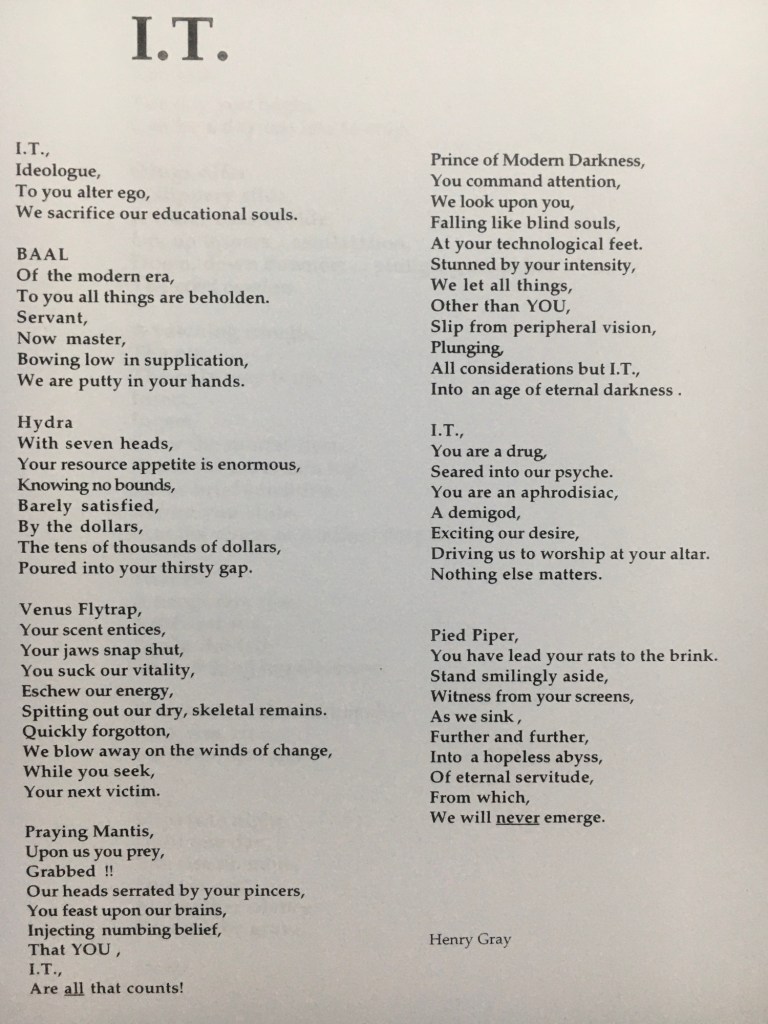
If I could uninvent something that is now paramount because of its influence in this world, it would be the discovery of Information Technology – which has led to so much instability and so much hurt through online communication that it’s benefit Is dwarfed by the negatives that have evolved from its creation.
At best, Information Technology Has reduced people of all ages, cultures, socio economic status, and others to depersonalised communicators and no longer speak to each other in a primary context of speaking and listening.
I wrote this poem sixteen years ago. It grew from the apprehension I felt about what was developing in the IT arena.
It has come to pass – and IT influence is ever more.
One garden shed full of tools, pots for pot plants, tiles for fixing bathrooms and toilets, empty rubbish bins and buckets, old roller blinds, and aluminium workbench, and all sorts of paraphernalia. It’s tidy but– Fits the mould of clutter.
An office full of memories and records but it’s in paper and electronic form going back to the 1970s. Many books, periodicals, articles that have been saved, self written assignments from the 1960s and 70s, and so on– Clutter.
The Laundry, with cupboards full of gear for washing, cleaning, painting, house cleaning agents, blasting rubbish, cutting grass, – Clutter.
I could go on but would never ever get to the end of my clutter.
Coming from a farming background I have to say that of all the animals in the world, my favourite animal is the humble sheep.
My father had fine wooded merino sheep on our farm and took great pride in the quality of the fleece the sheep produced.
Luck’s a fortune in respect of my Father’s sheep. My Father had bought a new farm in 1949. He had about 1200 sheep and had to shear them all himself with a single-stand shearing plant.
The farm at that stage had not been developed to have full shearing facilities.
I well remember my Father having to shear the sheep on the floorboard section of the machinery shed. He had to bale all the wool by hand.
Bales of wool then had to be manually manhandled onto the back of his truck and taken to the siding for train transport to the Fremantle wool stores in Perth.
I guess one of the reasons that sheep are my favourite animals quite apart from the fact that they have lovely natures, is the fact that my father’s first wool clip hit the best wool sale of all time.
Wool was in critically short supply after the Second World War and my father‘s clip went for so much money that he was able to pay the farm down in 12 months.
I am also a great admirer of the sheep in northern Scotland.
When visiting Scotland in 1996 we found that some of the sheep were very intelligent but they burrowed into the walls or embankments at the sides of the roads, to keep out of the freezing wind.
They were well protected. I thought that these sheep had amazing common sense.
I am not tempted to subscribe to Facebook, X, Tik Tok, Instagram or any social online accounts. These communications options are not for me. There is to much hurt caused by trolls and others who use these and other social media accounts to rip into and scarify account owners who become bullying victims.
It is wise in my opinion for me to steer clear. I cannot be scarred by people accessing my social media accounts, if I don’t have accounts to access.
Blogging, using LinkedIn and responding to newspapers through online comments will do me fine.
During my lifetime I have had many very interesting driving experiences. We have driven around Australia in hole and then part at least six times.
We have crossed flooded creeks, run into plagues of locusts, driven against an army of advancing cane toads, and had to dodge cattle.
By far and away the hairiest and most frightening drive I have ever undertaken was one Christmas holiday period around about 15 years ago. This was in the year or two just before I retired.
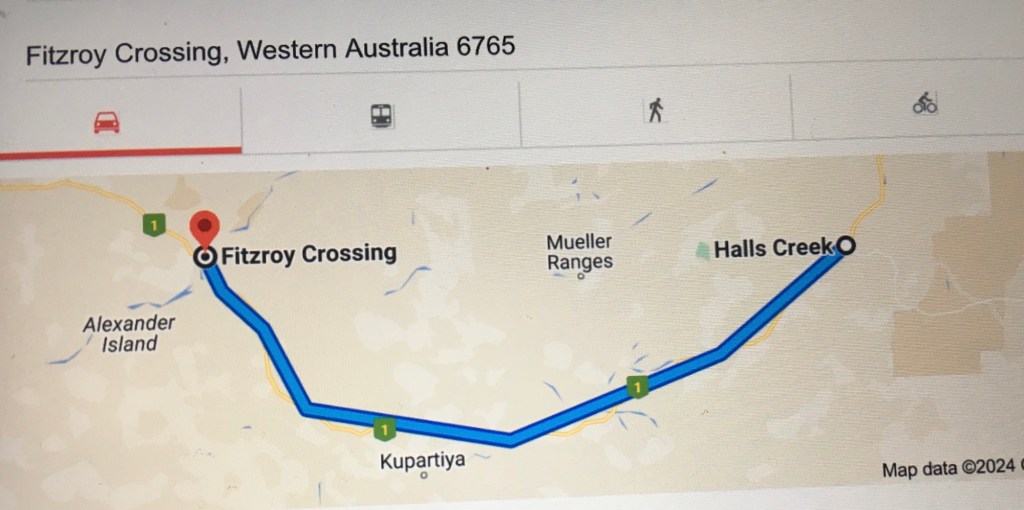
The wet season had come early to the Northern Territory and also to the top end of Western Australia. We were driving down to Perth from Darwin, a distance of just over 4000 km.
It was raining the whole time from Darwin until we got down to Carnarvon, 3000 kilometres into our journey.
On our first night out of Darwin we stayed at Halls Creek. It was raining when we got there and raining when we left early the next morning. We had come through a number of flooded road sections in order to get to Halls Creek and were anxious to be on our way early the following morning, heading toward Fitzroy Crossing. This was on the great Northern Highway.
We left Halls Creek just a wee bit before sunrise at 6 am.
The light of the day was just dawning, hindered by the fact that overhead were very heavy rain bearing clouds.
In fact the road and surround were so dark because of cloud cover… natural light at best, was penumbric.
Neither were we sure when we’re going to run into water across the road, or how deep and fast running it was going to be.
When we were about 60 km south of Halls Creek, a very large car with an eight cylinder engine passed us, going the other way toward Halls Creek.
A couple of minutes later I looked into the rear vision mirror and saw the car had turned around and was closing on us at breakneck speed. Without the shadow of a doubt they were trying to catch up with us, to do some sort of mischief.
There were six or seven adult indigenous persons in the car and as they gone past us in the other direction it seemed more than obvious that the impact of alcohol or drugs was. That kept us at some distance ahead of the car following which was gaining on us but it is much slower rate.
My heart was in my mouth because it was hard to tell whether there was water across the road or not and certainly the rain was still falling. I finished up doing around about 170 km an hour and wondering what might happen next.
Fortunately, a road train coming the other way and going toward Halls Creek passed us heading north.
Then came the second road train about a minute later. The two road trains must’ve deterred our pursuers, who gave up the chase.
That was the worst, most explosive driving experience I have ever had.
The heading translates as “Snacks are bad avoid them”. right now I would love a nice big feed of Kentucky Fried chicken, or if that was not available a Big Mac, or if that was not available baby from Red Rooster, or if that was not available on a couple of big whoppers from Hungry Jacks.
The thing is – I cannot!
I would love to – but I can’t!!
I’ve just been diagnosed with diabetes level two. Part of that is because I have led a more sedentary lifestyle since retirement that has put the weight on me.
I am in the process of being treated for diabetes and am reliably informed that the medication will be pretty well needed for the rest of my life. At the same time, I have cut back on everything sweet, including biscuits, lollies, and so on. I am allowing myself one ice cream a day.
Interestingly it hasn’t been so hard to resist the sweet things and the snacks because I’m motivated to overcome the challenges confronting me.
So the snacking would be lovely. But it cannot be a part of my dietary reality.
Describe an item you were incredibly attached to as a youth. What became of it?
Its registration number was M.932. It was a fantastic white in colour Holden utility that my father bought for me to use and later gifted to me when I left the family farm.
The utility gave me mobility as a young man
I was finally able to move independently and without having to rely upon my father giving me rides to places I wanted to be. It meant that I could go to cricket, to other activities, visiting, and to places away from home without having to trouble anybody for a ride. It also meant that I could carry out activities without other people within my family knowing what I was doing. Not that I really had anything to hide; it was just nice to be able to act and to be independent.
So is the 19 to 21-year-old man, the freedom of my own transport was quite exhilarating and most certainly appreciated.
May be the story of the Ute and the place is it went my best to be told at another time. Suffice to say that it lasted many years and drove many a mile – kilometres these days.
In 1972, I traded it for we needed the car accommodating family. What happened to that utility I do not know. What I do know is that it was a tremendous vehicle and served us well.
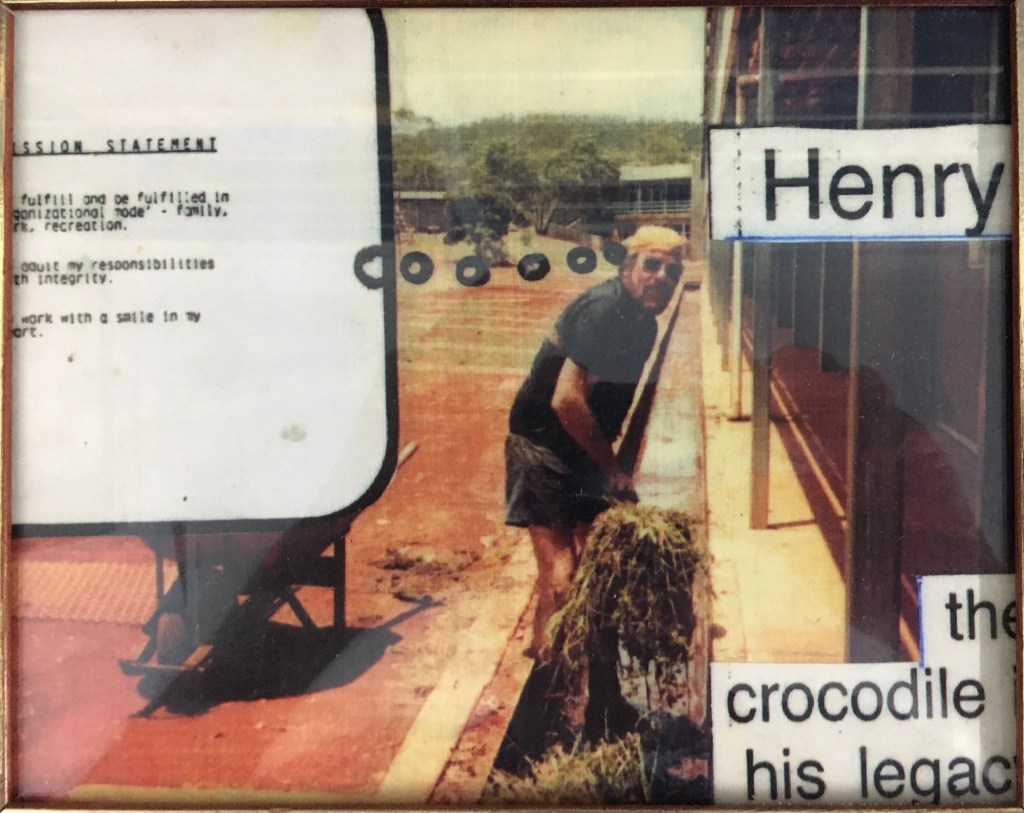
My mission (since 1982) was and still is embodied in my soul.
To fulfil and be fulfilled in organisational mode, family, work, recreation.
To aquit my responsibilities with integrity.
To live with a smile in my heart.
My mission to serve others and to be an educator to the best of my ability, led me to undertake tasks that were necessary in supporting educational efforts. At the time of this picture, I was the principal of Nhulunbuy Primary School in East Arnhemland in Australia’s Northern Territory. A stormwater drain running the length of the school, was choked with weeds. There was no-one to do the job, so it became Saturday – Sunday effort on my part.
Do you spend more time thinking about the future or the past? Why?
I awake each day, fearful of the fact that we are edging ever closer to the inevitable invasion of Taiwan by China. A recent column in ‘The Australian’ (Xi’s troops ready for Taiwan invasion) add to my foreboding. The start of this war cannot be far over the horizon and because of alliances, will quickly engulf the whole of SE Asia and the Pacific.
With Darwin being where Darwin is, and with the ever-upgrading of defence training and facilities, I stand in the yard, look at our home, look at THE surrounding neighbourhood, and wonder when (not ‘if’) it will be reduced to smouldering rubble by a missile or barrages of missiles directed at our city.
We are reasonably well prepared and ‘aware’ of cyclones. However, Darwin, Palmerston, Nhulunbuy (where fuel storage is anticipated) and Alice Springs (with Pine Gap being front and centre of Chinese interest) and other towns and communities will need bomb shelters and missile refuges. Our state of readiness for protection from environmental desecration and shattered infrastructure occsioned by war, is zero out of ten.
I feel war that will envelop our region is imminent, and we are far from ready.
The Bombing of Darwin in 1942 will be minuscule compared to the damage that will be wreaked on Darwin in the 2020s.
I contemplate the years ahead with apprehension and worry for my family and indeed for the whole of our Territory and Australian community.
Most gifts are tangible and concrete. They have material substance. They have extrinsic value and are worth something in monetary terms.
I don’t want any tangible gifts. For me, “appreciation“ for what I do for others is the gift I would seek. That appreciation might be expressed verbally, by some written message, in a card or by letter – and that is sufficient.
Over the years I have kept a file of “thanks and appreciation“ letters and messages.
I value highly appreciations that have been offered to me by people young and old. Those messages confirm that I have done something right and something that must has made a difference in the lives of others.
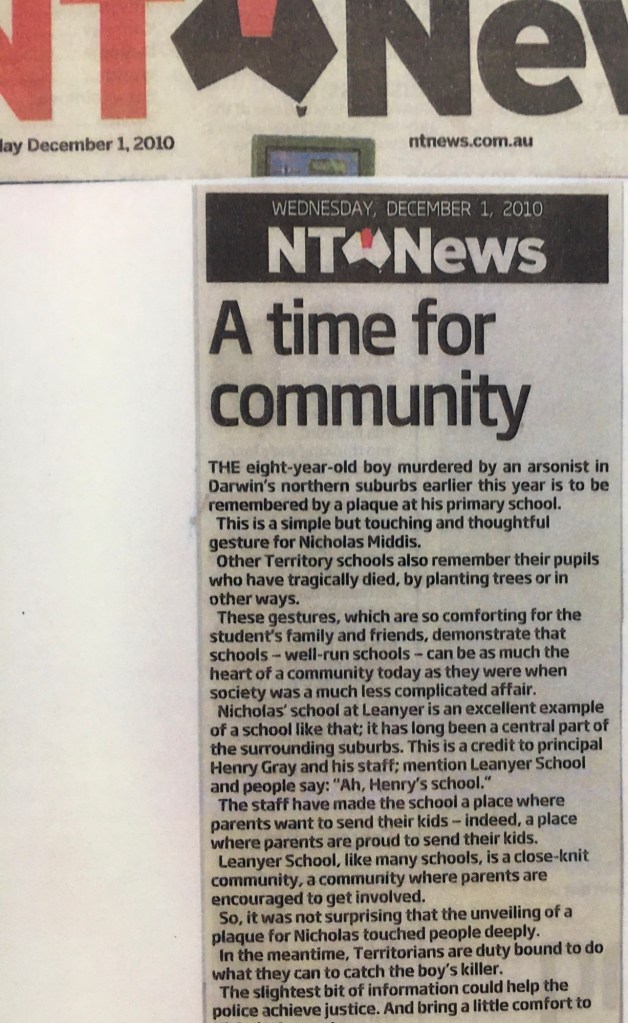
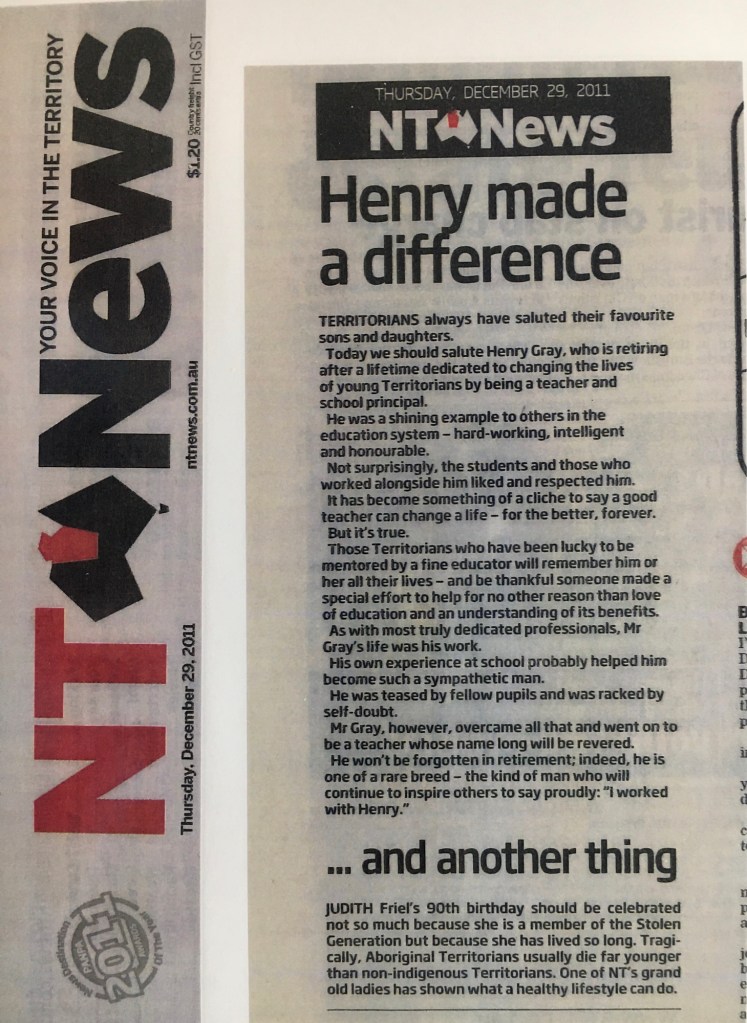
Among my prized possessions are two editorials that were written and published in the Northern Territory News. I am attaching them to this response.
At some stage a topic may come up that enables me to better express my thoughts about Nicholas Middis. He was a student at my school, and he met a very tragic and sad death. Nicholas is referred to in the first attached editorial.
In summary, the best gift I can be given is that appreciation which is intrinsic but which is without price.
During my lifetime I have attended three different colleges. All those colleges and some similarities and differences as well.
I’m not including Primary or high schools or designated universities in this response.
Western Australia Missionary College (WAMC)
I was a student at this college for my academic years 10 to 12. I attended from 1961 to 1963 inclusive.
The West Australian Missionary
College was operated by the Seventh Day Adventist Church. It was for students both young and old for those undertaking academic studies along with vocational training.
The church believed that Students should also work and that work was good for the soul. To this end, regardless of who you were and what your course of studies, it was compulsory to work a number of hours each week to go towards offsetting the cost of fees.
There were four student categories;
Category A student who had to work for nine hours a week.
Category The students who had to work for 14 hours a week.
Category See students who had to work for 18 hours a week.
category The students who had to work for 24 hours a week.
The cost of fees other than work or adjusted to reflect the number of hours being worked.
It was possible to work for eight hours on Sunday and for four hours each afternoon from Monday to Thursday. There was no work on camp Friday because, in the afternoon, students had to get ready For Saturday’s “Sabbath”. From sundown on Friday until sundown on Saturday, there was no work, with the time being devoted to church and religious activities.
It was a place of difference.
My second college was Graylands Teachers College housed in army huts built in Perth during World War Two. That was my place of learning in 1968 and 1969.
My third College. Mount Lawley
College of Advanced Education as an external student, from 1974 and 1975.
I have many stories I could tell about my times in these three places, all of which played an important part in my life.
Do you play in your daily life? What says “playtime” to you?
As an old man I don’t really play any more. But play was an important component in my growing up years and was enjoyed by our children who were born in the 1970’s.
I worry at its diminishment in these modern times.
Playing in the outdoors was something members of older generations took for granted when they were children. In more recent years there has been a foreclosure on what was once unregulated freedom. Safety and security issues have raised concerns about the wisdom of young people being allowed ‘old fashioned’ freedoms of play.
The upshot, is that many young people prefer to sit and play games on screens, rather than being in the outdoors letting off steam in a running, playing manner. There are hundreds of pieces of research that have been done, all pointing toward the fact that a lack of physical action and activity is depriving children of an energy outlet in play.
It is true that many children are now playing less than used to be the case. There are of course, a growing number of play centres in cities that attract young people, but they are often at distance from where people live. It also costs a lot to patronise these centres, meaning they are beyond the means of many families.
From time to time, walking or bike riding to school are promoted as one off family days. Children walk or ride with parents or others to school. Normally the majority are dropped off and picked up by parents and carers. Even on these special walk and ride days, most children (and many bikes) are collected after school.
School and public playgrounds used to be fun places for children. However, they have been impacted by occupational health and safety (OH&S) requirements that have taken many of the fun elements out of playgrounds. Roller slides used to be powerful drawcards for children but after an accident or two, OH&S decreed that rollers had to go and be replaced by a flat plastic or metal sheet down which children slid. Fun evaporated. ‘Stranger Danger’ awareness and the possibility of needle stick injuries have also discouraged parents from allowing children access to public playgrounds without supervision.
More and more families are living in high rise apartments. Limited playing space naturally encourages sedentary activity.
For whatever reason, physical activity and letting off steam in play situations seems to be diminishing. This is an unfortunate trend and not one helpful to the development of young people. It makes play opportunities at school all the more important.
Wishing you and yours all the very best for the time of the year in which we live – celebration of Christmas and entry into the new year.
.
I hope you can look back on 2023 as one during which you had much to celebrate as well as challenges to master. For us all, 2024 will offer 52 weeks of yet-to-be-experienced anticipation.
This year, it seems to me that there is a “forced joyfulness“ about the weeks of the festive season. With so much trouble in the world and with so many things going wrong on the International and domestic fronts, we are all making an effort to secure feelings of well-being during the 2023/24 Christmas and New Year period.
I just hope this lasts into the months of 2024. The year just ended gave very little that could be described as offering long-term optimism. So many people continue to struggle.
As we look at 2024 it seems that we have to hope that things will be better. That ‘hope without fulfilment’ has been the challenge besetting the world for the last three or four years. Whether or not the hope of an upturn in outlook and action for 2024 becomes a fulfilment or remains a distant hope is a matter that is very much up In the air.
Hopes:
That the Israel and Hamas conflict will resolve quickly.
That the Ukraine and Russian conflict will be over before 2024 is out.
That China will do less sabre rattling against Taiwan.
That the people of Australia will become more united and less divided by cultural, ethnic and religious considerations.
That the myriad of conflicts in every part of the world will cease and dialogue will lead to solutions.
That people will think ‘we’ rather than ‘I’ and ‘me’ in isolation from ‘us’.
That spending priorities will place the necessities of life ahead of frittering activities.
That all parents will take far better primary care of their children, rather than preferring institutional upbringing of their offspring.
That the world, locally, regionally and globally will be threatened less in terms of weather, climate and environmental disasters.


 EDUCATION, A LIFE FORCE