EDUCATIONAL THOUGHTS

Behavioural issues in schools are very real. In many schools, teachers spend as much time on matters of discipline and student control as they do on teaching. Poor behaviour of the few, deprive many students of learning opportunities. It is one of the reasons parents enrol their children in private schools.

More education money needs to be spent on teaching and learning needs and less on building and infrastructure. Facilities are being oversupplied while educational programs are being stretched. Expenditure balance is needed.

All the very best to our NT students and teachers for the upcoming school holiday. Your learning responsibility and teaching efforts earn the appreciation of parents and community. Have a great break; you deserve it.

SUPPORT ORGANISATIONS PLEASE REPRESENT YOUR PRINCIPALS AND TEACHERS

LET’S IGNORE THE PUBLIC DEBATE – A FACTOR OF BEMUSEMENT

Over the years I have on many occasions been told by principals and other educators that they do not read the paper or follow the popular news. They consider media, particularly it seems print media, to be biased against them and interested only in reporting negatives and downsides. That being the case, their predisposition is to shy away from reading or understanding what is being said and written about education.

Regardless of personal preference, it is to the detriment of school leaders and teachers if they do not know how education is being reported in the media. Without knowledge and awareness, repudiation and the expression of counterviewpoints is impossible.

I’m giving a shout out for the Aust Education Union (NT) but not the other representative associations.

Along with principals and teachers, it is important that their representative professional associations are in the business of knowing what is being written and said about members. Through their executives, they need to speak up in a representative context, participating in conversations and debates about issues. To shy away from this responsibility and cocoon against what is being raised in the public domain, is anathema.

Be bold, be representative and speak up!

Enjoy the school holidays

Today marks the beginning of the three week school holiday period separating Semester‘s one and two in the Northern Territory.

Significant periods of school holidays will be starting the children and teachers in schools elsewhere around Australia, either this weekend or next.

As a retired teacher I want to wish everyone all the very best for a happy, relaxed period of time away from the school.

These days, teachers particularly on students as well her off and on the receiving end of criticism. This can be for perceived lack of application and effort. It adds to the fact that we become a profession that takes on board criticism and also self reflects, where the reflections and thoughts are often negative.

It is important that educators take time to consider things that they have done well, outcomes of benefit students, the system and of course themselves! Self-congratulation is important.

Of course taking account of things that could be done differently and better is a part and parcel of self evaluation. However overlooking those things that have been done well means that reflection is one-sided. It needs to be balanced.

My suggestion is to periodically about and maybe note down those things that have been done well in order to balance the perceptual ledger. There is much more to education and our contributions than negatives.

I also suggest that educators think about the contributions of peers and associates, where their contributions have been a personal benefit or assistance to others. Touching base by text or card, phone call or message “thank you” in appreciation during downtime could well boost them as well as satisfying you for having recognised their contribution.

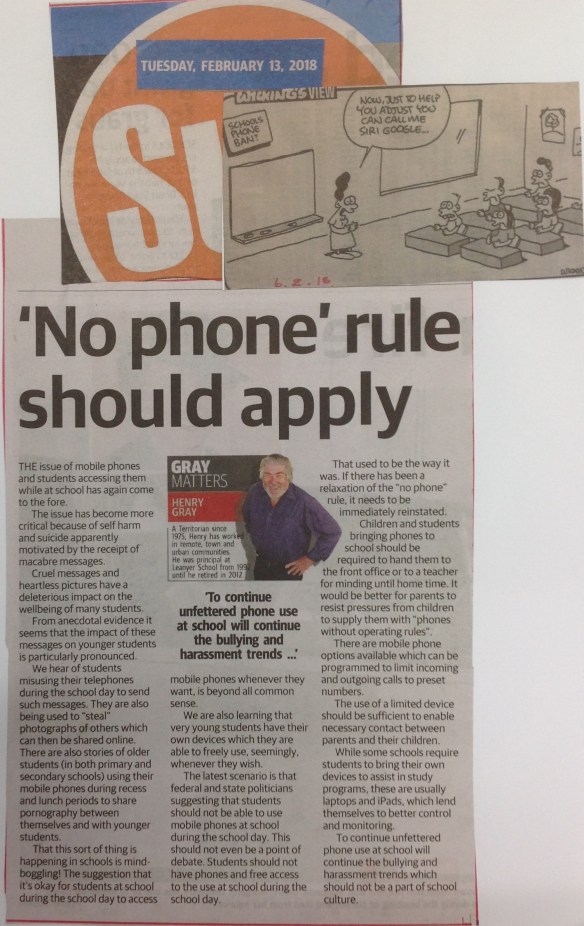
STUDENT PHONES IN SCHOOLS – EASY FIXED

I acknowledge Colin Wicking’s cartoon on the subject. He is the pre-eminent cartoonist with the NT News.

And the issue IS easily fixed. It is only an issue because policy pertaining to mobile phones in schools has either not been developed or if in place, often not enforced.

So ‘pushing the envelope’ because of ‘accomodation’ has been the outcome.

YOU NEVER HEAR FROM THEM AGAIN

As a long-term Northern Territory resident and a contributor to education pre-retirement for 36 years (and post retirement in various capacities for eight years since) I am often asked for an opinion or comment on various issues. These matters have had to do with general territory living, with education and with matters relating to more rural and remote areas of the territory (where we worked for quite a number of years before coming to Darwin).

One of the things I find bemusing is that while people are quite willing to ask for input, if that input is provided, there is rarely if any feedback on outcomes nor the benefit of that advice may have offered.

That’s not a case of asking over and over for thanks. It is however a case of being appreciated and people knowing that you’re interested in the outcomes of the conversations or meetings, where advice given has been a part of the discussion.

Is this a case of being appreciated or simply used?

In 2017 and 2018 there was wide ranging discussion on School Based Policing and the need for it to be returned as a program in Northern Territory schools. This is a subject in which I’ve been deeply interested for many years both from the viewpoint of being a practitioner and a student who wrote on the subject during a Masters university course.

Following quite intense conversations between the government, the Northern Territory Police, the Council of Government Schools Organisation and others the program has been reinstated and guidelines developed for its re-introduction.

I did receive verbal thanks from COGSO.

What crystallised my thoughts on this topic was receiving an email copy of the reinstated guidelines from Thomas Moorhead who is advisor to the Leader of the Opposition Gary Higgins, in the Northern Territory Parliament. I really appreciated sent these guidelines and reflected upon just how rare it is to receive follow up and feedback from those to whom assistance has been provided.

Responses of this nature are, unfortunately, all too rare these days. For the provider of input the process has a beginning (request for support) middle (assumption of the negotiations that follow) but no ending.

This is unfortunately a modern day trend that should be recognised and put to rights. However, I doubt that there will be any change.

YOU NEVER HEAR FROM THEM AGAIN … UNTIL THEY WANT ANOTHER FAVOUR!

PROGRAM RESURRECTION IS A REAL PLUS

This column was published in the NT Suns Newspapers on June 25 2019 under the title ‘Program plan a smart move’.

This was my final column for the Sun as it will no longer be printed. It has departed from the Northern Territory News stable.

I will continue to publish on my blog.


The NT Government’s reinstatement of the school based policing program is one of its smartest decisions. This is proof positive that governments are sometimes prepared to accept that not all decisions made, generate the best outcomes.

The School Based Policing program, introduced in the 1980’s, was a ‘top drawer’ initiative. Attached to high schools, each School Based Constable (SBC) had a number of feeder primary schools he or she attended. Constables would visit their schools to conduct Drug and Alcohol Education classes with children. They extended their role to include ‘stranger danger’ awareness and issues such as bullying.

The axing of the school based policing program from Territory schools was one of the worst decisions ever made. Judith Aisthorpe was absolutely right in reporting that when introduced to NT Schools in the 1980’s, “the program was heralded a success and adopted worldwide … the program in its original state was beneficial as it stopped crime and anti-social behaviour before it happened”. (Back to school for cops, NT News, 28/5/2018).

The dismantling of the School Based Policing program with the substitution of police station based ‘Youth Engagement Officers’, was tokenistic. As was forecast to happen, school programs lapsed, along with the contribution SBC’s made to the sharing of children’s learning and the development of positive attitudes. The absence of School Based Constables left a big hole in school support programs.

Fast forward twelve months, and Ms Aisthorpe has been able to write about the program in a far happier context. “The (reinstated) school based police program has been largely hailed as a success … schools, police officers and students (want) to see the program continue …” (School police praised but role ‘needs clarity’ NT News 15 June 2019).

Dripstone Middle School Principal Robyn Thorpe encapsulated positives of the program. “Being on site means (constables) can build positive relationships with students … staff and … community … that puts police in a positive frame rather than police being called in for negative reasons.” (Op cit). Senior Constable Dan Bull upheld the program for helping “… students deal with issues and problem solve hurdles they may have in the future.” (Op cit).

There is a need to train police to work with students. However, that may simply require the police training unit to dust off and reinstate the carefully designed training programs that were in place before the program was discontinued. There is no need to reinvent but simply revisit what was a part of the training regime. It is to be hoped the program regrows to include all NT schools.

___________________________

POSTSCRIPT

Thank you to those many people who have read my column and offered me feedback during the past six years. Sharing contemporary educational issues with you has been my pleasure. You are always welcome to access my blog ‘Education a life force’ at henrygrayblog.wordpress.com

HONORARY DOCTORATES SHOULD BE OFF THE AGENDA

Ash Barty is a credit to tennis and a shining example to all young (and not so young) people.

She deserves all the accolades she is earning. BUT

What I don’t like is that universities all over Australia will now be pushing each other out of the way to award her honorary doctorates.Honorary academics qualifications should never be awarded to those who haven’t earned them.

Adam Goodes is an example. He has justifiable earned recognition including Australian of the Year. He also has 3 honorary doctorates. For non academic prowess. WRONG.

As are the honorary doctorates that have been given to many other sportspeople, both indigenous and non-indigenous. The list of honorary doctorate holders ion the sporting domain is mind-boggling. Check it on Google.

Honorary doctorates trivialise tertiary education. Handing them out willy-nilly to sportspeople, politicans, retired defence personnel and others who may have made an occupational mark, discounts those who work hard and study for years to earn PhD’s and other academic doctorates. To add to the slight on genuine doctorate earners, graduation ceremonies offer accolades to honorary awardees while genuine doctorates earners are left to sit and hear from those being so honoured.

Wrong?

WRONG!

SUN UP, SUN DOWN

SUN UP, SUN DOWN

The Sun Newspaper was launched as a community newspaper supported by the NT News in on July 4 2019. Initially it was published under three mastheads for Darwin, Palmerston and Litchfield. Columns were common to all three editions, with some content local to each area being introduced into the editorial space. It was later that the three mastheads became one. And later still when the Sun was continued as a stand alone paper and also added as an insert into Tuesday’s edition of the NT News. There’s variations aside, the community newspaper, which had morphed from earlier versions, has been a feature of both print and later print and online news over the intervening years.

Until today.

I had been invited to write a column relating to education for the newspaper. My first column was published on July 4 2013. Since that time, I have written a weekly column on matters of an educational until today.

Today June 25 2019, was the last edition of the Suns Newspaper. Cessation is on the day my column marks six years of weekly writing for each of the 48 weeks of yearly Suns publication. So I got close to by 300th column but never quite made that anniversary.

Post retirement, I am glad I had this sharing opportunity.

Education Goes On

I ended my final column ( a happy one on the positives of our Government and the relevant departments reinstating School Based Policing) with the following postscript.

“Thank you to those many people who have read my column and offered me feedback during the past six years. Sharing contemporary educational issues with you has been my pleasure. You are always welcome to access my blog “Education a Life Force” at https://lnkd.in/g67RzwW

Newspapers evolve and change, often quite rapidly in this digital age. However, there is a place for print and for the sharing of local issues that go to policy and organisational prescription. That is what an appreciation of education in an ongoing and contemporary context should be about.

Naturally I am sad that the Sun has gone down. I will look to continuing my work in terms of educational commentary in other ways and through other forums.

My final point is to clear any misconception about my status as a Suns columnist. My contributions have been voluntary and not associated with any payment. My column has been a way of giving back for the advice and help I have received and the support I have been given as an educator over the years.

WHERE BULLYING BEGINS

KYLIE LANG IS SPOT ON

Kylie Lang’s column in the NT ‘Sunday Territorian’ today is spot on.

Bullying behaviour is so often learned at home. It is parents and caregivers who teach their children about the subject.

I’ve highlighted a couple of her comments. It will resonate with many teachers and school leaders. It is one of the best and most telling columns written in a long time.

TEACHER OR PUNCHING BAG?

This was posted by a teacher in Brisbane on a Facebook page. An excerpt is posted on my Linked In account and in it I made reference to the full text from this alarmed and dispirited professional educator. It is below in italics. It is reproduced without editing.

It is NOT true of all classes and all schools. But it IS an issue. An issue likely to mushroom as and if schools focus on the theory of organisational structure and let the issues of the moment, the classroom context and let slide the application of overall school behavioural management policies. These policies might be sets of nice documents and pretty words but without action they are useless verbage.

2 weeks ago I was sexually assaulted and verbally abused by a student in one of my classes. Supposedly none of the other students saw the sexual assault, but did recall some of the tirade that I also endured. As management could not find “proof” of the assault the student will be coming back to school next week.

Since the incident 3 of his friends in class have not held back from their verbal abuse of me in every class, always getting off with a slap on the wrist from admin. Its meant to result in suspension.

Today one of them physically threatened me and I had to send an emergency red card to the office for help, again. A dean is meant to arrive asap. It took 25mins.

The classroom behaviour is constantly escalating from this group.

Theres one more week of term. Despite the fact that I genuinely need the money to get through the holidays, and don’t want my reputation as a teacher smeared in future contracts within the department, I’m seriously considering not going back. My anxiety and stress is through the roof.

I’ll be at another school next term, a private school this time. I am forever swearing off working anywhere near my current school again and I feel so bad for the good students there having to condtantly endure the crap that they do when admin dont back up their own behavior guidelines.

This is a plaintive cry for help and support. It is echoed in far too many schools and far too many classrooms. It is a growing issue and one that is clouding the purpose and the essence of education.

NORTHERN TERRITORY’S EDUCATIONAL HISTORY IS INVISIBLE

It is a sad fact that our history of education in the Northern Territory is pretty “muted”. A lot has gone on over time but remembrances are diminishing as people leave, move on or become deceased. When Gary Barnes took on the CEOs role in 2009 he rued the fact that there was no history of education in the Northern Territory to which he could refer and be informed as the incoming CEO. This situation has not changed.

With that in mind, I have wondered whether or not it would be possible for a thread on “history”, with sub titles to differentiate the different aspects of Territory education that have happened in the past in the NT, to be built into the department’s website.

Under the subtitles (aboriginal education, bilingual education, and so on),an annual chronology could be established so the comments on specific subjects relating to the year of happening could be included.

There are other ways in which this reference could be extended. One might be bylines relating to theses and dissertations, that relate to educational history and developments in the Northern Territory completed over time At the moment any documentation of this nature would be housed with Charles Darwin University or possibly in the Northern Territory archives. Cross referencing in a “trove” manner to these sources could be useful.

I have raised this issue within the Education Department, so far with no positive response. Unless and until our educational history is visible and available, discounted policies will be revisited and past mistakes re-made.

THE LINK IS SEVERED

THE LINK IS SEVERED

Yesterday I received an email confirming the severance of a communications umbilical cord that has been part of my weekly program for the past six years – and it will be six years exactly when my final Suns column is published on Tuesday 25 June.

In my first column published on July 3 2013 I wrote under the heading of “Children always key to education”, that our first Director of Education Dr Jim Eedle had advised us that children should always be the focus of schools. His pronouncement made in March 1979 I revisited in what has transpired to be my second last column for the Suns. I wrote that ‘Education’s focus seems skewed’, with Eedle’s exhortation still pending and seemingly further away than ever because of system preoccupation with organisational focus. Structure rather than function seems to hold the dominant place on education’s agenda plate.

My final column, number 291 will applaud the reinstatement and regrowth of the School Based Policing program. Government and its related departments did the wrong thing in dismissing this program. The reinstatement demonstrates that wrong decisions can be acknowledged and made right.

I have enjoyed writing in a voluntary capacity and have done so to support our community knowing about what is happening.

I WOULD LIKE TO BE PROVED WRONG

I WOULD LIKE TO BE PROVED WRONG

But

It seems to me that the following thoughts are not figments of my imagination.

* University entry requirements have become almost free wheeling. Standards have been abandoned.

* University students are not students. Students are money.

* It seems to me that tertiary education has entered the age of mediocrity.

* The standards issues have taken a deep southern dive over the years. So have graduate expectations. And that is a real worry.

* The dive is still happening.

* A ‘B+’ value now was a ‘C’ back then.

Please make me be wrong.

EDUCATION’S BRIEF SEEMS SKEWED

This perception was published in the NT Sun Newspapers on June 19 2019 under the same title. Bolding mine for blogging.


The Northern Territory Government is 41 years old. So too, is the management of NT Education. Education was the first portfolio handed over by Canberra to the self-governing Northern Territory. This was supposed to mark the start of a new educational beginning.

In March 1979, all school principals were invited to a conference to meet with Education Director, Dr Jim Eedle.

In 1977, Dr Eedle had been appointed as director and oversaw the transition of education as a department becoming responsible to the NT Government.

Dr Eedle likened this to the dawning of a new day. He told principals to never forget that “schools are for children”. His other advice was to remember that structure and organisation should always be about reinforcing this key message.

To school leaders of the time that enduring advice was a prime focus.

Four decades later I believe education emphasis has drifted from the simple sincerity and unambiguous intention of Eedle’s advice. Educational organisation has broadened, deepened and become extraordinarily complex.

During Dr Eedle’s time at education’s helm, schools were supported by a single support section of the department. This has grown to six supporting educational divisions generating a plethora of directors and managers, many with their own group of support staff.

Some of this growth has been demanded by Canberra – because education at territory and state level is still quite centrally controlled. Some ideas about what schools should provide seems to come from “off-the-cuff” and poorly thought through politically or socially motivated suggestions. Other demands come from a community which seems to expect schools and teachers should be responsible for every aspect of child development.

This might be justified if the focus as urged by Dr Eedle meant that we were preparing students for the whole of life. However, it seems that Eedle’s exhortation has disappeared into the ether of change.

Focus on over-the-top accountability and compliance demands, have been responsible for growing the support arms of education. Increasing volumes of paperwork and accountability requirements are educational distractions. The monolithic departmental structure enveloping school education seems to be primarily focussed on data analysis and justification.

It appears that educational authorities now regard system organisation as being more important than the students it was designed to support. Structure is important, but not to the extent of students being in its shadow. It is time to revisit the intent and message from Dr Eedle who said 41 years ago that “Schools are for children.”

CARE FOR TEACHERS IS GOING SOUTH

What I wrote into a survey about perceptions of attitudes held for and about teachers. Written on June 14 2019

There is far too much loaded onto teacher in expectational terms. They are no longer able to teach in a direct and uncluttered manner. They are regarded as persons whose prime focus is to test, measure and evaluate students.

As professionals they are increasingly devalued. They are dumped on by systems and schools with demands they manage an ever expanding curriculum, one that is largely extraneous. In terms of load, things are added but never deleted. Accountabilities and justifications with which they have to conform are over the top.

Added to that is the fact they are dealing with students, especially secondary students in public schools who are often demotivated and disinclined. Respect of students for teachers at all levels is a diminishing quality.

Teaching is increasingly a thankless profession full of expectations (brickbacks) and light on for appreciation (bouquets).

STUDENT SUSPENSION SHOULD BE SUSPENSION

On many occasions, suspended students are suspended from school in order to preserve the sanity of teachers and to take pressure off other students.

I never suspended all that often (love close primary students are different to secondary peers). However, when students were suspended they were suspended and that was it.

Students should not be sacrificed and teachers should not be nailed to the wall by those who are deliberately defiant, whose purpose seems to be bent on disruption and maximising discomfort for classes and instructors.

I believe that education systems could be structured in a way that took the students from classrooms and allocated them elsewhere. However, I do not believe that pandering is the answer.

While some of these students have genuine learning difficulties and can be assisted, they have to take part in this as a self-help ambition. Those who know exactly what they’re doing and who are intentionally disinclined to not deserve places in our regular classrooms.

I believe that there is a need for systems to toughen up and take firm stances on behavioural issues. students are suspended from school in order to preserve the sanity of teachers and to take pressure off other students.

BEWARE ADDICTION TO ONLINE GAMING

This opinion piece was published in the NT Suns Newspapers on June 11 2019 under the title Be wary of online allure.


Technology has introduced cyberspace to young people in a way that both helps and hinders. It offers advantages and benefits that support and assist in their studies. However, there are downsides that can have a deleterious effect on their minds and lives.

One of the major digital age drawbacks is the savage impact social media has on lives through cyber bullying. Another downside is the temptation to complete assignments through cutting, pasting and plagiarising from online sources.

One of the more sinister impacts of the online age, is its ability to disrupt and change the behaviour of users. Young people can be influenced to alter their thinking about things important to their future life. Some of these changes are little short of bizarre.

“Australian children as young as seven … are launching aggressive attacks on their parents, lying to get out of school and avoiding family holidays to play Fortnite marathons, as the video game recruits a new generation of underage players.” (Jennifer Dudley-Nicholson, Kids in video game crisis, Sunday Territorian, 26 May 2019)

The author adds “Education and neuroscience experts warn excessive and premature use of (video games) is leading to a ballooning crisis for Australian families, … now checking their children into dedicated rehabilitation centres to wean them off screens and reintegrate them into social, family and school life.” (Op.cit)

This is an issue that has been looming for some time. Experts have cautioned against children of tender years being allowed uncontrolled access to gaming applications. However it seems their advice has largely been ignored.

There are others claiming to be experts who maintain that ‘games are just games’ and do not alter the perceptions of young people about the realities of life.

If a significant number of children and adolescents are so preoccupied with gaming that nothing else matters, then addiction is a real issue. Fortnite, one of the major online games is not recommended for player under 13 years of age.

It is influencing far younger children. The article quotes neuroscience communicator Jill Sweatmen who is concerned that this particular game is attracting children who at 7 or 8 years of age are too young and mentally unprepared to handle its content. “There are short term consequences and significant long term consequences to this.” (Op cit)

Parents need to be on guard and absolutely aware of the sites their children visit and the online games that can be so absorbing. Schools play their part, but awareness, education and the shaping of young attitudes has to start in the home. This issue cannot be ignored.

KEY LEARNING THREE: VALUE SYNERGY

Synergy is ‘collective energy’. It is the product of effort that can be achieved when a team of individuals pool their resources and work ‘together as one’ for the good of the team and the organisation.

Over time I learned to appreciate that a synergistic organisation is more positively proactive than one in which individuals work in isolation and with little sharing.

To be truly synergetic, those within organisations must value each other. They must rejoice in each other’s successes and appreciate the contributions each makes toward the organisation as a whole.

A synergistic organisation is one in which the individuals work in a way that puts the needs of the organisation as a whole above their own individual aspirations.

I learned from observation and conversation that synergy is a rare commodity. Many people within schools, businesses and other institutions are there primarily for themselves. I also learned that if Individuals worked for the collective good of the organisation, that as a workplace it was superior. I learned that synergy begets positive outcomes and in the school context enhanced student learning opportunities as well as being satisfying to students.

I learned that synergistic schools are the best schools.

WHAT’S NEW IS OLD

New ideas and approaches tend to be pre-tried (or old) ideas that have been planned, implemented, tried and dropped for new ideas in the past. In reality, they never fade completely away but sit and wait until ‘new leaders’ in time come along and revisit the old, trotting them out as new initiatives and possibly the way to the future.

If only education was about ‘steady state’ instead of bouncing from one idea to the next to the next! With all these changes, many of them coming from people in high places and systems level, school leaders and staff are constantly persuaded (or required) to move with the times. At the end of this process are students, poor students. What must THEY think? Of course, they are never asked. Always question the need for change.

PLAGARISM HAS MANY FACES


One of the sins of our educational profession and many others is claiming ‘ownership’ of ideas without sufficiently acknowledging the genesis of the initiative. So often something claimed as belonging to a person by that person, has its origins elsewhere. That applies to information gleaned from the web but also results from the claimant not sufficiently researching to determine whether her or his idea has been tried in another place and at an earlier time. As a long term educator, I can attest to that happening for me on quite a few occasions. Never did I protest loudly because if our children benefit, does it really matter where the idea was sourced. Nevertheless, one puts these things away in the back of one’s mind and it does impact upon the respect held for purloiners.

Always acknowledge the source of the ideas taken and developed.

NAPLAN ONLINE A FIZZER

This opinion piece was published in the NT Sun Newspaper on June 4 2019 under the title NAPLAN tests online fizzer.


NAPLAN this year went online. Selected schools within the Territory and around Australia had Year 3, 5, 7, and 9 students sit the tests online for the first time. That followed testing and trialling which determined NAPLAN was ready for this advance. Lots of assurances were given about this being the right move.

The online program declared ready for use by a significant number of schools, turned out to be fraught with operational glitches. Students in many schools including the NT, experienced major frustrations. In some cases schools could not establish internet connection. In other instances, servers dropped out and disconnected children who were in the process of completing their tests.

Steve Vivian reported in the NT News that “more than a third of NT schools were affected by technological glitches during … NAPLAN online testing. … Thousands of kids across Australia will resist NAPLAN after technical problems derailed the new online test.” (NT gets NAPLAN ‘disaster’ warning, 24/5/2019)

It was fortunate that the online testing program was only rolled out across “the 32 most ready NT schools” this year.

Twelve schools reported technical issues. It is small comfort for students (who must feel like experimental guinea pigs), that they have been the option of re-sitting disrupted tests.

For once, NT schools were advantaged by being in the vanguard of NAPLAN cyberspace progress. Elsewhere around Australia, the percentage of schools in which students were sitting for online tests was much higher. Technical failure and glitches confronting those sitting the tests was far more confronting. So much so that, “Victorian schools have been told they can scrap online NAPLAN tests and switch to paper and pen after computer glitches affected students taking the assessments across the country.” (ABC News 15/5/2019) The Sydney Morning Herald (15/5) reported on student tears and teacher dismay as children reverted to pen and paper tests.

There were online access problems for students in Queensland, South Australian and Western Australia. Major flaws were exposed in a process that was both premature and deeply flawed.

A major program of this nature has to be 100% foolproof before being released as part of standard testing practice. Hundreds of students have been let down by the system.

The botched testing of 2019 may soon fade from Australia’s collective mind. However the failed experiment will be long remembered by those who were the victims of this year’s NAPLAN program. Students due to sit tests in 2020 be not be looking forward to online testing with any great relish.

CHANGE TO SCHOOL FUNDING PRIORITIES

This column was published in the NT Sun Newspaper on May 28 2019 under the title Funds vital to schools.

Shifting the goalposts on funding priorities has provided for an infrastructural surfeit, but not necessarily the enhancement of teaching and learning program within those brand new facilities.


There have been some major shifts in educational funding priorities for education in the past decade.

The Global Financial Crisis (GFC) in 2008 changed the way school funding was prioritised. Prior to 2008 it was extraordinarily difficult to attract money for school capital works programs. Principals and school councils were often frustrated by the delays in gaining initial approval. There was real competition between schools for this funding. Works if approved, were often years away, buried in treasury’s forward estimates.

Minor New Works programs for infrastructure projects up to $250,000 were similarly queued for lengthy periods of time.

The GFC consigned this scenario to history. In order to stimulate building and construction, the Federal Government created the Building Education Revolution (BER).

Many billions of dollars were released to state and territory educational systems. ‘Build, build build, like there is no tomorrow’ became the order of the day.

Along with all educational authorities, the NT Education Department was overwhelmed with BER money. Funds were allocated for major construction in every Northern Territory school.

Although the BER is now history, it has given rise to a significant shift in funding priorities for NT schools. Compared with pre BER days, it seems that limitations on capital and minor new works funding have been totally relaxed.

Government tenders in the NT News each Wednesday confirm that money is being continually allocated for infrastructural works of all kinds. Included is funding for playground equipment, shade structures, irrigation upgrades and other works that were rarely funded in past times.

Previously, it had been up to school communities to fundraise for these improvements. Election days became times when nearly every school held a sausage sizzle or set up a fundraising food or drinks stall. Money raised was tagged for school projects. During the May 18 election, only 30% of NT schools operating as polling centres, held fundraising activities.

These fundraising events also build school and community togetherness, a relationship that should always be promoted.

Schools do not want for funds to support building, construction, environmental upgrades and ground improvements. However, there is a need for funding to recognise and support teaching and learning programs in classrooms. The ‘heart’ of the school is the teaching/learning interface. Buildings and facilities are necessary. However they should not be prioritised to the detriment of core learning needs or reduction in staffing levels for the sake of enhancing building and construction budgets.

While facilities are necessary, the support of students through classroom programs must not be compromised.