EMOJI STANDOFF

What are your favorite emojis?

EMOJI STANDOFF

As an old-fashioned person it was brought up with pencil pen and paper and his formative years happened well and truly before the age of computer and back in the days of the typewriter, correctional fluid, carbon paper for duplicate copies, and so on, I really do not have time for emojis. I don’t like them. I don’t like the way they have substituted for pros that expresses mood, feeling, environment, and general context,. I like to be able to write about things – Albeit enhanced these days by computer technology – but I do not like the substituting of emojis for descriptive text.

My only memorable experience was not with emojis but rather with Pokémon “characters” who can be found in different places at different times sending different messages.

I don’t play Pokémon but one day I was with a relation in the fish and chip shop. The shop was quite full of people at the time who were waiting for orders and the staff were flat out.

My relation played Pokémon while we were waiting and discovered a great big rat on the screen.

To all and sundry I then declared, probably not in whispering tones, “There’s a great big rat in the fish shop”! I will leave you to imagine the reaction.

.

‘CONSTANT’ TOPICS

What topics do you like to discuss?

MULTITUDE OF TOPICS

There are a multitude of topics that I like to discuss, both within myself and with others.

Why is it that any superannuation scheme touted as being one should replace existing schemes, is generally worse than the system it is designed to replace?

Why did the government which is always on about superannuation savings, allow people to tap into these funds during Covid, with billions and billions of dollars released being quite trivially expended?

Why are Indigenous Australian parents not held accountable for bringing up their children in the NT?

Why are Indigenous children deemed to be attending school in a satusfactory manner, if they attend on average 3 days of every 5 (60%)?

The list goes on? It always does.

One topic that is constant in my mind is this: why is it that lessons from the past and never adhered to and never learned in any sense of permanents. The past is always discounted, why?

LAST RISK, NEXT RISK

When is the last time you took a risk? How did it work out?

LAST RISK

With the way people drive, especially on Darwin, the last risk I took today was driving to the shopping centre to get some goods from Coles and lunch from Subway. Fortunately, the risk of driving paid off and I arrived home safe and sound.

I have to drive out again from home to a different shopping centre in a little while, so that will be the next risk I take and when it’s been taken it will be the last risk. I think driving is a terrible risk these days because you have to drive for others as well as yourself. That’s especially the case these days because Darwin roads are so busy all the time.

driving is a risk and we have more than our fair share of accidents. We live very close to a thoroughfare which would have at least 15 to 20 ambulance movements every day and we hear the sirens constantly. While not all of them connect with road accidents quite a few do. I always wonder when going out with the risk is one with which I feel comfortable. I do try to be a vigilant driver.

QUICK STEP, RIGHT STEP

Describe a risk you took that you do not regret.

A STEP NEVER REGRETTED

One day in June 1975 while working in Perth I noticed an advertisement about working in the Northern Territory. I rang up and talk to somebody at the van open “Commonwealth Teaching Service“, the organisation looking after Education in the Northern Territory.

My inquiry was in respect of the possibility of coming to the Territory in 1976.

18 hours later after my initial inquiry we were rung up and offered appointments in the Northern Territory to start immediately. We made up our minds to go! We had to give notice in Western Australia but this was facilitated by a terrific Principal of the school in which we were working.

So it was that we finished working at Glendale Primary School in Perth on Friday and start it in the Northern Territory the following Tuesday.

That was an impulse decision and one we never regretted.

48 years later we are still in the Northern Territory both retired and both very proud of our children and their families. Coming to the Territory turned out to be the right decision – albeit based on impulse– That we ever made.

How I wish I had acted!

Write about a time when you didn’t take action but wish you had. What would you do differently?

INACTION LEAD TO NEGATIVE CONSEQUENCES

It was a case of doing laundry. Will I turn the tap off because the machine is not quite full it has a fair way to go and I only have to go up the back and I’ll soon be returning.

No, I left the tap on in the washing machine will fill but I’ll soon be back so I won’t run over so there’s no need to take a precaution.

I was distracted when I went up the back first by a neighbour from over the fence. Then, I spider very right Pulp or the tree and I just had to get it down before the birds got into it.

It was a beautiful pawpaw and I took it back and put it on the bench near the laundry door.

That’s funny – that water coming out the door?

Oh no! The machine was well and truly full and the floor was well and truly wet and water was everywhere what a cleanup was facing me.

ON A WAR FOOTING

What makes you nervous?

ON A WAR FOOTING

I awake each day, fearful of the fact that we are edging ever closer to the inevitable invasion of Taiwan by China. A column in the NT News ‘US red alert on China … war machine gearing up’ (21/4) added to my foreboding. The start of this war cannot be far over the horizon and because of alliances, will quickly engulf the whole of SE Asia and the Pacific.

With Darwin being where Darwin is, and with the ever-upgrading of defence training and facilities, I stand in the yard, look at our home, look at the surrounding neighbourhood, and wonder when (not ‘if’) it will be reduced to smouldering rubble by a missile or barrages of missiles directed at our city.

We are reasonably well prepared and ‘aware’ of cyclones. However, Darwin, Palmerston, Nhulunbuy (where fuel storage is anticipated) and Alice Springs (with Pine Gap being front and centre of Chinese interest) and other towns and communities will need bomb shelters and missile refuges. Our state of readiness for protection from environmental desecration and shattered infrastructure occasioned. by war, is zero out of ten. I fear war that will envelop our region is imminent, and we are far from ready.

The Bombing of Darwin in 1942 will be minuscule compared to the damage that will be wreaked on Darwin in the 2020s. I contemplate the years ahead with apprehension and worry for my family and indeed for the whole of our Territory and Australian community.

REFLECTING ON REFLECTING

How do you unwind after a demanding day?

REFLECTING ON WINDING DOWN

As a retiree, I am not in the need of having to develop “winding down strategies“ for how I handle the end of each working day. I do remember when working, how much I looked forward to weekends, especially long weekends.

I have now been retired for 12 years and the weekends/weekdays merge into one and there’s no clear differentiation between the two any more.

In terms of “winding down”, The closest I come in retirement is remembering some of my winding down activities when still at work. One thing I always tried to do and as a school principal encourage the others to undertake, was to list at the end of each day things that had been accomplished as well as tasks that might still be outstanding. I also encourage people to keep a diary, particularly one noting down incidents and interviews together with any other salient points. Now that is something that I continue to do – I’ve kept my diaries back over time and on occasion have needed to refer to them.

In terms of winding down, it is important to include c

celebration with any notations about the ongoing challenges.

—-

.

SOCIAL MEDIA – NEVER EVER

How do you use social media?

SOCIAL MEDIA – NEVER EVER

My commitment to the use of social media is zilch! I have never had a Facebook account, Instagram, Twitter, TikTok, or any other social account and I never will.

I prefer to use professionally oriented applications like LinkedIn, The Conversation, The New Daily and so on. I also have a blog.

Far too much harm has been caused and is hurting people who use social media because of trolling, disparaging and hurtful comments, and indeed using these mediums to hunt down, sabotage people and hurt them.

When those platforms were first coming into vogue, I made up my mind that I would never open accounts with social orientations.

That decision was made well over a decade ago and the abstinence pledge is one to which I have stuck. Social media is not for me.

.

MEANINGFUL CURRICULUM “WHEREFORE ART THOU”?

Education’s worth

The curriculum has been diminished and diluted over time, to become meaningless in many respects. Mind you, it has been great for researchers and ‘theorists’ who like trying new angles and new approaches. To them, students are not people but Guinea pigs on whom to experiment. Basic and key learning has gone down the gurgler and mediocrity has become the cornerstone of Australian education.

The burden of non-teaching tasks being lumped onto schools and teachers is not new. However, in recent times, they have been magnified, almost marginalising many teachers from their students.

STRANGER CONVERSATIONS

Describe a random encounter with a stranger that stuck out positively to you.

MEETINGS WITH STRANGERS

Some encounters stand out more than others.

I am reflecting on the time my wife and I spent some weeks in the UK on long service leave in June and July 1996. People I saw and talked with.

. A man on the Yorkshire moors releasing pigeons to fly home.

. A Shearer with a portable shearing plant, shearing long wooled sheep at John-O-Groats.

. A street cleaner working in the early hours of the morning to cleanse a very dirty main thoroughfare in Dublin.

. A second Shearer on the Isle-of-Skye was using hand-held blades to remove the fleece. He was in the corner of the paddock dragging each cooled animal onto a tarpaulin and relieving it of its fleece. The sheep were being held in a tight group by a sheepdog awaiting their turn.

Conversations with these strangers – and many others – during our time in the Mother country were most interesting.

THE CHINESE THREAT

I awake each day, fearful of the fact that we are edging ever closer to the inevitable invasion of Taiwan by China. A column in the NT News ‘US red alert on China … war machine gearing up’ (21/4) added to my foreboding. The start of this war cannot be far over the horizon and because of alliances, will quickly engulf the whole of SE Asia and the Pacific.

With Darwin being where Darwin is, and with the ever-upgrading of defence training and facilities, I stand in the yard, look at our home, look at the surrounding neighbourhood, and wonder when (not ‘if’) it will be reduced to smouldering rubble by a missile or barrages of missiles directed at our city.

We are reasonably well prepared and ‘aware’ of cyclones. However, Darwin, Palmerston, Nhulunbuy (where fuel storage is anticipated) and Alice Springs (with Pine Gap being front and centre of Chinese interest) and other towns and communities will need bomb shelters and missile refuges. Our state of readiness for protection from environmental desecration and shattered infrastructure occasioned. by war, is zero out of ten. I fear war that will envelop our region is imminent, and we are far from ready.

The Bombing of Darwin in 1942 will be minuscule compared to the damage that will be wreaked on Darwin in the 2020s. I contemplate the years ahead with apprehension and worry for my family and indeed for the whole of our Territory and Australian community.

I ATE GOOD FOOD TO GROW

Describe a decision you made in the past that helped you learn or grow.

The canteen lady helps the little boy (me) grow

I’m a canteen lady and I want you to know, that in my role I can help you to do grow.

Little boy (me) who was teased because he was little and his legs swung from his shoulders, responded. “How?”

The canteen lady responded by saying “with my nourishing food I can help you to grow.”

So it was that I became determined to eat nourishing food and that decision helped me to grow.

USA – A NO-GO PLACE FOR ME

What place in the world do you never want to visit? Why?

AMERICA – THE TURNOFF COUNTRY

The country on earth that I would not visit enough is America. Canada would be fine and I’ve even taken a chance with some of the South American countries.

But for America in itself, a visit from me is not on and never will be. They are by far too gum the happiest of people and I think America is being a place where baby showers include a gun held in trust for the newborn until the age of five. from there comes a gradual acclimatisation to and awareness of firearms.

I would not feel at all safe in any place in America for I don’t know when I would be shot at; they say that what we hear is not representative of America but I do not believe that to be the case.

I would feel distinctly unsafe in America and would never go

THANK YOU UNCLE LLOYD

Describe a positive thing a family member has done for you.

THANKS TO AN UNCLE

When I was a young lad, I had an uncle named Lloyd. A farmer who was an inventor of agricultural equipment, he had been a pilot during the second world war. He was also a qualified accountant. He invested the money wisely and was approachable, being a man who would talk to, answer questions and converse with a little boy who was his nephew.

He was a humble person, a hard worker and an example to others. As years have passed, I have come to appreciate him for his interest in me, when I was a little boy.

WHAT MAKES A GOOD SCHOOL

What Makes a School Good

Abstract

Over time, educational systems and schools under their control have become increasingly complex. It seems that education’s prime purose of educating students has become consumed by rules, regulations, procedures and the ascendancy of all absorbing accountability. Justifying the existence of schools and their systems has taken over educational front-running. What has been forgotten is that “schools are for children” (Eedle, 1979).

For schools to be good, they must refocus on what they should prioritise. The focus should be on students, teachers, support staff, parents and the community working “together”. The synergy (collective energy) deriving from such a relationship will repurpose and refocus schools in a way that brings out the best.

The good news is that challenged schools can rebadge as positive, purposeful places of teaching and learning by building quality environments that confirm them as reasonable. Awareness, effort, commitment and true purpose can guarantee and sustain this transformation.

What Makes A School Good

“A good school has an involved staff working together, pushing themselves and their students to be the best. Failure is not an option for the teacher or the students. In good schools, teachers have a thorough and up-to-date knowledge of their subjects and a deep understanding of how students learn particular subjects.” (1)

That quotation identifies a key focus of good schools. It confirms that good schools need and have knowledgeable teachers who worry cooperatively and collaboratively to further the educational opportunities offered to students. But the definition does not go far enough because three other groups’ contributions are essential. If the roles of principals, parents, and, most notably, students are overlooked, the school becomes an organisation that can quickly tilt and tumble. I understand ‘Educational Matters’ focussing on teachers, but the definition of ‘goodness’ cannot stand based on considering teachers in isolation. Others also have a stake and interest in the operation and outcomes.

A more fulsome definition of a good school, including people and properties that make a school good, was offered in eight considerations penned by an American elementary teacher Shawnta Barnes.

“Teachers must believe all students can learn.

Students from all backgrounds who are racially, ethnically, linguistically or economically different are learning.

Teachers must know their content well.

The school communicates with parents clearly and frequently about Important issues and asks (others) for input before making decisions.

The principal must support teachers and build teacher leaders. A principal cannot run a school alone, but many feel they must. They micromanage, lead with fear and refuse to delegate to others. This creates toxic environments and leads to a rotating cast of teachers in the school.

Schools must be safe.

Schools need appropriate up-to-date resources.

Teachers should not be racist, bullies, pedophiles or present any danger to the school community.” (2; part emphasis mine; bracket mine)

These eight precepts offer a brief but rounded position on what should be the focus of education.

Education is primarily about people; interestingly, Barnes touches on material resources in only one of her eight points. Reading and reflecting on her paper brought back memories of our educational system in the Northern Territory and the underpinning philosophy upon which the NT Educational System was founded.

Barnes’s eight propositions emphasise function and the interactions of people within rather than focusing primarily on the structure and the organisational mechanics of schools.

Proposing Good Schools in the Northern Territory

The Northern Territory, with its then brand new accountable government, assumed responsibility for educational delivery in 1979. In March of that year, all school principals in the NT were called to a conference in Katherine, a regional town some 280 kilometres south of Darwin. There we met our new Director (the term these days is Chief Executive Officer) of Education, Dr James Eedle.

Eedle was keen to define a clear purpose and intention for Territory Schools. His message was short but profoundly impacting. Addressing us all as “ladies and gentlemen”, he said that in going forward as founders of a new system, we should “always remember that schools are for children.” (3)

Dr Eedle added that schools and systems could quickly disengage from remembering this point because of a misplaced focus on school and systemic organisation. His retort was that structure should always serve the reality that schools were for the educational and developmental furtherance of children.

In systemic terms, the Eedle imprimatur was sadly short-lived. His primary focus (“schools are for children”) has long been supplanted by the over-enthusiastic willingness to structure and restructure to where his original appeal seems to be all but forgotten.

Systems (and schools within) that are predisposed toward structure (often aligning with empire building) also deny the tenets of the Melbourne Declaration on Schools that was drafted and endorsed in 2008. This statement proposed that schools should concentrate on holistic education beyond academics and the social, emotional and moral/spiritual needs of children growing through their educational years toward adulthood.

Fortunately, there are schools in the Northern Territory and elsewhere that are good. These are schools where Eedle’s appeal and the 2008 Melbourne Declaration marry comfortably with the elements of good schools identified by Shawnta Barnes.

During my 40-odd years as an educator in both WA and the Northern Territory, I had the chance to learn a great deal about the elements of teaching, learning and development encapsulated within good schools. These markers (and others besides) go a long way toward making a school good.

Ingredients that help make Schools Good

• Students, teachers, support staff and parents/carers who feel a sense of shared belonging for and within ‘their’ school. They develop the sense of oneness and unity that characterise good schools.

• A good school is one in which everybody feels comfortable. This feeling of comfort and belonging is crucial for students because sometimes educational processes can overlook them as the cohort that matters most.

• It is paramount that children feel safe and good schools offer the assurance of safety. Matters that need to be followed up for the sake of student safety and well-being are managed both promptly and sensitively. Principals also don’t wait, hoping that issues will go away. Dealing with challenges while they are molehills rather than waiting until they turn into mountains is a hallmark of good schools.

• Accepting students and staff as ‘equal together’ regardless of race, colour, and creed helps make a school good. In an age of increasing diversity, the essence of a good school is not to create boundaries and divisions based on the socio-cultural definition: The focus is on collectivity that draws all those with stake and interest in the school “together as one”.

• Too often, there is a tendency within education and other organisations for problems, poor results, and different adverse outcomes to be blamed on teachers and students. If results are positive, leaders often claim the credit for success and bask in media glory to the exclusion of staff and students whose efforts and commitment have earned those outcomes. This inversion can quickly lead to the diminution of esprit de corp within schools. Contra-wise, schools that recognise those to whom credit is due are places that build a positive culture. It is sufficient for principals and school leadership team members to identify with those earning recognition through the association they share. These are “we” schools in which students and staff value each other and rejoice in the accomplishment of peers. They share rich connectivity that does not exist where individuals seek elevation by pushing others into the background.

• All too frequently, incoming Principals and leadership teams develop agendas that do not consider the school’s history and development that preceded their arrival. Retreating to Genesis 1:1 (4) and establishing an operational position without considering the school’s history and past progress is unprofessional. Discounting the past by starting over devalues the traditions upon which schools have been built. While change can be beneficial, acting in a way that arrogantly dismisses the past causes goodwill to wither and destroys morale. Good schools build upon the past, for this is ethos strengthening.

• Good schools are value-based places of teaching and learning. Identified values reinforced by their culture and operation are a focus for staff and students. These operational principles are reinforced through recognition and practice. A published values statement serves as a constant reminder of school operational precepts.

• Those values, often espoused in school mottos, underpin teaching and learning. They attest to the need for holistic educational development where social, emotional and moral/spiritual aspects of education embrace character enhancement. These schools are about more than academic considerations. Their focus is on the development of the whole person and. preparing today’s students for entry into life’s world as our next generation of adults and decision-makers.

It is the Atmosphere that Ultimately Counts

In good schools, principals and leadership teams offer reassurance and build confidence within their teaching and support staff groups, student cohorts and their communities of parents and carers. This does not mean lowering standards but acknowledging and appreciating their efforts. Making that appreciation public can help through sharing the efforts of students and teachers with the broader community.

Well-being cannot be bought as a material resource. Neither can it be lassoed, harnessed or tied down. The ‘feel’ of a school is an intangible quality that generates from within. It is a product of the professional relationships developed by those within the organisation. The atmosphere, which grows from the tone and harmony blossoming within schools, is precious. That feeling can also be lost if positive recognition and appreciation of students and staff is discounted.

It is up to Principals and leadership teams to ensure that positive atmosphere, precious yet fragile, is built and maintained. It is easy to lose the positive feeling, so necessary if an organisation is to grow and thrive on the basis of its human essence.

I recommend the wisdom of building spirit within our schools. It will add to feelings of staff satisfaction and well-being. Stability and happiness within school workplaces, embracing staff, students and community, will be the end result. And schools with these characteristics will be good.

Citations

1. educationmattersmag.com.au Frontispiece

2. Barnes, Shawnta S., “Here Are 8 Things That Make a Good School” in Better Conversation, Posted on July 12 2019

3. Dr Eedle addressed all Northern Territory Government School Principals during a three day workshop/conference held in Katherine in March 1979.

4. “In the beginning”, The first three words from Genesis 1:1, The Holy Bible.

Henry Gray

Retired Principal

April 18 2023

RESTAURANT NOT TOO FAR AWAY

What is your favorite restaurant?

EAT AT HOME

My favourite restaurant is our “Home Restaurant “. Our restaurant has a decent menu offering us a variety of meals for lunch and dinner tonight.

The restaurant is based on a menu that is increasing in scope. While enjoying eating at this restaurant, I also enjoy increased participation in cooking and freezing meals for future consumption.

Prices of the restaurant are most reasonable with most meals being shared between us costing no more than three dollars per person. Sun meals equally as nutritious and delightful to eat are less than that amount.

I have enjoyed our “Home Restaurant” for a good decade and it is still going strong. Unlike Restaurant One visits from time to time (or “visited” in our case), there is no change in ownership, no alteration of decor and no focus on fancy food that might look alright mate tastes okay but will certainly cost a fortune.

The final good thing about our restaurant is that it does not require people to dress up and act in a latte da way. The environment is friendly, the atmosphere relaxed, and the meals most enjoyable without any angst or anxiety about what the chef is going to present.

THE ‘AGING’ DECADE

Where do you see yourself in 10 years?

A DECADE FROM NOW

I recently turned 77 and feel increasingly chronologically enhanced. Thinking more than a month ahead is not something I aspire to do.

When I was young, I looked to the future with some anticipation and excitement and, on occasion, longed for time to pass quickly so I could get to where I was thinking futuristically.

Now that I am a very, very old man, my reflections are more back through the “rear vision mirror“ to where I’ve come from. Contemplating ageing, which aligns with contemplating the future, is somewhat offputting.

When somebody is very old, they may not like contemplating the future. It’s simply adding on in an ageing sense. I so thinking about the future is something I find worrying, for I don’t know what lies ahead for somebody moving from the septuagenarian years to the octogenarian years.

HAPPINESS IS…

What are 5 everyday things that bring you happiness?

HAPPINESS IS

Happiness is an approaching storm during the wet season. When it falls, the rain dissipates humidity is refreshingly cool and gives grass trees and vegetation an energetic boost of life.

Happiness is opening the fridge and discovering an aluminium basis with six hard-boiled and shelled eggs. That surprise (provided by my wife) makes for excellent and happy eating.

Happiness is the contact made with us by our children and grandchildren living a distance. That contact is quite regular through messaging that we share. It’s nice to know that we are loved and appreciated by our children and grandchildren and that, intern we can share the love we have for them with them.

Happiness and satisfaction are being able to receive projects and assignments and being prepared for school by our grandchildren to see how they are going and offering them editing advice. We can do that through email connection which is a very positive use of technologically developed media.

Happiness is growing pawpaw plants to give away.

TEACHERS – INSPIRING OR DEFLATING

Describe something you learned in high school.

HIGH SCHOOL LEARNING

I learned that some teachers care and teach in support of students. They were/are humanistic in outlook and regard students as people. I also learned some teachers lack enthusiasm and by their attitudes fail to inspire students.

That learning was good for me and stood me in good stead for my years as a teacher and principal.

THE FIRST WAS THE BEST

Describe one positive change you have made in your life.

THE FIRST WAS THE BEST

The FIRST real change I made during my life, was a decision I wanted to leave our family farm and train to be a teacher. I made that decision in January 1968. It was altogether too late to apply for entry into teachers college to begin in 1968. I would have to wait until 1969.

Buy some lucky chance while in the town of Moura, I happened to meet the then Minister for Education and Western Australia, the Honourable Edgar Lewis. He was our local member in the West Australian parliament. We got talking and I told him what my ambition for the future happened to be.

Unbeknownst to me, Mr Lewis took my situation on board and to the extent of where about three weeks later I received a telegram on a Friday. It told me I had been successful in my application to go to teachers college and could indeed start three weeks late with the 1968 intake. (Fortunately I had a leaving certificate for Year 12 which gave me the right to apply to become a teacher.)

I needed to be in Perth for following Monday in order to start my training, which was at Grayland Teacher’s College.m

So began a new career path for me. I graduated at the end of 1969. (At that stage training was for a two year period but in that time we did far, more work than people undertaking 4 year courses do these days.)

My first appointment with my wife (who was a qualified teacher) was to Warburton Ranges in far outback Western Australia.

My career is that Educator formally finished on 12 January 2012 when I retired. I could go on but won’t. I’ve never regretted becoming a teacher and school leader and I’m really terrifically glad that I have the chance way back then.

Note: after finishing year 12 at the end of 1963, I worked on our family farm for four years from 1964 to 1967 inclusive.

DOWN AND UP AND UP AND DOWN

What’s the most fun way to exercise?

UP AND DOWN

The best exercise for me is going up and down or down and up the 14 steps from the ground to the living area of our house. Up and down over and over for laundry, washing, shopping, gardening, putting the rubbish out and a myriad of activities each day.

The stairs are the providers of wonderful, refreshing and invigorating exercise

TINTIN ALL THE WAY

What book could you read over and over again?

KEVIN RUDD LOOK ALIKE

Past Australian Prime Minister Kevin Rudd has a “lookalike“. He is a fantastic literary figure who is employed in many tricky situations as a problem solver.

I refer to Tintin the intrepid reporter who enters into many adventures. They are recounted in a series of books, each one being a classic. They are set out like comics and make for really intensive reading.

It goes without saying that my favourite character in literary terms is Tintin. I have all of Tintin’s books and love to read and reread his adventures.

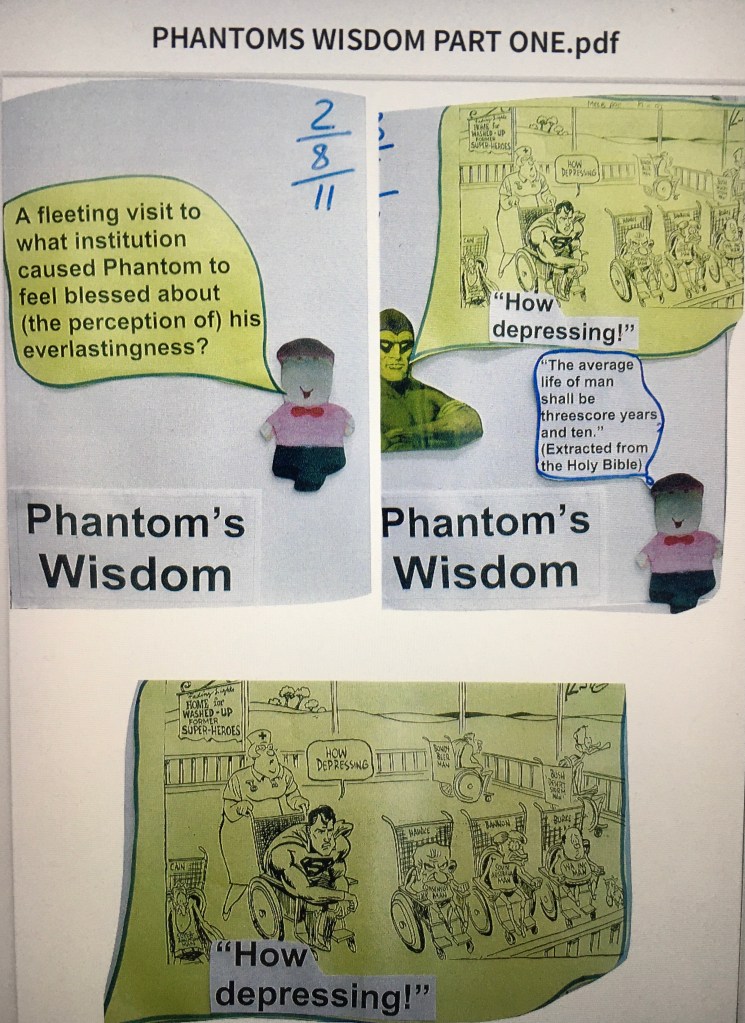
Tintin occupies the pedestal and takes the gold award for mine as being the best of literary characters. Coming a close second albeit it in total comic form is ‘The Phantom’. If I have to choose between the two, there is no issue – it’s Tintin all the way.

HAMMER HURL

What Olympic sports do you enjoy watching the most?

I just love the hammer throw at the Olympics. To see those very strong men and women who have trained and trained and trained stepping up and whirring, whirring and whirring that hammer is pulsating. Then willing and willing it on its fly path is just the best. It flies through the air like a giant missile as far as competitors can throw it before being pulled down by gravitational force to thump into the ground.

The hammer throw competition is a thrill from go to whoa.

OH, FOR COMMUNITY INPROVEMENT

How would you improve your community?

If I could improve my community (and that is beyond the ability of an advancing septuagenarian) it would be by the elimination of crime particularly those infractions which are opportunistic.

Darwin, Palmerston, Alice Springs, Tennant Creek, Nhulunbuy, and indeed every town and settlement within the Northern Territory is subject to a growing crime rampage. Some of it is alcohol-induced, other breaches simply, it seems, for the hell of it.

Much of the crime within the Northern Territory is being committed by young people, as young as 10 years of age. Car stealing, smashing into buildings, ram-raiding, breaking into homes, and torching cars, have become the nefarious domain of people of tender years. This includes 12 and 13 and 14-year-old children. One of the favourite pastimes is to steal vehicles, and random buildings, smash into other vehicles, particularly police wagons and know of course that they will get away with it because of the weakness of our judicial system and because punishment is not considered to be as important as rehabilitation.

LinkedIn with all of this is the need (and this would be one of my improvement measures) for parents and caregivers to be primarily and fully responsible for their children. They are not! Children often don’t feel safe at home and that’s why they run around the streets and get into trouble.

The situations in which I speak are escalating in the Northern Territory and I can only see things getting worse.

COVID IS EVERLASTING

How have you adapted to the changes brought on by the Covid-19 pandemic?

Covid 19 has had and continues to have a major impact on my life. Fortunately, I have not had a bout of Covid but know and understand how rife it was – and still is all around Australia.

Physical distancing, mask-wearing, detergent use and avoiding close contact in closed quarters or within crowded situations were recommendations made to us by health authorities when Covid was regarded as a raging pandemic.

Suddenly the pandemic became endemic and the health protocols were relaxed- not all at once but gradually until it almost seemed that Covid was no longer an issue.

No longer an issue but Covid hospitalizations and death rates have gone through the roof.

Authorities wanted everyone to carry on almost as if there were no issues at all but that does not wash.

I still practice all the previously recommended protocols, and will for the foreseeable future. I don’t go out to sports or other events. I keep my vaccinations up. Covid continues to be a major worry to me and I feel it will be a factor that forever influences my life.

ROUTINES FOREVER

What are your morning rituals? What does the first hour of your day look like?

the darkness slips away,

Sun rises on another day,

I smile with happiness and say

It’s routine time hip hip hooray,

Shower, shave and dress so neat,

Deodoriser so I smell so sweet,

Eat my toast and drink my tea,

Then it’s off to work for me,

Driving kids by bus to school,

They act the goat, play the fool,

Acting just the way I did,

When their age and but a kid.

Some things don’t change, ‘twill always be,

Life’s routines for you and me.

LISTENING – a unique quality

Which aspects do you think makes a person unique?

Individual uniqueness can be powerfully positive or extremely negative, depending on which qualities of uniqueness are manifest.

I wanted to focus on the positive. I believe that the best and most positive “uniqueness“ is that demonstrated by people with the ability to listen, consider other persons view points, and not be people jumping to conclusions. It’s almost unique these days for people to listen. They are too busy talking and verbally postulating to listen to others.

Give me a good listener (and I hope I am one) any day.

Listening – a unique and dying quality.

THE GRAY ROOM

If you could have something named after you, what would it be?

I have a name that has been given to a conference room on the 11th floor of the Michell Centre in Darwin. That floor and several others at least by the Northern Territory Department of Education.

The conference room has a label on the door saying “The

GRAY Room”. Inside the room and on the wall is a small plaque. It states that I was nominated for the honour of having a room named after me by Sue Murphy who was one of the Directors of Education at the time. It recognises the fact that as the School Principal, I supported students and staff in a way that was appreciated.

From time to time I think about this room and feel glad that I was recognised as a person who was there for students staff and the community.

LAUGHTER IS INFECTIOUS

What makes you laugh?

Arnold Glasgow once wrote, “laughter is tranquilliser with no side effects.” How true is that statement.

There has been a virtual avalanche of incidents that have generated much laughter for me during my lifetime. From the time I was very young through to my old age, there have been hundreds and hundreds of incidents giving rise to laughter and then merry reflection.

One standout situation that gave me cause to laugh happened when I was 10 or 11. A weekly newspaper ‘The Farmers Weekly’ had a page for children titled ‘Cousin Anne’s Corner’. Children could join and become members. They could also write letters that were published with responses from Cousin Anne.

I wrote a letter, purportedly from my sister, seeking club membership. The letter talked about the fact that she was ever so lucky because she had an elder brother who was kind, loving and who looked after her. The letter offered glowing comments about her sibling. I took an envelope and one of my Mother’s postage stamps, addressed the envelope, placed the letter inside and posted it at the post office near my school.

Three weeks later my ‘sister’s’ letter was published with a response from Cousin Anne telling her how lucky she was to have an ‘out of the box’ brother like me; that I was one of a kind.

The reaction from my Mother and sister was predictable, but it was worth the angst of their reactions. It was a laugh then and on other occasions during the following years.